

Introduction
Why do some leaders have the loyalty of their teams while others can’t keep them motivated? The answer most often is not IQ, technical skills, or even experience. The answer is emotional intelligence (EI). It is the capacity to be aware of your own emotions and to navigate well the emotions of others. Emotional intelligence separates positional leaders from influential ones.
In today’s fast paced, AI driven world, EI is more than a soft skill. It’s a leadership necessity. Studies reveal that 90% of top performers at work have high emotional intelligence, making it one of the strongest predictors of professional success. Whether you’re leading a cross functional team, negotiating with stakeholders, or leveraging AI to make data driven decisions, EI is the hidden factor that determines outcomes. In digitally mediated workplaces, emotional signals travel differently, leaders must become interpreters of invisible cues.
This blog demystifies emotional intelligence meaning, the four main elements, how to master it for career growth, AI linkages, and practical means of enhancement. Real life success tales, measuring tools, and pitfalls to be avoided are also included. It’s your guide to becoming an EI master in 2026.
EI is now a measurable leadership capability, not an abstract personality trait.
What Is Emotional Intelligence and Why It Matters in 2026?
What EI is essentially doing is marrying self awareness with interpersonal skills. Unlike IQ, which peaks in early adulthood, EI can be built over the course of your career. That’s why more companies are putting money into curating context based corporate learning competency programs based on sustainable learning models like Nextagile’s NextLearning framework that focus on EI rather than technical certifications. Unlike technical skills, EI compounds with deliberate practice over time.
The Science Behind EI: Latest 2026 Research
Current studies in 2026 emphasize the neurobiology of emotions, demonstrating that more EI leaders engage areas of the brain used for empathy and decision making more powerfully. Interestingly, research indicates that hybrid workspaces have heightened the need for emotionally intelligent communication. Leaders these days consider needing to decipher digital signals like tone in emails, stammering in video calls, or disconnection in chat replies. Emotional literacy is becoming a cognitive advantage in hybrid and remote leadership.
Why 90% of Career Success Is Based on EI?
Technical skills may land you a job, but emotional intelligence ensures that you stay promoted. According to Forbes in 2026, 9 out of 10 leading performers exhibit high EI. Why? Because careers are progressed through influence, teamwork, and leadership fueled by EI.
Suppose two managers: one provides clear direction but overlooks emotional undertows, the other actively listens, empathizes, and inspires. Who creates a stronger team? The second manager. That’s why EI in the workplace is no longer a choice; it’s the basis for leadership, client confidence, and creativity. Promotions increasingly reward relational effectiveness over individual brilliance.
The 4 Core Components of Emotional Intelligence
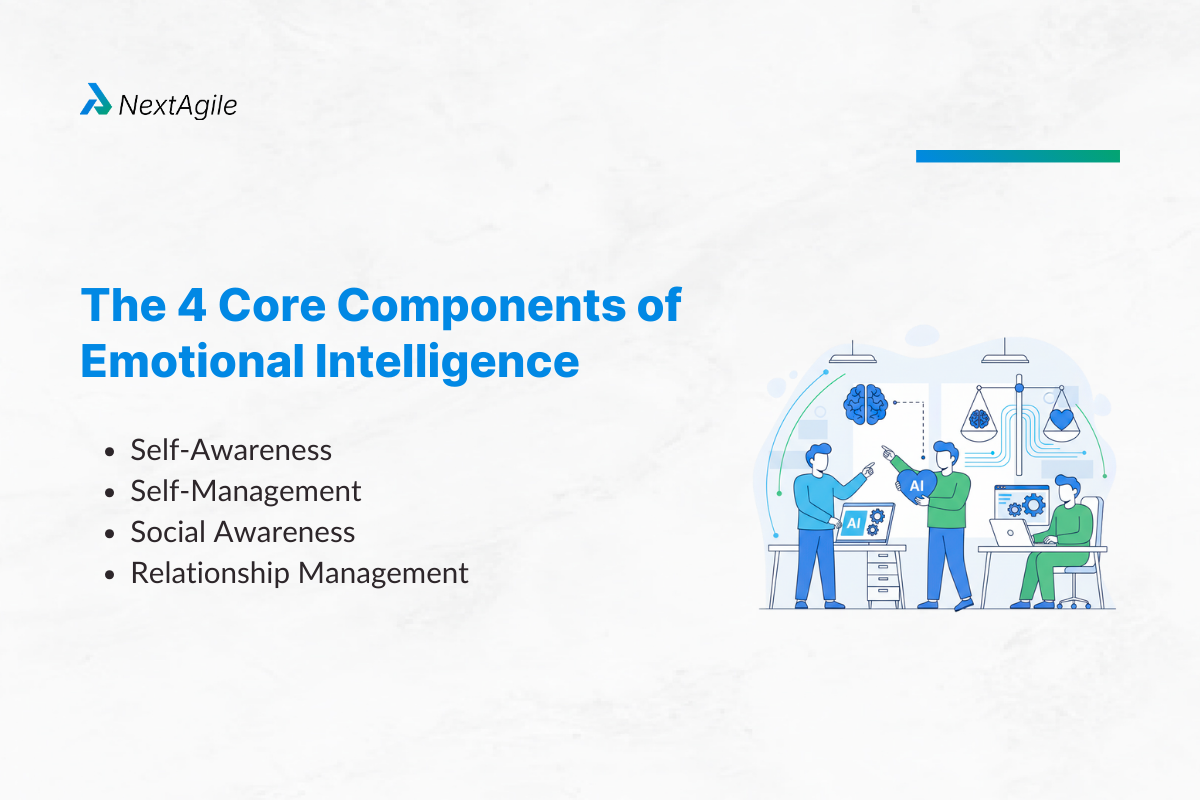
Daniel Goleman’s model is still the best known. These are the four pillars that comprise EI:
-
Self Awareness
Self awareness is the ground zero of EI. Leaders who know their triggers, strengths, and blind spots are better decision makers. Consider this: how do you expect to lead others when you can’t lead yourself? High self awareness avoids emotional hijacking in high stress meetings and enables leaders to project authenticity. Awareness precedes control; control precedes leadership impact.
-
Self Management
Once you’re aware of your emotions, the next step is control. Self management is about staying composed under pressure, adapting to change, and avoiding impulsive reactions. In practice, it means a leader who remains calm during a product failure inspires trust instead of panic. Emotional regulation under pressure signals maturity and credibility.
-
Social Awareness
This takes empathy and organizational awareness. Socially aware leaders are able to “read the room,” pick up on unspoken dynamics, and tune into cultural nuances. It’s especially important in psychological safety workshops where establishing an environment of trust demands high levels of social sensitivity. Empathy enables leaders to anticipate friction before it surfaces.
-
Relationship Management
The summit of EI is establishing and maintaining effective relationships. It involves influencing without formal authority, managing conflict constructively, and motivating others. Leaders who excel here can bring together diverse groups around a common purpose, even in difficult times. Trust is the currency of leadership, and EI is how it is earned.
Emotional Intelligence Assessment: Test Your EQ Level
Free EI Assessment Tools and Quizzes
There are some free online tests for EQ that will gauge your self awareness, empathy, and flexibility. They’re not comprehensive, but they’re a good place to start. It’s a form of emotional check up a rapid diagnosis before one does more in depth work. Self measurement initiates intentional behavioral change.
360 Degree Feedback: What Others See in You
The most accurate way to measure EI is asking those around you. A 360 degree feedback process highlights how your peers, managers, and direct reports perceive your emotional behavior. It often reveals blind spots you’d miss on your own. External perception often exposes gaps hidden from self evaluation.
Interpreting Your EQ Score and Next Steps
Scoring high is not an excuse to stop growing, and scoring low is not a career killer. Rather, apply the results to establish EI growth targets. Collaborate with a coach, take emotional intelligence courses, and engage in daily self reflection. Growth mindset is the foundation of EI development.
Key Skills That Enhance Leadership and Professional Development

-
Mastery of Communication and Active Listening
Great leaders don’t merely communicate effectively, they listen effectively. Active listening establishes trust, avoids misunderstandings, and demonstrates respect. It’s a habit you can cultivate by repeating back what’s been said and asking open ended questions. Listening is the fastest way to increase leadership influence.
-
Conflict Resolution and Difficult Conversations
Conflict avoidance destroys trust, while poorly resolving conflict builds resentment. Emotionally intelligent leaders employ empathy and assertiveness to resolve conflicts. They structure conversations based on mutual goals instead of personal assaults. Emotionally intelligent confrontation prevents long term relational damage.
-
Empathy and Emotional Coaching Methods
Empathy is not just “feeling with someone.” It’s about providing the proper support at the proper time. Emotional coaching by leaders enables team members to develop through feelings of validation with direction for performance enhancement. Validation builds safety; direction builds performance.
-
Resilience and Stress Management Methods
Workplace stress is unavoidable. EI keeps leaders grounded, manages emotions, and demonstrates calmness. Easy strategies such as reframing issues and mindful living can be the difference between burnout and breakthrough. Emotionally grounded leaders stabilize teams during uncertainty.
Emotional Intelligence + AI: The Future of Leadership
Artificial Intelligence (AI) is revolutionizing all industries, but here’s the catch, the information alone doesn’t move people. That’s where emotional intelligence (EI) comes in. Tomorrow’s leaders are not merely technologically advanced; they are emotionally intelligent leaders with human touch added to their digital innovation. Technology amplifies efficiency, but EI preserves humanity.
-
AI Tools That Facilitate Emotional Intelligence Growth
AI is no longer simply a matter of number crunching. In leadership training programs, AI powered tools now monitor tone in communication, read microexpressions, and offer insights on empathy levels. For example, sentiment analysis programs will catch when your emails seem abrupt or detached. Virtual reality solutions stage office disagreements and enable leaders to rehearse conflict resolution with emotional awareness in a secure setting.
Firms incorporating these data powered EI training programs have seen quicker EI development in managers. It’s like a gym for your feelings but fuelled by facts. Feedback driven simulations accelerate emotional skill acquisition.
- How Leaders Using AI Leverage Emotional Intelligence
Current AI leaders apply EI to make technology more human. Take a manager who applies predictive analytics to identify declining productivity. Rather than scolding the worker, an emotionally intelligent leader digs deeper: Is he stressed? Burnt out? Dealing with personal problems?
This fusion of data informed insight + emotional intelligence enables leaders to act with compassion while still fixing performance problems. It’s why top leaders in tech saturated cultures are usually the most emotionally intelligent. They know that beneath every dashboard metric lies a people’s story. Data identifies problems; EI uncovers human causes.
-
Future Trends: EI in AI Driven Workplaces
By 2030, workplaces will be more AI fueled from recruitment robots to project tracking automation. But the most in demand leaders will be those who can apply empathy to AI decisions. For instance, hiring managers won’t only be going by AI shortlists but applying EI to sense cultural fit and team chemistry.
We’ll also see EI embedded into AI itself. Imagine chatbots capable of detecting customer frustration not just from words but from tone then escalating to a human with the right sensitivity training. Emotional intelligence won’t compete with AI; it will complement it.
In short, those who incorporate EI with AI will be future proofed. Those who fail risk being displaced not by AI, but by more emotionally intelligent colleagues who can leverage it more effectively. Human centered leadership will differentiate organizations in automated environments.
Practical Strategies to Enhance Your Emotional Intelligence
Emotional intelligence is not something you’re born with it’s a muscle you can develop. The good news? Change doesn’t mean wholesale overhaul. It comes from mindful daily routines.

- Begin with Self Reflection
Maintain a “trigger journal.” At the end of each day, record when you were frustrated, inspired, or anxious. Ask: What caused it? How did I react? With time, patterns are revealed that increase self awareness. Awareness of triggers reduces unconscious behavioral patterns. - Cultivate Mindful Pausing
Before responding to a challenging email or heated conversation, pause for 10 seconds. This brief delay breaks automatic responses and gives more reflective answers. A short pause often prevents long term relational fallout. - Develop Social Awareness in Meetings
Next time you’re in a meeting, focus less on what’s being said and more on how. Notice tone shifts, body language, or silence. These cues often reveal more than words. Emotional cues are frequently embedded in silence, not speech. - Strengthen Relationship Management
Follow the 80/20 rule in conversations: listen 80%, speak 20%. When people feel truly heard, relationships deepen, that’s a hallmark of high EI. People commit more deeply when they feel understood. - Leverage Training & Coaching
Consider taking an emotional intelligence course or engaging an executive coach. Formal feedback speeds up development, particularly through simulation and role play. Structured feedback shortens the EI learning curve. - Leverage Technology for Growth
Apps now offer “mood check ins” and even check your speech tone on calls. These inform you, enabling real time adjustments to enhance emotional intelligence, making it tangible and measurable. Real time emotional feedback transforms awareness into immediate action.
The secret? Repetition. Emotional intelligence takes time, but day by day practice builds into transformational leadership.
Emotional Intelligence Success Stories: Real World Applications
Tech Industry Example
A Fortune 500 software firm had a high turnover rate. Rather than doubling down on performance KPIs, a VP of Engineering spent money on EI workshops. Managers learned to recognize burnout signals, validate team frustrations, and coach with empathy. Attrition decreased 30% in 12 months saving millions in recruitment costs. EI investment directly reduced cost and improved retention.
Healthcare Example
During the pandemic, a hospital leader used EI to keep morale up. Instead of giving generic “stay strong” speeches, she conducted small group sessions to validate fear and stress. Staff noted increased resilience, and patient care metrics remained positive despite resource pressure. Emotional validation strengthened resilience under crisis conditions.
Start Up Example
A start up CEO who was notorious for micromanaging changed after EI coaching. By converting to trust leadership, employees were empowered, innovation blossomed, and the company raised Series B funding. Trust replaced control, unlocking innovation and growth.
These narratives illustrate an enduring fact: applying emotional intelligence increases performance in all sectors. EI is not such theory, it is tangible effect in actual work environments.
Common Emotional Intelligence Errors
EI misuse can weaken leadership as much as EI absence. Even good intentioned leaders falter in using EI. Following are four typical errors:
- Over Empathy
Being overly empathetic can have opposite effects. Leaders may withhold critical feedback to save feelings, which ends up hurting performance. Balance empathy with responsibility. Compassion must coexist with performance accountability. - People Pleasing
Some get EI mixed up with saying “yes” all the time. Real EI isn’t about liking people it’s about respecting them. Leaders with high EI understand when to say “no.” Boundaries are a critical component of mature EI. - Emotional Over Identification
Leaders will absorb their team’s stress as if it were their own. It leads to burnout. High EI involves empathy without taking it on, you feel with others, but you don’t drown with others. Leaders must empathize without internalizing emotional burden. - Cultural Blind Spots
Not every culture expresses emotions the same way. A smile might signal agreement in one culture but discomfort in another. Global leaders must adapt their EI lens. Contextual intelligence is essential for global emotional leadership.
The solution? Treat emotional intelligence as dynamic, not fixed. Continuously refine your awareness, adapt to new contexts, and avoid the trap of thinking you’ve “mastered” it. Emotional intelligence in leadership is less about perfection and more about progression.
Conclusion
In 2026 and beyond, emotional intelligence isn’t just a nice to have, it’s a career and leadership differentiator. Leaders who cultivate EI outperform peers, build stronger organizations, and thrive in AI driven workplaces. EI is becoming a strategic leadership differentiator across industries.
Remember, EI is learnable. Whether through reflection, coaching, or digital tools, small daily practices compound into profound shifts. At NextAgile, we’ve coached executives who went from struggling managers to inspirational leaders, all by mastering EI. Small behavioral shifts compound into transformational leadership presence.
The future belongs to leaders who combine data with empathy, authority with compassion, and strategy with self awareness. The question isn’t whether emotional intelligence matters, it’s whether you are ready to make it your competitive advantage. Leaders who master emotions lead performance, culture, and change simultaneously.
If you’re looking to build emotional intelligence in your next level leadership, consider partnering with a trusted leadership training company like NextAgile that aligns contextual leadership training programs with executive coaching and overall organizational agility. Our team excels at aligning leadership development with organizational objectives.
Frequently Asked Questions:
1. How does emotional intelligence impact workplace productivity?
Emotional intelligence improves teamwork, reduces conflict, and encourages participation, all of which directly drive productivity. Teams led by high-EI leaders communicate effectively, resolve conflicts efficiently, and support one another under pressure. Research in 2026 shows these teams outperform low-EI teams by up to 20%, minimizing friction and maximizing collaborative energy.
2. How does emotional intelligence contribute to decision-making?
Decision-making is not solely rational. Emotional intelligence allows leaders to balance emotional dynamics with data. For example, when approving layoffs, EI enables leaders to weigh financial imperatives alongside employee impact, resulting in stronger long-term trust, loyalty, and organizational stability.
3. Is there a baseline test for quantifying emotional intelligence?
There is no single universal test, but well-respected measures such as EQ-i 2.0 and MSCEIT are commonly used. These assessments evaluate dimensions like self-awareness, empathy, and stress tolerance. Organizations also use 360-degree feedback to gain nuanced insights and guide structured emotional intelligence development.
4. Which industries most rely on highly emotionally intelligent employees?
Healthcare, education, and customer service rely heavily on emotional intelligence to improve patient, student, and client outcomes. Increasingly, tech and finance also value EI, as leaders translate complex data into human context, enhancing innovation and decision-making quality. Even highly analytical industries now view emotional capability as a key performance lever.