Introduction Agile delivery has always relied heavily on human judgment. Product Owners decide what to build next, Scrum Masters help teams navigate delivery challenges, and engineers collaborate to determine how work should be executed within each sprint.
However, the rapid rise of artificial intelligence introduces a new concept: AI decision making in Agile. Many organizations are experimenting with AI-assisted sprint planning, intelligent backlog prioritization, and predictive delivery analytics. These capabilities allow teams to move beyond intuition and make decisions based on patterns discovered across thousands of historical delivery events.
Yet this transformation also raises an important question for Agile leaders and practitioners:
Who ultimately controls decisions in AI-driven Agile teams? This is not a technology question, it is a leadership question. If AI can recommend sprint scope, highlight delivery risks, and suggest backlog priorities, where should human judgment remain central?
Understanding the balance between AI insights and human leadership is critical for organizations adopting AI in Agile project management. The goal is not to replace Agile teams with algorithms, but to create AI-augmented teams where data-driven insights strengthen human decision-making.
Enterprise Decision Challenges Driving AI Adoption in Agile Many organizations initially adopt Agile frameworks expecting faster delivery and greater adaptability. While Agile often improves collaboration and responsiveness, enterprises frequently encounter new challenges as their Agile environments scale.
One major issue is decision overload.
Product teams must continuously prioritize hundreds of backlog items while balancing:
Stakeholder demands Technical constraints Delivery timelines These decisions often rely on incomplete data and subjective judgment.
Another challenge involves delivery predictability.
Teams may struggle to accurately estimate sprint capacity or anticipate delays caused by:
Dependencies Technical debt Changing requirements Additionally, modern Agile ecosystems generate enormous volumes of data across project management tools, code repositories, and CI/CD systems. While this data contains valuable insights, it is difficult for humans alone to analyze and interpret it effectively.
AI systems can help address these challenges by analyzing historical delivery patterns, identifying risk signals, and recommending planning decisions based on data rather than intuition.
For many organizations, AI is emerging as a decision-support layer within Agile delivery, helping teams move from reactive decision-making → predictive planning.
What Is AI Decision Making in Agile? The Shift From Human Judgement to Augmented Intelligence At its core, AI decision making in Agile refers to the use of artificial intelligence to support planning and delivery decisions within Agile teams.
Traditional Agile teams rely on experience, intuition, and collaboration to guide decisions such as backlog prioritization, sprint scope, and delivery forecasting. While these practices remain valuable, they can be enhanced by AI systems capable of analyzing large volumes of delivery data.
AI tools can examine historical sprint outcomes, velocity patterns, backlog characteristics, and workflow metrics to generate insights that help teams make better decisions.
For example, AI systems can:
Predict sprint capacity using machine learning models Recommend backlog priorities based on business value and dependencies Detect delivery risks by analyzing workflow patterns Forecast release timelines using historical delivery trends Rather than replacing Agile decision-makers, these systems act as decision-support mechanisms.
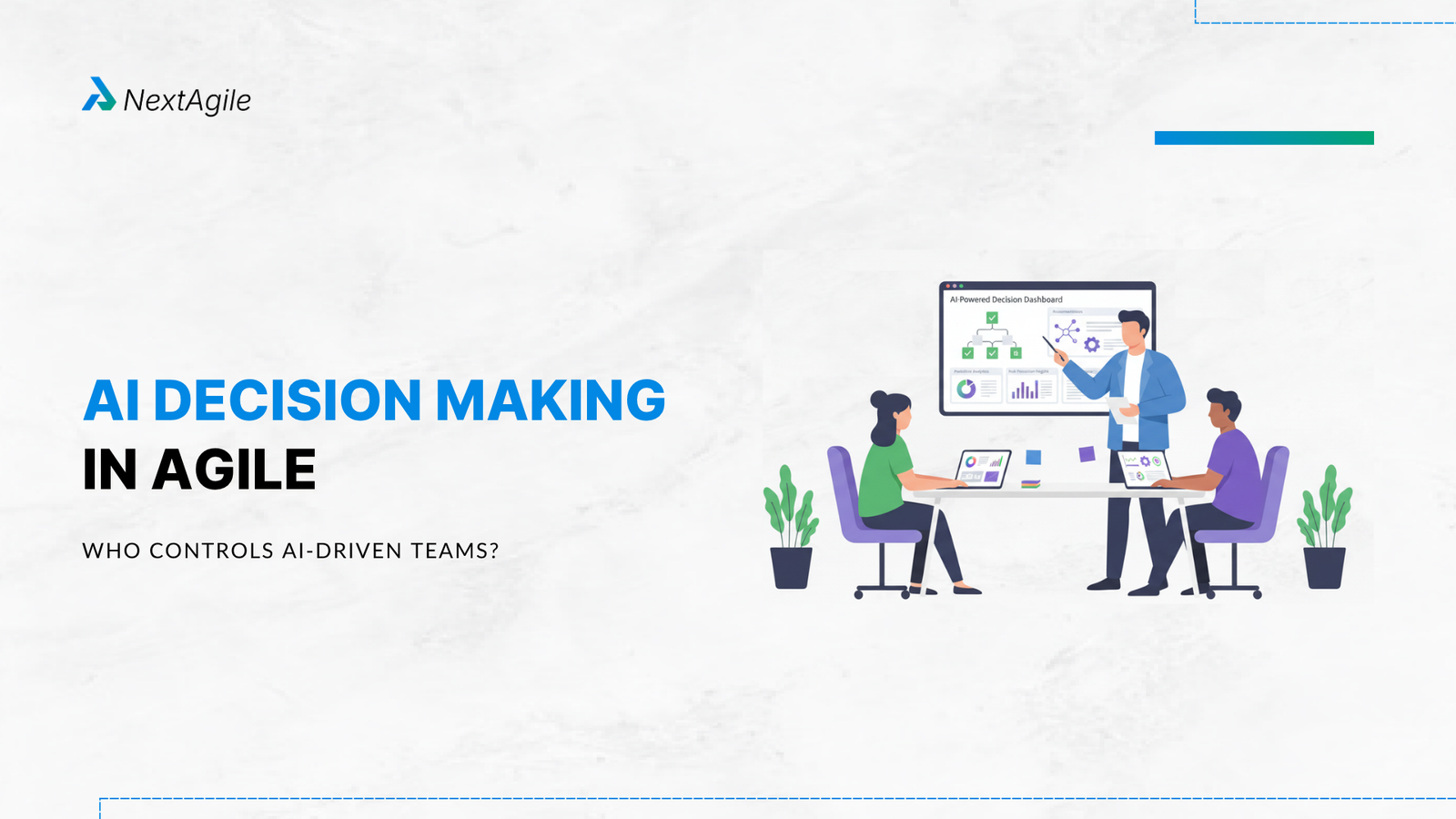
AI is beginning to influence Agile decisions, such as sprint forecasting and backlog prioritization, but the final authority still sits with Product Owners, Scrum Masters, and delivery leaders.
This shift represents a move from purely human judgment toward augmented intelligence, where AI provides analytical insights and humans retain strategic decision authority.
This transition from judgment to augmentation is where most organizations either gain leverage or lose control. Teams that treat AI as an advisory system improve decision quality without compromising ownership. Teams that treat AI as an authority risk drifting into passive execution, where decisions are accepted rather than challenged. The distinction is subtle but critical, because long-term agility depends not just on faster decisions, but on better decision reasoning.
Key Use Cases of AI in Agile Development Artificial intelligence is already being applied across multiple stages of the Agile development lifecycle. These use cases illustrate how AI supports decision-making within Agile teams.
1. AI Backlog Prioritization AI systems can analyze product usage data, customer feedback, and backlog dependencies to suggest prioritization decisions. By evaluating value, effort, and risk, these tools help Product Owners manage large backlogs more effectively.
2. Sprint Forecasting Machine learning models can analyze past sprint data to estimate realistic capacity for upcoming sprints. This enables teams to adjust sprint scope and reduce the likelihood of incomplete work.
3. Workflow Optimization AI analytics tools monitor workflow data within Agile boards and identify stages where work frequently stalls. These insights help teams optimize flow and improve cycle times.
4. Quality Risk Detection AI models can analyze defect patterns across past releases and identify areas of the codebase that may require additional testing attention.
These applications demonstrate how AI supports data-driven Agile decision making, improving both efficiency and predictability.
While these use cases demonstrate clear efficiency gains, their real value lies in pattern recognition at scale. AI is not just speeding up existing decisions; it is surfacing insights that were previously invisible to teams. However, this also creates a new dependency. As teams begin to rely on AI-generated insights, their ability to independently interpret delivery signals can weaken if not consciously maintained. High-performing teams therefore balance AI assistance with continuous human validation to avoid decision complacency.
3 Ways AI Decision Making in Agile Teams Is Already Happening AI is already influencing everyday Agile decisions from how teams prioritize backlogs to how they forecast sprint capacity.
1. Backlog Prioritisation Product backlogs often contain hundreds of user stories, features, and technical improvements competing for attention. Deciding what should be delivered first can be complex.
AI-driven analytics tools can evaluate backlog items using multiple factors such as business value, dependency relationships, and delivery risk.
By analyzing these elements, AI systems can recommend priority rankings for backlog items. These recommendations help Product Owners focus on work that delivers the greatest value while minimizing delivery risks.
AI also supports AI for product backlog management by continuously analyzing backlog data and identifying patterns that affect delivery outcomes.
2. Sprint Capacity and Velocity Forecasting Estimating sprint capacity is one of the most important planning decisions Agile teams make. Traditionally, teams rely on past velocity and experience when determining how much work to include in a sprint.
Machine learning models can improve this process by analyzing historical sprint data, task complexity, and team availability.
These models generate predictive insights that help teams determine whether a sprint backlog is realistic. If the AI system detects that the planned workload exceeds expected capacity, it may recommend reducing scope or adjusting sprint goals.
Through AI-assisted sprint planning , teams gain a clearer understanding of delivery feasibility before work begins.
3. Risk and Dependency Detection In large Agile environments, dependencies between teams and work items often create hidden risks that affect delivery timelines.
AI analytics tools can analyze backlog relationships and workflow data to detect these dependencies automatically.
For example, if a user story depends on another team’s deliverable, the AI system can highlight this relationship and warn the team about potential delays.
Similarly, AI can identify patterns that frequently lead to sprint spillovers, enabling teams to address issues proactively.
Note – Across these scenarios, a consistent pattern emerges: AI is most effective when it operates within clearly defined boundaries. When AI recommendations are treated as inputs rather than directives, teams retain flexibility and critical thinking. But when these recommendations go unchallenged, teams risk optimizing for metrics instead of outcomes.
How AI Decision Making Improves Agile Project Predictability? One of the most valuable outcomes of AI adoption is improved project predictability.
In traditional Agile environments, predicting delivery timelines becomes increasingly difficult as projects grow in complexity. Dependencies, changing priorities, and unforeseen technical challenges often affect sprint outcomes.
AI systems can improve predictability by analyzing delivery data across multiple dimensions.
For example, AI tools can evaluate:
Historical sprint velocity trends Cycle times across workflow stages Backlog complexity and dependencies Team availability and workload distribution By combining these inputs, AI models generate data-driven forecasts that help teams anticipate delivery outcomes more accurately.
This capability is particularly valuable for organizations using AI in Agile project management, where leaders need visibility into delivery progress across multiple teams.
Predictive analytics enables organizations to detect potential delays earlier, adjust sprint scope proactively, and align delivery expectations with stakeholders.
Ultimately, AI transforms Agile planning from reactive estimation to predictive project management.
However, improved predictability does not automatically translate to better outcomes. There is a tendency to equate accurate forecasts with effective decisions, but predictability without strategic alignment can still lead to efficient delivery of low-value work. The real advantage emerges when predictive insights are combined with strong product thinking and prioritization discipline. In that sense, AI enhances visibility, but value creation still depends on human judgment.
Will AI Replace Product Managers and Scrum Masters? The rise of AI in Agile environments has prompted many professionals to ask whether roles such as Product Managers and Scrum Masters might eventually become obsolete.
In reality, AI can automate certain analytical and administrative tasks, but it cannot replace the leadership responsibilities these roles perform.
Product Managers are responsible for defining product vision, aligning stakeholders, and ensuring that development work supports business goals. These responsibilities require strategic thinking and organizational awareness that AI cannot replicate.
Similarly, Scrum Masters play a crucial role in facilitating collaboration, resolving team impediments, and fostering continuous improvement.
AI systems can certainly assist these roles. For example, AI tools can generate delivery reports, analyze sprint metrics, and highlight potential risks. However, the final authority over Agile decisions remains with human leaders. What is more likely than replacement is role evolution. Product Managers and Scrum Masters will increasingly shift from information gatherers to decision integrators. Their value will lie not in generating insights, but in interpreting AI outputs, challenging assumptions, and ensuring alignment across stakeholders. This evolution elevates these roles rather than diminishes them, placing greater emphasis on strategic thinking, communication, and decision accountability.
Organizations adopting AI capabilities often combine technology with expert guidance from partners offering agile consulting services , ensuring that AI supports rather than disrupts Agile delivery practices.
Agentic AI and Agile Decision Making: Why the Stakes Just Got Higher? A new development in artificial intelligence is the emergence of agentic AI, systems capable of performing tasks and making limited decisions autonomously.
In Agile environments, agentic AI could potentially perform actions such as adjusting backlog priorities, reallocating tasks, or recommending workflow changes without direct human input.
While these capabilities offer efficiency gains, they also introduce new risks.
Autonomous decision systems may lack contextual awareness about:
Business priorities Stakeholder relationships Organizational constraints For example, an AI system might recommend prioritizing technically simple tasks because they improve velocity metrics, even if those tasks do not align with product strategy.
This raises important questions about governance and accountability in AI-driven Agile environments.
As organizations explore agentic AI in Agile, defining clear boundaries for AI decision authority becomes essential.
Governance and Trust in AI-Driven Agile Decisions For AI-assisted decision-making to succeed, Agile teams must trust the insights generated by AI systems.
Trust depends on transparency. Teams need to understand how AI models generate recommendations and which data sources influence their outputs.
Explainable AI techniques can help by showing the reasoning behind AI predictions. For example, a sprint capacity recommendation may be based on past velocity trends, team availability, and historical sprint spillovers.
Organizations must also define governance structures that clarify accountability. If an AI system recommends a decision that leads to delivery issues, teams must understand how responsibility is shared between human leaders and AI tools.
Establishing governance frameworks ensures that AI remains a support system rather than an uncontrolled decision-maker.
The Human-in-the-Loop Model: Where Humans Must Stay in Control of Agile Decisions Many organizations adopt a human-in-the-loop model when integrating AI into Agile environments.
In this model, AI systems provide recommendations and insights, but human decision-makers retain final authority.
There are several areas where human judgment remains essential:
Defining product strategy Evaluating trade-offs between competing priorities Negotiating stakeholder expectations Managing organizational change AI can analyze data and highlight patterns, but it cannot fully understand the broader business context in which Agile decisions occur.
The most effective Agile teams treat AI as a collaborative partner that enhances decision quality without replacing human leadership.
Decision Rights Framework for AI-Augmented Agile Teams To ensure AI supports rather than overrides human decision-making, Agile teams need a clear decision-rights framework that defines where AI provides insights and where humans retain authority.
Decision Type AI Role Human Role Sprint forecasting Predict outcomes Team validates Backlog prioritization Suggest priorities Product Owner decides Risk detection Identify signals Scrum Master resolves Release planning Provide analytics Leadership approves
This framework ensures that AI operates within defined boundaries while empowering teams to leverage data-driven insights.
What Nextagile Recommends: Preparing Teams for AI Decision Making in Agile Organizations adopting AI in Agile environments should take a structured approach to implementation.
First, teams must improve the quality of delivery data. AI insights are only as reliable as the data used to generate them. Second, organizations should introduce AI capabilities gradually, starting with analytics tools that support decision-making rather than autonomous systems. Third, teams should develop AI literacy, ensuring that Agile practitioners understand how AI models generate recommendations and how those insights should be interpreted. Finally, organizations should align AI adoption with their broader agile transformation journey , ensuring that technology strengthens existing Agile practices rather than replacing them. Real-world experiences from Agile Case studies by Nextagile demonstrate that combining Agile expertise with AI insights leads to more effective delivery outcomes.
The organizations that succeed in this transition are not the ones adopting AI the fastest, but the ones integrating it the most thoughtfully.
Conclusion Artificial intelligence is transforming how Agile teams plan, prioritize, and execute their work.
From AI-assisted sprint planning to predictive delivery analytics, AI systems provide valuable insights that help teams make better decisions.
However, the rise of AI also introduces new questions about decision authority and governance.
As AI continues to evolve, the most successful organizations will not allow AI to replace Agile leadership. Instead, they will adopt AI-augmented decision-making, where AI analyzes data and humans provide strategic direction. As an agile consulting company , NextAgile partners with enterprises to combine Agile practices, human leadership, and AI-powered delivery intelligence. Do reach out to us at consult@nextagile.ai and we would be happy to explore more.
FAQs About AI Decision Making in Agile Q1: Will AI replace product managers in agile? No. AI can support Product Managers by analyzing data and recommending priorities, but defining product vision and aligning stakeholders requires strategic thinking and leadership.
Q2: Can AI make decisions in a sprint? AI can provide recommendations about sprint capacity, backlog priorities, and risk signals. However, Agile teams remain responsible for final sprint decisions.
Q3: What is AI-driven backlog prioritisation? AI-driven backlog prioritization uses algorithms to analyze value, effort, dependencies, and risk factors to suggest the order in which backlog items should be addressed.
Q4: What happens to human judgment in AI agile teams? Human judgment becomes even more important. While AI provides analytical insights, humans must evaluate context, strategy, and stakeholder priorities.
Q5: Is agentic AI compatible with scrum? Agentic AI can support Scrum teams by automating analysis and generating recommendations. However, Scrum values emphasize collaboration and human accountability, so AI should remain a decision-support tool rather than a decision-maker.
Anuj Ojha is Co-Founder & Consulting Head at NextAgile. Anuj has designed & led multiple turnkey transformation journeys across industries, domains & geographies and has 16+ years of experience as an agile practitioner. He has worked with CXOs, CTOs & Key Leaders to translate their business objectives on the ground, contextualizing org transformations and creating buy-in across level, leading a team of coaches/consultants to implement agility across 150+ teams & trained more than 12k team members. Anuj’s core area of interest is business agility & working with leaders & teams to achieve long term sustainable, Agile culture & mindset.
 Skip to content