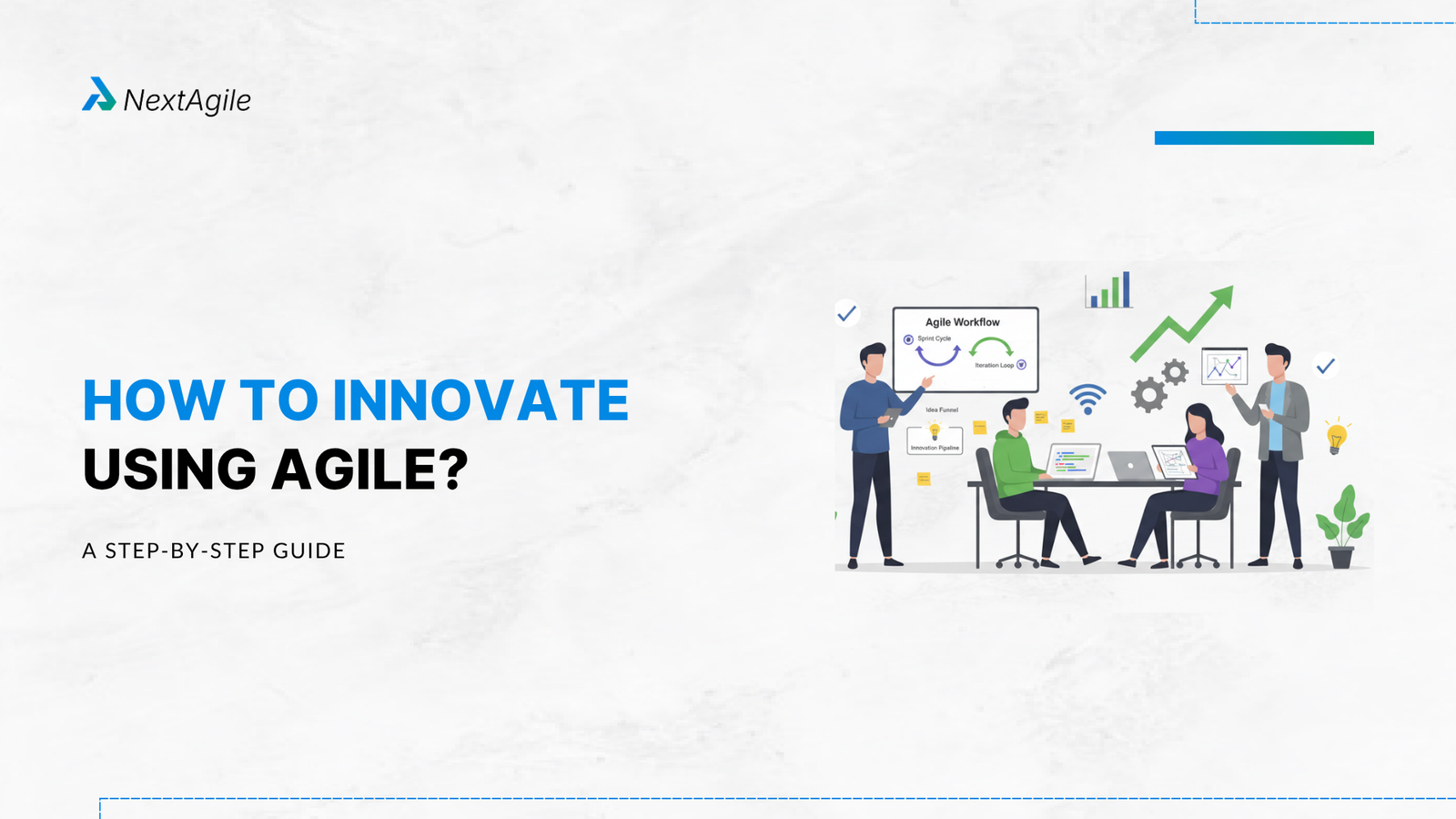
Key Takeaways Agile innovation combines Agile delivery with structured experimentation. Continuous feedback helps teams validate ideas early. Dual Track Agile separates discovery from delivery. Innovation backlogs help prioritize and manage ideas. Agile frameworks enable organizations to innovate faster with lower risk. What is Agile Innovation? In today’s fast-moving markets, organizations can no longer rely on slow and linear innovation processes. Customer needs evolve quickly, technologies shift rapidly, and competitive advantages disappear faster than ever. To stay relevant, companies need an approach that allows them to experiment, learn, and adapt continuously. This is where agile innovation becomes critical.
Agile innovation is the practice of using Agile principles , such as:
Iterative development Rapid feedback loops, and Cross-functional collaboration It enables organizations to:
Validate ideas quickly Reduce innovation risk, and Deliver new solutions faster than traditional innovation models. Agility brings innovation closer to everyday work, where teams are constantly learning, testing ideas, and improving outcomes instead of waiting for a single breakthrough moment.
This approach enables organizations to reduce innovation risk while increasing the speed at which ideas move from concept to market.
Why Innovation Is No Longer a Linear Process? Historically, innovation followed a predictable sequence: research, design, build, launch. While this model worked when markets moved slowly, it often fails in today’s uncertain environments.
Modern innovation requires:
Continuous experimentation Rapid learning cycles Early customer validation Cross-functional collaboration Agile frameworks naturally support these needs because they emphasize small increments, quick feedback, and adaptive planning. Instead of betting everything on one big idea, organizations run multiple small experiments and scale the ones that succeed.
As a result, agile innovation reduces risk while increasing the likelihood of discovering breakthrough opportunities.
Teams that embrace this shift often stop asking, “Is this the right idea?” and start asking, “What is the fastest way to test if this idea works?” That change in thinking is where real innovation begins.
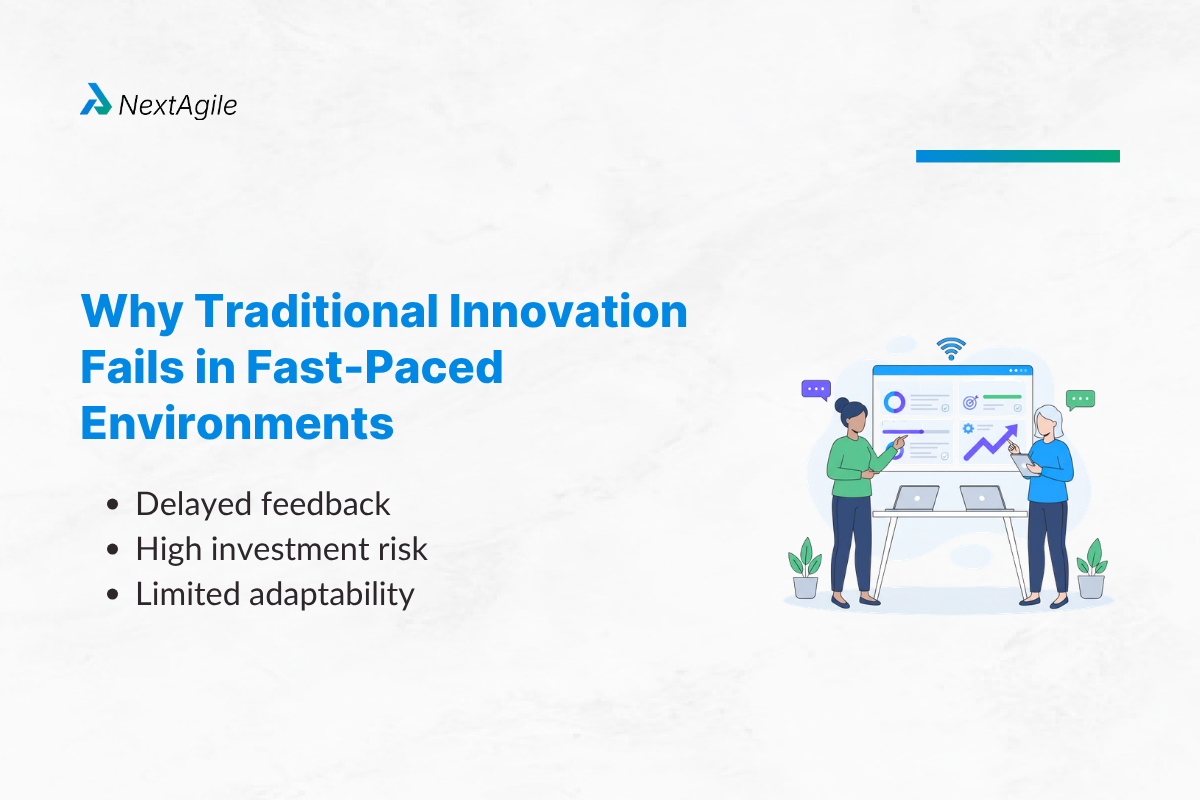
Why Traditional Innovation Fails in Fast-Paced Environments Many organizations still rely on traditional innovation models that assume requirements and market conditions remain stable. In reality, markets change faster than these processes can respond.
Traditional innovation programs often involve long planning cycles, heavy documentation, and large upfront investments before testing ideas with customers. By the time the solution reaches the market, customer expectations may have already shifted.
This creates three major problems:
Delayed feedback – Teams validate ideas too late in the processHigh investment risk – Large budgets are committed before validationLimited adaptability – Teams struggle to pivot once plans are locked Agile innovation addresses these challenges by shifting from prediction to experimentation.
Instead of trying to plan the perfect solution, Agile teams continuously test ideas through small increments and adapt based on real customer insights.
Waterfall Innovation vs Agile Innovation Factor Waterfall Innovation Agile Innovation Planning Extensive upfront planning Iterative planning Customer feedback Late-stage validation Continuous feedback Risk High due to late testing Lower due to early validation Adaptability Difficult to change direction Easy to pivot Time to value Slow Fast
By focusing on rapid experimentation and learning, agile innovation enables organizations to respond quickly to changing market conditions. What many teams experience is frustration. By the time something is ready to launch, it already feels outdated. Agile helps avoid this by bringing learning forward instead of pushing it to the end.
Market Unpredictability and the Need for Iteration Markets today are shaped by rapid technological advancements, evolving customer behaviors, and global competition. Under these conditions, innovation cannot rely on static assumptions.
Agile practices enable teams to run small experiments, gather feedback, and refine ideas before scaling them. This iterative approach helps organizations discover valuable solutions faster while avoiding costly failures. In reality, no team gets everything right the first time. Iteration simply accepts this and builds a way of working around it, where learning is expected and improvement is continuous.
Agile Innovation Process: A Step-by-Step Framework To implement agile innovation effectively, organizations need a structured yet flexible process that supports experimentation and learning.
The 4 Key Steps of Agile Innovation The agile innovation process typically follows four structured steps:
Idea Capture – Collect potential innovations from teams, customers, and stakeholders.Validation – Test ideas through experiments, prototypes, or customer interviews.Execution – Build validated ideas in Agile sprints.Feedback Loop – Collect insights from users and iterate continuously. What makes this process effective is not the steps themselves, but the discipline to move through them quickly and repeatedly. The goal is not perfection in one cycle, but steady progress across many cycles.
Idea Capture Innovation begins with collecting ideas from across the organization. Product teams, customers, and stakeholders can all contribute potential improvements or new opportunities.
Ideas are typically stored in an innovation backlog, where they can be evaluated and prioritized. Good ideas often come from unexpected places. Teams that actively listen to customers, support teams, and internal stakeholders tend to build a richer and more relevant innovation pipeline.
Validation Before investing heavily in development, Agile teams validate ideas through small experiments such as prototypes, user interviews, or proof-of-concepts.
Validation helps teams answer critical questions:
Does the problem truly exist? Do customers care about the solution? Is the idea technically feasible? This is where many organizations see the biggest shift. Instead of debating ideas in meetings, teams start testing them in the real world, which leads to faster and clearer decisions.
Execution Once an idea is validated, it moves into delivery sprints where teams build working increments of the solution. Agile practices such as sprint planning, backlog refinement, and retrospectives help maintain momentum. Execution becomes smoother when the idea has already been validated. Teams spend less time guessing and more time building something they know has value.
Feedback Loop Customer feedback is continuously collected through testing, analytics, and user interactions. Insights from this feedback guide future iterations and improvements. Feedback works best when it is frequent and easy to act on. Small, regular insights are often more valuable than large reports that arrive too late to influence decisions.
Integration with Sprints and Releases Innovation activities can be integrated into regular sprint cycles. Teams may dedicate capacity to experimentation while continuing to deliver core product features.
This ensures innovation remains an ongoing capability rather than a separate initiative. When innovation becomes part of regular sprint work, it stops competing with delivery. Instead, it becomes a natural extension of how teams plan, build, and improve products.
How Dual Track Agile Fuels Innovation? One of the most effective ways to support agile innovation is through Dual Track Agile, which separates discovery from delivery.
Discovery vs Delivery Explained Discovery track focuses on exploring ideas, validating assumptions, and identifying valuable opportunities.Delivery track focuses on building and releasing validated solutions. By running these tracks simultaneously, teams ensure that validated ideas are always ready for development. Teams often describe this as creating breathing space. Discovery allows room to think and explore, while delivery ensures that validated ideas keep moving forward.
Benefits of Running Both Tracks in Parallel Running discovery and delivery together creates several advantages:
Faster idea validation Reduced development waste Stronger alignment with customer needs Continuous innovation pipeline Over time, this creates a steady flow of ideas that are ready for development, reducing idle time and helping teams maintain momentum.
When to Implement Dual Track Agile? Dual Track Agile is particularly valuable when:
Product teams need faster innovation cycles Customer needs are unclear or evolving Organizations want to reduce product development risk Using Now-Wow-How to Prioritize Innovative Ideas The Now-Wow-How framework helps teams prioritize ideas based on feasibility and originality.
Explanation of the Matrix The framework divides ideas into three categories:
Category Description Now Easy to implement but incremental improvements Wow Innovative and high-impact ideas How Ideas with potential but unclear feasibility
Running Now-Wow-How Sessions with Agile Teams Teams brainstorm ideas and place them within the matrix. This visual approach helps quickly identify high-value opportunities worth exploring.
Examples from Innovation Hackathons During hackathons or innovation sprints, teams often generate dozens of ideas. The Now-Wow-How matrix helps narrow these down to the most promising concepts for experimentation.
What makes this framework effective is its simplicity. It allows teams to quickly move from a long list of ideas to a focused set of actions without overcomplicating the decision process.
Building Agile Innovation Teams Innovation rarely succeeds in siloed environments. Agile innovation thrives when cross-functional teams collaborate closely to explore and develop ideas.
Effective innovation teams typically include:
Product managers Engineers Designers Customer experience specialists Business stakeholders These diverse perspectives help teams identify opportunities, validate assumptions, and design solutions that deliver real value.
A culture of experimentation is equally important. Teams must feel safe testing ideas, learning from failures, and iterating quickly.
Organizations that support experimentation tend to generate more breakthrough innovations.
The real strength of these teams comes from how they work together. Different perspectives lead to better questions, and better questions often lead to better solutions.
Agile Innovation Management: Turning Ideas into Outcomes Innovation does not happen by chance; it requires structured management and visibility.
Managing the Innovation Backlog An innovation backlog allows organizations to track ideas, experiments, and validated opportunities. Product leaders can prioritize initiatives based on impact, feasibility, and strategic alignment.
Metrics to Measure Innovation Success Traditional metrics like output or delivery speed do not capture innovation effectiveness.
Innovation Metrics That Matter To manage agile innovation effectively, organizations should track metrics such as:
Experiment success rate Time from idea to validation Customer adoption of new features Revenue generated from new initiatives These metrics help leaders understand whether innovation activities are creating meaningful business value. Without visibility, good ideas often get lost. A structured approach helps teams keep track of what is being explored, what is working, and what should be scaled further.
Tools to Track Innovation Work Several collaboration tools support innovation management:
Jira for backlog tracking Miro for ideation workshops Confluence for documentation These tools provide visibility and help teams coordinate innovation efforts effectively. Tools support the process, but they do not replace it. Clear thinking and strong collaboration matter far more than the choice of tool.
Common Pitfalls in Agile Innovation and How to Avoid Them Even organizations that adopt Agile practices can struggle with innovation if the underlying culture or processes are not aligned.
The Most Common Agile Innovation Mistakes Some frequent pitfalls include:
Treating innovation as a side project rather than a core capability Skipping validation and building solutions too early Overloading teams with delivery work without innovation capacity Measuring innovation using only delivery metrics Avoiding these mistakes requires leadership support, dedicated discovery time, and clear innovation metrics. Most of these challenges come from trying to fit innovation into systems designed for predictable delivery. Adjusting how teams plan and measure work makes a noticeable difference.
How NextAgile Empowers Agile Innovation? Many organizations struggle to implement agile innovation effectively because their processes, culture, and leadership practices were designed for traditional delivery models.
NextAgile helps organizations transform their innovation capability through targeted consulting and workshops.
Workshops on Dual Track Agile and Innovation Planning Our customized agile training workshops help product teams understand how discovery and delivery can work together to accelerate innovation.
Customized Now-Wow-How Frameworks NextAgile agile consultants help teams adapt ideation frameworks to their product strategy and business goals.
Case Studies Demonstrating Innovation Acceleration Example of Agile Innovation in Practice A large fintech organization partnered with NextAgile to accelerate product innovation. By implementing Dual Track Agile and structured discovery sprints, the team reduced idea validation time from three months to three weeks.
Within six months, the organization launched three new customer-driven features that significantly improved user engagement. You can check our agile case studies for more details.
Coaching Agile Innovation Teams NextAgile coaches work closely with product teams to embed innovation practices into everyday delivery workflows.
What makes these approaches effective is how they are adapted to each organization. There is no single model that works everywhere, so flexibility and context are key.
Taken together, these practices shift innovation from something occasional to something continuous, where teams are always exploring, validating, and improving.
Conclusion For many organizations, the real shift happens when innovation becomes part of how teams think, not just what they do. It becomes less about big ideas and more about consistent learning and improvement.
Innovation today requires speed, experimentation, and continuous learning. Organizations that rely on rigid innovation processes struggle to adapt to fast-changing markets.
Agile frameworks provide a practical way to build innovation capabilities through iterative experimentation, rapid feedback loops, and cross-functional collaboration.
By adopting structured approaches such as Dual Track Agile, innovation backlogs, and idea prioritization frameworks, organizations can transform innovation from occasional breakthroughs into a continuous capability. Organizations that succeed with agile innovation are not necessarily the ones with the most ideas, but the ones that learn the fastest and act on those learnings consistently.
If your organization is looking to experiment quickly, validate ideas early, and deliver impactful solutions through continuous learning, collaboration, and iterative development, agile innovation becomes critical. As an agile consulting company , NextAgile can help you co‑create and implement a practical agile transformation roadmap . Do reach out to us at consult@nextagile.ai and we would be happy to explore more.
Frequently Asked Questions Q1: How does Dual Track Agile support continuous innovation? Dual Track Agile separates discovery from delivery, allowing teams to explore ideas and validate assumptions before development begins. This reduces waste and ensures only validated ideas move into implementation.
Q2: What are some real-world examples of Agile innovation in action? Companies often run innovation sprints, hackathons, or discovery cycles to test ideas quickly. Many successful digital products have evolved through rapid iterations and continuous customer feedback.
Q3: How do Agile teams prioritize innovative ideas effectively? Agile teams often use frameworks such as Now-Wow-How or impact-effort matrices to evaluate ideas based on feasibility and potential impact.
Q4: Can Agile innovation work in large enterprises? Yes. Large organizations often adopt structured frameworks such as Dual Track Agile, innovation backlogs, and cross-functional discovery teams to enable innovation at scale.
Q5: Why do many innovation initiatives fail even with Agile practices? Because teams adopt Agile ways of working but continue making decisions based on assumptions instead of real feedback. Without validation, speed alone does not lead to better outcomes.
Q6: How much time should teams allocate to innovation versus delivery? There is no fixed ratio. Many teams start by dedicating a small portion of sprint capacity to discovery and gradually adjust based on outcomes and priorities.
Q7: What is the biggest mindset shift required for agile innovation? Moving from trying to get everything right upfront to being comfortable testing, learning, and improving continuously.
Q8: How do leaders support agile innovation effectively? By creating an environment where teams can experiment safely, make decisions quickly, and learn from outcomes without unnecessary delays or approvals.
Q9: How do you know if agile innovation is working in your organization? If teams are regularly testing ideas, learning from real users, and using those insights to improve products, innovation is working as intended.
Anuj Ojha is Co-Founder & Consulting Head at NextAgile. Anuj has designed & led multiple turnkey transformation journeys across industries, domains & geographies and has 16+ years of experience as an agile practitioner. He has worked with CXOs, CTOs & Key Leaders to translate their business objectives on the ground, contextualizing org transformations and creating buy-in across level, leading a team of coaches/consultants to implement agility across 150+ teams & trained more than 12k team members. Anuj’s core area of interest is business agility & working with leaders & teams to achieve long term sustainable, Agile culture & mindset.
 Skip to content