Introduction Why do some companies thrive in uncertainty while others collapse under pressure? The answer often lies in workspace culture. A workplace driven by a self organizing culture isn’t just a trend — it’s a proven way to build agile, resilient, and high-performing teams. By reducing dependency on rigid hierarchies, organizations empower employees to take ownership, innovate freely, and respond faster to market changes. This type of culture empowers teams to take ownership, make decisions, and adapt rapidly without waiting for top-down approval.
Hierarchy slows response time; distributed ownership accelerates it. Self organization converts decision latency into competitive advantage. In our experience coaching leaders across industries, We’ve noticed a pattern: organizations that embrace self organizing cultures not only outperform in productivity but also enjoy higher engagement and creativity. Employees feel trusted. Leaders focus less on micromanagement and more on guiding vision and purpose. Engagement rises when authority and responsibility coexist at the team level.
This isn’t just theory. Technology giants, start-ups, and even old-school corporations are moving towards self organizing workplace cultures because they understand that agility is no longer a choice — it’s survival. Throughout this guide, we’ll discuss what self organizing culture is, how to construct it step-by-step, the role of leadership, best practices, and real-life examples you can learn from. By the end, you’ll have a practical roadmap to start your transformation and you’ll see why self organizing teams are at the heart of the future of work. The shift is not structural alone, it is behavioral, psychological, and systemic.
What is Self Organizing Culture? A self-organizing culture is one in which groups coordinate, respond, and create value with minimal dependence on formal hierarchy. Instead of decisions and accountability concentrating at the top, decision-making and responsibility are shared among and between individuals and groups. Picturing it as less of a pyramid and more of a living network. Power moves closer to the problem, where context is richest and decisions are fastest.
Here, individuals do not simply “take orders.” They actually create results, share accountability, and continually learn from each other. This is not chaos or undirection. Rather, the system feeds on common principles – transparency, trust, mutual accountability, and consistency of purpose with organizational goals. Structure exists but it serves the teams rather than controlling them.
Key Characteristics of a Self Organizing Culture:
Empowerment : Employees are counted on to make decisions affecting their work.Collaboration : Teams are cross-functional and function with collective intelligence.Adaptability : The team is able to react rapidly to marketplace changes.Accountability : Both success and failure belong to the team, not the individual.Continuous learning : Failure is perceived as a chance to learn. Together, these characteristics replace dependency with distributed ownership. Those organizations adopting this culture tend to experience greater innovation, less middle management baggage, and shorter execution cycles. Not surprising that agile consulting firms frequently highlight self organization as a foundation for change. Reduced managerial layers also shorten feedback and decision cycles dramatically.
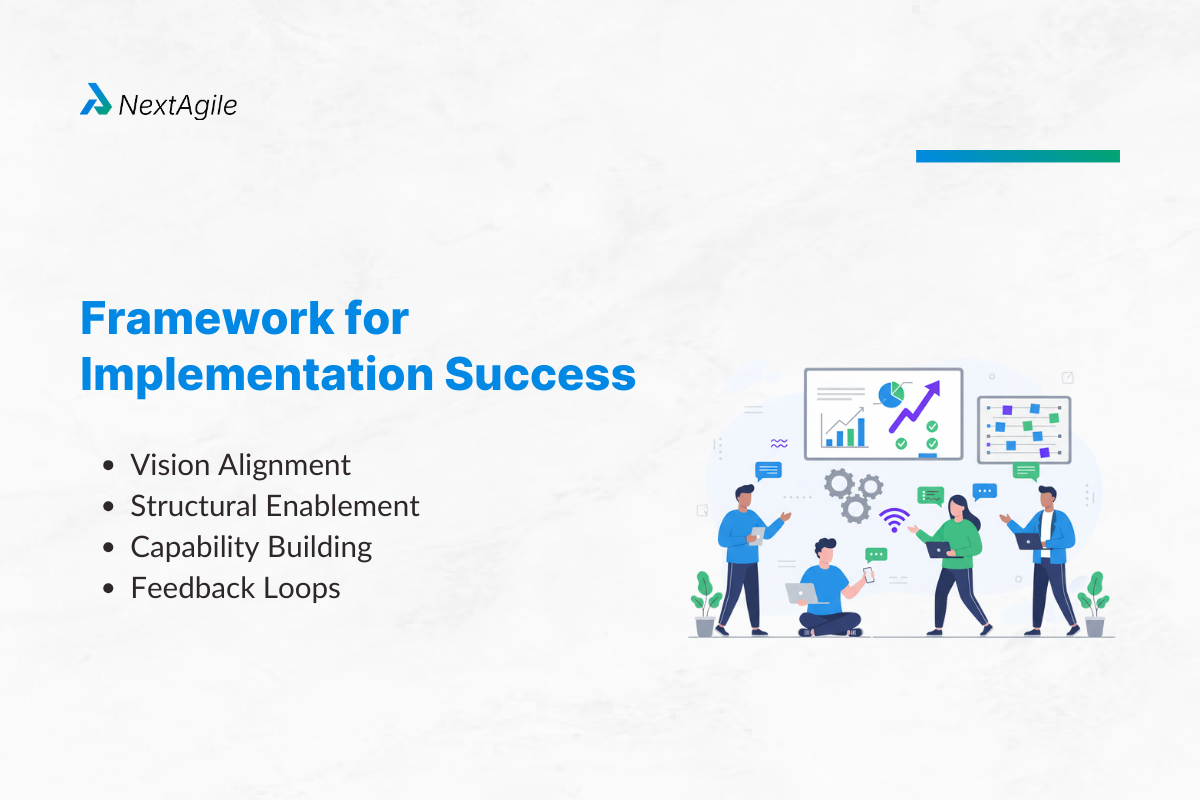
Framework for Implementation Success Creating a self organizing workplace culture isn’t a matter of throwing a switch. Transformation succeeds when culture, structure, and leadership evolve simultaneously. It takes a conscious design combining leadership intent, structural redesign, and cultural reinforcement.
Here’s an easy-to-follow 4-part design we implement with clients at NextAgile Consulting :
Vision Alignment : Leaders need to articulate a clear, compelling purpose that teams follow. Purpose becomes the north star replacing managerial control.Structural Enablement : Flatten hierarchies, redefine roles, and create cross-functional squads. Teams must be designed for autonomy, not merely labeled agile.Capability Building : Educate employees in decision-making, collaboration, and agile practices. Skills determine whether empowerment leads to performance or confusion.Feedback Loops : Put in place systems for ongoing learning and course correction. Learning mechanisms sustain autonomy without losing alignment. When all these four elements fall into place, organizations transcend slogans and truly incorporate self organization into their DNA.
Leadership Role in Self Organizing Culture One of the largest myths is that leaders become unnecessary in a self organizing culture. A big no. Instead, leadership becomes even more important but the function changes. Leaders no longer play the role of controller of work. They become enablers of context and vision . Leadership shifts from authority over people to accountability for outcomes.
Key leadership role in cultivating self organizing culture involves:
Ensuring psychological safety in which employees feel safe enough to voice their opinions. Making sure organizational purpose is communicated and clear. Coaching people, not directing work. Demonstrating accountability and flexibility. Leaders become architects of the environment rather than supervisors of activity. When we were consulting an Insurance major, their transformation came to a standstill in the beginning because leaders were not willing to let go. Once we re-defined leadership as steering the “why” and allowing teams to take ownership of the “how,” performance accelerated. Leaders became generators of innovation, not bottlenecks. Letting go of control unlocked speed, ownership, and innovation simultaneously.
Essential Leadership Competencies for Self Organizing Teams
Self organizing cultures require leaders with certain competencies like:
Emotional intelligence : to feel and respond to team dynamics.Facilitation skills: to lead collaboration rather than dictate. Systems thinking: to comprehend how decisions cascade throughout the organization. Resilience: to accept ambiguity and change strategies. Mentorship: to build others’ ability for self leadership. These competencies can be developed through executive coaching, leadership training , and feedback-based development. These capabilities redefine leadership success in decentralized systems.
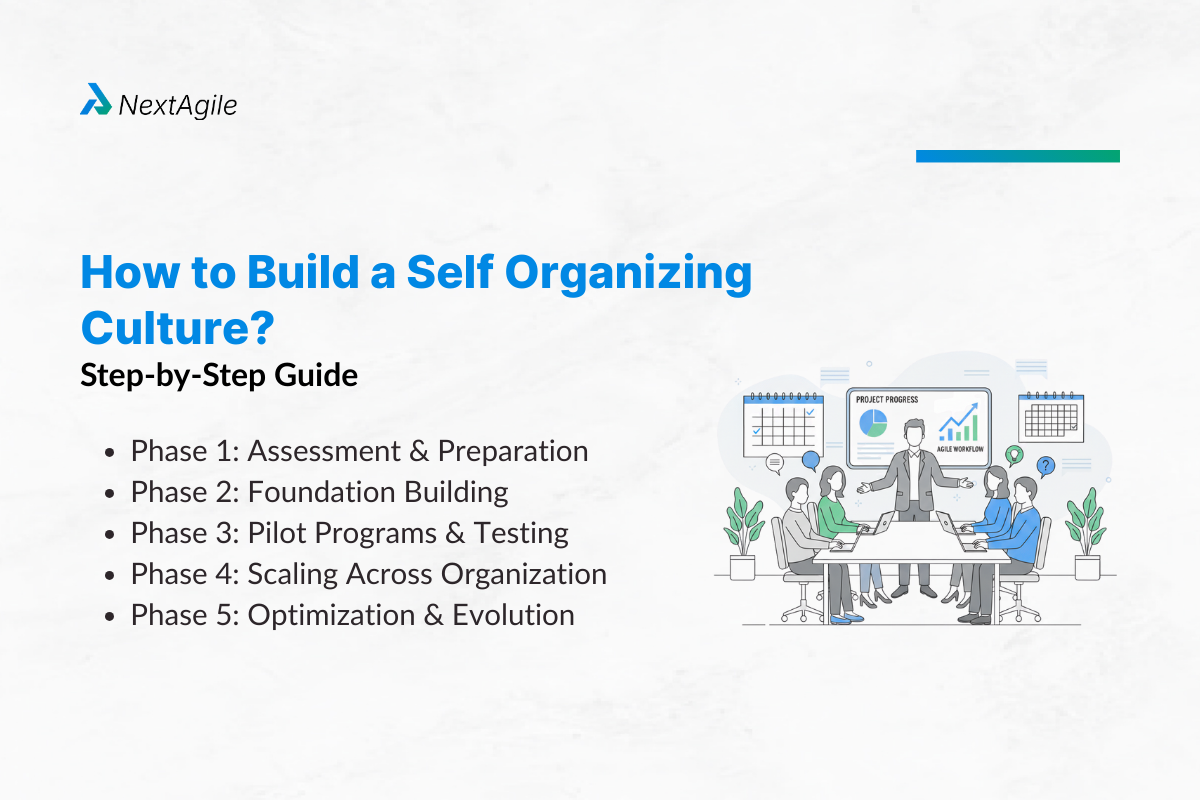
How to Build a Self Organizing Culture: Step-by-Step Guide?
Phase 1: Assessment and Preparation Begin by assessing your current culture. Hold surveys, interviews, and workshops to gauge trust levels, decision-making roadblocks, and leadership readiness. Pinpoint cultural blockers — micromanaging, siloed communication, absence of autonomy.
Develop a transformation blueprint that defines goals and success metrics. This paves the way for true buy-in. Cultural readiness determines transformation velocity.
Phase 2: Foundation Building Create small cross-functional teams with specific objectives. Redefine roles from command-and-control to facilitation and accountability. Add foundations of self organizing workplace culture which promotes transparency, ownership, constant learning.
Offer initial training in agile methods , conflict resolution , and shared decision-making. Early behavioral conditioning prevents later structural breakdown.
Phase 3: Pilot Programs and Testing Execute pilots with 1–2 teams. Monitor metrics such as speed of delivery, employee satisfaction, and rate of innovation. Utilize retrospectives to document lessons learned.
Success at this phase lays the foundation for scaling wider. Pilots create proof, safety, and momentum for organizational scaling.
Phase 4: Scaling Across Organization Once pilots are successful, scale practices across departments. Leadership must offer supportive guardrails which includes budget control, decision authority, and accountability frameworks. Guardrails maintain coherence while preserving autonomy.
This stage demands communications campaigns to get everyone on purpose and progress aligned.
Phase 5: Optimization and Evolution In year 2+, emphasize refining practices. Implement tools for enabling a self organizing culture, advanced analytics, and cycles of continuous improvement. The culture adapts to new market realities, remaining relevant and resilient. Mature self organizing cultures continuously refine rather than stabilize.
Best Practices for Self Organizing Culture Certain strategies consistently distinguish successful self organizing transformations from unsuccessful ones:
Begin small, scale smart: Pilots minimize resistance and generate credibility Invest in leadership coaching: Leaders require mindset change as much as employees Codify principles: Write down cultural principles so that they do not get lost in scaling Foster peer accountability: Teams must hold peers accountable for outcomes Harness technology: Technology like Jira, Slack, or Miro facilitates coordination easily Sustainable change happens through reinforcement, not declarations.
Sustainable change often begins with an Organizational Culture Workshop
Key Takeaways from Successful Implementations Successful companies don’t “adopt practices.” They adopt a new identity. Employees begin acting like owners, not executors. Leaders are measured by outcome, not activity. And companies become talent magnets because people desire autonomy with purpose. Identity-level change is what differentiates transformation from experimentation.
Essential Tools & Technology Stack
A successful self organizing culture is not possible without the proper tools. Tools act as coordination scaffolding for decentralized decision-making. Collaboration platforms, project systems, and analytics dashboards serve as the foundation.
Examples include:
Collaboration: Slack, Microsoft Teams, Miro Project management: Jira, Trello, Asana Visualization of work: BusinessMap Knowledge sharing: Confluence, Notion Analytics: Power BI, Tableau Choosing the Right Technology Stack for 2026
In 2026, AI-driven platforms and integration suites reign supreme. Tools that enable automated reporting, forecast workload bottlenecks, and accommodate hybrid workspaces are a must. Select tech that grows with you, integrates effortlessly, and fosters distributed teams. Intelligent tooling reduces oversight while increasing visibility.
Impact and ROI of Self Organizing Culture
The productivity effect of self organizing culture is large. Research indicates that such cultures enhance cycle time, lower staff turnover, and make the bottom line larger. When individuals own decisions, they deliver quicker and of better quality. Ownership directly correlates with execution speed and quality.
Additional advantages of self organizing culture in a business are more robust innovation pipelines and improved resilience in times of crisis. ROI through finances results from lower overhead in management, quicker product releases, and greater employee motivation.
How Self Organizing Culture Increases Engagement and Productivity? When employees are trusted, engagement increases. Autonomy fuels intrinsic motivation. Teams coalesce around a shared purpose instead of waiting for directives. The outcome? Increased productivity and a culture in which people desire to remain long term. Autonomy activates discretionary effort that traditional structures suppress.
Measuring Success: KPIs & Analytics
You can’t manage what you don’t measure. A self organizing culture needs clear KPIs to exhibit value and impart accountability.
Key KPIs are:
Cycle time reduction : How fast teams get from idea to deliverySpeed of decision-making : Time to approve or act on an initiativeEmployee engagement scores : Tracked via survey and feedback loopsInnovation rate : Quantity of new ideas experimented and deployedRetention rates : Are employees staying on longer because they feel trusted? Measurement reassures stakeholders that empowerment is driving tangible results. These metrics indicate if autonomy is being converted to performance. For instance, if cycle time is reducing but engagement scores are diminishing, it indicates burnout risk.
Measurement needs to be a mix of quantitative and qualitative insight. Numbers reveal trends, yet interviews and retrospectives explain why the trends happen. A combination of data and stories creates the actual picture.
Most importantly, beware of vanity metrics. Having more meetings doesn’t mean there is more collaboration. Rather, track outputs such as customer satisfaction gains or revenue impact from innovation. Outputs and impact matter more than activity indicators.
Tracked consistently, such KPIs are evidence that self organizing culture drives engagement and productivity. And they give doubting leaders comfort that empowerment isn’t a “fluffy HR thing” — it’s a quantifiable driver of ROI.
Advanced Analytics and Reporting Techniques Simple dashboards aren’t sufficient in 2026. Organizations require sophisticated analytics to really grasp cultural influence.
Predictive analytics can spot potential risks such as burnout or attrition before they materialize as full-blown crises. For instance, monitoring patterns of work across teams can find telltale signs of overload. Network analysis software plots collaboration patterns. Leaders can visualize whether information is flowing freely or if there are still bottlenecks in ancient hierarchies. Sentiment analysis from chat tools or survey responses provides instantaneous feedback about team morale. When morale is low, interventions can be proactive instead of reactive. Last, integrated reporting platforms integrate operational, financial, and cultural measures. Such systems provide leaders with a unified view of how self organization drives business results. In short, analytics converts gut feel into facts, allowing organizations to hone their transformation. Advanced insights make cultural transformation observable and manageable.
Case Studies & Real-World Examples
To learn about the advantages of a self organizing culture within business, let’s see how companies in various sectors have used it.
Self Organizing culture in a Tech Startup
A SaaS startup began using self organizing teams
Self Organizing culture in a Manufacturing Company
At a typical manufacturing business, compliance with safety measures had plateaued. By engaging frontline teams to develop safety measures, incidents fell sharply. Teams suggested and executed more than 50 productivity projects within a year, generating millions in savings. Not only were cost savings notable, but also the boost in innovation from employees previously labeled as “assembly line workers.” Frontline ownership unlocked innovation previously buried under hierarchy.
Self Organizing culture in a Global Bank
A universal bank employed self organizing teams to bring out new digital offerings. Consumers enjoyed quicker service improvements, and satisfaction levels increased 25% within six months. Notably, the bank did not suffer burnout by injecting feedback loops and sharing duties. Structured autonomy improved speed without sacrificing governance.
Agile Teams in a Large Enterprise
One Fortune 500 company used agile squads to experiment with innovation. Budget control and the power to change direction resided in these teams. Outcome? A revolutionary product line that generated 15% of annual sales. Empowered squads created measurable revenue impact.
Startups & Innovation Context
It’s seductive to believe this only applies in agile startups. Case studies, though, reveal otherwise. From banks to factories, self organization is applicable wherever leaders are willing to trust teams and establish enabling structures.
The moral of these cases? Success is achieved when leadership redefines control as empowerment. Teams flourish when they are given purpose, clarity and trust in delivery. Purpose plus trust consistently unlocks performance across industries.
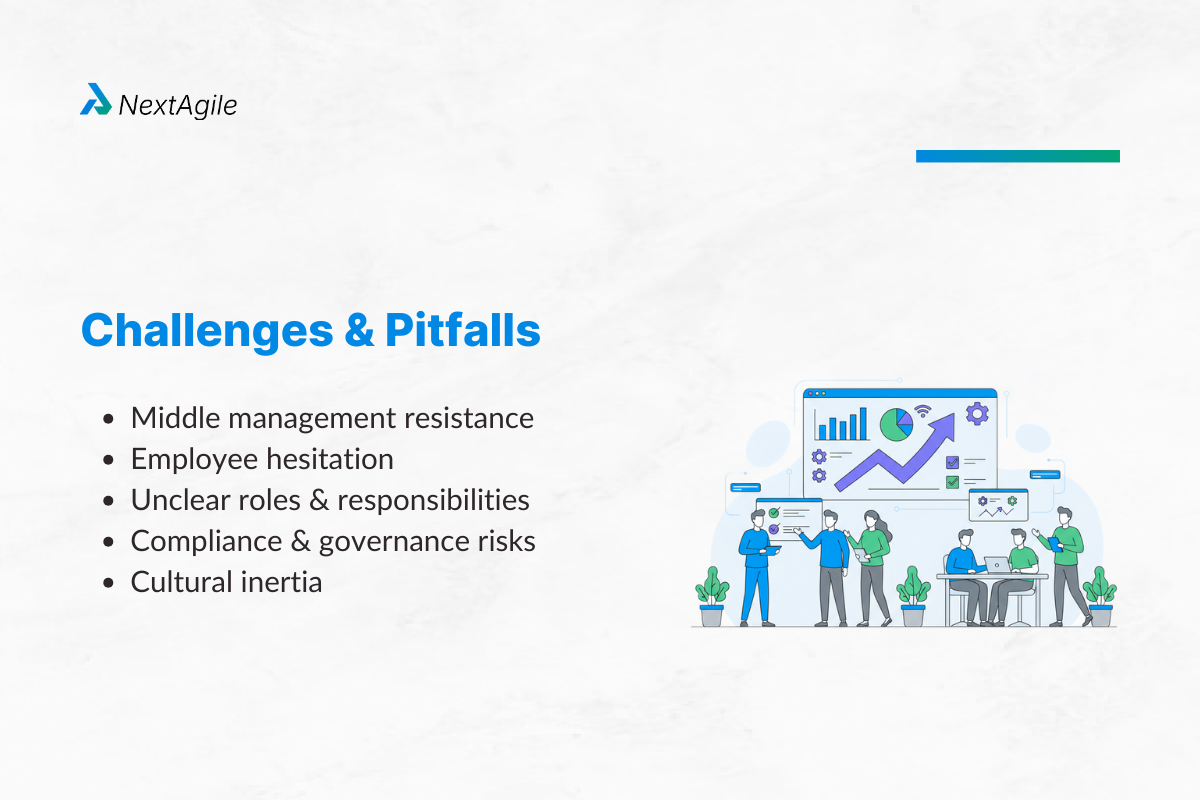
Bouncing Over the Challenges & Pitfalls Resistance is natural whenever control shifts from hierarchy to teams. Any transformation has its challenges, and establishing a self organizing workplace culture does too. The transition can be painful because it requires a total reassessment of how authority, responsibility, and trust work within the business.
A typical trap is middle management resistance . Managers are likely to feel threatened when their decision-making authority is delegated to the team. Rather than becoming irrelevant, their role becomes one of coaching, mentoring, and empowerment. Businesses that fail to facilitate this transition tend to encounter latent sabotage or silent resistance. Redefining managerial identity is critical to transformation success. Another challenge is employee hesitation . Not everyone is immediately comfortable with autonomy. Some individuals may prefer direction over accountability. To counter this, organizations must provide structured onboarding, mentorship, and continuous feedback loops so employees gradually build confidence in self organization. Confidence follows structured exposure to autonomy. Unclear roles and responsibilities can also throw a project off track. Too-soft boundaries can lead to duplicated effort or paralysis by analysis. A low-tech solution is to write down decision rights and escalation mechanisms, so autonomy doesn’t degenerate into anarchy.Compliance and governance risks are often overlooked. In industries like finance or healthcare, distributed decision-making can create accountability gaps. Embedding compliance officers into squads and implementing transparent audit trails can address these risks effectively. Embedded compliance preserves accountability in distributed systems.Finally, cultural inertia, the “we have always done it this way” mindset can be the toughest barrier. Leaders must actively champion small wins, showcase stories of success, and celebrate behaviors that reflect self organizing principles. Visible wins accelerate belief faster than strategy decks. The reality is that most organizations don’t collapse due to a bad idea. They falter because they underestimate the level of patience, persistence, and leadership bandwidth needed. By recognizing these traps ahead of time, companies can develop plans that convert resistance into momentum.
Mitigation steps:
Give clear vision and boundaries Develop leaders to transition from controllers to coaches Celebrate small wins to build trust Deal with compliance issues upfront Future Trends & Next Steps The future of self-organizing culture at work will be dictated by two giant forces: workforce expectations and technology.
Let’s start with Technology . AI-powered platforms will cut coordination overhead by allocating tasks automatically, forecasting workload bottlenecks, and bringing insights to the surface. Virtual collaboration spaces will become more like physical offices, providing equal hybrid experiences. For remote settings, this means less isolation and more interconnectedness. Second, Employee Expectations . The younger generations are in demand for autonomy and meaning. They don’t accept rigid structures. Organizations that don’t evolve will find themselves struggling with retaining talent. Self-organizing culture in distributed working environments will no longer be a choice, it will be an expectation baseline. Startups are already proving this model works for speed and innovation. Large enterprises are now catching up, blending self organization with governance to manage scale. We’ll see more hybrid models emerge where teams self organize within defined strategic boundaries.
For leaders, the next step is clear: experiment now. Waiting risks falling behind. The journey starts small but compounds over time. Organizations that delay experimentation risk cultural obsolescence.
Conclusion A self-organizing workplace culture isn’t a fad. It’s a proven, replicable methodology that creates strong, innovative, and adaptive organizations. In a world of perpetual change, inflexible hierarchies simply can’t adapt. Self organization is rapidly becoming a strategic capability, not a cultural experiment.
When teams are empowered, they don’t simply carry out tasks but they take ownership of results. This ownership inspires accountability, creativity, and intrinsic motivation. Leaders then transition from being micromanagers to visionaries and coaches. The culture becomes one that supports trust and transparency over control and compliance. Empowerment transforms employees into proactive value creators.
Of course, change isn’t instant. It takes patience, intentional design, and ongoing reinforcement. There will be mistakes, there will be resistance, and progress will be slow at times. But those who persevere are rewarded far beyond the discomfort.
The ROI extends beyond profit. It manifests itself in employee motivation, customer satisfaction, and long-term viability. Organizations that adopt self organizing culture not only excel — they become places that people want to be part of.
Organizations that sustain autonomy build resilience competitors struggle to replicate. At NextAgile we’ve walked alongside companies making this shift. The results have been inspiring: leaders rediscovering purpose, teams unlocking innovation, and organizations thriving in uncertainty. If you’re looking to build a sustainable self organizing culture, consider partnering with a trusted leadership training company like NextAgile that aligns contextual leadership training programs with executive coaching and overall organizational agility. Our team excels at aligning leadership development with organizational objectives.
Frequently Asked Questions 1. What happens to middle management in a self-organizing culture transformation? Middle managers transition from controllers to coaches and facilitators. Rather than watching tasks, they establish clarity, dislodge obstacles, and foster team abilities. Their worth is in facilitating cooperation and crafting alignment between vision from leadership and team action. They do not go away, they mature. Coaching replaces supervision as the core managerial value.
2. How do you ensure consistency of company culture across multiple self-organizing teams? Consistency derives from common principles, not strict rules. Set firm cultural anchors such as transparency, accountability, and customer centricity. Repeated retrospectives, cross-functional learning meetings, and stories told by leadership instill these values. Capturing cultural guidelines also ensures teams work independently but stay in tune with the organizational spirit. Principles scale culture more effectively than centralized controls.
3. What is the largest monetary investment needed for self-organizing change? The biggest investment is most often in training, coaching, and technology adoption. Collaboration tools, agile practices, and data analytics tools are essential. But the highest cost is leadership time spent in leading culture change, managing resistance, and facilitating capability development. Over a period, ROI vastly exceeds these initial investments. Leadership bandwidth is the hidden cost driver in transformation.
4. What legal or compliance risks should companies be aware of before initiating self-organizing culture? Legal threats are unfocused accountability, data protection in distributed decision-making, and adherence to labor laws. To avoid, definitively set roles, decision rights, and escalation routes. Utilize proper documentation and audit trails. In heavily regulated sectors, have the compliance officers incorporated into self-organizing squads for proactive governance. Governance embedded early prevents autonomy from creating compliance gaps.
Alok Dimri is the co-founder and leads the overall business at NextAgile, where he is responsible for strategy, client and consultant partnerships, and a whole lot of other core business activities like solutioning, branding, and customer engagement.
Over the past 16 years, he has worked extensively in business strategy, new business development, and key account management initiatives across process consulting and training domains.
 Skip to content