...

Conflict Management: Strategies, Styles & Workplace Examples (2026)

Conflict Management Meaning, Strategies & Styles Conflict Management Meaning, Strategies & Styles
Share

Introduction

Conflict! Any workplace has it, and let’s face it, we have all encountered it. The question isn’t whether or not conflict will occur, it’s how you deal with it when it does. That’s where conflict management comes into play. Most leaders instinctively avoid conflict, assuming harmony equals performance. In reality, suppressed conflict quietly erodes trust and delays critical decisions.

This blog will deconstruct what conflict management is all about, meaning of conflict management, why it is important for professionals and companies, and how you can implement effective conflict management strategies and styles. You’ll gain hands-on workplace techniques, discover real-world case studies, and observe how leaders convert conflict into opportunities for development.

Whether you are an employee managing team dynamics or a manager leading cross-functional initiatives, this article will provide you with the insight and skills to resolve disputes effectively. Because at the end of the day, conflict is not the enemy: unmanaged conflict is.

What Is Conflict Management and Why It Matters?

Definition and goals of conflict management 

Conflict management is the practice of recognizing, confronting, and resolving conflict in a constructive manner while maintaining relationships and fulfilling organizational objectives. It’s not about eliminating conflict entirely — which isn’t realistic. Rather, it’s about establishing a system by which disagreements are handled in a manner that fosters development, not destruction. Effective conflict management means preserving respect while resolving differences.

The objectives of conflict management are three in number – 

  1. To reduce the harmful effects of such disagreements as stress, resentment, or disengagement
  2. To encourage constructive dialogue where differing opinions are appreciated
  3. To push cooperation towards solutions to mutual benefit for both parties and the organization. When organizations skip these goals, conflict shifts from task-focused to personal, making recovery harder and costlier.

In the hybrid and changing business environment of today, conflict is no longer merely about disagreements among co-workers. It pervades across cross-functional groups, virtual working, allocation of resources, and even varied leadership styles. Conflict can hurt trust, suck away productivity, and drive away high-performing staff when not managed. Managed, though, conflict becomes an innovation driver, more solid relationships, and improved decision-making. Hybrid work has amplified invisible conflict and the misunderstandings grow faster when tone, context, and intent are filtered through screens.

In reality, conflict management is a mix of strategies, styles, and communication skills that enable individuals to manage disputes effectively. From selecting the appropriate negotiation style to using active listening, the goal is always to transform conflict into a chance for improved outcomes. The leaders who become skillful at this tend to have their teams more resilient, innovative, and engaged.

Why managing conflict is so crucial in work and life 

Ever wonder why some teams thrive under pressure while others implode? The difference often lies in how conflict is managed. Unresolved disputes tend to escalate, leading to toxic work environments, reduced productivity, and higher turnover. Teams don’t collapse because conflict exists; they collapse because conflict lingers unaddressed.

On the other hand, managing conflict well can cultivate trust, deepen collaboration, and spark creative problem-solving. In leadership coaching, I’ve seen executives transform difficult conversations into breakthrough innovations simply by handling conflict differently. Leaders who reframe conflict as data rather than disruption respond more rationally and constructively.

Conflict resolution also applies beyond the workplace. Families, friendships, and social interactions all depend on the same concepts – respectful communication, listening, and conflict resolution. The reality is that conflict is inherent in every relationship, whether business or personal. Being able to resolve it keeps relationships intact while arriving at solutions that benefit everyone concerned.

That’s why companies are spending more money on curating contextual conflict management training programs. It’s no longer a “soft skill” – it’s a key leadership competency for success in today’s complicated world.

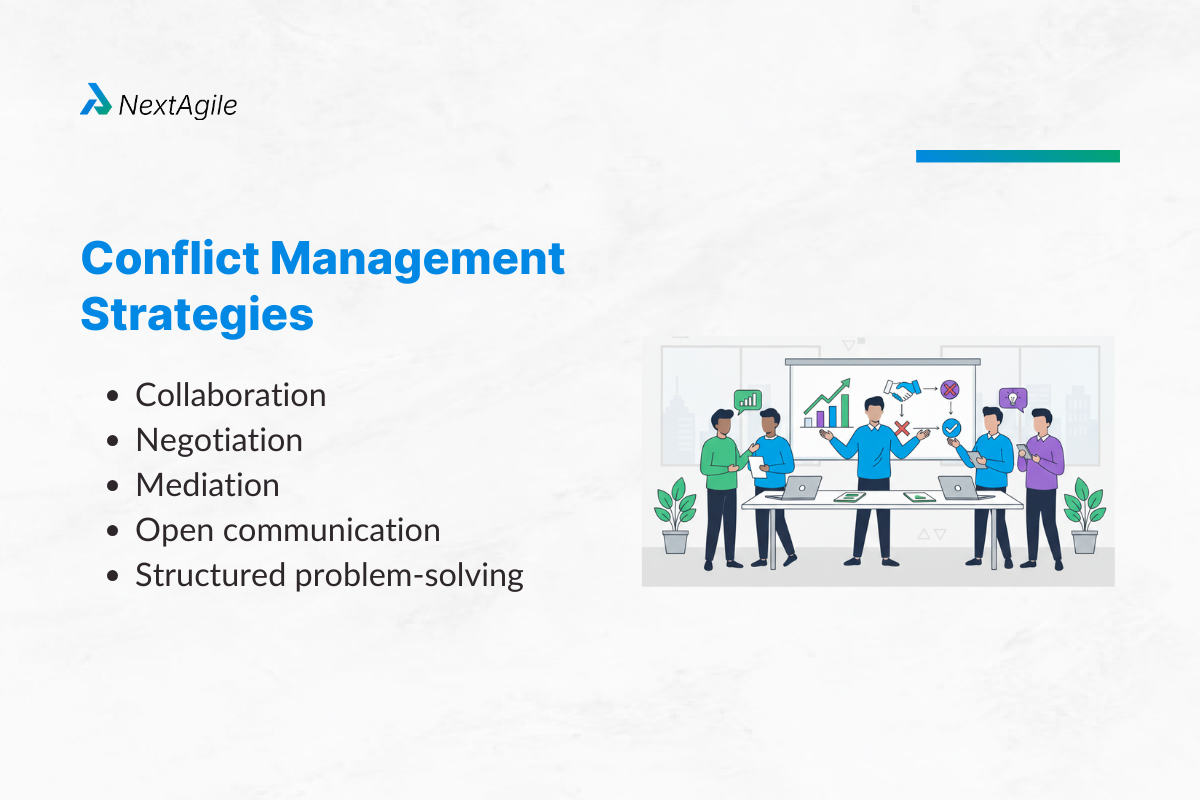
Conflict Management Strategies

Conflict Management Strategies

Conflict management is fundamentally a matter of strategy. You can’t use the same solution to every problem – what you do to settle a minor team spat isn’t going to resolve a boardroom-level fight.

Some of the most prevalent conflict management techniques include:

  • Collaboration – Collaborating to seek a win-win solution. This produces the best results but takes time and effort from everyone.
  • Negotiation – Sounding out the middle ground where both parties compromise. This gets things moving fast but potentially at the cost of deeper resolution.
  • Mediation – Employing an independent third party (such as HR or a facilitator) to resolve problems constructively.
  • Open communication – Promoting openness and discussion prior to escalating into conflict.
  • Structured problem-solving – Employing frameworks to examine the underlying issue and find actionable solutions.

These approaches permit flexibility but necessitate self-reflection, empathy, and flexibility. The effectiveness of any strategy depends less on the method and more on the intent and emotional maturity behind it.

How to select the appropriate strategy?

The appropriate strategy selection relies upon three variables: stakes, relationship, and available time.

  • If there are high stakes and strong long-term relationships, collaboration or mediation is best
  • If there is limited time and moderate stakes, negotiation or compromise would be better. 
  • For low-stakes conflicts, avoidance or deferral is acceptable at times, as long as it is not a habitual pattern.

Leaders must ask: What’s on the line? How much does this relationship matter? Do we have time to work through this deeply? The responses will determine the selection of strategy. Avoidance should be strategic, not emotional. When used unconsciously, it signals leadership discomfort rather than situational judgment.

Conflict Management Styles

The 5 Primary Conflict Management Styles

These styles are not personality traits but see them as situational choices that can be consciously developed. Scholars frequently cite the Thomas-Kilmann Conflict Mode Instrument, which classifies five primary conflict management styles:

  • Competing – This is an assertive, uncooperative style. It’s effective where fast, firm action is required such as requiring compliance or making urgent phone calls. But excessive use can harm relationships. Overuse creates fear-based compliance, which reduces long-term psychological safety and idea sharing.
  • Collaborating – The most constructive of all the styles. It works to achieve a win-win in which both sides’ concerns are satisfied. Best for tough problems, but needs trust and time. While slower, this style produces the strongest alignment and ownership because all voices feel heard.
  • Compromising – A middle-ground solution in which both sides compromise. It’s efficient and equitable but might ignore deeper problems. Compromise solves immediate friction but may resurface if root causes remain unresolved.
  • Avoiding – This style avoids conflict. It works with minor issues or when emotions are strong, but extended avoidance usually returns to bite. Chronic avoidance often leads to silent resentment, which later manifests as disengagement or attrition.
  • Accommodating – This collaborative style prioritizes others’ needs. It keeps harmony intact but can lead to resentment if done too much. Excess accommodation can unintentionally reward aggressive behavior from others.

Applying the Right Style in Different Situations 

There is no one conflict handling style that suits all situations. Experienced professionals adjust their method according to the situation’s gravity, the relationship being risked, and the long-term impact.

  • For instance, competing might be required when speed and decisiveness are essential, like applying safety regulations or forcing financial decisions. 
  • Conversely, working together is best when diverse opinions are welcome, such as during strategic planning or product development. While it is slower, the reward is long-term commitment and out-of-the-box thinking.
  • The compromising style is effective when time or money is short, or both sides require a workable middle ground. It gets things moving without leaving anyone completely unheard. 
  • Conversely, avoiding can be effective when feelings are running high and instant confrontation would dig the hole deeper. It’s a temporary time-out — but leaders need to go back to the problem later in order to avoid it festering.
  • Finally, accommodating is appropriate when harmony is more important than winning the point, e.g., in trivial conflicts or in defending less skilled team members.

The actual skill is to know when to switch gears. Effective leaders read the situation, stay assertive yet empathetic, and select the style that best saves relationships and propels progress. Skilled leaders treat styles like gears by mastering the art of shifting intentionally as context changes.

Conflict Management in the Workplace

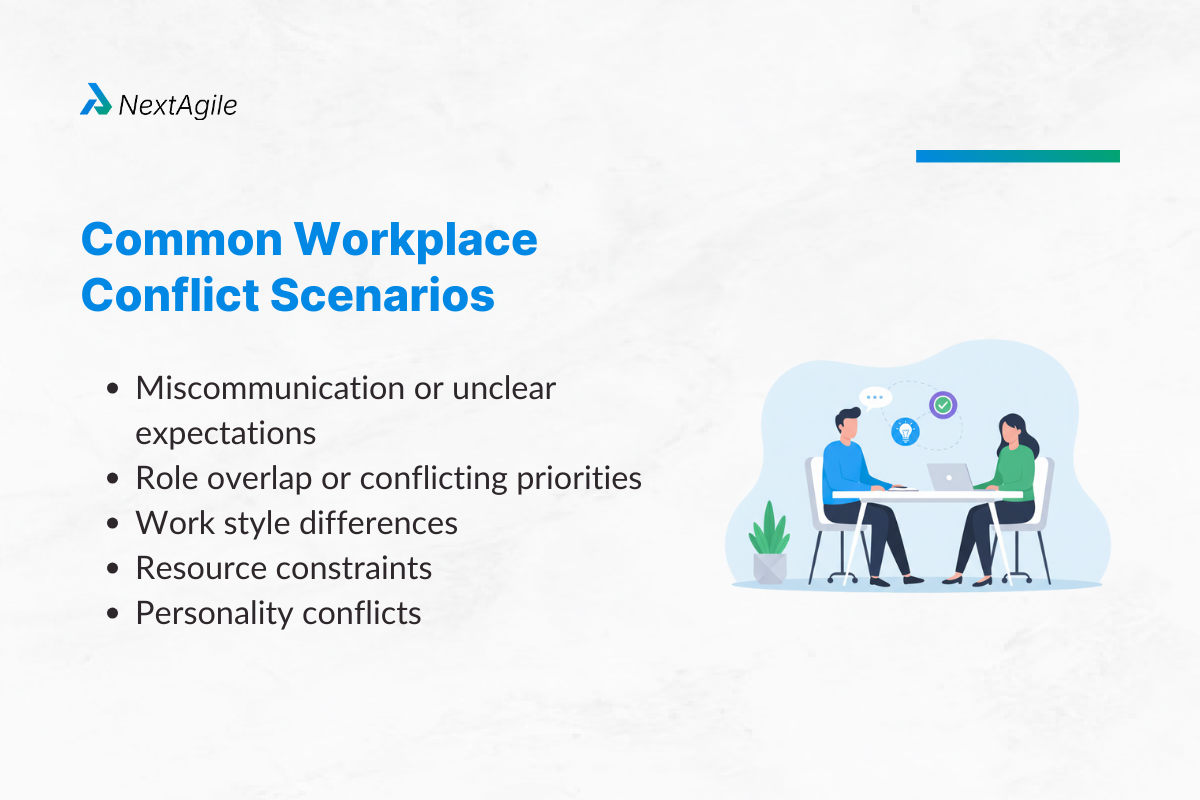
Common Workplace Conflict Scenarios 

Common Workplace Conflict Scenarios

Conflicts in the workplace typically occur because:

  • Miscommunication or unclear expectations
  • Role overlap or conflicting priorities
  • Work style differences
  • Resource constraints
  • Personality conflicts

For instance, in hybrid teams, some team members may feel others are not pulling their weight. In the project environment, departments will feud over budget responsibility. If left unchecked, these conflicts result in lower morale and lost deadlines.

Identifying such patterns in early stages is the initial step. Leaders need to habituate themselves towards observing early signs like frequent disagreements, lack of engagement during meetings, or passive-aggressive behavior. Most workplace conflicts stem from unclear ownership rather than actual disagreement.

Practical Solutions for Leaders and Employees

Employees can decrease tension at the workplace by actively listening, posing questions for clarification, and confronting issues immediately before they are blown out of proportion. Recording agreements also avoid future conflicts. Psychological safety is the foundation of healthy conflict. Without it, employees choose silence over honesty.

For leaders, the responsibility is greater. They must create an environment where conflict management in the workplace is normalized, not avoided. That means modeling constructive dialogue, setting clear expectations, and providing conflict management training for managers. Organizations that integrate conflict resolution into their Corporate Leadership Training programs tend to build stronger, more collaborative cultures. In fact, many teams benefit from dedicated conflict management workshops facilitated by experts who help employees practice these techniques in real time.

Real Examples and Lessons Learned

Brief case studies of conflict resolution 

Case 1: Cross-functional conflict

A sales and marketing team conflicted over lead quality. Marketing was accused by sales of giving unqualified leads, while marketing claimed sales wasn’t following up. Tension mounted until leadership intervened with mediation. Through deliberate conversation, they found misaligned KPIs. By getting performance metrics aligned and adding shared dashboards, the conflict transformed into cooperation. Both teams reported increased conversion rates and better alignment within months. Misaligned metrics are one of the most common structural triggers of inter-team conflict.

Case 2: Remote team misunderstanding

A project manager assumed a team member was disengaged during virtual calls due to minimal participation. Frustration grew, affecting trust. Upon investigation, the real issue was poor internet connectivity, not lack of commitment. The manager shifted to asynchronous updates and written feedback, restoring confidence and improving productivity. This highlights how assumptions often fuel unnecessary conflict. Perception gaps in remote work are often mistaken for performance gaps.

Case 3: Leadership tension

Two senior executives battled over the ownership of the budget, generating open conflict between departments. The CEO stepped in, redefining the issue as a joint responsibility. By introducing dual accountability, the two leaders were motivated to cooperate, not compete. Their dual control not only minimized rivalry but also enhanced project execution and effectiveness. Shared accountability reduces territorial conflict by redefining success as collective.

Key takeaways professionals can apply 

There are a number of lessons here. Speed of intervention is often the deciding factor between manageable conflict and cultural damage. First, resolve conflicts early on before they escalate into systemic team dysfunction. Second, set expectations and goals early on because most conflicts are the result of misaligned priorities, not poor intentions. Third, don’t make assumptions; leaders need to explore underlying causes, not make assumptions.

Another important takeaway is the importance of neutral facilitation. Whether by HR, outside consultants, or formal conflict management workshops, third-party objectivity frequently expedites resolution.

Last, recall that conflict can be a growth agent. When handled constructively, disputes compel teams to recreate processes, question assumptions, and invent. Professionals who welcome conflict as a possibility and not peril  frequently realize improved solutions and build more durable relationships. Conflict handled well strengthens teams; conflict ignored weakens culture.

Conclusion 

Conflict is unavoidable but unmanaged conflict is expensive. Knowing conflict management styles and strategies, professionals can turn disagreements into building blocks of cooperation and growth. Every unresolved conflict carries a hidden tax on morale, time, and trust.

Great leaders don’t shun conflict; they welcome conflict with clarity, empathy, and an arsenal of methods. Workers who learn conflict management skills become more resilient, improved collaborators, and more effective contributors to group achievement.

Conflict maturity is now a leadership differentiator, not just an HR capability. If you’re ready to build these skills within your organization, consider curating contextual immersive learning programs leveraging corporate leadership training company like Nextagile. Explore our unique four phase learning journey – NextLearning to equip leaders of tomorrow through impact driven leadership programs.

FAQs 

  1. How does emotional intelligence affect conflict management?

Emotional intelligence is at the heart of successful conflict management. High-EQ leaders are able to control their own emotions, understand others, and remain calm under stress. Through an understanding of underlying emotions and motivations, they are able to transform strained situations into positive dialogue. This capacity averts conflicts from exploding into personal or destructive battles. High emotional awareness enables leaders to respond thoughtfully instead of reacting defensively.

  1. Can conflict management enhance team creativity and innovation?

Yes, conflict management effectively fuels creativity. When respectfully encouraged disagreement is allowed, team members are comfortable to contribute distinctive opinions. The collision of ideas tends to ignite innovative answers that would not surface under complete harmony. Conflict managed prevents groupthink and encourages teams to challenge assumptions, resulting in higher-quality, more innovative solutions. Innovation often lives on the other side of respectful disagreement.

     3. How does technology (remote work, virtual teams) contribute to conflict management in the present time?

Technology has revolutionized workplace conflict. Remote teams usually experience miscommunication because of the absence of face-to-face cues. Nevertheless, features such as video calls, collaboration software, and formalized updates minimize misunderstandings. Virtual leaders have to be careful about being clear, having the right tone, and ensuring everyone is included to avoid digital friction and prevent conflicts from escalating in virtual spaces. Digital communication requires over-clarity because intent is easily misread without nonverbal context.

  1. How do leaders define success in conflict management?

Success is not only measured by the number of disputes resolved. Leaders measure employee engagement rates, turnover, and effectiveness of collaboration. Lower complaints, faster decisions, and better team morale are among indicators. Employee feedback on fairness and communication style also indicate if conflict management practices are creating a healthier workplace culture. The real success metric is whether relationships improve after the conflict, not just whether the issue is closed.

  1. What are early warning signs that a conflict needs management before escalation?

Warning signs include recurring disagreements, employees avoiding certain colleagues, tension during meetings, or drops in productivity. Subtle cues like sarcasm, withdrawal, or passive-aggressive communication often signal growing frustration. Addressing issues at this stage allows leaders to defuse situations early, preserving trust and preventing long-term damage to team relationships. Early intervention prevents emotional buildup that makes resolution exponentially harder later.

Leave a Reply

Your email address will not be published. Required fields are marked *