...

Building a Culture of Psychological Safety: A Practical Guide (2026)

Building a Culture of Psychological Safety at Work Building a Culture of Psychological Safety at Work
Share

Introduction

Why do some teams thrive under pressure while others crumble at the first sign of change? The secret often lies in an organizational culture driven by psychological safety, the belief that one can speak up, share ideas and take  risks without fear of embarrassment or retribution. Building a culture of psychological safety is the invisible engine behind organizational courage and innovation.

But establishing this culture isn’t an accident. It takes deliberate effort on the part of leadership, HR, and teams.From creating open communication to reworking processes that enable openness, every rung in the organization has a stake.

In this guide, we’ll explore why psychological safety matters, break down its core elements, provide a step-by-step framework for implementation, and share actionable strategies for modern workplaces from hybrid teams to fast-paced, high-pressure environments. By the end, you’ll have a clear roadmap for embedding psychological safety into your organizational DNA. 

Safe cultures accelerate learning while unsafe cultures institutionalize hesitation.

Understanding the Psychology Behind Building a Culture of Psychological Safety 

Psychological safety, at its essence, speaks to fundamental human needs: belonging, respect, and the ability to contribute. When employees can safely express opinions, own up to errors, or question assumptions, engagement and creativity thrive. When fear is in charge, teams silence each other, and organizational learning grinds to a halt.

The term became recognized thanks to Harvard professor Amy Edmondson, who described psychological safety as a “shared belief that a team is safe for interpersonal risk-taking.” That is, it’s the shared trust that voicing something won’t result in humiliation or punishment. This shared belief determines whether ideas surface or stay buried.

Psychological safety thrives on trust, empathy, and inclusive communication. Leaders play a pivotal role: their behavior signals what is acceptable. 

Let’s briefly discuss the three pillars which drive Psychological Safety as per our experience as a leadership consulting and training company – 

  1. Leadership – A manager who dismisses questions or punishes mistakes inadvertently creates a culture of fear. Conversely, leaders who actively solicit input, acknowledge errors, and celebrate learning foster environments where creativity and collaboration can flourish. Leadership reactions become emotional signals that teams quickly internalize.
  2. Team dynamics – Not only are high-performing teams talented, but they are also interpersonally safe, i.e., members feel safe challenging assumptions, offering new ideas, and admitting ignorance. In psychologically safe cultures, disagreement is no longer stress-inducing but is instead a productive conversation. High performance without safety leads to burnout; safety sustains performance.
  3. Context – It’s also worth noting that psychological safety is environment-specific. Teams with multiple backgrounds, distributed configurations, or cross-cultural teams present specific challenges. Having an understanding of the psychology involved is the precursor to developing interventions that actually succeed across settings. Context matters. Safety must be intentionally designed for each team environment.

In this day and age of remote work, agile teams, and technological upheaval, psychological safety is no longer a nice-to-have; it’s a business necessity. When teams are safe, they contribute more freely, innovate more quickly, and overcome obstacles with resilience. Time and time again, research demonstrates that organizations that make psychological safety a priority experience greater engagement, lower turnover, and improved overall performance. 

Silence in teams is rarely neutrality, it is often fear disguised as compliance.

Core Elements of Building a Culture of Psychological Safety 

Psychological safety isn’t one policy or a workshop, it’s a multi-dimensional culture. High-performing organizations continually infuse several key elements:

  • Leadership Modeling: Leaders establish the tone. Self-disclosing errors, questioning, and vulnerability embolden others to follow suit.
  • Open Communication: Candid, two-way communication builds trust. Employees require forums for idea sharing, feedback, and concerns without fear.
  • Inclusive Practices: Psychological safety flourishes in diverse teams when every voice is heard. Policies and processes must actively invite contribution from everyone, not only the loudest voices.
  • Learning-Oriented Mindset: Mistakes are to be learned from, not penalized. Teams that learn from failures as lessons build continuous improvement.
  • Structured Support Systems: Mechanisms like feedback loops, mentorship programs, and safe spaces for dialogue enforce safety norms.

These components are interrelated. Leadership behavior impacts team norms, which in turn impact individual openness to voice. Organizations that incorporate these values across the board experience increased engagement, innovation, and retention. Psychological safety is cumulative; every leadership interaction either builds or erodes it.

It is important to note that psychological safety does not equate to comfort. It supports challenge, debate, and healthy conflict but within a context of trust. Teams learn more quickly, adapt more successfully, and react more imaginatively to change when safety exists. Safety encourages candor, not complacency.

Incorporating these foundational elements depends on strategic planning as well as day-to-day practice. Leaders and HR specialists need to track team climate, demonstrate preferred actions, and support norms by means of recognition, coaching, and system support.

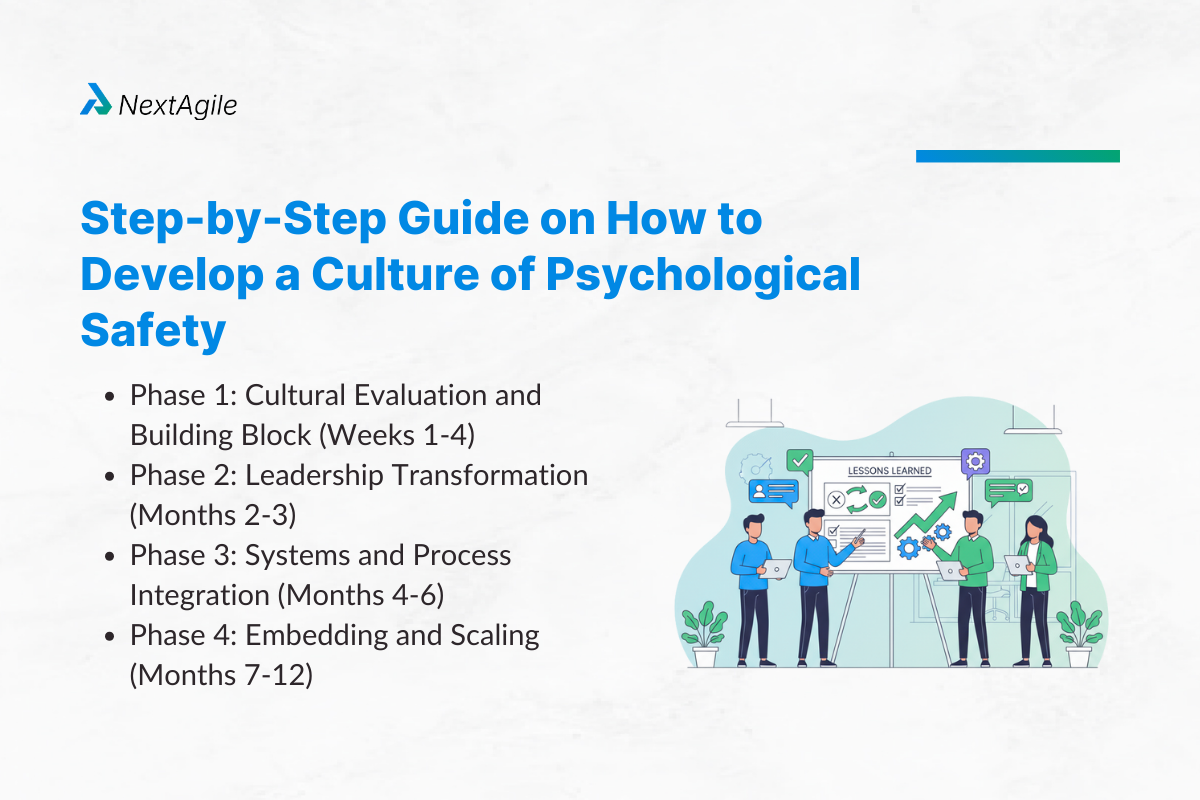
Step-by-Step Guide on How to Develop a Culture of Psychological Safety 

Step-by-Step Guide on How to Develop a Culture of Psychological Safety

Phase 1: Cultural Evaluation and Building Block (Weeks 1-4) 

Understand the current situation before applying initiatives. Measure levels of psychological safety through surveys, interviews, and focus groups. Pinpoint high-risk zones where fear, silence, or blame dominate.

Establish clear goals: specify what psychological safety is for your company. This can be measures such as frequency of speaking up, rates of error reporting, or responses to engagement surveys. Create a baseline to track progress along the way.

Share intentions with teams in advance. Clarify that the intent is not to remove accountability but to build a safe space for learning and innovation. Leaders need to visibly be involved in this evaluation phase, with commitment and responsiveness to feedback. Baseline measurement transforms psychological safety from intent into strategy.

Phase 2: Leadership Transformation (Months 2-3)

Leaders are the keys to psychological safety. This stage is about building leadership behaviors that exemplify openness, empathy, and inclusivity.

Psychological Safety Training workshops must include:

  • Active listening techniques
  • Providing and receiving constructive criticism
  • Publicly acknowledging errors
  • Fostering varied opinions

Executive coaching can speed up behavior transformation, assisting leaders in viewing blind spots and building habits that create a sense of safety. Leaders who lead by vulnerability communicate that others may do the same safely, reinforcing top-down culture.

Consistent check-ins, peer support networks, and 360-degree feedback systems keep people accountable and monitor leadership behavior improvement. Behavioral change at leadership level is the single biggest multiplier of team safety.

Phase 3: Systems and Process Integration (Months 4-6) 

Psychological safety must be embedded in organizational systems, not just leadership behaviors. This includes:

  • Performance reviews that reward learning, risk-taking, and collaboration
  • Anonymous feedback channels for sensitive topics
  • Recognition programs highlighting inclusive and safe behaviors
  • Decision-making processes that invite input from diverse voices

Embedding safety within workflows on a daily basis prevents it from being an event-driven activity. Agile ceremonies, brainstorming, and cross-functional projects must all be infused with safety principles, so safety becomes an operational part of the fabric.

It’s all about measurement: monitor engagement stats, idea submission, and incidents. Utilize these to tune systems and fill gaps before they become major issues. Systems institutionalize safety when leadership attention shifts elsewhere.

Phase 4: Embedding and Scaling (Months 7-12) 

Maintaining psychological safety demands ongoing reinforcement and amplification across teams. Run refresher workshops, share success stories, and promote cross-team sharing of best practices. Leverage long term sustainable learning models like NextAgile’s NextLearning framework to build long term capability by internalizing concepts and putting them into practice.

Mentorship and buddy systems assist in diffusing safety norms, especially in remote or recently formed teams. Leaders must review periodically the surveys and feedback mechanisms to ensure culture gains are not diluted over time.

For long-term effects, incorporate psychological safety principles into succession planning, talent development, and onboarding new talent. Embed it as organizational DNA, not a special project.

Scaling also includes adjusting strategies to accommodate distinctive team environments like remote, agile, or cross-cultural teams that might require special approaches while maintaining core principles. Culture sustains only when reinforced through structure, storytelling, and leadership continuity.

HR Guide to Building Psychological Safety Culture 

HR is responsible for infusing psychological safety. HR beyond policies can facilitate leadership growth, plan safe avenues of feedback, and track cultural well-being.

Following are a few key actions recommended for HR Teams:

  • Policy Alignment: HR policies must promote psychological safety through non-punitive approaches to mistakes.
  • Training & Development: Prepare managers to promote safe environments through training in empathy, feedback and delegation, and conflict management.
  • Monitoring & Measurement: Utilize surveys, focus groups, and exit interviews to measure safety levels. Recognize trends and intervene early.
  • Recognition Programs: Reward actions that illustrate safety, inclusion, and positive challenge.
  • Conflict Mediation: Intervene in a neutral fashion when issues between people occur, ensuring fairness and maintaining trust.

By aligning with leadership and integrating these initiatives into HR systems, organizations establish a persistent and scalable culture. Psychological safety isn’t solely a leader’s job.  HR ensures structures, processes, and policies enable it at scale. HR acts as the guardian ensuring psychological safety survives beyond leadership rhetoric.

Contemporary Workplace Psychological Safety Tactics 

Remote and Hybrid Teams 

Remote arrangements can suppress spontaneous interactions, and thus psychological safety is more difficult to create. Deliberate practices make the difference:

  • Begin meetings with open check-ins
  • Asynchronous idea sharing
  • Establish virtual “safe spaces” for conversation
  • Publicly acknowledge contributions to foster trust

Leaders need to overcommunicate norms and make room for every voice, quiet ones included. Remote psychological safety has a lot to do with being visible, heard, and acknowledged, and about trust-building rituals. Visibility and recognition replace hallway reassurance in distributed environments.

Global and Cross-Cultural Teams 

Cultural norms shape who speaks up. Some will keep quiet when challenging authority, while others relish debate. To establish safety:

  • Train leaders on cultural sensitivities
  • Support inclusive dialogue practices
  • Offer anonymous feedback channels
  • Embracing diverse voices in decision-making

The intent is to make raising one’s voice around the world commonplace, so that international teams have the freedom to contribute without worry of being misunderstood or punished. Inclusion is the bridge that converts diversity into psychological safety.

High-Stakes and High-Speed Environments 

Mistakes scare people in high-risk businesses. To create safety, leaders can:

  • Frame mistakes as opportunities to learn
  • Debrief setbacks constructively
  • Enforce transparency by communicating openly
  • Emphasizing psychological safety in conjunction with performance targets

Even in high-pressure settings, teams function best when individuals feel comfortable to innovate, voice concerns, and own gaps early for averting bigger failures and enhancing outcomes. Fear thrives in urgency unless leaders deliberately normalize learning.

Metrics of Psychological Safety Culture Success 

Metrics are what guarantee initiatives work. Some of the most important metrics are:

  • Employee satisfaction and engagement
  • Number of times ideas are contributed
  • Filing of errors or near-misses
  • Retention and turnover rate

Surveys, focus groups, and 360-degree feedback provide quantitative and qualitative data. Monitor trends longitudinally, and modify interventions accordingly.

Routine measurement shows commitment, conveys accountability, and sustains behavioral change so that psychological safety becomes ingrained rather than fleeting. Measurement reinforces seriousness and prevents safety from becoming symbolic.

Bouncing Back from Obstacles and Typical Challenges 

Resistance frequently stems from fear, leadership doubt, or misunderstanding. Typical pitfalls include:

  • Leaders demoting psychological safety as “soft”
  • Employees fearing punishment even with new initiatives
  • One-time workshops without systemic support

To address these issues:

  • Communicate the business value of psychological safety
  • Use data and case studies to demonstrate impact
  • Align interventions with company objectives
  • Provide consistent reinforcement across leadership and HR

Consistent effort, clear communication, and visible senior leader commitment are essential to breaking through resistance. Psychological safety fails when treated as an event instead of an operating norm.

Real-World Success Stories and Case Studies 

Companies that invest in psychological safety see phenomenal outcomes:

  • Groups of tech firms boosted innovation output through the development of psychologically safe ideation spaces
  • Healthcare teams lowered medical mistakes by open reporting practices
  • Agile teams increased velocity and cooperation after leadership role-modeling vulnerability

These instances point out that psychological safety drives quantifiable business outcomes, from increased performance to greater engagement. It’s not some theoretical construct.  It’s actionable, practical, and life-changing when applied carefully. These outcomes confirm that safety directly fuels performance and innovation.

ROI and Business Impact of Psychological Safety 

Psychological safety enhances retention, decreases mistakes, increases productivity, and fuels innovation. Organizations observe:

  • Reduced turnover and recruitment expenses
  • Improved speed of problem-solving and decreased failure
  • Increased staff engagement and satisfaction

Safety culture investment pays off in financial as well as human capital. Groups take informed risks, share information better, and innovate with confidence, building sustainable competitive advantage. Psychological safety converts human confidence into measurable business value.

Future Trends in Psychological Safety (2026 and Beyond) 

In the future, psychological safety will cross-pollinate with technology, hybrid work, and AI-facilitated collaboration. Emerging trends are:

  • Digital platforms to share ideas in a safe environment
  • Analytics based on AI to monitor team sentiment
  • More focus on inclusivity and cross-cultural safety
  • Embedding safety into leadership capabilities and organizational KPIs

Organizations putting psychological safety first will be at the forefront of agility, innovation, and employee well-being. Safety will soon be tracked as rigorously as productivity and financial metrics.

Building Your Personal Action Plan: From Insight to Implementation 

Begin with self-reflection: examine your leadership behaviors and team culture. Find gaps and set realistic goals.

Second, design a roadmap: rank interventions like leadership coaching, feedback mechanisms or organized team rituals . Put someone in charge and set deadlines.

Lastly, measure and iterate: monitor progress using surveys, conversations, and performance metrics. Psychological safety is a moving target for which frequent reflection, adjustment, and reinforcement are essential. Transformation begins with awareness but succeeds through disciplined follow-through.

Conclusion 

Building a culture of psychological safety isn’t an optional “soft skill” initiative, it’s a strategic imperative. Teams that feel safe speak up, innovate, learn from mistakes, and collaborate effectively. Leaders, HR, and employees all play a role in embedding this culture. Teams that feel safe outperform not by effort, but by openness and speed of learning.

From measuring existing culture to shifting leadership habits, aligning systems, and scaling practice, organizations that make psychological safety a priority experience real gains in engagement, innovation, and business results. Remote teams, cross-cultural arrangements, and high-stress environments can all be improved by customized interventions aligned with fundamental principles.

The ROI is obvious: reduced turnover, increased productivity, improved decision-making, and a more resilient workforce. Ahead on the horizon, psychological safety will be at the heart of organizational agility and success in 2026 and beyond. Safety is becoming a strategic advantage rather than an HR initiative.

The path requires intention, commitment, and ongoing reinforcement but the reward is an organization where people can flourish, share their best ideas, and grow together. In today’s fast-changing work world, that is the ultimate competitive strength. In uncertain markets, psychological safety becomes the foundation of adaptability and resilience.

If you’re looking to build an organizational culture driven by psychological safety, consider partnering with a trusted leadership training company like NextAgile that aligns contextual leadership training programs with executive coaching and overall organizational agility. Our team excels at aligning leadership development with organizational objectives.

FAQs 

  1. How long does it really take to develop a culture of psychological safety?
    Significant change typically takes 6–12 months. Quick wins may appear within 3–4 months through leadership modeling, structured training, and system adjustments. Embedding safety into the culture requires ongoing reinforcement and monitoring, along with continuous feedback loops to ensure adoption and retention. Sustainable safety requires repetition, reinforcement, and leadership consistency.
  2. Is it possible to develop psychological safety culture without altering leadership?
    Leaders set the tone. Without leadership alignment, initiatives often remain superficial because employees observe cues from their leaders about what is safe to say. Changing leadership behaviors, therefore, is crucial for systemic psychological safety. Engaged leaders model transparency, vulnerability, and openness, which empowers teams. Psychological safety mirrors leadership behavior more than policy.
  3. How do you create psychological safety in heavily regulated sectors (healthcare, finance, aviation)?
    Use structured reporting systems and clear processes to maintain both compliance and safety. Encourage open dialogue while emphasizing learning over blame. Training should clarify regulatory obligations and safety principles, ensuring employees understand how to speak up safely without violating industry rules. Structured governance ensures safety and compliance coexist.
  4. How do you establish psychological safety with reserved team members who only speak up occasionally?
    Offer multiple feedback channels such as written surveys, anonymous submissions, or one-on-one sessions. Encourage small group discussions and provide recognition when contributions are made. Tailor approaches to individual comfort levels, ensuring introverted members feel equally valued. Alternative channels empower quieter voices without forcing visibility.
  5. Can automation and AI tools hurt or help psychological safety culture?
    AI can help by tracking engagement trends, sentiment, and feedback patterns, offering insights into team dynamics. However, over-reliance on AI without human empathy can erode trust. Balance digital tools with personal check-ins, mentorship, and human-led discussions to preserve authentic psychological safety. AI should enhance awareness, not replace human trust-building.


Leave a Reply

Your email address will not be published. Required fields are marked *