Introduction Ever wonder why some leaders inspire greatness while others struggle to get buy-in? Leadership isn’t just about a title, it’s about influence, vision, and the ability to bring out the best in people. These days, leadership is one of the most in-demand skills across industries. Whether you’re managing a small team, leading a division, or aiming for the C-suite, the ability to guide, motivate, and inspire is non-negotiable. If you are honest, do people follow you because they want to, or because they have to?
In my experience coaching senior executives, I’ve seen careers skyrocket when professionals invest in leadership development. Conversely, I’ve also seen high-potential leaders plateau because they ignored the leadership skills that actually move the needle. In most cases, it wasn’t intelligence holding them back, it was unexamined behavior.
Here’s the best news: leadership can be learned. But learning leadership requires unlearning habits that once made you successful. It’s not something that people are born with and will just magically possess. Anyone can learn leadership skills to enhance both individual career development and business success through practice, self-reflection, and proper strategies.
Here in this blog, we will go deeper into what leadership skills are, why they are important, and most importantly how to build leadership skills that set you apart. And along the way, I’ll provide practical examples, coaching advice, and actionable strategies that you can use right now. You will also learn where most professionals unknowingly sabotage their leadership growth.
What Are Leadership Skills? Leadership abilities are those that allow a person to efficiently lead people and groups towards common objectives. They’re not just decision-making or strategy, they include communication, emotional intelligence, problem-solving, flexibility, and the power to generate trust. Leadership skills aren’t traits; they are behaviors observed over time.
Consider it: leadership combines technical expertise and people skills. You can have the best business plan, but if you can’t get your team fired up to implement, results will be stuck in neutral. You can be popular, too, but in the absence of decisiveness and direction, individuals won’t know where to go with you. Teams don’t fail because of bad plans, they fail because no one commits to executing them.
Managers can strengthen capability through Next Agile Leadership Training
As a coach, I’d reduce leadership skills to two categories:
Interpersonal skill s: communication, empathy, conflict resolution, relationship building.Strategic abilities: vision, forecasting, decision-making, innovation, flexibility. Warning: Leaders who lean too heavily on one side eventually lose credibility.
Both are crucial. Great leaders combine them elegantly, they win loyalty as well as achieve results.
Surprisingly, leadership abilities aren’t reserved for managers alone. Even individual contributors gain when they practice leadership. Why? Because companies prefer individuals who can initiate, work across teams, and take ownership. It indicates being prepared for leadership roles in the future. If you don’t hold a title today, how are you practicing leadership anyway?
In short, leadership skills represent the blend of influence, action, and character that allows someone to guide others effectively. And unlike many technical abilities, leadership has no shelf life it’s relevant whether you’re leading today’s project or shaping tomorrow’s enterprise strategy.
New practitioners should master agile coaching essentials to drive change.
Importance of Leadership Skills in Career Growth At some point, technical excellence stops differentiating you. Here’s the thing: leadership competencies are career accelerators. Technical capability can get you in the door, but leadership skill gets you promoted.
I’ve worked with mid-level managers with great leadership presence who jumped over colleagues because they showed initiative, communication, and the capacity to influence stakeholders. Meanwhile, technically brilliant colleagues get stuck at middle management because they never learned leadership presence. Which of these two profiles feels uncomfortably familiar?
Growth starts with understanding the strengths and weaknesses of a leader
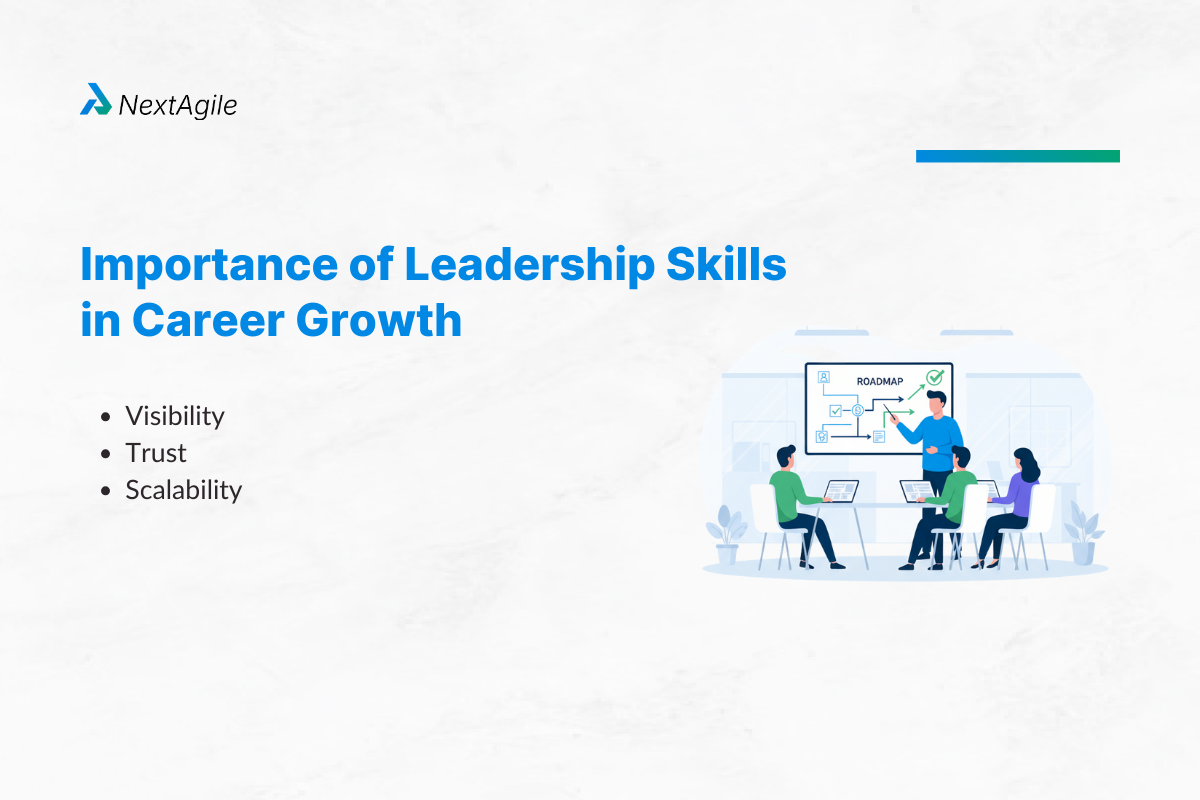
Promotion decisions are rarely about performance alone, they are about perception. Leadership skills propel career advancement in three ways:
Visibility : Leaders are inherently more visible throughout the organization, working with executives, clients, and cross-functional teams.Trust : When managers and peers trust your judgment and leadership ability, they’ll champion your advancement.Scalability : Leadership demonstrates you can look beyond your own work to drive results through others the single greatest requirement for senior positions. Think about it: the higher you go, the less you personally execute. Your success hinges on inspiring, empowering, and aligning others.
For career professionals who aspire to C-suite leadership, leadership potential is the discriminator. Companies look for leaders with the ability to handle uncertainty, work with diverse teams, and get results in tough situations. That’s why leadership development is a sustained career investment, not an expedient “nice-to-have”. At senior levels, leadership blind spots become organizational risks.
Many organizations prefer blended agile training consulting
Why Leadership Development is Critical for Workplace Success? In today’s fast-paced workplace, leadership development is no longer all about individual achievement, it’s about survival as an organization. Most organizations don’t fail because of strategy but they fail because leadership capacity doesn’t scale.
Contemporary organizations are subject to relentless change: digital transformation, remote work, economic instability, and cultural change. Without empowered leaders, teams lose direction, morale falls, and output diminishes. And in fact, leadership effectiveness is frequently the largest indicator of team engagement and retention.
The strongest cultures weren’t built on policies, they were modeled daily by leaders. From my work with Fortune 500 clients, I’ve observed that leadership development impacts organizations in three ways:
Culture building : Leaders shape culture through their behaviors and decisions. Investing in leadership skills ensures a positive, inclusive, and resilient culture.Business agility Employee development : Great leaders don’t only achieve business objectives they also develop people and mentor talent, building a lasting supply of next-generation leaders. When organizations fail to develop leaders, the price is high: high turnover, disengaged workers, and lost strategic momentum.
That’s why forward-thinking organizations often partner with leadership enablement companies like nextAgile to align leadership development with transformation goals. Transformation efforts stall when leaders aren’t equipped to lead differently. (Here at NextAgile, for instance, we frequently help companies integrate leadership development with their transformation process, playing not just the role of an consulting firm but that of a genuine transformation ally.)
Bottom line? Leadership development is a business imperative, not simply an HR program.
Organizations strengthen pipelines with leadership development training .
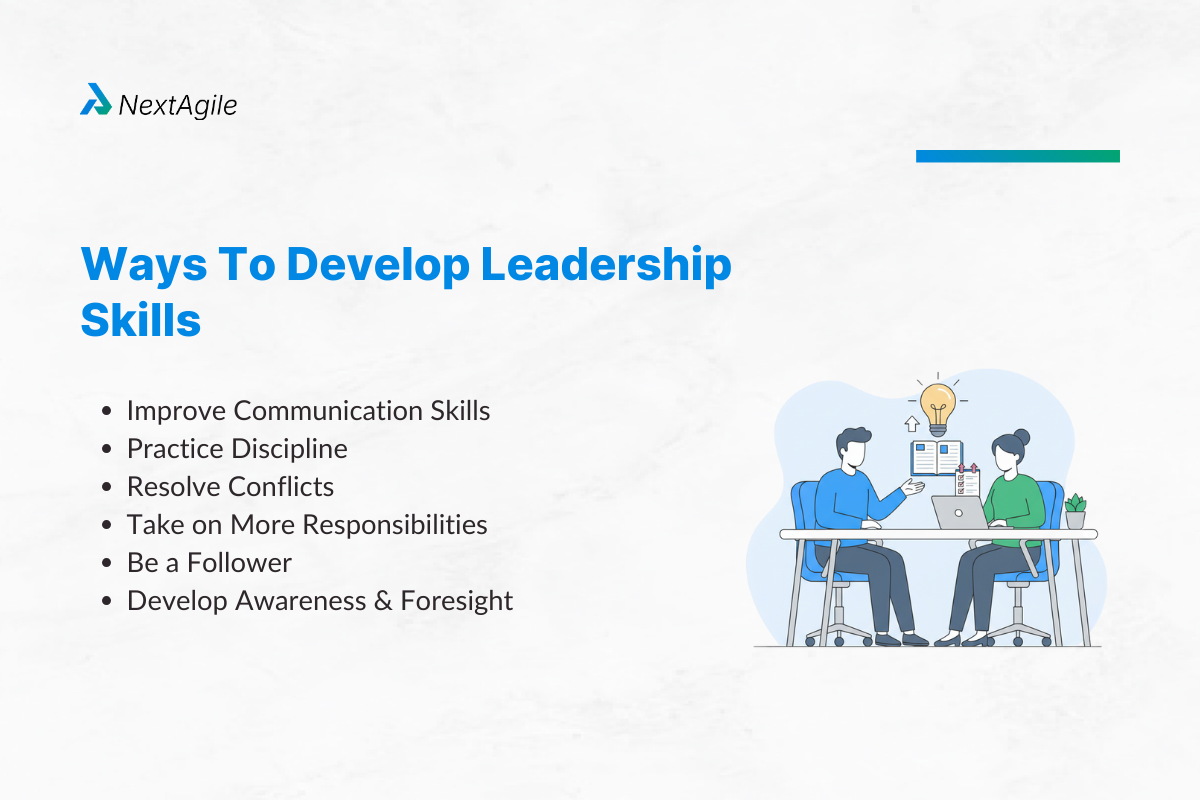
How To Develop Leadership Skills Now, let’s go tactical. If you’re asking yourself how to create leadership skills, here are tested methods you can use right away. You don’t need to do all of these, start with the one you resist most.
Managers can strengthen capability through our Leadership Training Workshop .
Improve Communication Skills Good communication is at the core of leadership. It’s not so much about being clear of speech, it’s about listening attentively, adapting your message to the listener, and building alignment.
Effective leaders don’t promote complexity. They distill complexity, point out what’s important, and motivate action. Communication builds trust too and trust is leadership’s currency.
A tip that works: Use “active listening .” When team members offer suggestions, repeat the major points to ensure understanding. This demonstrates respect and minimizes miscommunication. Another is to become a master storyteller telling business updates in story form makes them more compelling and memorable.
If you would like to develop your leadership at work, begin with your patterns of communication. Remember, if your message is misunderstood, the responsibility is still yours.
Ask yourself: after you speak, do people act or ask for clarification?
Practice Discipline Teams don’t follow intentions; they follow patterns.
Discipline is consistency, its about being present, following through, and demonstrating dependability. Leaders without discipline lose credibility rapidly.
For example, if you promise a deadline but routinely fail to meet it, your team will question your leadership. On the other hand, when you reliably follow through on commitments, you create a strong example.
To develop discipline, begin with small steps. Establish priorities, manage time, and be accountable for yourself. Regularity and consistency foster trust and influence over time. Discipline is how trust is built when no one is watching.
Resolve Conflicts Unresolved conflict doesn’t disappear, it shows up as disengagement.
Conflict cannot be avoided in any business setting. What distinguishes leaders is how they deal with it. Avoiding conflict allows tension to build up and harms relationships. I learnt over time that avoiding conflict doesn’t make them disappear, it compounds them.
Successful leaders use conflict as a challenge. They listen to both sides, seek root causes, and aim for win-win outcomes.
One strategy I suggest is “separating people from problems.” Attack the problem, not individuals. This maintains productive and professional discussions. Check our customized conflict management workshop if you and your teams struggle at conflict management.
Take on More Responsibilities Development of leadership often begins by going beyond your comfort zone. Taking on additional responsibilities shows initiative and toughness. Leadership growth comes from stretch and not burnout.
Consider projects that expose you to cross-functional teams, client interactions, or strategic decision-making. These stretch assignments not only build your skills but also increase your visibility throughout the organization.
Balance is the key so don’t take on too much, but do stretch beyond your current scope.
Be a Follower Ironically, good leaders can follow. They respect others in authority, learn from their mentors, and grasp the dynamics of working as part of a team. How you follow is often how you will eventually lead.
By being a good follower, you build empathy for those you will eventually lead. You also get exposure to various leadership approaches, helping you form your own style.
Recall: following is not passive. It’s being actively in support of vision and executing with excellence.
Develop Awareness and Foresight Leadership is not only about the here and now, it’s about looking ahead. Farsighted leaders anticipate threats and opportunities earlier than others. Leaders who don’t reflect repeat mistakes with more authority.
Self-awareness also comes into play understanding your strengths, weaknesses, and influence on others. That self-knowledge lends itself to authenticity and credibility.
A real-world exercise: Regularly reflect. Following important meetings or initiatives, ask yourself what worked, what didn’t, and how you impacted results. Doing this repeatedly develops foresight and awareness.
Inspire Others Real leadership is inspirational, not instructional. Leaders who inspire tap into discretionary effort the extra energy people contribute when they are motivated.
Inspiration sometimes results from vision and authenticity. When leaders paint a compelling picture of the future and practice what they preach, people naturally align behind them. Inspiration fades when actions don’t match words.
To inspire others, show your “why” for decisions, celebrate team successes, and recognize individual contributions. Inspiration creates loyalty and engagement.
Empower the Team Micromanagement suffocates motivation. Empowering leaders push decision-making down, trust their people, and give them the resources they need to achieve.
Empowering others unleashes their potential while releasing you to lead on strategy. It’s a two-way win. If everything flows through you, you are the bottleneck.
Action step: Don’t tell people exactly how to do things, but define what you want them to accomplish. That way, they own the “how.” This freedom increases ownership and creativity.
Keep Learning Leadership is a lifelong journey. The best leaders I’ve coached never stop learning; they read widely, attend workshops, and seek feedback.
In today’s fast-changing business world, outdated leadership styles quickly lose relevance. Staying current with leadership research and practices is critical.
Build a habit of continuous learning by scheduling time for professional development every quarter. Invest in coaching, mentorship, or leadership programs. What worked five years ago may now be holding you back.
Listen Attentively Listening gets no respect. Leaders who listen establish trust, reveal insights, and avoid expensive errors. Most leadership failures can be traced back to something that wasn’t heard.
Active listening involves complete attention, not interrupting, and seeking clarifying questions. It makes people on the team feel respected and valued.
It often resolves problems quicker than talking. Leaders who excel with this skill by default build stronger relationships and credibility.
Encourage Collaboration Leadership is not a one-man show. Excellent leaders encourage collaboration, smash silos, and encourage teamwork.
You can foster collaboration by designing cross-functional projects, celebrating collective successes, and encouraging psychological safety.
One tactical strategy: Rotate facilitators of meetings so every hand gets a chance to own it. Collaboration not only enhances results but also creates a stronger, more resilient culture.
Have a Positive Attitude Attitude is contagious. Leaders who stay optimistic in the face of adversity inspire confidence and resilience in their teams.
This doesn’t equate to ignoring issues. It means addressing them with a solutions-focused attitude.
Positive attitude also creates emotional safety. When groups understand failure won’t lead to blame, they’ll innovate and risk more.
Be More Decisive Indecisiveness costs too much. Leaders who dawdle too long lose both momentum and credibility. Delayed decisions often feel safe but they are rarely neutral.
Being decisive isn’t about charging forward blindly. It’s about collecting the appropriate data, hearing input, and then proceeding with confidence.
Practice decisiveness through small decisions. Develop the muscle of choosing, taking ownership of outcomes, and learning from consequences. Your speed of decision-making and confidence improve over time.
Practical capability building often starts with leadership workshop training.
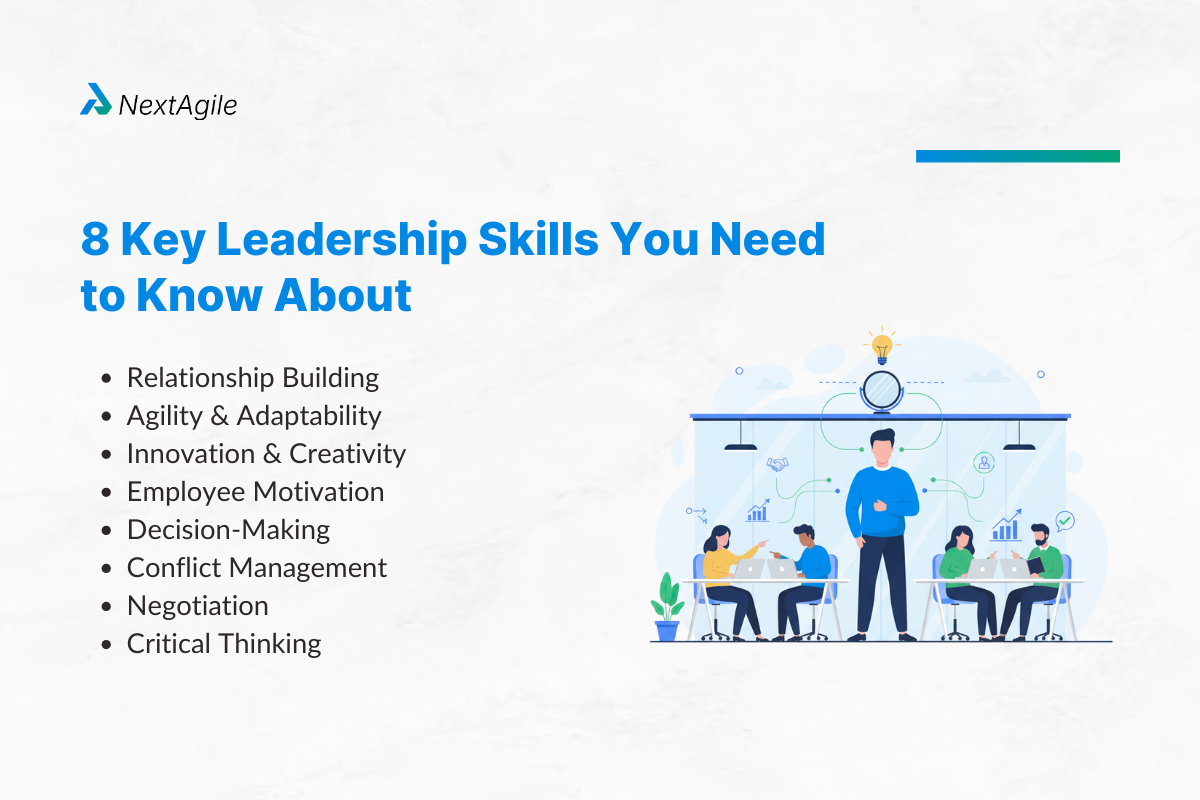
8 Key Leadership Skills You Need to Know About
These skills rarely appear in isolation, they reinforce each other.
Relationship Building Leadership thrives on relationships. Strong leaders earn trust and credibility by being authentic and dependable. They build networks that enable collaboration, open dialogue, and innovation. When people feel connected to their leader, they are more engaged, motivated, and willing to go the extra mile to achieve collective goals. Agility and Adaptability Innovation and Creativity Employee Motivation Decision-Making Conflict Management Negotiation Critical Thinking What Are Common Challenges in Leadership Development?
Leadership development isn’t easy. Common challenges include:
Resistance to change : Professionals tend to hold on to habits, even if new ones are required.Time pressures : Executives have busy workloads, giving them minimal time for reflection or learning.Shortage of feedback : Leaders aren’t provided with candid feedback, and therefore may be unaware of blind spots.Overconfidence : Certain leaders think they’ve “arrived,” and have no further room to grow. Which of these challenges are you currently rationalizing?
Systemic issues also affect organizations, such as misaligned leadership pipelines or limited training resources.
Conquering these demands intentionality by finding time, getting coaching, and implementing ongoing feedback.
How a Good Leader Impacts the Organization? A good leader has the power to reshape an organization’s culture, performance, and future. Leadership impact compounds, for better or worse.
Good leaders:
Increase employee engagement and turnover reduction. Foster innovation by establishing psychological safety. Enhance business results through clarity and direction. Poor leadership, however, cultivates disengagement, silos, and lost opportunities. At NextAgile, we’ve seen organizations reinvent themselves through leadership excellence, often as part of larger change initiatives involving organization transformation. With the right leadership, entire organizations shift from rigid to adaptive, from reactive to visionary.
Conclusion Leadership growth is uncomfortable by design. It is not built in moments of authority but in moments of choice. Developing leadership skills is a journey, one that requires self-awareness, practice, and commitment. The most effective leaders I’ve coached weren’t born leaders. They became leaders by consistently investing in their growth, learning from setbacks, and staying open to feedback.
If you’re serious about career advancement, focus on building communication, decision-making, and the ability to inspire others. For organizations, leadership development isn’t optional it’s the foundation of agility, innovation, and resilience.
Remember, leadership isn’t about titles. It’s about impact. And every professional, at every level, has opportunities to practice leadership daily. Choose one behavior to practice this week and let others feel the difference.
If you’re looking to accelerate your journey, consider partnering with a trusted leadership training company like NextAgile that aligns contextual leadership training programs with executive coaching and overall organizational agility. Our team excels at aligning leadership development with organizational objectives.
Frequently Asked Questions Most leadership questions aren’t about capability, they are about courage.
1. How can introverts become leaders? Introverts can lead by employing listening, empathy, and reflective communication. They don’t have to be the loudest to motivate quiet confidence tends to beget deeper trust. Prioritize preparation, clarity, and one-on-one relationship building to enhance leadership influence. Some of the most trusted leaders are introverts because they listen before they lead.
2. What are the best ways to practice leadership in everyday life? A leader can practice leadership through initiative-taking, peer support, and asking for feedback. Small actions such as helping run meetings, helping colleagues, or smoothing disputes, develop leadership muscles. The things a leader does on a daily basis are more important than formal roles. Leadership practiced daily compounds faster than leadership practiced occasionally.
3. How does a leader establish trust among a team? Trust grows faster through consistency than charisma. Trust is built when leaders are predictable, open, and equitable. Keeping promises, giving constructive criticism, and thanking them for their efforts come a long way. Leaders who care about the success of their people are trusted by teams.
4. How can leaders manage resistance from team members? Leaders must listen to the issues, understand the problems, and provide the “why” for changes. Overcoming resistance needs patience, clarity, and occasional compromise. Buying in is more powerful than coercion. People resist change less when they feel heard more.
Alok Dimri is the co-founder and leads the overall business at NextAgile, where he is responsible for strategy, client and consultant partnerships, and a whole lot of other core business activities like solutioning, branding, and customer engagement.
Over the past 16 years, he has worked extensively in business strategy, new business development, and key account management initiatives across process consulting and training domains.
 Skip to content