Agile transformation helps organizations deliver faster by shifting from slow, project-based work to continuous value delivery. It changes not just processes but also leadership mindset, team structure, and decision-making. Companies adopt it to stay competitive, improve customer experience, and respond quickly to market changes. Success depends on leadership alignment, cross-functional teams, and treating Agile as a long-term cultural shift. Introduction Agile transformation is the process of changing how an organization operates so teams can deliver value faster, adapt to change quickly, and collaborate more effectively. Instead of relying on rigid project plans and hierarchical approvals, Agile organizations work through cross-functional teams, iterative delivery cycles, and continuous customer feedback.
In simple terms, Agile transformation moves companies from project-driven execution to value-driven delivery.
Organizations pursue Agile transformation when traditional operating models slow innovation, delay product launches, and create organizational silos. For many modern enterprises, Agile transformation is not simply a methodology shift. It is a strategic operating model change that enables continuous innovation and long-term business agility.
Before exploring Agile Transformation frameworks and maturity models, it will help to clarify what Agile transformation actually means in practice and how organizations adopt it at different scales.
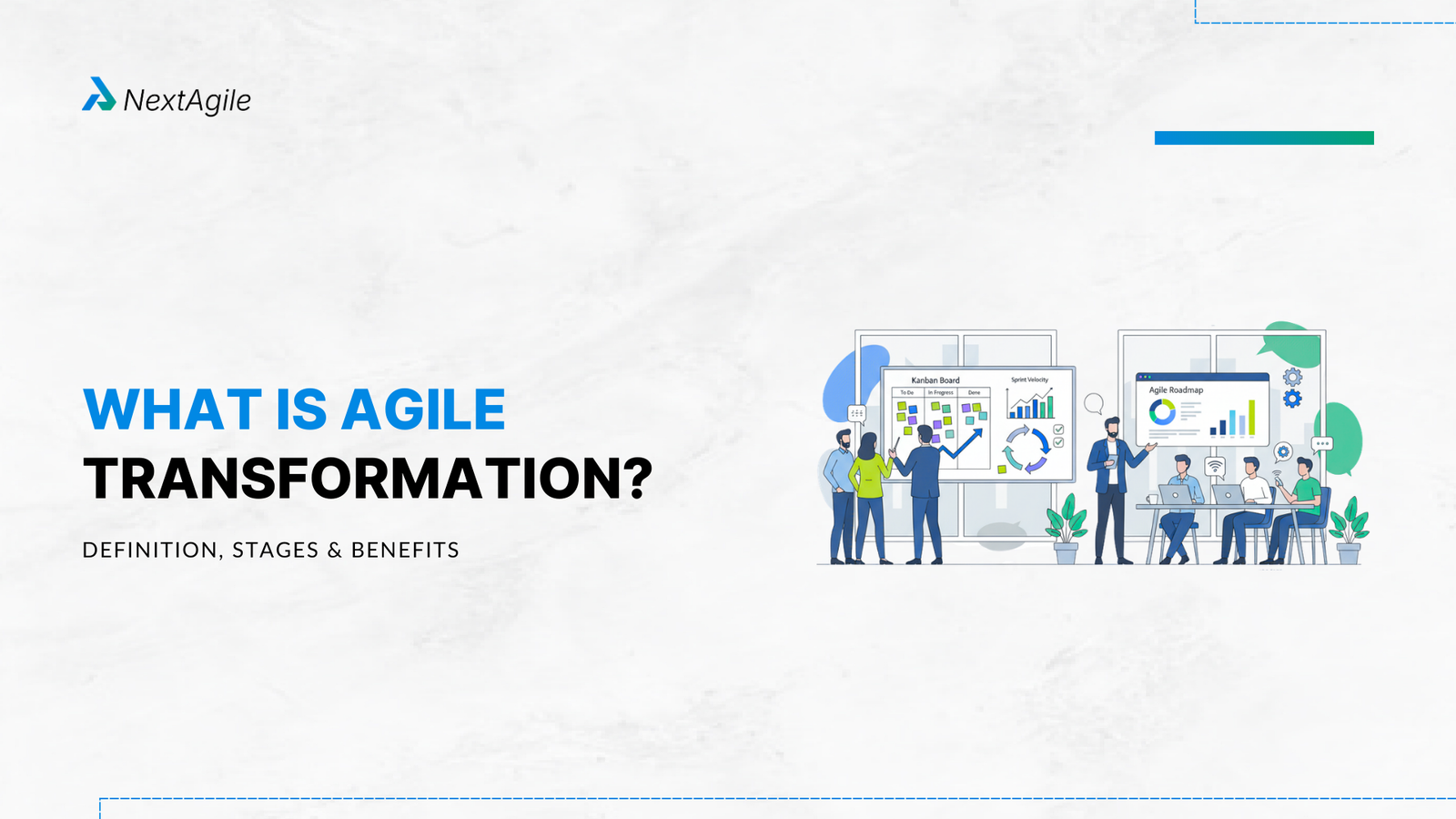
What is Agile Transformation? (Definition, Types & Quick Comparison) Agile transformation refers to the organizational shift from traditional project-centric ways of working to adaptive, value-driven delivery models .
Instead of managing work through rigid project plans and hierarchical approvals, Agile organizations organize teams around customer value streams
At its core, Agile transformation involves three key changes:
Structural change : Teams move from siloed departments to cross-functional product teams.Leadership change : Managers transition from task controllers to servant leaders .Delivery change : Work shifts from long project cycles to short iterations focused on customer value. Organizations approach agile transformation in different ways depending on their size and industry.
Common Types of Agile Transformation Transformation Type Focus Typical Organizations Team-Level Agile Adoption Introducing Scrum or Kanban within teams Startups, small tech teams Department-Level Transformation Aligning multiple teams with Agile practices Mid-sized companies Enterprise Agile TransformationRestructuring the entire organization around value delivery Large enterprises
Choosing the Right Agile Transformation Approach Organizations rarely follow a single agile transformation model. In practice, companies often combine multiple approaches depending on their structure, industry, and strategic goals.
For example:
Selecting the right approach depends on factors such as:
Organizational complexity Regulatory constraints Leadership readiness Product portfolio size Technology maturity Understanding these factors early helps leaders design transformation strategies that are practical, scalable, and aligned with business outcomes .
Enterprise transformations often rely on scaling frameworks that help coordinate multiple Agile teams while maintaining strategic alignment.
While Agile transformation can significantly improve delivery speed and collaboration, organizations usually begin the journey because their existing operating model is no longer effective.
Scaling organizations often partner with an agile transformation & consulting company for faster results.
Why Do Companies Go Through Agile Transformation? Organizations typically pursue Agile transformation when traditional operating models begin to limit their ability to compete.
Several common triggers drive transformation initiatives.
1. Slow Product Delivery Traditional development cycles often take months or years to release new features. Agile transformations reduce delivery cycles by enabling teams to release incremental improvements continuously.
2. Changing Customer Expectations Customers expect faster innovation and personalized experiences. Agile delivery models allow organizations to gather feedback quickly and adjust product direction.
3. Increasing Market Uncertainty Industries such as technology, fintech, healthcare, and e-commerce experience constant disruption. Agile organizations can pivot more effectively when market conditions change.
4. Inefficient Organizational Structures Many traditional organizations operate with departmental silos that slow decision-making. Agile transformation promotes cross-functional collaboration that reduces bottlenecks.
5. Talent Engagement Challenges Modern professionals prefer autonomy, ownership, and collaborative environments. Agile teams often report higher engagement because they empower individuals to contribute meaningfully.
What Changes During an Agile Transformation? Agile transformation impacts several dimensions of an organization simultaneously. These shifts collectively reshape how organizations operate and innovate.
Leaders shift from command-and-control management to empowering teams and enabling experimentation .
Instead of functional departments, organizations create cross-functional agile teams capable of delivering end-to-end value .
Annual planning cycles evolve into continuous planning and adaptive roadmaps .
Success metrics shift from task completion to customer outcomes and business impact .
Decisions move closer to the teams delivering value, allowing faster response to change.
Organizational Dimensions Impacted by Agile Transformation A successful agile transformation typically affects multiple layers of the organization simultaneously.
These dimensions include:
Strategy Alignment Operating Model Leadership Behavior Delivery Systems Funding and Governance Because these dimensions are interconnected, Agile transformation requires system-level change rather than isolated team adoption.
Although every organization follows a unique path, most successful Agile transformations progress through a series of recognizable stages that gradually expand Agile practices across the enterprise. Understanding these stages helps leaders set realistic expectations and avoid common transformation pitfalls.
The 3 Stages of Agile Transformation While every transformation journey is unique, most successful initiatives follow a recognizable progression.
Phase 1: Leadership Alignment & Vision Setting The first stage focuses on building executive clarity around why transformation is necessary . Without leadership alignment, Agile initiatives often remain isolated within teams and fail to scale.
During this phase organizations typically:
Define strategic transformation goals Identify value streams and product areas Assess current delivery challenges Train leaders on Agile principles and decision frameworks Organizations also begin building agile transformation roadmap and agile capability development programs .
Leaders often strengthen internal capabilities through structured agile learning programs
Phase 2: Building Cross-Functional Pilot Teams The second stage introduces Agile practices within carefully selected pilot teams.
These teams serve as experiments that validate new ways of working before wider rollout .
Key activities during this stage include:
Forming cross-functional product teams Introducing Agile ceremonies and delivery practices Establishing product ownership roles Implementing feedback loops with stakeholders Organizations frequently complement this stage with capability development programs such as agile and scrum masterclass
Phase 3: Scaling Across the Organization Once pilot teams demonstrate measurable improvements, organizations expand Agile practices across additional departments.
Scaling agile requires alignment across multiple dimensions:
Governance models Portfolio management processes Leadership structures Funding models Organizations also begin aligning strategic planning with outcome-driven frameworks such as OKRs OKR consulting services .
At this stage the transformation shifts from team-level improvement to enterprise operating model change .
Many enterprises partner with an experienced agile transformation company
Agile Transformation Roadmap: A 10-Step Implementation Framework Most organizations assume Agile transformation begins with training teams on Scrum or Kanban. In reality, sustainable transformation requires a structured operating model shift .
As an agile consulting company, we’ve found that successful transformations tend to follow the below 10 step agile transformation framework.
This roadmap ensures that transformation moves from leadership intent → team execution → enterprise scaling .
The 10 Step Agile Transformation Roadmap: Step Focus Area Key Outcome 1 Context for Change Acknowledging the challenges that require the transition to agile methodologies. 2 Executive alignment Leadership buy-in & Commitment 3 Current state assessment Agility Assessment and knowing current agile maturity 4 Transformation strategy Define the high level agile transformation strategy with key milestones and timelines 5 ‘Knowing’ Phase Build awareness and understanding of agile principles , practices, identified frameworks through contextual agile trainings 6 ‘Doing’ Phase Start Implementing agile practices in pilot teams & projects 7 Measure Set up agile metrics to ensure transparency and measure productivity, quality, and customer satisfaction 8 Scale Agile Practices Gradual expansion to more teams and departments, informed by insights gained from pilot projects 9 ‘Being’ Phase Sustained consistency and commitment to embed agile principles into the organization’s DNA 10 Continuous Improvement Continuous iteration and refinement of practices, processes and structures.
The goal is not to “implement Agile” but to build a continuously adapting organization.
Check our detailed 10 step agile transformation roadmap to know about each of these steps in greater depth.
Key Agile Transformation Benefits When executed effectively, Agile transformation delivers measurable organizational benefits.
Shorter development cycles allow organizations to launch new features and products faster.
Improved Customer Experience Continuous feedback loops ensure products evolve based on real user needs.
Frequent iterations reveal problems earlier in the development cycle.
Increased Team Productivity Cross-functional teams reduce handoffs and improve collaboration.
Agile environments encourage experimentation and learning, enabling faster innovation cycles.
Strategic Business Outcomes Enabled by Agile Transformation Beyond delivery speed improvements, Agile transformation often creates broader strategic advantages for organizations.
Common enterprise outcomes include faster innovation cycles, improved product-market fit, stronger customer engagement, reduced operational waste and increased organizational resilience.
These outcomes explain why Agile transformation has become a central strategy for companies navigating rapid technological change and uncertain markets .
Agile Transformation Maturity Model (Enterprise Capability Levels) As Agile practices expand across teams and departments, organizations often ask an important question: “How Agile are we today and what should we improve next?”
Maturity models help answer this question by mapping the evolution of Agile capabilities across leadership, teams, and operating models.
Organizations do not become Agile overnight.
In reality, Agile capability evolves through distinct maturity stages as teams, leaders, and operating models gradually change.
The Agile Transformation Maturity Model helps organizations understand where they currently stand and what the next improvement step should be.
Agile Transformation Maturity Levels Maturity Level Characteristics Organizational Reality Level 1: Awareness Teams experiment with Agile practices Agile seen as a delivery technique Level 2: Team Adoption Multiple teams adopt Scrum or Kanban Improvements in delivery speed Level 3: Cross-Team Alignment Teams collaborate across products Reduced silos and improved coordination Level 4: Product Operating Model Organization shifts to product-centric teams Faster innovation and customer value Level 5: Business Agility Strategy, funding, and leadership operate in Agile ways Organization becomes adaptive and resilient
Check our detailed Agile Transformation Maturity Model (Enterprise Capability Levels) to know about each of these levels in greater depth.
Common Agile Transformation Challenges (And How to Overcome Them) Even well-planned transformations encounter obstacles.
Understanding these challenges helps leaders prepare for them proactively.
Resistance to Change (Culture Problem) Employees accustomed to hierarchical decision-making may resist new collaborative models.
Solution: invest in leadership communication, training, and transparency about transformation goals.
Lack of Leadership Commitment Without visible executive support, Agile initiatives lose momentum quickly.
Solution: ensure leaders actively participate in transformation planning and capability building.
Treating Agile as a Methodology, Not a Mindset Many organizations focus only on implementing frameworks without changing leadership behaviors.
Solution: prioritize mindset shifts through leadership coaching and organizational learning programs.
Check our detailed article on 25 most common agile transformation challenges and solutions to explore this in much greater detail.
Agile Transformation vs Digital Transformation: Key Differences Although the terms are often used interchangeably, Agile transformation and digital transformation address different organizational challenges.
Dimension Agile Transformation Digital Transformation Primary Focus Ways of working Technology modernization Goal Faster delivery and adaptability Digital customer experiences Change Scope Culture, teams, leadership Systems, platforms, processes Success Metric Delivery speed and value flow Digital adoption and efficiency Relationship Enables adaptability Enables new digital capabilities
In practice, many organizations pursue both transformations simultaneously, with Agile ways of working supporting digital innovation initiatives.
Real-World Agile Transformation Examples (Scenario-Based) Technology Platform Company A fast-growing technology company struggled with slow release cycles caused by coordination across multiple development teams.
By reorganizing teams around product areas and introducing Agile delivery cycles, the organization reduced release timelines significantly while improving product quality.
Financial Services Organization A financial services company adopted Agile practices to improve collaboration between product, engineering, and operations teams.
Cross-functional teams enabled faster decision-making and improved alignment between technology initiatives and business goals.
Enterprise IT Department An enterprise IT department transformed its operating model to align delivery teams with business units.
This change improved stakeholder engagement and increased transparency around delivery progress.
Key Lessons from Real-World Agile Transformations Across industries, successful Agile transformations share several common patterns.
Organizations that achieve lasting results typically:
Start with clear executive sponsorship Begin with pilot teams rather than enterprise rollouts Invest heavily in leadership capability development Align strategy, funding, and delivery models Treat transformation as a continuous evolution rather than a one-time project These lessons highlight that Agile transformation is fundamentally an organizational learning journey .
Check our detailed article on real world agile transformation examples to understand more nuances to a successful agile transformation journey
Is Agile Transformation Right for Your Organization? Despite its advantages, Agile transformation is not automatically the right solution for every organization.
Not every organization requires a full Agile transformation.
Leaders should carefully evaluate their operating context, market dynamics, and organizational readiness before launching large-scale transformation initiatives.
Indicators That Transformation May Be Necessary
Slow product delivery cycles Increasing market competition Customer dissatisfaction with product updates Organizational silos slowing decision-making Situations Where Transformation May Not Be Required Organizations operating in stable environments with predictable workflows may benefit more from incremental improvements rather than full transformation.
Leadership teams should carefully assess organizational readiness, strategic priorities, and change capacity before committing to a transformation journey.
Organizations exploring agile transformation should start by referring to agile transformation FAQs agile consulting company
Signs Your Agile Transformation Is Working Organizations often look for early indicators that their transformation efforts are producing meaningful results.
Common positive signals include:
Shorter product release cycles Improved collaboration across teams Faster decision-making by leadership Stronger alignment between business and technology teams Increased transparency in delivery progress These signals typically appear during the early phases of transformation and gradually expand into measurable business outcomes.
Conclusion Agile transformation is not a quick process change or a simple framework adoption. It represents a fundamental shift in how organizations think about leadership, teamwork, and value delivery. It helps organizations to move from slow, project-driven delivery to continuous value creation.
Organizations that approach transformation strategically, investing in leadership capability, team collaboration, building systems that support continuous learning and adaptation and outcome-driven planning, often unlock significant improvements in innovation speed, customer satisfaction, and organizational resilience.
In today’s competitive markets, organizations must respond quickly to evolving customer expectations, technological disruption, and global competition. Traditional operating models designed for predictable environments often struggle to keep pace with these changes.
Organizations pursuing Agile transformation typically aim to accelerate product and feature delivery, improve cross-team collaboration, respond faster to market shifts, increase transparency in decision-making and strengthen customer feedback loops.
When implemented strategically, Agile transformation becomes a long-term capability for organizational adaptability. Large organizations trust Next Agile Transformation programs for enterprise change.
For leaders navigating uncertain markets and rapid technological change, Agile transformation provides a practical pathway toward building organizations that can continuously evolve and compete in dynamic environments. NextAgile consulting has extensively worked with organizations across domains, geographies and has curated and implemented more than 20+ agile transformation journeys. Explore our practical Agile Transformation services to curate a contextual agile implementation plan today. Do reach out to us at consult@nextagile.ai and we would be happy to explore more.
Frequently Asked Questions 1. How long does an agile transformation take? Most enterprise transformations take 12-36 months depending on organization size, leadership commitment, and cultural readiness.
2. What is agile transformation in simple terms for non-tech teams? Agile transformation means changing how teams collaborate, make decisions, and deliver value so organizations can adapt quickly to customer needs and market changes.
3. Do small businesses need agile transformation, or is it only for large enterprises? Small businesses may not require full enterprise transformation but can still benefit from Agile principles such as iterative planning, customer feedback, and cross-functional collaboration.
4. How do you measure agile transformation success? Common metrics include:
Time-to-market improvements Customer satisfaction scores Team engagement levels Delivery predictability Business outcome metrics such as revenue impact or product adoption. 5. What are the main goals of Agile transformation? The main goals of Agile transformation are to improve delivery speed, increase customer value, enhance collaboration across teams, and enable organizations to adapt quickly to market changes. By shifting from rigid project structures to iterative delivery models, companies can respond faster to evolving customer needs.
6. What is the difference between Agile adoption and Agile transformation? Agile adoption typically involves implementing Agile practices such as Scrum or Kanban within individual teams. Agile transformation is a broader organizational change that reshapes leadership behavior, team structures, governance models, and decision-making processes to support continuous value delivery.
7. What are the key pillars of a successful Agile transformation? Successful Agile transformations typically focus on four pillars: leadership mindset change, cross-functional team structures, iterative delivery systems, and outcome-based performance metrics. These pillars ensure that Agile becomes an organizational capability rather than just a team-level methodology.
8. Who leads an Agile transformation in an organization? Agile transformations are usually led by executive leadership teams in collaboration with transformation leaders, Agile coaches, and product leaders. Strong leadership sponsorship is critical because transformation affects organizational structure, decision-making processes, and company culture.
9. What are the first steps in starting an Agile transformation? The first steps of an Agile transformation usually include executive alignment, assessing the current delivery model, defining the transformation vision, and launching pilot teams. These early steps help organizations test Agile practices while building internal momentum for broader organizational change.
10. What frameworks support Agile transformation at scale? Several frameworks support scaling Agile across large organizations, including Scaled Agile Framework, Large-Scale Scrum, and Disciplined Agile. These frameworks provide structures for coordinating multiple Agile teams while maintaining alignment with organizational strategy.
11. How do you measure the success of an Agile transformation? Agile transformation success is typically measured through improvements in time-to-market, customer satisfaction, team engagement, product quality, and business outcomes. Organizations also track delivery predictability, innovation rates, and feedback cycle speed to evaluate transformation impact.
12. Why do many Agile transformations fail? Many Agile transformations fail because organizations treat Agile as a methodology instead of an operating model change. Common failure factors include lack of leadership commitment, resistance to cultural change, unclear transformation goals, and focusing on tools and ceremonies instead of mindset and collaboration.
13. What role does leadership play in Agile transformation? Leadership plays a critical role in Agile transformation by setting the strategic vision, enabling empowered teams, and removing organizational barriers. Leaders must transition from command-and-control management to servant leadership that supports experimentation, learning, and decentralized decision-making.
14. How does Agile transformation improve customer value? Agile transformation improves customer value by enabling teams to deliver product improvements more frequently and gather continuous feedback. This iterative approach allows organizations to adjust product direction quickly based on real customer needs and market signals.
15. Can non-technology teams adopt Agile transformation? Yes, Agile transformation can apply beyond technology teams. Functions such as marketing, operations, HR, and product management can adopt Agile principles like iterative planning, cross-functional collaboration, and continuous improvement to enhance responsiveness and efficiency.
16. What cultural changes are required for Agile transformation? Agile transformation requires cultural shifts toward transparency, collaboration, experimentation, and shared accountability. Teams must become comfortable with continuous learning and incremental improvement rather than relying on rigid long-term planning and hierarchical approvals.
17. What industries benefit most from Agile transformation? Industries experiencing rapid change or high customer expectations benefit significantly from Agile transformation. These often include technology, fintech, healthcare, e-commerce, telecommunications, and product-driven organizations where speed of innovation is critical.
18. What is the difference between Agile transformation and business agility? Agile transformation focuses on changing how teams deliver work using Agile principles. Business agility represents the broader capability of an organization to adapt strategy, leadership practices, and operating models quickly in response to changing market conditions.
19. How long does it take to see results from an Agile transformation? Organizations often begin seeing early improvements within the first 3-6 months through pilot teams and faster delivery cycles. However, achieving full enterprise-level benefits typically takes 12-36 months as leadership behaviors, operating models, and organizational culture evolve
A typical Agile transformation includes:
Leadership mindset change – leaders shift from command-and-control management to enabling empowered teams. Cross-functional teams – product, engineering, design, and business roles collaborate within the same team. Iterative delivery – work is delivered in short cycles rather than long project phases. Continuous feedback – customer insights guide product improvements. Outcome-based metrics – success is measured through customer value, not task completion. 20. Explain Agile Transformation in short? Agile transformation is the process of changing how an organization operates so teams can deliver value faster, collaborate more effectively, and respond quickly to change.
It typically involves shifting from project-based work to product-based teams, adopting iterative delivery cycles such as Scrum or Kanban, empowering cross-functional teams to make decisions and aligning strategy with continuous customer feedback.
The goal of Agile transformation is not simply adopting Agile practices but building an organization capable of continuous innovation and adaptation.
Alok Dimri is the co-founder and leads the overall business at NextAgile, where he is responsible for strategy, client and consultant partnerships, and a whole lot of other core business activities like solutioning, branding, and customer engagement.
Over the past 16 years, he has worked extensively in business strategy, new business development, and key account management initiatives across process consulting and training domains.
 Skip to content