Introduction Ever wonder why some leaders consistently inspire trust, alignment, and high performance while others, equally experienced, struggle to get buy-in?most leadership failures aren’t strategy failures; they’re self-awareness failures.
A senior leader can have a sharp strategy, a capable team, and strong market positioning and still underperform. Why? Because their blind spots quietly erode trust, limit input, and distort decision-making.
Research by organizational psychologist Tasha Eurich found that while 95% of people believe they’re self-aware, only 10-15% actually are . That gap isn’t just interesting. It’s dangerous. It’s where misalignment grows, culture weakens, and performance stalls.
In today’s leadership landscape, defined by transformation, ambiguity, and distributed teams, self-awareness in leadership is no longer optional. It’s the foundation of emotional intelligence, adaptability, and influence at scale.
The leaders who outperform aren’t the ones with the most answers.
They’re the ones who understand themselves well enough to ask better questions, especially under pressure. Self-awareness is not a soft skill layered on top of leadership. It is a core operating capability.
In high-stakes environments, leaders are constantly making decisions with incomplete information, influencing without authority, and setting emotional tone without realizing it. In such contexts, lack of self-awareness does not remain neutral. It actively distorts judgment, narrows perspective, and reduces the quality of outcomes.
This is why organizations investing in transformation increasingly prioritize leadership self-awareness as a foundational capability, not a developmental add-on.
Let’s break down what that really looks like and how to build it deliberately.
What Self-Awareness in Leadership Really Means? Internal vs External Self-Awareness Most leaders equate self-awareness with introspection.leadership self-awareness has two dimensions:
Internal self-awareness – This is your clarity on: Values that drive decisions Emotional triggers that shape reactions Thinking patterns that influence judgment This is the inner operating system of leadership. And under pressure, it dictates behavior far more than intention.
External self-awareness – This is your understanding of: How others actually experience you The emotional climate you create The signals your behavior sends, intentionally or not Here’s where most leaders get it wrong.
Delayed feedback loops Unspoken frustration within teams Gradual erosion of trust Until performance issues surface, often too late to correct easily.
Why Confidence Is Not the Same as Self-Awareness Confidence is visible.
Overconfidence in incomplete data Reduced openness to alternative perspectives Unintentional suppression of dissent This is where strong leaders begin to plateau, not due to lack of capability, but due to unexamined patterns.leadership blind spots , particularly around listening, emotional tone, and openness to challenge.
Confidence says, “I know what to do.”Self-awareness asks: “What might I be missing and how is my approach landing?” A self-aware leader operates with both conviction and curiosity.
“Am I shutting down dissent too quickly?” “Is my urgency creating pressure or clarity?” “What feedback am I not hearing?” Most leaders intellectually understand this.But under pressure, fewer than 10% actually apply it in real time.
Multiple perspectives can be valid simultaneously Early signals often contradict established assumptions Their own thinking is subject to bias, especially under pressure This allows them to operate with nuance instead of rigid certainty.
The Research Case: What Studies Tell Us About Self-Aware Leader? How Self-Awareness Links to Team Performance and Trust Let’s ground this in evidence.
Faster course correction Higher team alignment Stronger trust during uncertainty Over time, these small adjustments produce significantly better outcomes.
More likely to create psychologically safe environments Rated higher on effectiveness by their teams Better at managing complexity and change Why does this matter?
Overreact in high-pressure situations Micromanage when uncertainty increases Dismiss alternative viewpoints Instead, they create space for input, challenge, and alignment.
The first team outperformed targets by 18% The second struggled with alignment and missed key milestones Same strategy. Different self-awareness.
The Self-Awareness Gap Here’s the critical risk.360 feedback for leaders , we routinely see:
Leaders rating themselves high on communication Teams rating them significantly lower Gaps in perceived openness, empathy, and clarity And these aren’t minor discrepancies. They’re systemic patterns.
As leaders move into senior roles, feedback frequency drops sharply . Fewer people challenge them. Fewer signals reach them. And blind spots expand. That’s why executive self-awareness must be actively engineered , not assumed.
Regular 360 feedback cycles with interpretation support Leadership retrospectives focused on behavior, not just outcomes Structured coaching engagements tied to business scenarios Without these, even capable leaders operate on outdated self-perception.
Structured feedback loops Deliberate reflection External perspective (leadership coaching , peer challenge) Because without recalibration, even high-performing leaders plateau, not due to lack of capability but lack of insight.
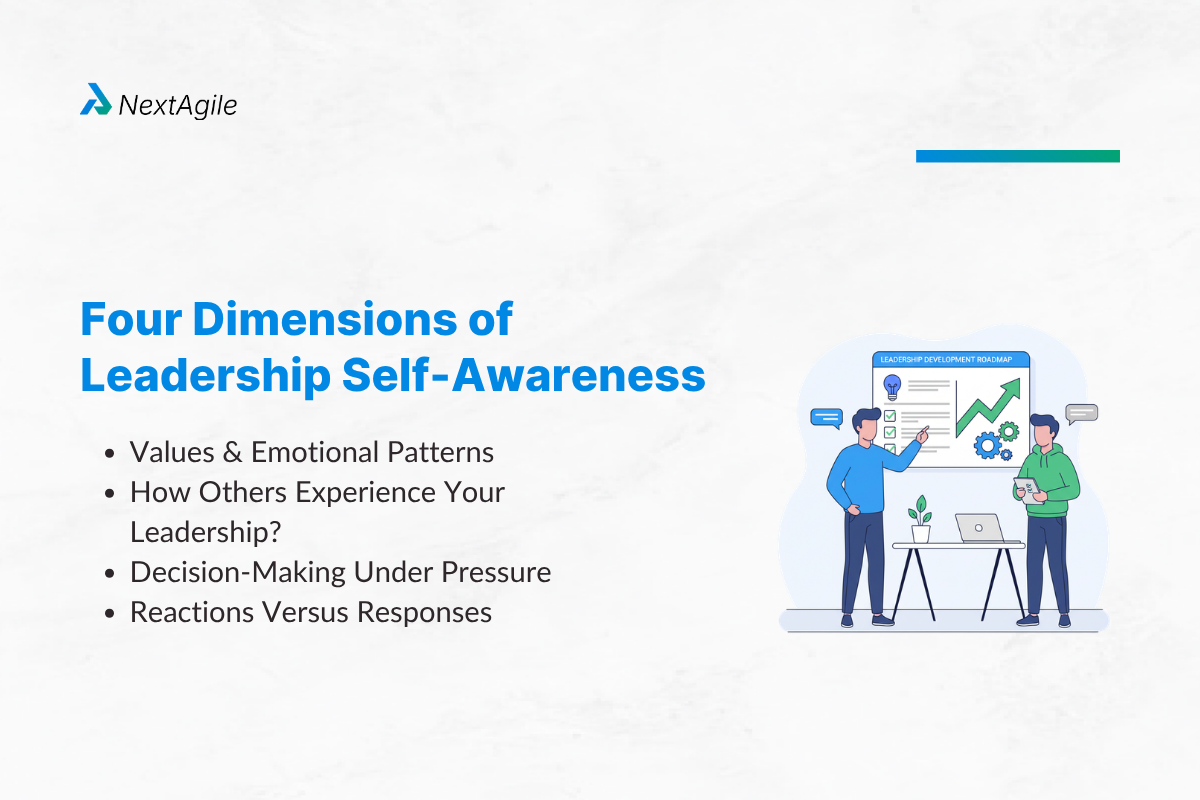
Four Dimensions of Leadership Self-Awareness
Values and Emotional Patterns At the core of self-awareness is understanding what drives you and what disrupts you.
What situations consistently trigger frustration? When do you become overly directive or disengaged? Because under stress, leaders don’t default to values.
A leader under pressure may believe they are driving urgency The team may experience it as anxiety or lack of trust Without awareness, these repeated micro-patterns shape team culture more than stated values.
How Others Experience Your Leadership? The most critical question in leadership is simple:How do people actually experience me?
Communication tone Listening behavior Decision transparency Closing this gap requires structured feedback and not informal opinions.feedback , when designed well, provides
Comparative insights across stakeholders Consistency in evaluation criteria Actionable signals rather than vague perceptions This makes behavior change more precise and measurable.
Decision-Making Under Pressure Pressure amplifies default behavior.
“What assumptions am I making?” “Am I optimizing for speed or quality?” That pause often prevents costly decisions.
Re-evaluate assumptions Invite critical input Separate urgency from importance This improves both decision quality and team confidence.
Reactions Versus Responses Leadership is a series of micro-moments.Reaction is automatic. Response is intentional.
How to Develop Self-Awareness as a Leader?
Start With Feedback but Don’t Stop There Most leaders begin with tools like 360 feedback for leaders .
Prioritize 1-2 behavioral changes at a time Track those changes in real situations Actively seek validation from teams on improvement Without this loop, feedback becomes informational rather than transformational.
Interpreting patterns Linking behavior to outcomes Practicing new responses consistently This is where structured leadership coaching programs
Reflection That Actually Changes Behavior Reflection often feels unproductive which is exactly why most leaders avoid the one practice that actually changes behavior.
They capture patterns closer to real events They reduce hindsight bias They enable faster behavioral adjustment Consistency matters more than depth.
What triggered me today? How did I respond? What would a better response look like? Over time, patterns emerge. And once visible, they become changeable.
Coaching and Peer Accountability Self-awareness accelerates in dialogue.
Objective pattern recognition Behavioral challenge Safe space for honest reflection But equally important is peer accountability. At senior levels, unfiltered feedback becomes rare. Leaders who build small, trusted circles for candid input develop awareness faster and sustain it longer.
Common Self-Awareness Gaps at Senior Levels As leaders rise, self-awareness often declines, not because of capability, but because of the environment.
Over-reliance on past success Reduced feedback exposure Subtle defensiveness Misalignment between intent and impact Gaps in emotional intelligence leadership The risk?
Slower decisions Lower engagement Reduced innovation Which makes them harder to diagnose and more dangerous over time.
Reduced quality of dialogue in leadership forums Lower challenge levels in decision-making discussions Increased alignment time across teams Because they are gradual, they often go unaddressed until performance impact becomes visible.
Self-Awareness and Its Impact on Team Performance Let’s make this practical.self-aware leader creates:
Psychological safety → people speak up Clarity → decisions are understood Trust → intent matches behavior These directly impact:
Execution speed Innovation quality Talent retention In contrast, low awareness creates friction:
Teams filter communication Feedback is withheld Alignment weakens Self-awareness removes these invisible barriers.
Teams become more open in communication Feedback flows more freely across levels Accountability becomes shared rather than enforced This shifts the system from compliance-driven execution to ownership-driven performance.personal effectiveness consistently. And in today’s environment, that’s not just beneficial. It’s a competitive advantage.
Insight into behavior Intent into consistent experience Feedback into measurable change Leaders who master this translation create environments where both people and performance scale together.
Conclusion If there’s one capability that consistently separates high-impact leaders, it’s Self-awareness in leadership.
How you decide How you communicate How you’re experienced Which ultimately determines how your team performs.leadership coaching company , we at NextAgile understand the crucial impact that the right leadership has on organizational change. Cultivating leadership skills is not a nicety in today’s fast-paced world, it’s a necessity for lasting success. Leadership development is a strategic investment, not a soft skill. Reach out to us consult@nextagile.ai to explore how we can help your leadership journey.
Frequently Asked Questions 1. What is self-awareness in leadership? It’s the ability to understand your internal drivers (values, emotions, thinking) and your external impact on others.
2. Why is self-awareness important for leaders? It improves decision-making, builds trust, and reduces blind spots, leading to stronger team performance.
3. How do you develop self-awareness as a leader? Through feedback, reflection, coaching, and consistent behavioral adjustment.
4. What are signs of self-awareness in a leader? Openness to feedback Emotional regulation Alignment between intent and impact Willingness to challenge assumptions 5. How does self-awareness impact leadership decision-making? Self-awareness improves decision-making by helping leaders recognize biases, question assumptions, and evaluate how their thinking may be influencing outcomes. This leads to more balanced, data-informed, and context-aware decisions.
6. Can self-awareness be developed at senior leadership levels? Yes, but it requires intentional effort. Senior leaders often have fewer feedback channels, so development depends on structured inputs like 360 assessments, executive coaching, and deliberate reflection practices tied to real business situations.
7. What is the difference between emotional intelligence and self-awareness in leadership? Self-awareness is a core component of emotional intelligence. It focuses specifically on understanding your own emotions, triggers, and impact, while emotional intelligence also includes managing relationships, empathy, and social skills.
8. Why do leaders struggle with self-awareness despite experience? As leaders grow, feedback becomes less direct and less frequent. Combined with past success reinforcing existing behaviors, this creates blind spots that limit self-awareness unless actively addressed.
9. What tools can leaders use to improve self-awareness? Common tools include 360-degree feedback, leadership coaching, journaling, behavioral assessments, and peer feedback groups. The effectiveness depends on how consistently insights are translated into behavior change.
10. How does self-awareness influence team culture? Leaders set the emotional and behavioral tone for their teams. A self-aware leader creates openness, trust, and clarity, while low awareness can lead to fear, misalignment, and reduced communication.
11. What are common blind spots in leadership self-awareness? Typical blind spots include overestimating communication effectiveness, underestimating emotional impact, resisting feedback unconsciously, and relying too heavily on past success patterns.
12. How often should leaders practice self-reflection? Short, frequent reflection is more effective than occasional deep reflection. Daily or weekly structured reflection helps identify patterns early and enables faster behavioral adjustments.
13. Is self-awareness more important than technical or strategic skills? Self-awareness does not replace technical or strategic skills, but it amplifies their effectiveness. Without it, even strong strategies can fail due to poor execution, misalignment, or trust gaps.
14. How can organizations build self-awareness at scale? Organizations can embed self-awareness through leadership development programs, regular feedback systems, coaching interventions, and cultural norms that encourage reflection and open dialogue.
Anuj Ojha is Co-Founder & Consulting Head at NextAgile. Anuj has designed & led multiple turnkey transformation journeys across industries, domains & geographies and has 16+ years of experience as an agile practitioner. He has worked with CXOs, CTOs & Key Leaders to translate their business objectives on the ground, contextualizing org transformations and creating buy-in across level, leading a team of coaches/consultants to implement agility across 150+ teams & trained more than 12k team members. Anuj’s core area of interest is business agility & working with leaders & teams to achieve long term sustainable, Agile culture & mindset.
 Skip to content