Introduction Ever wonder why some organizations seem laser focused while others struggle despite having similar resources? The difference often lies in how they manage performance. Traditional performance management annual reviews, rigid goal setting, and subjective ratings feels outdated in today’s fast moving business world. Enter OKRs (Objectives and Key Results).
In recent years, OKR frameworks for organizations have emerged as a game changer for driving alignment, focus, and accountability. But here’s the real question: How OKR enhances performance management
What is OKR and Why It’s Becoming Central to Performance Culture OKR stands for Objectives and Key Results. An Objective defines what you want to achieve (ambitious, inspiring), and Key Results define how you measure success (specific, measurable, and time-bound).
Why is OKR suddenly in the spotlight for performance management? Because companies today need agility, transparency, and continuous feedback things traditional appraisals rarely deliver.
Modern organizations operate in fast changing environments. Static annual goals don’t cut it anymore. Teams need clarity and the ability to pivot quickly. OKRs provide that flexibility by linking strategy to execution in a transparent and measurable way.
A Shift from Traditional Appraisal Systems to Continuous Alignment Remember those annual performance reviews where employees waited 12 months to learn if they were “meeting expectations”? It’s no surprise these systems often failed. Performance tracking in agile teams requires continuous alignment, not one off evaluations.
The shift is clear:
From rigid yearly reviews to dynamic, quarterly OKR cycles From subjective ratings to data driven performance management OKRs thrive in this new reality because they create an ongoing dialogue between managers and employees about priorities, progress, and growth.
Understanding the Performance Management Gap Despite all the investment in HR systems, many companies struggle with performance management gaps that lead to disengagement, misalignment, and wasted effort.
Challenges in Current Performance Management Systems Annual cycles create a disconnect between strategy and execution.Subjective metrics fuel bias and frustration.Lack of transparency breeds mistrust.Misaligned goals lead to teams pulling in different directions. Traditional systems focus on evaluation, not improvement. They often measure what happened instead of enabling better outcomes.
What Are OKRs in a Performance Context? When we talk about OKRs for performance, we’re not just setting goals we’re building a culture of alignment and accountability.
Quick Refresher on OKR Structure (Objective + Key Results) Objective: What you want to achieve (qualitative and inspiring).Key Results: How you’ll measure success (quantitative and verifiable). For example:Objective: Improve customer experience.Key Results:
Increase Net Promoter Score from 60 to 75. Reduce average support response time from 12 hours to 4 hours. Notice how OKRs for employee performance provide clarity and measurable outcomes, unlike vague statements such as “do better at customer service.”
How OKRs Differ from KPIs and SMART Goals This is where confusion often sets in. KPIs measure what is happening, while OKRs define what we want to make happen and how to measure progress.
OKR vs KPI for performance: KPIs are ongoing metrics; OKRs are directional goals with a clear finish line.SMART goals are static; OKRs encourage ambition and flexibility. How OKRs Enhances Performance Management in Organizations Here’s the good part: OKRs aren’t just about setting goals. They reshape the way performance is managed from what matters most to how we track it daily.
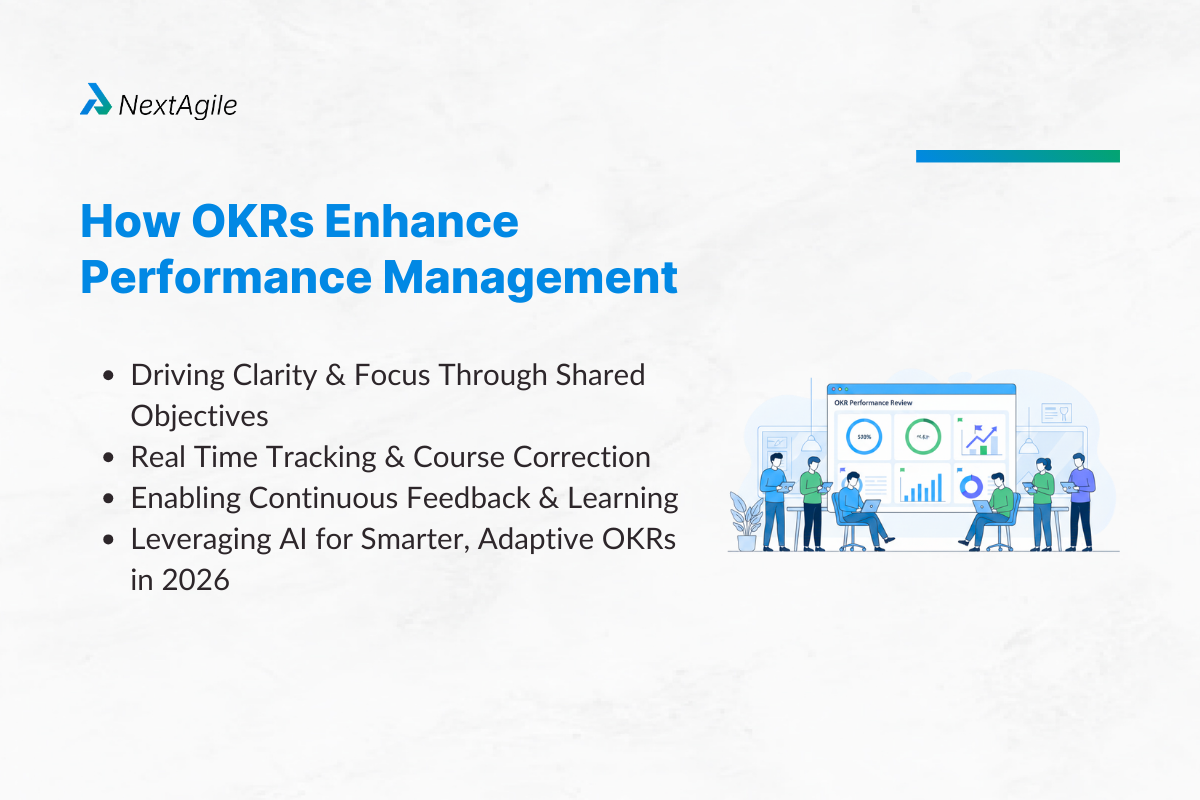
Driving Clarity and Focus Through Shared Objectives Imagine every team pulling in different directions chaos, right? OKRs fix that by aligning goals with OKRs across all levels. Everyone knows what matters most this quarter and why.
Real Time Tracking and Course Correction With OKRs, performance tracking in agile teams becomes simple. Progress is visible, updates are frequent, and teams can adjust priorities mid cycle instead of waiting until year end.
Enabling Continuous Feedback and Learning Annual reviews are rear view mirrors. OKRs, on the other hand, are real time dashboards. Managers and employees engage in ongoing check-ins, making feedback timely and actionable.
Leveraging AI for Smarter, Adaptive OKRs in 2026 In 2026, AI powered OKR tools are transforming performance management by suggesting personalized goals based on past performance, predicting progress risks/outliers in real time, automating insights, and recommending ambitious follow ups when momentum is high. This turns static OKRs into dynamic, intelligent drivers flagging alignment gaps, enabling faster course corrections, and boosting overall execution without added bureaucracy.
Organizations modernizing reviews often use Performance Management Consulting Services.
Key Benefits of Integrating OKRs into Performance Management Improved Team Alignment and Transparency When everyone sees company, team, and individual OKRs, there’s no ambiguity. Alignment becomes a shared responsibility.
Greater Accountability at All Levels Ownership is clear. Teams know their impact, and managers can track progress objectively.
Motivation Through Ownership and Autonomy Employees don’t just take orders they set OKR goal setting for teams collaboratively, creating a sense of purpose and engagement.
Better Manager Employee Conversations OKRs give structure to conversations. Instead of vague “how are you doing?” check-ins, discussions focus on progress toward specific outcomes.
OKRs for Individual, Team & Organizational Performance Here’s where the real magic happens linking employee OKRs with business goals so that everyone rows in the same direction.
Setting Cascading OKRs from Strategic to Personal Levels Company level OKRs define the strategic direction.Team OKRs break it into actionable priorities.Individual OKRs connect personal contributions to team success. This strategic alignment using OKRs turns company vision into measurable execution.
Role of Leadership in OKR Driven Performance Culture Leadership isn’t just about setting OKRs it’s about modeling commitment and creating an environment where OKRs thrive.
Using OKRs Alongside Performance Reviews One common myth: OKRs replace reviews. They don’t. Instead, they make reviews smarter and fairer.
Making Reviews More Objective and Less Biased OKRs provide data driven performance management, reducing bias and subjectivity.
Turning Reviews into Growth Focused Conversations Reviews shift from judging past performance to planning future success, supported by clear progress metrics.
Case Examples of Blended OKR Review Cycles Many companies run quarterly OKR reviews alongside annual career discussions. This keeps feedback continuous while maintaining structured growth plans.
Best Practices for Implementing OKRs for Performance Set Stretch Goals Where ~70% Achievement = Success OKRs thrive on ambition aim high so that hitting 70% is considered strong progress (common benchmark in OKR driven organizations). Keep a realistic baseline for confidence, but avoid sandbagging. Cross reference the FAQ: “A common benchmark: 70% achievement is often considered success.
Avoid Using OKRs Directly for Compensation Linking OKRs to pay can kill ambition. OKRs should inspire progress, not fear failure.
Run Quarterly Retros with a Growth Mindset Focus Use retros not just for process tweaks but to reinforce learning from stretch goals celebrate progress even at 70%, analyze shifts in priorities, and refine for the next cycle. In 2026, incorporate AI insights (if using tools) for trend spotting in retros.
Common Pitfalls to Avoid
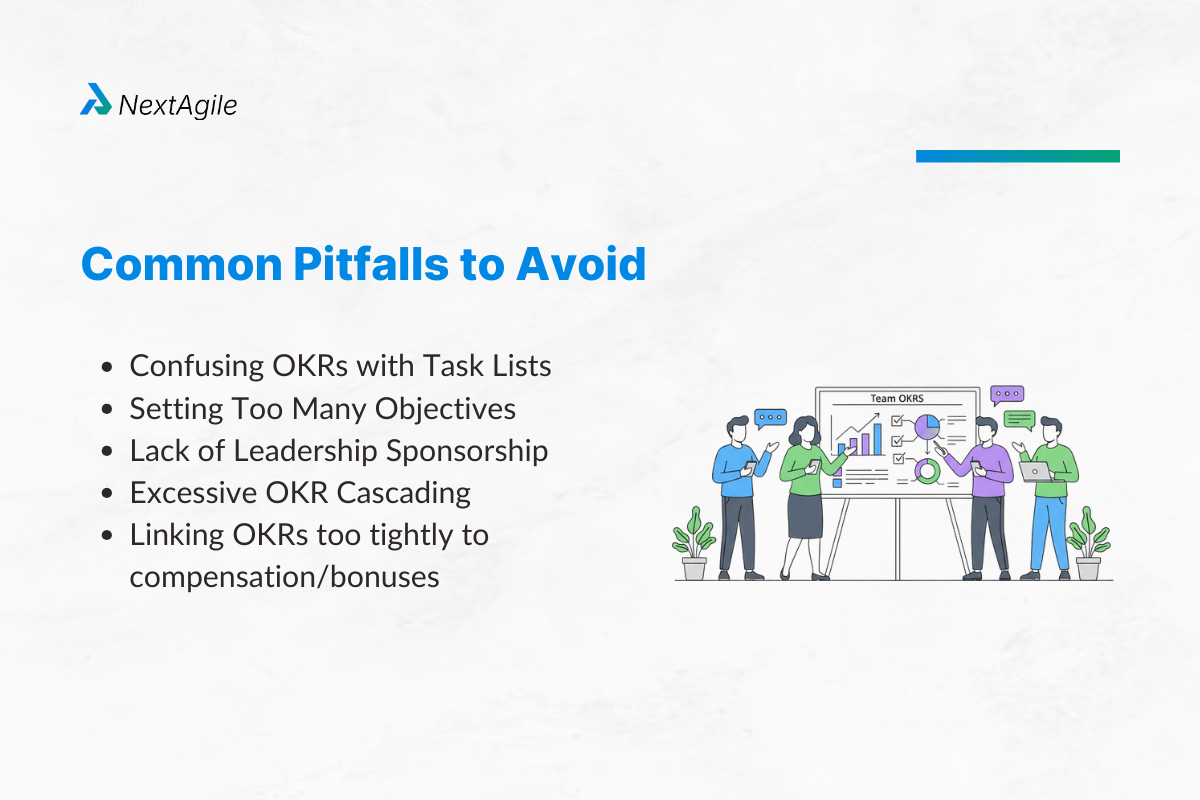
Confusing OKRs with Task Lists : They’re outcomes, not activities.Setting Too Many Objectives : Keep it focused 3 to 5 objectives per level.Lack of Leadership Sponsorship : Without top level buy-in, OKRs won’t stickOver cascading or excessive nesting of OKRs : Creates unnecessary complexity and dilutes focus keep alignment simple.Linking OKRs too tightly to compensation/bonuses : Discourages true ambition and leads to conservative goal setting (one of the top implementation errors). Case Studies & Success Examples How Tech and Consulting Firms Are Transforming Performance Using OKRs Companies like Google and Spotify swear by OKRs because they scale alignment across thousands of employees without adding bureaucracy.
Real Stats: Engagement, Alignment, Productivity Boosts Organizations using OKRs report up to 60% improvement in data driven decision making . Teams with effective OKR adoption see stronger strategic alignment and higher employee engagement (with many recommending OKRs for productivity boosts). High performing OKR teams complete more key results through focused habits (e.g., fewer objectives lead to higher completion rates). Recent benchmarks show engaged teams using OKRs can be 20% more profitable via better alignment and retention. Conclusion OKRs are not just another goal setting tool. They’re a performance culture shift. They replace static plans with dynamic alignment, outdated reviews with continuous feedback, and guesswork with data driven performance management.
When teams align around purpose, not just metrics, performance soars. In a 2026 world of rapid change, AI driven tools, and hybrid teams, don’t wait, just start your OKR journey with NextAgile today and turn alignment into real business impact. Explore more NextAgile OKR Consulting services to structure and implement OKRs across your business or start with NextAgile OKR Training to introduce your teams to OKRs.
Thinking about bringing OKRs into your performance strategy? Start with one team, test the process, and iterate. At NextAgile, we’ve helped organizations of all sizes design OKR frameworks for organizations that deliver real business impact.
Ready to transform your performance culture? Book a consultation with NextAgile today.
Frequently Asked Questions 1. Can OKRs completely replace traditional performance appraisals? Not entirely. OKRs (Objectives and Key Results) focus on goal alignment and measurable outcomes, whereas traditional performance appraisals typically evaluate overall job performance, competencies, and behavioral aspects.
OKRs drive forward looking progress , encouraging innovation and ambitious targets (stretch goals).Performance appraisals often tie to promotions, bonuses, and long term development plans. In modern organizations, many companies integrate OKRs with performance reviews rather than replacing them completely. For example, OKRs measure contribution to strategic goals, while performance reviews assess soft skills, leadership, and team collaboration.
2. How often should OKRs be reviewed? Ideally, OKRs should be reviewed regularly throughout the cycle, not just at the end.
Weekly or bi weekly check-ins: Track progress, identify blockers, and adjust priorities.Mid cycle review (usually quarterly): Evaluate if objectives are still relevant and make adjustments.End of cycle review: Assess outcomes, grade results (e.g., 0.0 – 1.0 scale), and learn for the next cycle. Frequent reviews ensure OKRs remain a living framework, aligned with business changes rather than a static document.
3. What if an OKR is not achieved how is it handled? Not achieving an OKR is not considered failure if the team learns and adapts. OKRs encourage ambitious goals, so hitting 100% every time often means the targets were too easy.
Analyze why: Was the goal unrealistic, or did priorities shift?Document learnings: Capture what worked, what didn’t, and adjust for the next cycle.Focus on progress, not punishment: OKRs are about continuous improvement , not rigid scorecards. A common benchmark: 70% achievement is often considered success in OKR driven organizations.
4. How can HR teams drive OKR adoption? HR plays a strategic role in embedding OKRs into culture:
Educate and train: Conduct workshops on writing effective OKRs and linking them to company strategy.Champion leadership buy-in: Ensure executives use OKRs visibly; adoption starts from the top.Integrate with performance processes: Align OKRs with performance check-ins, feedback loops, and development plans.Provide tools & templates: Offer OKR software or dashboards that make tracking simple and transparent.Celebrate success stories: Share examples of teams using OKRs effectively to drive engagement. 5. Are OKRs suitable for non technical or support functions? Absolutely. OKRs are not just for tech teams; they work across all business areas:
HR: “Improve employee engagement” → “Increase eNPS score from 60 to 75 by year end.”Finance: “Enhance reporting accuracy” → “Reduce month end close time by 20% in Q2.”Customer Support: “Improve customer satisfaction” → “Raise CSAT from 80% to 90% this quarter.” The key is to adapt OKRs to the nature of the role, focusing on measurable outcomes rather than vague tasks.
Anuj Ojha is Co-Founder & Consulting Head at NextAgile. Anuj has designed & led multiple turnkey transformation journeys across industries, domains & geographies and has 16+ years of experience as an agile practitioner. He has worked with CXOs, CTOs & Key Leaders to translate their business objectives on the ground, contextualizing org transformations and creating buy-in across level, leading a team of coaches/consultants to implement agility across 150+ teams & trained more than 12k team members. Anuj’s core area of interest is business agility & working with leaders & teams to achieve long term sustainable, Agile culture & mindset.
 Skip to content