Introduction
The Growing Importance of GenAI in Software Development
GenAI is becoming integral to modern software development cycles. From automating documentation and generating test cases to building conversational interfaces and simulating user scenarios, its applications are wide ranging. The development lifecycle is witnessing a paradigm shift, engineers no longer just build software but collaborate with AI models to co-create solutions.
What “Training Your Teams” Truly Means in This Context
Training in the GenAI context isn’t limited to a workshop or tutorial. It’s about building foundational understanding, fostering hands-on experimentation, and aligning AI usage with enterprise values and goals. It requires establishing a long term learning ecosystem supported by tools, mentorship, governance, and cross-functional collaboration.
Why Train Developers on Generative AI
Benefits
- Enhanced Efficiency: Automate repetitive tasks, boost productivity, and enable faster iterations.
- Innovation at Scale: Empower teams to design new user experiences, interfaces, and software components using GenAI.
- Accelerated Time to Market: Speed up prototyping and testing phases, allowing quicker product rollouts.
Risks of Untrained Adoption
- Misuse of Models: Improper prompting or reliance on incorrect outputs can lead to bugs or misinformation.
- Hallucinations: Generative models can fabricate responses, if not managed, this can compromise product integrity.
- Technical Debt: Unstructured experimentation without guidelines may lead to long-term maintenance challenges.
Defining Training Objectives of Generative AI
Technical Literacy
Developers must grasp how transformer models and large language models (LLMs) operate. This includes understanding tokenization, attention mechanisms, and output determinism. The goal is to build confidence in using GenAI as a development partner.
Practical Proficiency
- Prompt Engineering: Learn how to design effective prompts and evaluate responses.
- Fine tuning: Customize base models for domain specific tasks.
- Embedding Usage: Integrate vector representations for search, clustering, or recommendation systems.
Governance Awareness
- Ethics: Promote responsible usage.
- Security: Ensure models and data are protected.
- Compliance: Adhere to regulatory standards, especially in sensitive sectors like finance or healthcare.
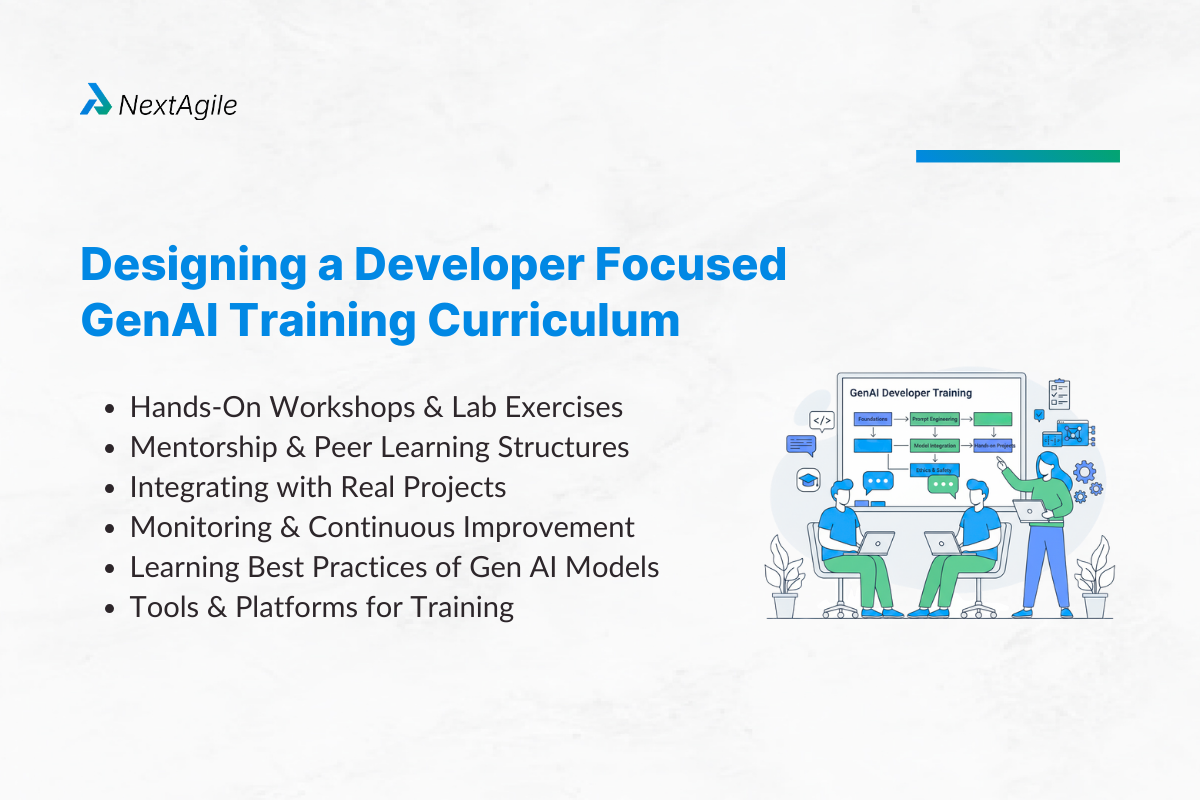
Designing a Developer focused GenAI Training Curriculum
Core Modules
- Theoretical Foundations: Overview of GenAI concepts, architecture, and evolution.
- Hands-on Labs: Real-time exercises with GenAI APIs and tools.
- Best Practices: Covering prompt design, safety layers, and evaluation.
Recommended Topics
- Transformer-based model architectures (GPT, BERT, T5)
- Prompt design strategies for consistency and safety
- Content filtering, watermarking, and safety protocols
Suggested Duration
A phased program spanning 2 to 4 weeks, supplemented by periodic follow-up workshops. Each week can be dedicated to:
- Week 1: Fundamentals and tooling
- Week 2: Prompting and use case design
- Week 3: Fine tuning and integration
- Week 4: Ethics, deployment, and best practices
Hands-On Workshops & Lab Exercises
● Prompt Generation and Response Refinement
Expose teams to prompt experimentation and optimization techniques. Help them understand how temperature, top-p sampling, and token limits influence output.
● Fine Tuning on Custom Datasets
Use domain specific datasets to teach model customization. Include evaluation cycles to compare base model outputs with fine tuned versions.
● RAG Pipelines and Evaluation Metrics
Introduce Retrieval Augmented Generation (RAG) pipelines, the GOTO enterprise pattern to ground LLM outputs into proprietary Knowledge Base . Explain how to evaluate them using relevance metrics like BLEU, ROUGE, and accuracy scores.
● Error Handling
Teach common error categories, semantic drift, hallucination, truncation, and their mitigation.
Mentorship & Peer Learning Structures
● Pair Programming with GenAI Tools
Encourage pairing developers with GenAI agents (like GitHub Copilot) during coding sessions to build familiarity.
● Internal “GenAI Champions” Network
Identify early adopters or skilled developers who can mentor others and advocate best practices.
● Knowledge Sharing Sessions
Hold periodic internal meetups where teams share experiments, challenges faced, and learnings.
Integrating with Real Projects
● Pilot Projects
- Start with low risk but high value projects such as:
- Auto generation of API documentation
- Dynamic test case generation
● Measuring Impact
- Time saved during development cycles
- Error reduction in test suites
- Developer satisfaction via feedback surveys
● Iterative Feedback Loop
- Use pilot project outcomes to refine training materials and update best practices.
Monitoring and Continuous Improvement
● Metrics Dashboard
- Track:
- Model usage statistics
- Prompt effectiveness
- Adoption rates across teams
● Quarterly Retraining
- Organize knowledge updates every 3 months. Include:
- New tools or API changes
- Security and compliance updates
● Developer Feedback Loop
- Let developers suggest new use cases, tools, or workflows for incorporation into the training pipeline.
Best Practices and Standards of Generative AI Models
● Usage Policies
- Define where, when, and how GenAI should be used within the organization.
● Security & Compliance
- Ensure that:
- Sensitive data is excluded from prompts.
- Model outputs are monitored and verified.
● Bias Auditing
- Create checkpoints to audit model behavior, especially when outputs are user facing or decision influencing.
Tools & Platforms for Training
● Platforms
- OpenAI Playground: For prompt experimentation
- Hugging Face: Model repositories and inference APIs
- Anthropic Console: Claude based models with safety layers
● Tools
- Jupyter Notebooks: For custom experiments
- Safe Sandboxes: Controlled environments for trial
- RAG Pipelines: Real world data retrieval with generative response layering
Conclusion
As generative AI becomes a pillar of modern engineering, training your development teams becomes a necessity rather than an option. Effective GenAI training enables accelerated innovation, greater efficiency, and responsible adoption.
Investing in structured training, real world projects, governance frameworks, and mentorship ecosystems ensures sustainable success. These programs are enablers for organizations transitioning the GenAI adoption from POC to production grade. This isn’t just about learning a new tool, it’s about transforming how your organization builds software.
The future of development is collaborative, between humans and intelligent models. Begin your journey now.
Is your organization looking to integrate AI into your development and operational processes? Start with an AI readiness assessment first and see what the gap is between the As-Is and the desired To-be state. Reach out to NextAgile AI Consulting group for an in-depth contextual discussion with our AI experts. You can write to us consult@nextagile.ai or leave a message on our website. You can also explore NextAgile AI Training enablement programs for your teams and leadership for ramping up your Gen AI capabilities.
FAQs
1. How long does training take?
Typically 2–4 weeks of structured learning, followed by ongoing workshops and refreshers every quarter.
2. Do developers need an ML background?
No. A foundational understanding of how GenAI models work is sufficient. ML or data science knowledge is a plus but not mandatory.
3. What infrastructure is needed?
Access to cloud based model APIs (like OpenAI), sandbox environments for safe testing, and GPUs (if running models locally) is recommended.
4. Can non dev roles be included?
Yes. Product managers, designers, QA engineers, and technical writers benefit greatly from prompt engineering and GenAI tooling exposure.
5. How to scale training across teams or locations?
Use a mix of asynchronous modules, live sessions, peer led workshops, and dedicated champions in each location.
6. How NextAgile GenAI Trainings Will Help Your Teams Train on Generative AI Models
At NextAgile GenA Training, we offer enterprise centric GenAI enablement programs. Our approach includes:
- Custom training design aligned with your tech stack and domain
- Practitioner led sessions with real world labs
- Long term support through mentoring, toolkits, and governance guidance
- Impact measurement and continuous iteration support
Start your GenAI training journey with NextAgile Consulting, equip your teams for the future.