Introduction You’ve probably heard the buzzwords everywhere: AI, Generative AI, machine learning. But what do they actually mean? More importantly, why does the difference matter? In the current digital era, artificial intelligence isn’t just a tech trend; it’s shaping industries, consumer behavior, and competitive strategy. While AI has been around for decades, the rise of generative AI in 2024 and beyond is changing the game entirely.
Generative AI (GenAI) isn’t your traditional AI system that simply classifies or predicts outcomes. Instead, it creates new content – text, images, music, even code. That creative capability is why businesses are racing to adopt it. But here’s the question: What is generative AI vs AI, and why should executives, marketers, and tech leaders care?
Enterprises exploring adoption can start with our Generative AI Workshop for Enterprise
In this guide, we’ll break down the difference between generative AI and traditional AI, explore how they work, share real world examples, and explain what the future looks like for both. If you’re planning an AI strategy for your organization, understanding this distinction isn’t optional—it’s critical.
Once fundamentals are clear, evaluate practical generative AI tools
Enterprises evaluating use cases often engage a trusted generative AI consulting firm.
Why the Comparison Matters in Today’s AI Landscape Artificial Intelligence has evolved massively over the past two decades. What started as rule based systems in the early 2000s now powers self driving cars, personalized recommendations, and generative tools like ChatGPT. This shift from traditional AI to generative AI represents more than just a technological upgrade; it’s a transformation in how machines interact with data and humans.
Why does this comparison matter? For CXOs and transformation leaders, this distinction directly impacts cost models, risk exposure, and organizational readiness. And organizations often struggle to differentiate between traditional AI and generative AI when building digital strategies. Deploying the wrong AI type can lead to wasted resources, compliance risks, or missed innovation opportunities. For example, if your goal is fraud detection , traditional AI works perfectly. But if you want personalized content generation for marketing , generative AI is your answer.
In 2024–2025, enterprises are adopting AI technologies comparison frameworks before committing to investments. Understanding the difference between generative AI vs traditional AI ensures you pick the right tool for the right job—and future proof your business for what’s coming next.
Companies exploring use cases can start with a trusted Gen AI consulting service .
Rise of Generative AI in 2024–2025 The generative AI wave began with GPT-3, but the explosion happened in 2023 with ChatGPT, Midjourney, and other tools going mainstream. Fast forward to 2025, and generative AI is at the heart of enterprise innovation strategies. Why? Because it doesn’t just analyze data; it creates something new, saving time and enabling creativity at scale.
Marketing teams now generate hundreds of personalized ads in seconds. Legal teams draft contracts using AI powered tools. Generative AI is also fueling drug discovery, product design, and education. According to Gartner, by 2025, 70% of enterprises will experiment with generative AI , while 40% will integrate it into production environments.
The technology stack behind this rise includes transformer models , GANs (Generative Adversarial Networks) , and diffusion models . These innovations make it possible to generate content that feels human like and contextually relevant. And as models become multimodal (text, image, audio combined), the possibilities for businesses are nearly limitless.
Understanding Traditional Artificial Intelligence (AI) Definition and Core Characteristics Traditional AI refers to systems that perform tasks by mimicking human intelligence using pre-defined rules, patterns, and statistical models. These systems analyze data, make predictions, and automate decisions—but they don’t create new content.
Core characteristics:
Predictive, not generative. Relies on supervised learning and explicit logic. Narrowly designed for specific tasks. Types: Narrow AI vs General AI Narrow AI (Weak AI): Designed for specific tasks like voice recognition or fraud detection.General AI (Strong AI): Theoretical AI that can perform any cognitive task like a human. This doesn’t exist yet. Common Applications Fraud detection in banking Search engines like Google Voice assistants like Alexa E-commerce recommendation engines What Is Generative AI? Generative AI is a specialized branch of artificial intelligence designed to create original outputs rather than simply analyze or predict. It can produce text, images, audio, and even code by learning patterns and structures from vast training datasets. Unlike traditional AI, which focuses on decision making or classification, generative AI synthesizes new data that resembles its training input.
What makes it “generative” is its ability to model the probability distribution of data and generate fresh content that didn’t exist before. Instead of relying on rigid rules, these systems leverage learned relationships to craft plausible outputs. This allows businesses to scale creativity, automate content production, and personalize user experiences like never before.
The core technologies powering generative AI include:
Generative Adversarial Networks (GANs) , which use a generator and discriminator to create realistic imagesVariational Autoencoders (VAEs) , which encode data into latent spaces for controlled generation Transformer models , the backbone of large language models like GPT that handle sequential data and context effectively. Together, these architectures drive applications from conversational agents to image synthesis, unlocking a new era of AI driven innovation.
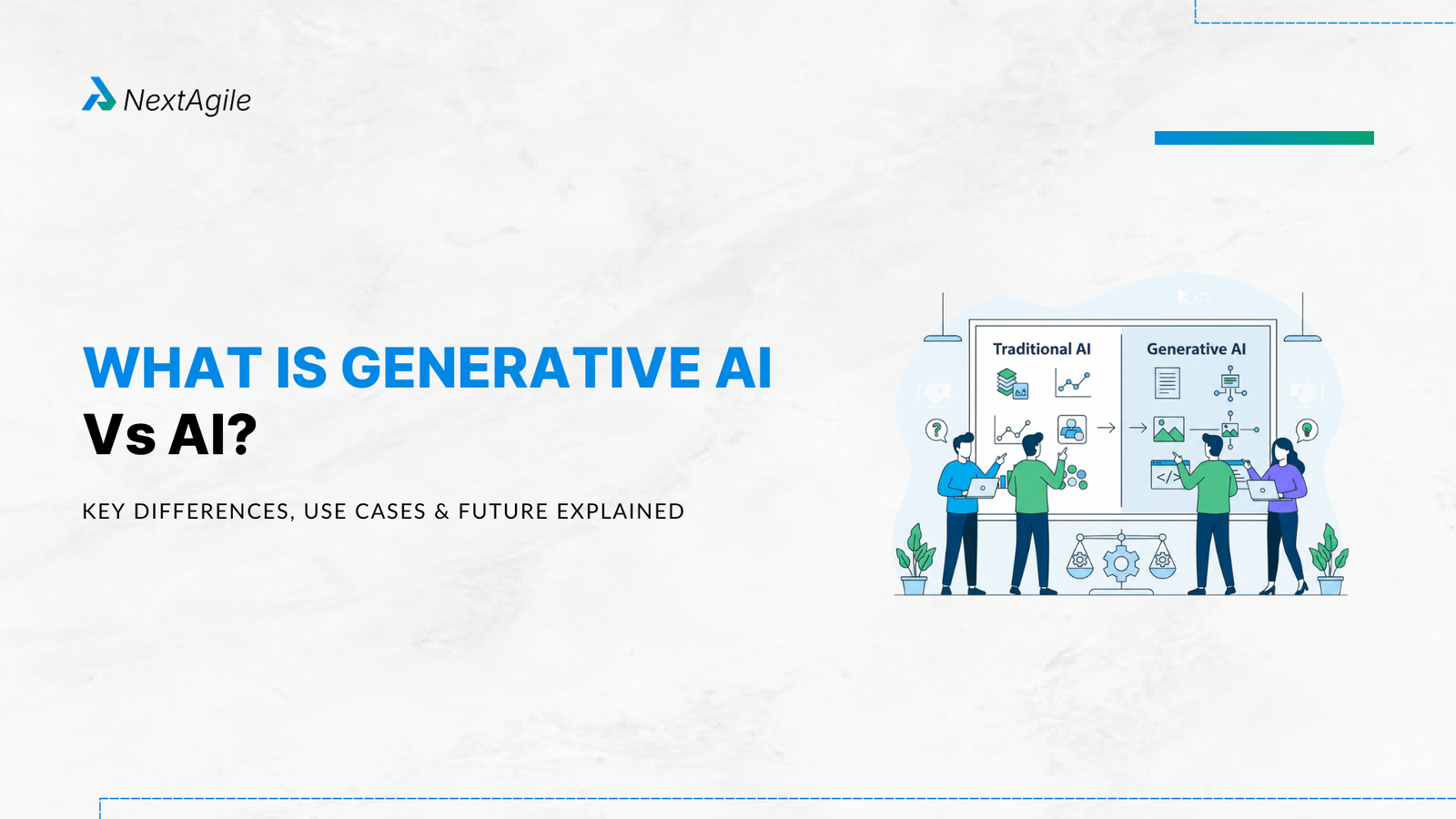
Generative AI vs AI: What’s the Difference? Generative AI and AI differ fundamentally in purpose and output. Traditional AI focuses on prediction and classification. It analyzes data to forecast outcomes, detect anomalies, or recommend actions. Generative AI, however, creates new content text, images, audio, or code based on patterns learned from large datasets.
In a nutshell
Aspect Generative AI AI Output Creates new content Predicts / Classifies Data Dependency Large, diverse datasets Structured, labeled Examples ChatGPT, DALL·E Fraud detection Enterprise Risk Higher (needs governance) Lower
Input Output Behavior Traditional AI takes input and provides structured outputs, such as “spam” or “not spam.” Generative AI, on the other hand, synthesizes new outputs that resemble human generated data, like a paragraph of text or a digital painting.
Learning Approaches Traditional AI primarily uses supervised learning, where models learn from labeled data to make predictions. Generative AI relies on unsupervised, self supervised, or reinforcement learning to model complex distributions and generate realistic outputs.
Examples ChatGPT (Generative) vs Amazon Alexa (Traditional): ChatGPT creates conversational text responses; Alexa retrieves predefined answers.DALL·E (Generative) vs Image Classifier (Traditional): DALL·E generates new images from text prompts; classifiers only label existing images. How Generative AI Works (Simplified Explanation) Generative AI works by training models on massive datasets to learn underlying patterns and relationships. It uses advanced architectures like transformers and neural networks to predict the next element in a sequence—whether words in a sentence or pixels in an image. These models operate on probability distributions to create coherent and contextually relevant content.
Key components include:
Massive Training Data: Large scale datasets teach models about language, visuals, or audio.Generative Models: Technologies like GANs, VAEs, and transformers enable creativity.Use Cases: NLP for chatbots, computer vision for image synthesis, and multimodal systems for combining text, image, and audio outputs. Generative AI transforms static data into dynamic, original content, driving innovation in marketing, design, and automation.
Use Cases & Applications in the Real World Artificial intelligence impacts almost every sector, but its applications vary depending on whether you use traditional AI or generative AI.
Traditional AI Traditional AI dominates in predictive and analytical roles. In healthcare , it assists in diagnosing diseases, analyzing scans, and predicting patient risks. In fintech , it drives fraud detection by identifying anomalies in transactions. Customer service relies on traditional AI for chatbots that resolve routine queries and voice assistants that follow rule based scripts. These systems excel in structured, repetitive tasks where accuracy and reliability are key.
Generative AI Generative AI focuses on creative problem solving and adaptive outputs. It powers content creation , enabling marketers to produce blogs, ad copy, and videos at scale. In design , it generates images, prototypes, and UI concepts instantly. Developers use coding assistants like GitHub Copilot to write and debug code faster. Its flexibility enables personalization in campaigns and innovative product design.
Industry Examples: Marketing teams use GenAI for personalized ads, legal firms draft contracts with AI tools, and educational platforms deploy GenAI to create interactive learning modules.
Benefits of Generative AI
Generative AI provides transformative advantages across industries. First, it offers creativity and automation at scale , enabling businesses to produce articles, designs, and multimedia in minutes rather than weeks. Marketing teams can generate ad variations instantly, while product teams create prototypes without extensive manual effort. This level of automation not only saves time but also unlocks creative possibilities that were previously limited by human bandwidth. Next, personalization in user experience is a game changer. Generative AI can analyze user preferences and generate dynamic content—customized emails, personalized landing pages, and tailored recommendations—at scale. This leads to deeper engagement and improved conversion rates without overwhelming operational costs. Finally, rapid prototyping and simulation accelerates innovation cycles. From fashion designs to architectural models, generative tools allow businesses to visualize and test ideas quickly. In industries like automotive or aerospace, simulation driven design helps reduce risks and costs associated with physical testing. Together, these benefits make GenAI an essential tool for modern businesses aiming for agility and efficiency. Limitations & Ethical Concerns Despite its benefits, generative AI faces serious limitations and ethical challenges. One key issue is hallucination , where models generate plausible but incorrect or fabricated content—posing risks in sensitive sectors like healthcare or legal documentation. Another concern is bias in training data , which can reinforce harmful stereotypes or unfair decisions if left unchecked. Businesses must deploy bias detection and implement diverse datasets to mitigate this risk.
Additionally, explainability and transparency challenges create compliance hurdles, especially in regulated industries. Complex AI models often operate as black boxes, making it difficult to trace decision making logic. This lack of clarity can hinder trust and accountability. To address these issues, companies need strong governance frameworks, human oversight, and transparent AI policies. Ethical use of GenAI requires balancing innovation with responsibility towards all the stakeholders.
Tools and Platforms Powering AI and Generative AI Traditional AI: TensorFlow, IBM Watson.
Generative AI: ChatGPT, Bard, Claude, Midjourney, Sora.
When to Use Generative AI vs Traditional AI Decision making framework: Use Generative AI when creativity, content generation, or design tasks dominate the project scope. Opt for Traditional AI for predictive analytics, rule based automation, or structured data processing.Project requirements and complexity: Generative AI excels in projects needing innovation, natural language interactions, or complex pattern creation (e.g., text, images, video). Traditional AI is better for deterministic systems like fraud detection or recommendation engines.Budget, data availability, and regulatory factors: Generative AI requires large datasets, high computational power, and substantial budgets. It may face compliance issues in regulated industries. Traditional AI, with its structured approach, often works with smaller datasets, lower costs, and clearer compliance paths. Choosing the right approach depends on your goals—creativity vs precision, innovation vs stability, and compliance vs flexibility.
Generative AI vs AI in Search Technology How traditional search works: Relies on keyword matching, indexing, and ranking algorithms to retrieve relevant links from vast databases.Generative search & AI overviews: Tools like Google SGE and Perplexity AI create conversational answers, synthesizing information rather than just listing links.Impact on SEO and content strategy: Content must shift toward context rich, user intent driven writing optimized for AI summaries instead of simple keyword stuffing. The Future of AI: Convergence or Divergence? Is all AI becoming generative? Not entirely—traditional AI remains critical for predictive analytics and rule based systems.Trends in enterprise adoption: Organizations are integrating both approaches, blending generative creativity with predictive accuracy.Predictions for 2025 and beyond: Expect hybrid AI ecosystems where generative models enhance UX while traditional AI powers data driven decisions. Common Misconceptions Summary of key takeaways: Generative AI and traditional AI serve different but complementary purposes. Generative AI excels in creativity and automation, while traditional AI shines in predictive and analytical tasks.How to choose the right AI approach: Evaluate your project goals, data availability, complexity, and compliance requirements. Generative AI suits tasks like content creation, personalization, and design, whereas traditional AI fits fraud detection, search, and structured analysis.Next steps for learning or adoption: Begin with small scale pilots to test capabilities, then scale based on measurable outcomes. Stay updated on emerging tools and frameworks, and consider partnering with AI strategy experts to ensure compliance, ROI, and future scalability. Conclusion Summary of key takeaways: Generative AI and traditional AI serve different but complementary purposes. Generative AI excels in creativity and automation, while traditional AI shines in predictive and analytical tasks.How to choose the right AI approach: Evaluate your project goals, data availability, complexity, and compliance requirements. Generative AI suits tasks like content creation, personalization, and design, whereas traditional AI fits fraud detection, search, and structured analysis.Next steps for learning or adoption: Begin with small scale pilots to test capabilities, then scale based on measurable outcomes. Stay updated on emerging tools and frameworks, and consider partnering with AI strategy experts to ensure compliance, ROI, and future scalability. Is your organization looking to integrate AI into your development and operational processes? Start with an AI readiness assessment first and see what the gap is between the As-Is and the desired To-be state. Reach out to NextAgile AI Consulting group for an in-depth contextual discussion with our AI experts. You can write to us consult@nextagile.ai or leave a message on our website. You can also explore NextAgile AI Training enablement programs for your teams and leadership for ramping up your Gen AI capabilities.
FAQs 1. Is ChatGPT traditional AI or generative AI?
ChatGPT is a generative AI model built on transformer architecture. Unlike traditional AI, which predicts or classifies data, ChatGPT creates original text responses based on context. It’s trained on vast datasets to understand patterns and generate human-like conversations, making it a prime example of generative AI rather than traditional rule based AI.
2. Can generative AI be used for analytics?
Yes, generative AI can assist with analytics by summarizing insights, generating reports, or creating data visualizations from structured data. However, it’s not a replacement for traditional analytical models used for predictive modeling or statistical analysis. Instead, it complements analytics by making data interpretation and presentation more user friendly and accessible.
3. Are all LLMs considered generative AI?
Yes, all large language models (LLMs) like GPT-4 or LLaMA fall under generative AI because they generate new content—text, code, summaries—based on learned patterns from massive datasets. Their primary function is generative, not just classification or prediction, which clearly distinguishes them from traditional AI models.
Alok Dimri is the co-founder and leads the overall business at NextAgile, where he is responsible for strategy, client and consultant partnerships, and a whole lot of other core business activities like solutioning, branding, and customer engagement.
Over the past 16 years, he has worked extensively in business strategy, new business development, and key account management initiatives across process consulting and training domains.
 Skip to content