Skip to content
![Agile vs Traditional Project Management [2026 Guide]](https://nextagile.ai/blogs/wp-content/uploads/2026/03/Agile-vs-Traditional-Project-Management-2026-Guide.png "Agile vs Traditional Project Management: Key Differences 1")
Introduction
If your leadership team is debating Agile vs Traditional Project Management, you’re not just choosing a project management methodology. You’re choosing how your organization handles uncertainty.
Over the past decade, we’ve seen enterprises spend millions on transformation programs without clarity on this single decision. Some implemented Agile where governance maturity was low. Others stuck to Waterfall while operating in volatile markets. Both choices when applied in the wrong context created friction, waste, and lost opportunity.
The truth? The right choice depends on three variables:
- Level of uncertainty
- Regulatory exposure
- Speed-to-market pressure
In 2026, the debate isn’t ideological. It’s strategic.
Executive Signal
This decision directly influences:
- Capital allocation discipline
- Portfolio risk exposure
- Revenue realization speed
- Governance complexity
- Competitive positioning
Project methodology is not a PMO discussion. It is a boardroom variable.
This guide goes beyond textbook comparisons. We’ll break down:
- The real difference between agile and traditional project management
- Cost, risk, and ROI impact
- Enterprise case mini-stories
- Indian IT service provider realities
- A leadership-level decision framework
- Career implications in India and globally
Agile vs Traditional Project Management: Detailed Comparison Table
| Parameter | Agile | Traditional (Waterfall) |
| Approach | Iterative, adaptive | Sequential, phase-gated |
| Planning | Rolling-wave planning | Detailed upfront planning |
| Scope | Flexible | Fixed baseline |
| Team Structure | Cross-functional, empowered | Functional silos |
| Client Involvement | Continuous | Milestone-based |
| Documentation | Lean, value-focused | Comprehensive |
| Risk Handling | Early and incremental | Late-stage detection |
| Best For | Uncertain, evolving environments | Stable, predictable environments |
| Cost Model | Incremental funding | Fixed budget allocation |
| Time to Market | Faster incremental releases | Full delivery at end |
| Popular Tools | Jira, Azure DevOps | MS Project, Primavera |
| Certifications | CSM, SAFe, PMI-ACP | PMP, PRINCE2 |
On paper, the differences look procedural.
In practice, these differences reshape the following:
- Funding governance
- Executive reporting
- Risk exposure
- Competitive positioning
That’s why this decision is rarely “operational.” It’s strategic.
What the Table Doesn’t Show. The real divergence appears in:
- How funding approvals flow?
- How performance is measured?
- How change requests are treated?
- How are executive dashboards structured?
Framework choice reshapes enterprise behavior.
What Is Agile and Traditional Project Management?
What Is Traditional Project Management? (The Waterfall Approach Explained)
Traditional project management, commonly called Waterfall, follows a structured, linear sequence:
Requirements → Design → Build → Test → Deploy
It assumes that requirements can be defined upfront and change is costly.
This model excels in:
- Construction projects
- Infrastructure rollouts
- Government contracts
- Manufacturing systems
- Defense and aerospace
If you’re building a metro rail system, you cannot “iterate” structural engineering decisions.
Mini Case Story: Indian Manufacturing ERP Rollout
A large Indian manufacturing company attempted to run an ERP transformation using Agile ceremonies without stable requirements. The result? Scope drift, vendor misalignment, and compliance risk. The program eventually reverted to a structured phase-gated approach, and delivery stabilized.
Lesson: When requirements are legally binding or contract-driven, predictability outweighs flexibility.
Traditional project management provides:
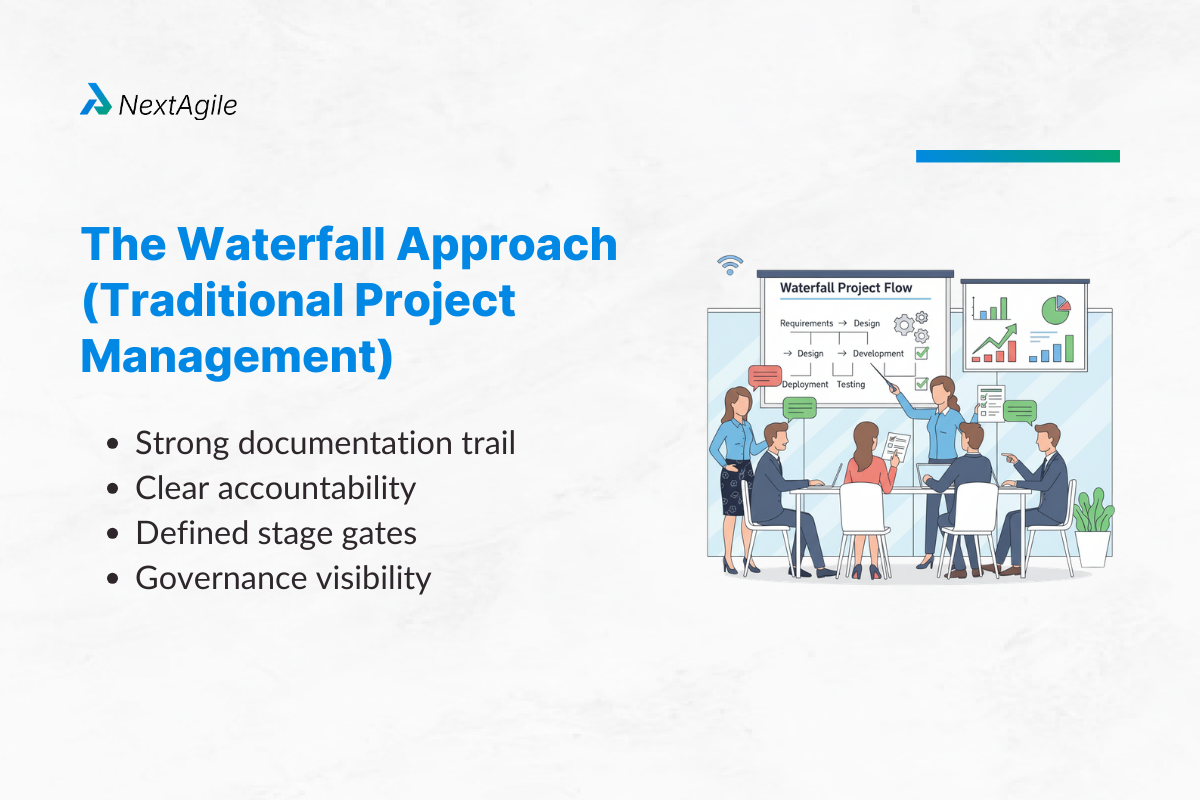
- Strong documentation trail
- Clear accountability
- Defined stage gates
- Governance visibility
But here’s the limitation.
If market assumptions shift mid-program, adapting becomes expensive. According to findings widely discussed by Standish Group, large multi-year projects with rigid requirements historically show higher failure or partial-success rates – especially in technology initiatives.
Waterfall isn’t outdated. It’s context-dependent.
When Waterfall Outperforms Agile?
Traditional project management excels when:
- Requirements are contractually frozen
- Audit traceability is mandatory
- Interdependencies are infrastructure-heavy
- Failure tolerance is near zero
In these environments, predictability protects capital.
What Is Agile Project Management?
Agile project management assumes uncertainty is inevitable.
Instead of eliminating uncertainty upfront, it reduces it through short feedback loops.
Core elements include:
- Iterative delivery (2-4 week sprints)
- Customer collaboration
- Adaptive backlog prioritization
- Continuous improvement
- Working increments over heavy documentation
Mini Case Story: Indian FinTech Scale-Up
A fintech startup in Mumbai initially planned a 12-month feature roadmap using Waterfall-style planning. Six months in, RBI compliance updates changed regulatory requirements. The product roadmap became obsolete.
After shifting to Agile, they began delivering in monthly increments, adapting features based on regulatory clarifications. Time-to-market improved, and capital risk reduced.
The key difference between agile project management and traditional project management isn’t speed.
It’s risk distribution.
Risk Architecture Difference
Traditional concentrates uncertainty into later validation phases. Agile decomposes uncertainty into manageable increments.
The implication:
- Waterfall = larger downside, lower governance overhead early
- Agile = smaller incremental risk, higher collaboration intensity
Different architectures. Different exposure curves. Use of different agile project management techniques.
Agile distributes risk across iterations. Traditional concentrates risk toward later phases.
Agile vs Traditional Project Management: Cost, Risk & ROI Comparison
This is where the debate becomes serious.
| Factor | Agile | Traditional | Business Impact |
| Budget Model | Incremental funding | Fixed upfront allocation | Capital flexibility |
| Risk Detection | Early via iterations | Often late | Exposure management |
| Time to Market | MVP early | Full release at end | Revenue acceleration |
| Failure Exposure | Limited by increments | Larger sunk-cost risk | Financial resilience |
| ROI Realization | Gradual | Post-delivery | Cash-flow timing |
Why Do CFOs Care About This Debate?
At executive level, three financial mechanics matter:
- Cash flow timing
- Capital-at-risk duration
- Opportunity cost of delay
Agile improves optionality.
Traditional improves predictability.
The correct choice depends on volatility tolerance.
Budget Model – Executive Reality
- Traditional budgeting locks capital upfront.
- Agile enables stage-wise investment. If a product underperforms, funding can stop early.
- This isn’t just “flexibility.”
- It’s capital efficiency.
- In volatile markets, CFOs increasingly prefer incremental funding tied to measurable outcomes.
Risk Detection – The Hidden Cost
- Waterfall risk often appears during testing or deployment.
- Agile surfaces technical and business risk every sprint.
- In our enterprise engagements, we’ve seen organizations detect architecture flaws in sprint 3 instead of month 10 — saving crores in rework.
ROI Realization – The Strategic Edge
- Traditional ROI happens after completion.
- Agile ROI happens incrementally.
- For SaaS, eCommerce, EdTech, or AI-driven businesses, incremental monetization isn’t optional. It’s survival.
Incremental Monetization Advantage
In digital businesses:
- Early feature releases validate pricing
- Beta launches reduce product-market risk
- Iterative improvements increase lifetime value
Waiting 12-18 months for a full release is often financially inefficient in competitive markets.
Real-World Use Cases: When Agile or Traditional Works Best
Agile for IT, SaaS & EdTech Startups (India & USA Examples)
Startups in Bengaluru, Hyderabad, and Silicon Valley operate in uncertain markets.
They need:
- MVP launches
- User feedback loops
- Data-driven pivots
- Rapid experimentation
Agile enables adaptive strategy execution.
A US-based EdTech firm we advised released 14 micro-feature improvements in 5 months. Under traditional planning, those would have waited for a quarterly release.
Speed compounds advantage.
Traditional for Construction, Government & Manufacturing
In infrastructure projects, regulatory audits, and safety-critical environments:
- Scope must be frozen
- Documentation must be complete
- Risk tolerance is low
For example, government digital identity systems often require rigid compliance phases before deployment.
Here, structured governance ensures accountability.
Hybrid Is Not a Compromise
Mature enterprises increasingly adopt:
- Agile delivery within
- Traditional governance around
This preserves compliance while enabling adaptive execution. Hybrid succeeds only when governance is redesigned intentionally.
Do TCS, Infosys and Wipro Use Agile or Traditional Project Management?
Large Indian IT service providers like Tata Consultancy Services, Infosys and Wipro use both.
For fixed-price contracts, Waterfall remains common.
For digital engineering and cloud modernization, Agile dominates.
The real-world pattern isn’t Agile vs Traditional.
It’s context-driven hybridization.
Enterprise Delivery Reality
Large IT service providers often structure portfolios like this:
- Core systems modernization → Structured phase-gated
- Digital product engineering → Agile / DevOps
- Regulatory programs → Traditional with iterative pilots
Methodology becomes portfolio-segment specific.
Why Most Agile vs Traditional Decisions Fail at the Executive Level?
Here’s an uncomfortable truth.
Most failures aren’t about frameworks.
They’re about governance misalignment.
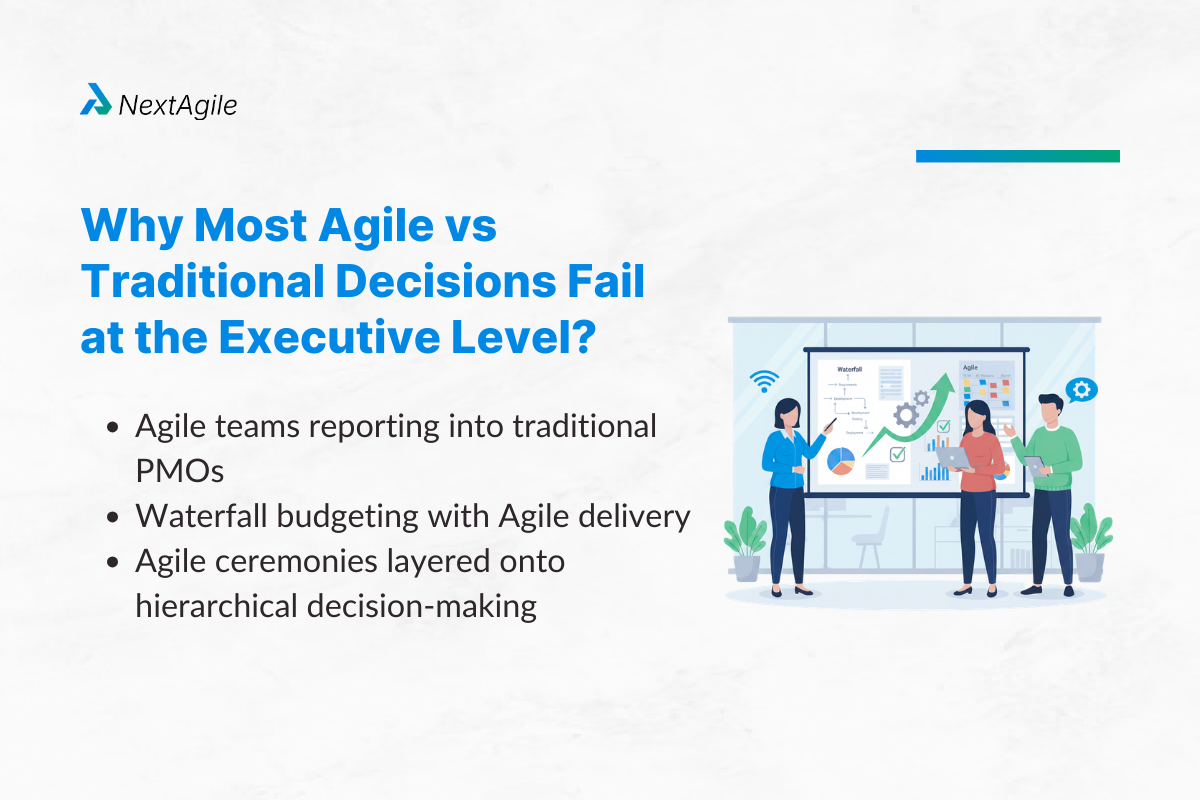
We’ve seen:
- Agile teams reporting into traditional PMOs
- Waterfall budgeting with Agile delivery
- Agile ceremonies layered onto hierarchical decision-making
The result?
Process theater.
Symptoms of Misalignment
If you observe:
- Agile teams waiting 6 months for funding approvals
- Waterfall programs reporting weekly “sprint” updates
- PMOs demanding stage gates inside Scrum cadences
You are witnessing structural inconsistency. Framework language without governance alignment creates confusion.
True transformation requires alignment across:
- Funding model
- Performance metrics
- Leadership behavior
- Organizational design
Without that, the debate becomes cosmetic.
Agile vs Traditional: How to Choose the Right Approach?
Here’s a leadership-level decision framework.
| Project Type | Team Size | Deadline Flexibility | Recommended Approach |
| Mobile app development | Small–Medium | Flexible | Agile |
| ERP implementation | Large | Fixed | Traditional / Hybrid |
| EdTech product build | Small–Medium | Adaptive | Agile |
| Government IT contract | Large | Strict | Traditional |
| Marketing campaign | Small | Moderate | Agile |
Ask These Strategic Questions:
- Are requirements stable for 12+ months?
- Is regulatory compliance dominant?
- Is speed-to-market a competitive differentiator?
- Can scope change without legal risk?
- Is customer feedback essential for validation?
Decision Matrix Logic
Use this simplified heuristic:
High volatility + Competitive innovation → Agile bias
High compliance + Fixed scope contracts → Traditional bias
Mixed constraints → Thoughtful hybrid
Clarity prevents ideology-driven decisions.
High uncertainty + innovation pressure → Agile
High predictability + compliance constraints → Traditional
Hybrid approaches work when governance is thoughtfully redesigned.
How to Build Agile or Traditional Project Management Capability?
| Role | Training Path | Timeline | Outcome |
| Project Manager | PMP / PRINCE2 | 3–6 months | Structured delivery mastery |
| Scrum Master | CSM / SAFe | 1–3 months | Iterative facilitation |
| Product Owner | Agile Product Leadership | 1–2 months | Value optimization |
| Executive | Agile Leadership Workshop | 1–2 weeks | Strategic agility |
Certification vs Capability
Certifications validate knowledge. Capability requires:
- Cross-functional coordination
- Governance redesign
- Data-driven transparency
- Leadership behavioral shift
Methodology adoption without organizational redesign produces marginal returns.
However, capability building must go beyond certifications.
True transformation includes:
- Governance redesign
- Value-stream alignment
- Outcome-based funding
- Data-driven performance metrics
That’s where advisory depth matters.
The Strategic Inflection Point
As AI, automation, and regulatory dynamics accelerate change, delivery systems must match market velocity. Organizations that misalign delivery model with market volatility experience:
- Budget overruns
- Missed opportunity windows
- Talent attrition
- Competitive erosion
Delivery architecture is now a strategic differentiator.
Conclusion
So Agile vs Traditional Project Management which wins in 2026?
The better question is, “Which risk profile does your organization carry?”
Traditional provides control and predictability, while agile provides adaptability and incremental value realization.
The future isn’t dogmatic; it’s deliberate.
Indian enterprises competing globally must design delivery systems aligned to volatility, compliance, and capital efficiency. Frameworks don’t create competitiveness; aligned governance and disciplined execution do.
Organizations don’t fail because they chose Agile or Waterfall. They fail because they misalign delivery with business reality. The most competitive enterprises in India aren’t choosing sides. They’re designing context-driven systems. That’s the real evolution.
The Real Competitive Edge
Agile does not guarantee innovation. Traditional does not guarantee control. Competitive advantage emerges when:
- Governance matches uncertainty
- Funding aligns to value
- Risk is distributed intentionally
- Execution discipline remains high
Methodology is a tool. Alignment is the advantage.
At NextAgile, we have collaborated with numerous clients across geographies to help them design and implement contextual business agility transformation journeys as an agile consulting partner. Do reach out to us at consult@nextagile.ai and we would be happy to explore more.
Strategic FAQs: Agile vs Traditional Project Management in 2026
The following answers address leadership-level concerns around governance, cost control, career positioning, and enterprise transformation in Indian and global contexts.
-
Is agile vs traditional project management relevant for non-IT industries in India?
Yes. Manufacturing, banking, healthcare, and infrastructure all face trade-offs between predictability and adaptability. Hybrid models are increasingly common.
-
Can a team switch from traditional to agile mid-project?
Yes, but it requires scope re-evaluation, governance adjustment, and stakeholder alignment. Without leadership buy-in, hybrid confusion can arise.
-
Which methodology gives more accurate cost estimates?
Traditional gives detailed upfront estimates when requirements are stable. Agile improves estimate accuracy progressively in uncertain environments.
-
For freshers in India, should I learn Agile or PMP?
Agile is increasingly dominant in digital industries. PMP remains valuable in structured sectors. Learning both improves versatility.
-
Which has higher global demand in 2026?
Agile roles are growing faster globally in digital sectors. Traditional remains strong in infrastructure and regulated industries.