Skip to content
Introduction
Nearly 60% of enterprise Agile transformations stall at scaling not due to lack of effort, but due to unclear maturity progression.
Most organizations adopt Agile practices.
Few understand how maturity evolves and what it takes to move forward. This is why the Agile Transformation Maturity Model is essential.
Agile transformation is not a rollout it is a maturity journey where each stage demands a fundamental shift in how decisions, funding, and delivery operate.
The real differentiator is not how well teams execute.
It is how effectively the enterprise makes decisions, prioritizes value, and adapts to change.
At the enterprise level, maturity is not a measure of Agile adoption; it is a measure of decision effectiveness at scale. Organizations that fail to progress are not constrained by team capability but by legacy decision models, funding structures, and governance systems that were never designed for adaptive execution.
What Is the Agile Transformation Maturity Model?
The Agile transformation maturity model is a structured framework that helps enterprises:
- Assess current transformation state
- Identify maturity gaps
- Build an enterprise Agile transformation roadmap
- Progress toward true business agility
Unlike basic models, it evaluates:
- Strategy-to-execution alignment
- Leadership behavior
- Decision-making systems
- Value delivery flow
In practice, this model serves as a decision diagnostic, not just a capability assessment. It reveals how work flows, how priorities are set, and where systemic friction exists between strategy and execution, making it a critical tool for transformation leaders driving enterprise-wide change.
How It Differs from a Generic Agile Maturity Model
Generic models assess:
- Team-level practices
- Scrum/Kanban adoption
This model evaluates:
- Enterprise adaptability
- Portfolio alignment
- Cross-functional decision-making
It answers a more important question: “How adaptive is the organization over How Agile are the teams?” This distinction becomes especially important in large organizations where localized Agile success often masks systemic inefficiencies. Without an enterprise lens, teams may appear mature while the organization continues to struggle with alignment, prioritization, and value realization.
Why Enterprise Transformation Cannot Begin Without a Baseline?
Without a maturity baseline:
- Transformation lacks direction
- Investments become fragmented
- Progress cannot be measured
A structured Agile maturity assessment ensures clarity before scaling. More importantly, the absence of a baseline often leads to premature scaling, where frameworks are introduced before foundational maturity exists. This creates the illusion of progress while embedding inefficiencies deeper into the operating model.
The Economics of Agile Maturity (What Each Stage Costs You)
Every maturity stage has a hidden cost.
- Stage 1-2: Slow delivery, high rework, missed opportunities
- Stage 3: Faster execution but poor prioritization
- Stage 4: Scaling complexity and governance overhead
- Stage 5: Optimized value delivery and adaptability
The cost of staying immature is a lost competitive advantage. From an executive perspective, each maturity stage represents a different return profile on engineering investment. As maturity increases, the proportion of effort translating into customer and business value improves significantly, making maturity progression a direct lever for ROI optimization.
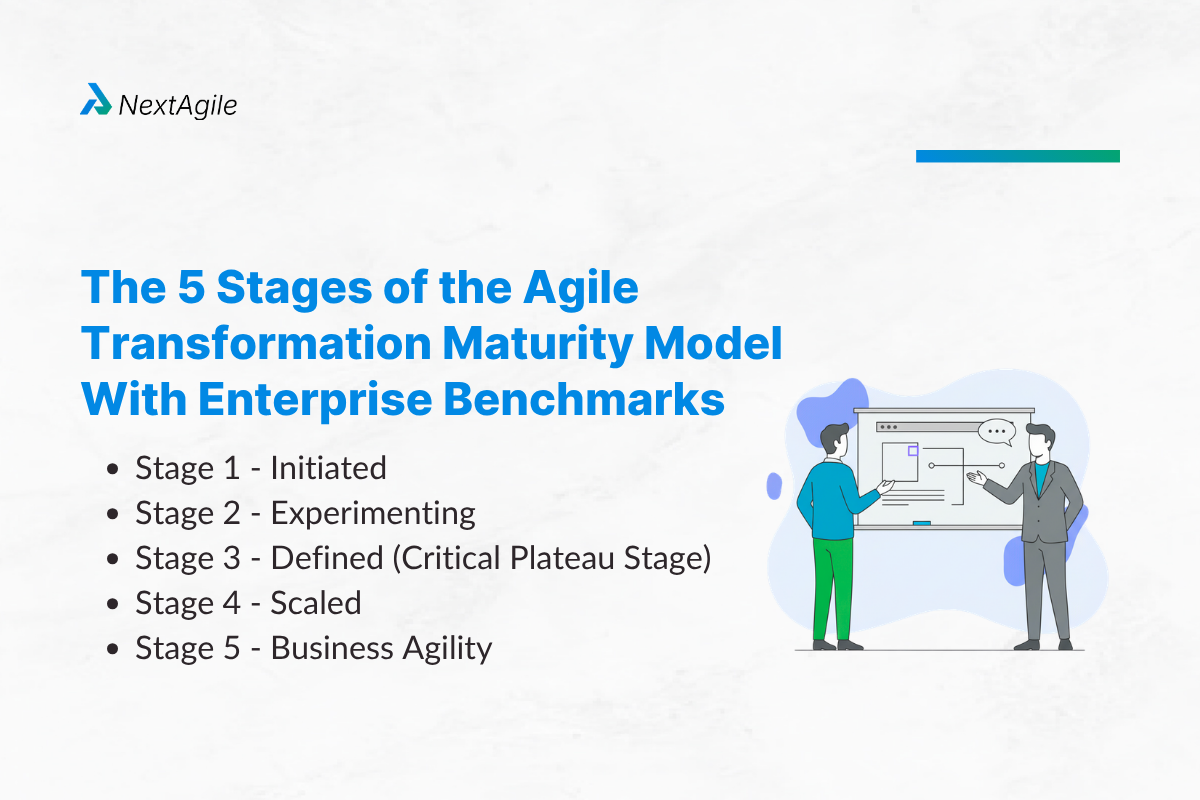
The 5 Stages of the Agile Transformation Maturity Model With Enterprise Benchmarks
These stages should not be interpreted as linear milestones but as capability thresholds. Enterprises often exhibit characteristics of multiple stages simultaneously, and progress depends on resolving the most critical systemic constraints rather than advancing uniformly across all dimensions.
Stage 1 – Initiated
Reality:
- Waterfall dominance
- Siloed teams
- No shared Agile language
Enterprise Signals:
- Long release cycles (months)
- Heavy dependency bottlenecks
- Low visibility
Risk:
Slow response to market change.
What Needs to Change:
- Awareness and education
- Initial Agile pilots
- Leadership buy-in
Stage 2 – Experimenting
Reality:
- Pilot teams adopt Agile
- Practices inconsistent
- Early success stories
Enterprise Signals:
- Isolated team success
- Lack of scaling strategy
Risk:
“Local optimization” Agile works in pockets, not enterprise-wide.
What Needs to Change:
- Standardize practices
- Align leadership
- Define transformation vision
This stage often creates a false sense of momentum. Early wins generate optimism, but without a clear scaling strategy, organizations risk institutionalizing inconsistency where different teams evolve divergent ways of working that later become barriers to alignment.
Stage 3 – Defined (Critical Plateau Stage)
Reality:
- Agile practices standardized
- Cross-team collaboration begins
Enterprise Signals:
- Improved delivery speed
- Visible metrics
- Still slow decision-making
The Hidden Problem:
At Stage 3, delivery improves but decision-making remains centralized. Teams move faster, but value delivery does not.
Risk:
Scaling inefficiency.
What Needs to Change:
- Decentralize decision-making
- Align governance with Agile
- Introduce outcome-based metrics
Stage 3 is where most transformations stall because it exposes the limits of team-level agility. Progress beyond this point requires a fundamental shift in how decisions are made, funded, and governed, moving from centralized control to distributed, outcome-driven ownership.
Stage 4 – Scaled
Reality:
- Frameworks like SAFe or LeSS implemented
- Portfolio visibility improves
Enterprise Signals:
- Coordinated delivery
- Value stream alignment
- Structured governance
Risk:
Process-heavy scaling without outcome focus.
What Needs to Change:
- Simplify governance
- Focus on value streams
- Align funding with outcomes
At this stage, complexity shifts from delivery to coordination. Without deliberate simplification, governance structures can become heavier than the problems they were designed to solve, which are slowing down decision-making and diluting the benefits of scaling.
Stage 5 – Business Agility
At maturity, Agile stops being a framework and becomes the mechanism through which enterprises continuously sense change, decide priorities, and deliver value.
Enterprise Signals:
- Real-time decision-making
- OKR-aligned execution
- Continuous innovation
Outcome:
- High adaptability
- Faster time-to-value
- Sustainable competitive advantage
At true maturity, the organization operates as a responsive system where strategy, execution, and feedback are continuously aligned. The competitive advantage here is not speed alone but the ability to reallocate resources and priorities faster than the market changes.
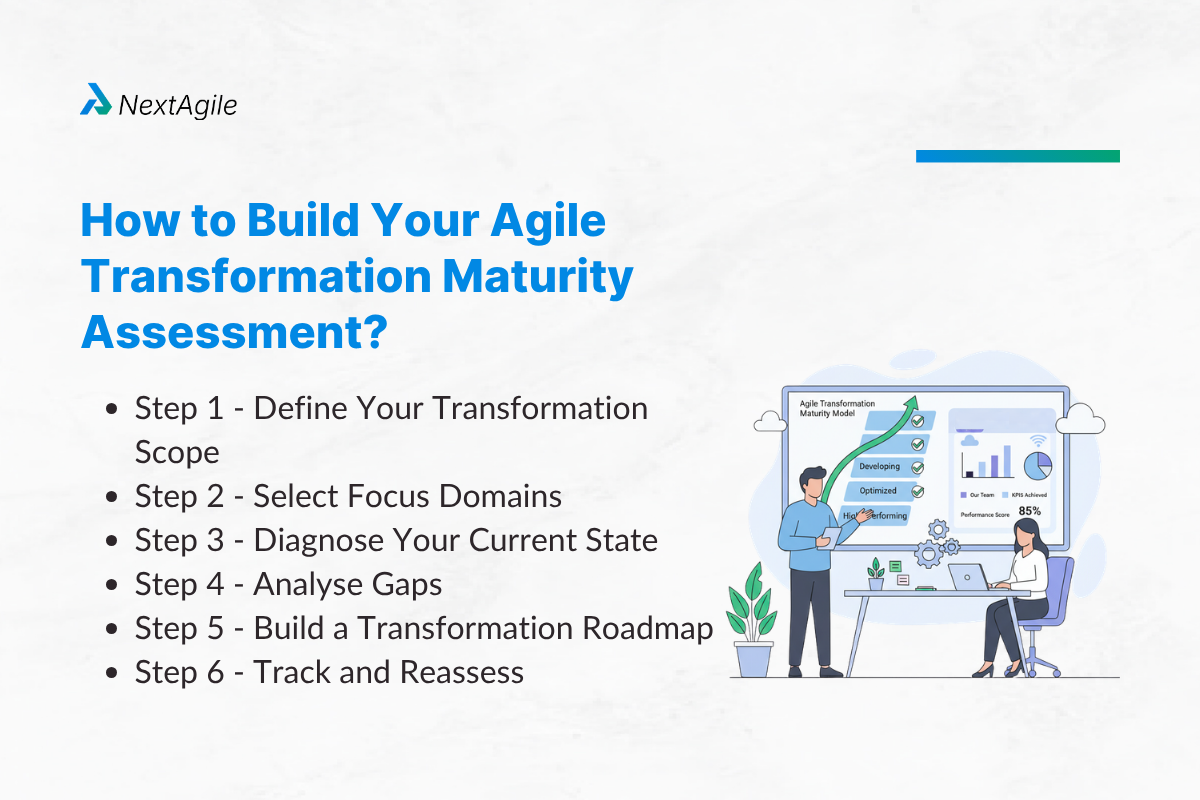
How to Build Your Agile Transformation Maturity Assessment?
Most maturity assessments fail because they measure activity instead of focusing on decision effectiveness or business outcomes. A critical shift in modern maturity assessments is the move from static evaluation to continuous sensing. Leading organizations treat maturity not as a periodic checkpoint, but as an evolving signal that informs ongoing transformation decisions.
Step 1 – Define Your Transformation Scope
Start with:
- Team
- Program
- Portfolio
- Enterprise
Use our quick agility health assessment tool – team agile maturity self assessment for initial evaluation.
Step 2 – Select Focus Domains
Assess across:
- Culture
- People
- Process
- Metrics
- Leadership
- Technology
Step 3 – Diagnose Your Current State
Measure:
- Decision latency
- Delivery speed
- Feedback cycles
- Value realization
Among these, decision latency is often the most underestimated metric. Even with fast delivery cycles, slow or centralized decision-making can negate agility benefits and create hidden bottlenecks across the system.
Step 4 – Analyse Gap
Compare:
- Current state vs target maturity
- Identify bottlenecks
Step 5 – Build a Transformation Roadmap
Create a roadmap aligned with:
- Business goals
- Value streams
Leverage external enterprise agile transformation consulting for execution.
Effective roadmaps at this stage are constraint-driven. The focus shifts from implementing practices to systematically removing the highest-impact barriers to flow, alignment, and value delivery.
Step 6 – Track and Reassess
- Quarterly maturity reviews
- Continuous improvement loops
How SAFe Accelerates Agile Transformation Maturity?
Where SAFe Fits (Stages 3-5)
SAFe is effective when:
- Agile is already defined
- Scaling is required
- Portfolio alignment is needed
The Common Trap
Enterprises that treat SAFe as a maturity model often plateau, because SAFe scales delivery but does not automatically evolve decision systems. The effectiveness of SAFe, therefore, depends less on adoption fidelity and more on how well it is adapted to the organization’s maturity context. When applied without this alignment, it can scale existing inefficiencies rather than resolve them.
Integrating OKRs for Measurable Outcomes
Why OKRs Fit Maturity Progression
OKRs enable:
- Strategic alignment
- Outcome tracking
- Focused execution
Leverage external OKR Consulting Services to drive measurable results. OKRs also act as a bridging mechanism between strategy and execution, ensuring that maturity progression is directly tied to measurable business outcomes rather than internal performance metrics alone.
From Activity to Outcomes
Shift from:
- Velocity → Value delivered
- Output → Business impact
Agile Transformation Maturity and Performance Management
The Accountability Gap
Traditional systems:
- Reward output
- Ignore outcomes
Fixing It
- Align KRAs with Agile goals
- Integrate OKRs
- Define Agile competencies
Without aligning performance systems to Agile maturity, organizations create structural contradictions where teams are expected to operate with agility but are measured using traditional output-driven metrics.
KPIs to Measure Agile Transformation Maturity
Track:
- Lead time
- Cycle time
- Deployment frequency
- Customer satisfaction
- Business value delivered
Also measure:
- Decision speed
- Team autonomy
- Feedback cycle time
Enterprises that mature successfully combine these metrics into a balanced system by linking flow efficiency, decision speed, and outcome realization to create a holistic view of transformation progress.
Why 60% of Enterprises Stall at Stage 3
Root Causes
- Leadership misalignment
- Traditional governance
- Centralized decision-making
Breakthrough Strategy
- Redesign decision systems
- Align leadership behavior
- Shift to outcome metrics
Maturity accelerates when decision-making evolves. The breakthrough at this stage is systemic redesign. Organizations that successfully progress rewire decision rights, funding models, and governance structures to enable true decentralization.
Agile Transformation Maturity in 2026: The AI Shift
AI-Powered Maturity Dashboards
- Real-time insights
- Predictive analytics
- Continuous tracking
AI in Transformation Execution
- Smarter retrospectives
- Faster planning
- Better prioritization
AI introduces a new dimension to maturity by enabling real-time visibility and predictive decision-making. As a result, maturity models themselves are evolving from static frameworks to adaptive systems that continuously guide transformation.
Agile Maturity Model vs SAFe vs CMMI
| Model | Focus | Best Use |
| Agile Transformation Maturity Model | Enterprise adaptability | End-to-end transformation |
| SAFe | Scaling Agile | Large enterprises |
| CMMI | Process maturity | Compliance-heavy industries |
Choose based on transformation goals by avoiding fascination with framework popularity. In practice, many enterprises combine elements of these models. The key is integration and ensuring that process maturity, scaling frameworks, and adaptability models work cohesively rather than in isolation.
From Maturity to Competitive Advantage
Agile maturity is not the goal. Competitive advantage is.
Organizations at higher maturity levels:
- Launch faster
- Adapt quicker
- Outperform competitors
Maturity is the pathway & business impact is the destination. This is where maturity transitions from an internal capability to an external differentiator. Organizations that operationalize maturity effectively can sense market shifts earlier, respond faster, and sustain advantage in increasingly volatile environments.
The most important shift for enterprise leaders is this: Agile maturity is no longer a transformation metric; it is an operating capability. It defines how effectively the organization can align strategy, execution, and outcomes in real time.
Conclusion
The Agile transformation maturity model provides a clear path from fragmented delivery to scalable execution to adaptive enterprise agility.
But progression is not automatic.
It requires:
- Clear baselines
- Strategic alignment
- Continuous evolution
Organizations that succeed:
- Redesign decision systems
- Align strategy with execution
- Focus on outcomes and not activity
As an agile consulting company, we help enterprises accelerate this journey through Agile transformation consulting services and enterprise agile maturity assessment consulting for turning maturity into measurable business outcomes. Do reach out to us at consult@nextagile.ai, and we would be happy to explore more.
Frequently Asked Questions
1. How Long Does It Take to Progress Between Stages?
Typically 6-18 months depending on complexity and leadership alignment.
2. How Do You Get Leadership Buy-In?
By linking maturity progression to business outcomes like ROI, speed, and competitive advantage.
3. What Is the Difference Between Maturity and Readiness?
- Readiness = ability to start
- Maturity = ability to scale
4. Self-Assessment or Consultant?
Start with self-assessment, but use experts for deeper insights and structured transformation.
5. How Often Should Maturity Be Assessed?
Quarterly or bi-annually for continuous tracking.
6. What is the biggest mistake enterprises make in Agile maturity progression?
Focusing on scaling frameworks before evolving decision-making and governance systems. This leads to process-heavy transformations without corresponding improvements in business outcomes.
7. Can different parts of an organization be at different maturity stages?
Yes. Most enterprises operate across multiple maturity levels simultaneously. The key is to identify critical value streams and prioritize maturity progression where it delivers the highest business impact.
8. How do you measure ROI from Agile maturity improvement?
ROI can be measured through improved time-to-market, increased value delivery, reduced rework, and better alignment between strategic goals and execution outcomes.
9. What role does leadership play in advancing maturity stages?
Leadership is the primary driver of maturity progression. Advancing beyond Stage 3 requires leaders to decentralize decision-making, align incentives with outcomes, and redesign governance structures.
10. Is it necessary to reach Stage 5 for all organizations?
Not necessarily. The target maturity level should align with business context, industry dynamics, and strategic goals. However, organizations in highly competitive or rapidly changing markets benefit significantly from higher maturity levels.