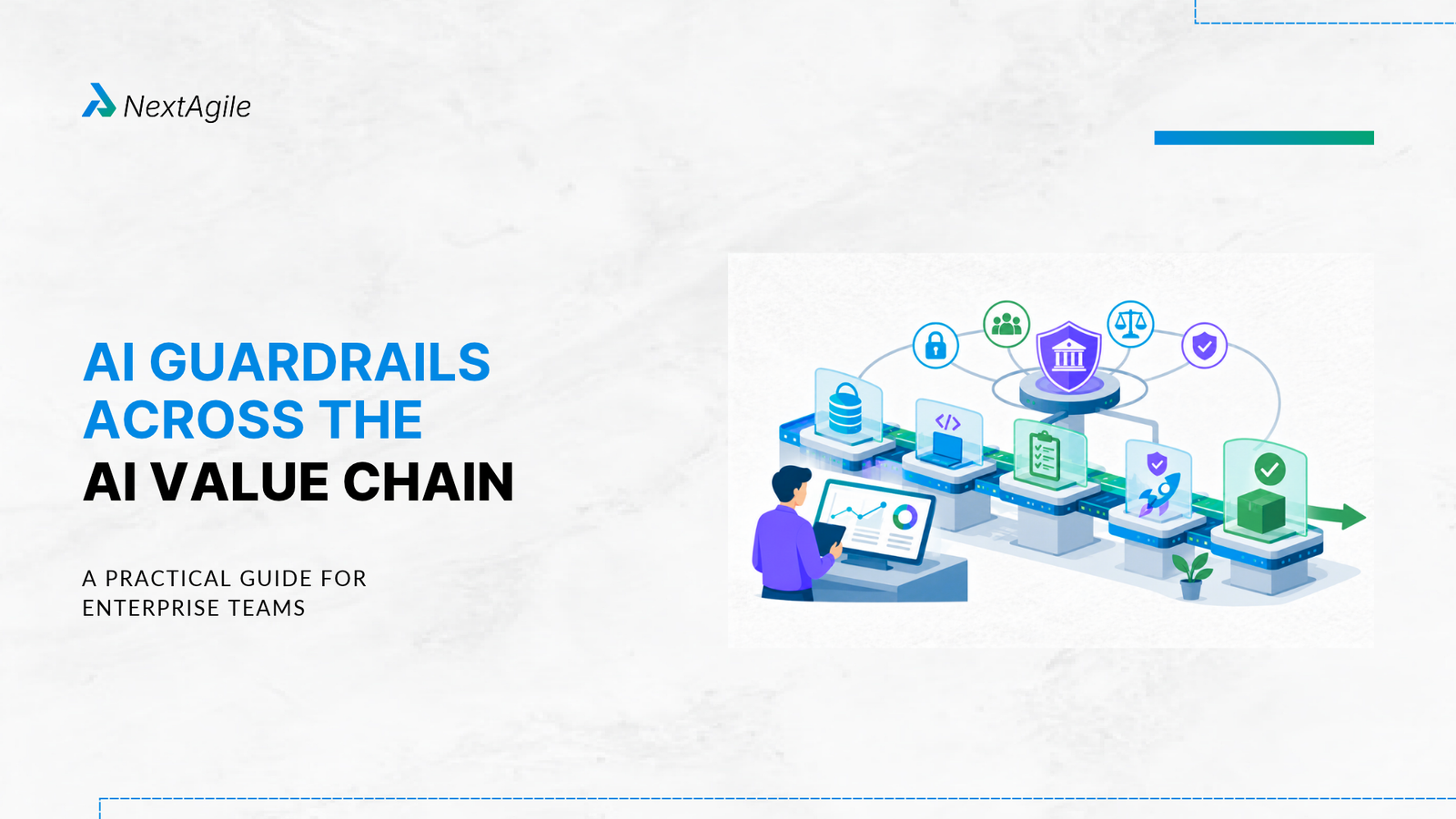
AI Guardrails Across the AI Value Chain: A Practical Guide for Enterprise Teams
Arun Tiwari
Talk to Expert for Free
Table of Contents
AI guardrails are the technical and procedural controls that limit what an AI system accepts, what it can do and what it returns. Most teams bolt them onto the chatbot at the end. They work better when they are built into every stage of the AI value chain: data, model choice, application design, tool access, deployment and monitoring, with a named owner at each stage.
Key Highlights of AI Guardrails
A guardrail is a control, not a policy document. It has to run somewhere: before the model is called, around a tool call, or after the model responds.
A system prompt that asks the model to behave is not a guardrail. It is advisory and can be overridden by prompt injection.
NVIDIA’s NeMo Guardrails documentation describes five rail types: input, retrieval, dialog, execution and output. Input and output rails are the most common.
Each stage of the value chain fails differently, so each needs different controls.
Roles shift along the chain. Under the EU AI Act, a company that rebrands or substantially modifies a high-risk system can become its provider.
Guardrails need measurement. Track what they block, what they miss and how often they block legitimate work.
What Are AI Guardrails?
AI guardrails are controls that keep an AI system inside agreed limits. They decide which inputs are allowed in, which actions the system may take and which outputs may reach a user or another system. Some are technical, such as a filter that masks personal data. Some are procedural, such as a rule that a human must approve a payment above a set limit. Some are contractual, such as a supplier duty to tell you before a model changes.
It helps to separate guardrails from governance. Governance sets who decides, what is allowed and how exceptions are handled. Guardrails are how those decisions are enforced at run time. If you are still agreeing the policy layer, start with our guide to the AI governance framework, then return here to put the controls in place.
It also helps to be clear about what is not a guardrail. A line in a system prompt that says “never reveal confidential data” is an instruction, and a determined or simply unlucky input can override it. A real guardrail sits outside the model, checks the traffic and takes an action: allow, block, redact or escalate to a person. That independence from the model is what makes it a control.
Why AI Guardrails Belong in the Whole Value Chain
An enterprise AI system is rarely built by one team. Data comes from one place, a model from a vendor or an internal team, the application from another team, and the tools it calls belong to other systems. A failure at any link can reach the end user. A guardrail that only inspects the final answer cannot undo poisoned training data or an agent that was given permission to delete records.
For this guide we use a simple six-stage working model of the AI value chain. It is a practical framing, not a formal standard:
Data sourcing and preparation
Model selection or training
Application and orchestration (prompts, retrieval, workflows)
Agents and tool access
Deployment and integration
Monitoring, incidents and change
Regulation also treats the chain as shared. The EU AI Act names distinct roles, including provider, deployer, importer and distributor, and gives them different duties for high-risk systems. Article 25 explains that roles can move: a party that puts its own name or trademark on a high-risk system already on the market substantially modifies it or changes the intended purpose of a system so that it becomes high-risk takes on the provider’s obligations. It also requires a written agreement between a high-risk provider and third parties that supply tools, services, components or processes used in the system. Check the current application dates and your own risk tier before relying on any single obligation.
The Five Types of AI Guardrails
NVIDIA’s NeMo Guardrails documentation groups guardrails by the point at which they run. The grouping is a useful checklist even if you use other tools.
Guardrail type
Where it runs
Typical checks
Input
Before the model is called
Unsafe content, jailbreak attempts, off-topic requests, personal data in the prompt
Retrieval
In a RAG pipeline, after documents are retrieved
Filter documents and chunks so only trusted context reaches the model
Dialog
Across conversation turns
Keep the conversation within the allowed flow and policy
Execution
Around tool or function calls
Validate the call, its arguments and its result before and after an external system is touched
Output
After the model responds
Filter, edit or block unsafe or off-policy content before it reaches the user
Other writers group guardrails by purpose instead: technical controls (filters and validators), operational controls (monitoring and incident response), governance controls (policy, approvals and audit) and organisational controls (roles, training and accountability). The two views fit together. The five run-time types are mostly technical, and a complete programme needs the other three categories around them.
Managed services follow the same idea. Amazon Bedrock Guardrails, for example, offers content filters, denied topics, word filters, sensitive information filters, contextual grounding checks and automated reasoning checks and can be applied to inputs and model responses. Open-source libraries such as Guardrails AI let you compose validators, including for personal data and toxic language, around a model call.
What Goes Wrong: The Risks Guardrails Address
The OWASP Top 10 for LLM Applications (2025) is the most useful public list of what goes wrong: prompt injection, sensitive information disclosure, supply chain, data and model poisoning, improper output handling, excessive agency, system prompt leakage, vector and embedding weaknesses, misinformation and unbounded consumption. Two of these deserve extra attention in an enterprise setting.
Excessive agency is the risk that a system is given more autonomy or permission than its task needs. A support assistant that can read an order is low risk. One that can also issue refunds, edit customer records and send emails is a different risk class. Improper output handling is the risk that model output is passed to another system without validation, for example generated text inserted straight into a database query or a web page. Both are failures of the system around the model, which is why they cannot be fixed by a better prompt.
 Skip to content