Key Highlights of GraphRAG vs RAG Standard RAG retrieves document chunks based on semantic similarity. GraphRAG retrieves connected knowledge using entity relationships and graph traversal. GraphRAG performs significantly better for multi-hop reasoning, entity resolution, and cross-document synthesis. Microsoft’s open-source GraphRAG framework accelerated enterprise adoption beginning in 2024 and continues to mature in 2026. GraphRAG typically costs 3 to 5 times more than standard RAG once you account for graph construction, maintenance, and retrieval orchestration. Hybrid architectures combining vector RAG and GraphRAG are emerging as the dominant enterprise pattern in 2026. Agentic GraphRAG is the next frontier: AI agents dynamically exploring and reasoning across graph structures rather than performing a single retrieval pass. The Shared Goal: Giving LLMs Access to Your Real Knowledge Both RAG and GraphRAG were built to solve the same fundamental limitation of LLMs: they know what was in their training data, not what is in your organization. For a complete foundation on standard RAG before reading this comparison, see NextAgile’s What is RAG guide, which covers the 5-step retrieval process, the 4 core components, RAG vs fine-tuning comparison, and the 5 most common implementation mistakes. As Memgraph’s GraphRAG research explains, both architectures emerged to solve the problem that LLMs lack up-to-date, connected knowledge. RAG bridges this gap by retrieving relevant information from external sources. GraphRAG builds on this by adding structure and reasoning, enabling models to understand how pieces of information are related.
How Standard RAG Works: Vector Similarity Retrieval Standard RAG is fundamentally a semantic retrieval system.
Your documents are:
Chunked into smaller sections Converted into embeddings Stored inside a vector database When a user submits a query:
The query becomes an embedding The system retrieves semantically similar chunks Those chunks are inserted into the LLM prompt The model generates an answer grounded in retrieved context In production environments, this architecture works surprisingly well when retrieval fundamentals are handled correctly:
Good chunking strategy Strong embedding model Hybrid retrieval Reranking Proper metadata filtering Access control enforcement The problem is that semantic similarity alone does not understand relationships.
A vector database may retrieve five relevant paragraphs individually while completely missing the fact that:
Entity A owns Entity B Vendor C supplied both systems Incident D happened after Policy E changed Customer F appears across three disconnected datasets That is where standard RAG begins to plateau.
And honestly, this is usually the point where teams misdiagnose the issue.
Many organizations jump toward GraphRAG before fixing basic RAG problems:
Poor chunking Weak metadata Missing rerankers No hybrid retrieval Broken access control Stale embeddings You should not reach for graph architectures until your baseline retrieval quality is already strong. For the full technical implementation including chunking strategy, reranker integration, and production monitoring, NextAgile’s What is RAG guide is the authoritative reference.
How GraphRAG Works: Graph-Based Relationship Retrieval GraphRAG constructs a knowledge graph from your document corpus. Entities such as people, organizations, concepts, events, and products are extracted as nodes. Relationships between entities are extracted as edges. As Weaviate’s GraphRAG exploration describes, when a user submits a query, GraphRAG identifies the relevant entities in the query, traverses the knowledge graph to find connected entities and relationships, retrieves the contextual information available across the connected graph, and provides the LLM with relationship-aware context that standard vector retrieval cannot produce.
Microsoft’s open-source GraphRAG implementation , released in 2024, demonstrated in benchmark testing that GraphRAG produces measurably better answers than standard RAG for queries requiring global understanding of a document corpus and multi-hop reasoning across connected entities.
GraphRAG vs RAG: Direct Comparison Dimension Standard RAG GraphRAG Retrieval method Vector similarity search Graph traversal + entity relationships Best query types Semantic search, document lookup, FAQ Multi-hop reasoning, connected analysis Knowledge structure Flat document chunks Structured graph entities and relationships Implementation complexity Moderate High Implementation timeline 2–8 weeks 8–16 weeks Operational cost Lower 3–5x higher Maintenance burden Re-embedding documents Continuous graph maintenance Hallucination control Good Better for cross-entity reasoning Explainability Source citations Relationship-path explainability Enterprise maturity in 2026 Standardized and mature Rapidly growing but operationally heavier
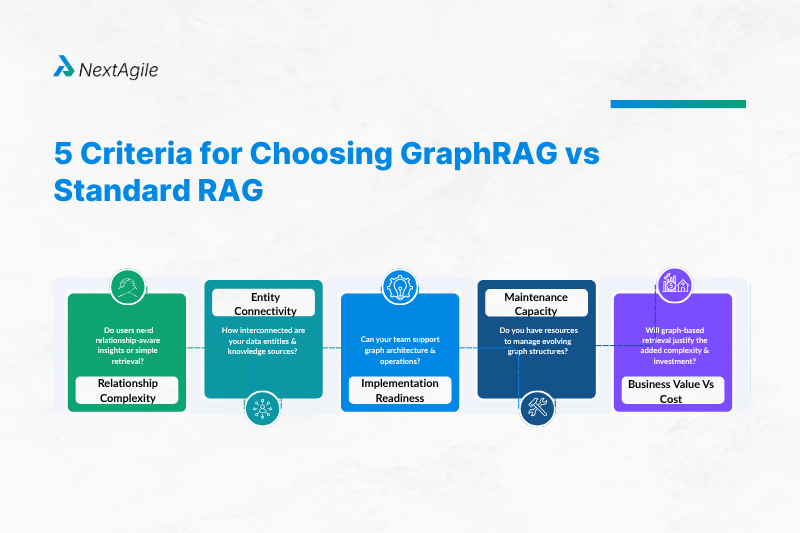
5 Criteria for Choosing GraphRAG vs Standard RAG
Criterion 1: Does your use case require relationship reasoning? This is the single most important question.
If your users mainly ask:
“What does policy X say?” “Find information about topic Y” “Summarize this document” Standard RAG is usually enough.
GraphRAG becomes valuable when users ask:
“How are these systems connected?” “Which entities influenced this outcome?” “What relationships exist across these datasets?” Relationship-heavy workflows justify graph retrieval.
Simple semantic lookup usually does not.
Criterion 2: How complex is your entity landscape? GraphRAG works best when your domain naturally contains interconnected entities.
Strong GraphRAG candidates include:
Insurance claims networks Financial counterparty analysis Healthcare clinical relationships Pharmaceutical research Legal precedent systems Supply chain ecosystems Weak candidates:
Small FAQ systems Basic documentation search Simple support bots Small internal wikis If your knowledge base lacks meaningful relationship density, the graph layer often becomes unnecessary complexity.
Criterion 3: What is your implementation capacity? This part gets underestimated constantly.
A production GraphRAG deployment usually requires:
Entity extraction pipelines Relationship extraction models Graph schema design Graph databases Traversal orchestration Graph query optimization Governance controls Ongoing graph validation That is a very different engineering profile from deploying standard RAG.
If your organization is still early in AI Maturity Model ,, standard RAG is almost always the correct first step.
GraphRAG becomes realistic once:
Retrieval quality is stable Governance exists MLOps is operational Your team can maintain graph infrastructure long-term Criterion 4: What is your maintenance capacity? This is where architecture diagrams stop being fun.
Every new document entering a GraphRAG system potentially changes:
Entities Relationships Node structures Graph traversal paths Relationship weights That means continuous maintenance.
Standard RAG maintenance is comparatively simple:
Re-embed documents Update metadata Reindex vectors GraphRAG maintenance requires operational ownership of the graph itself.
If your enterprise struggles to maintain metadata quality today, introducing graph complexity can amplify those problems quickly.
Criterion 5: What does your budget support? GraphRAG costs more in almost every category:
Engineering effort Infrastructure Graph databases Token usage Maintenance Governance Observability The important question is not: “Is GraphRAG technically superior?”
The real question is: “Does relationship-aware retrieval create measurable business value worth the additional operational complexity?”
For many enterprises, the answer is eventually yes. But not on day one. As Weaviate recommends , deploy standard RAG first, measure where it fails, and only move to GraphRAG if the failures are specifically in relationship-based retrieval rather than other factors.
When NOT to Use GraphRAG Do not use GraphRAG when your standard RAG system is not yet optimized. Poor chunking strategy, missing reranker, or weak embedding model are standard RAG problems that GraphRAG does not solve. Do not use GraphRAG when your use case is primarily document lookup and semantic search. Standard RAG handles this better with lower cost and complexity. Do not use GraphRAG when your team lacks graph engineering expertise. Do not use GraphRAG when your knowledge base is under 10,000 documents. The relationship density required for GraphRAG to outperform standard RAG typically requires larger document corpora. Do not use GraphRAG when your budget does not support the 3 to 5x cost premium. Standard RAG with a well-tuned reranker, as described in NextAgile’s What is RAG guide , often delivers 80 to 90% of GraphRAG’s quality at 20 to 30% of the cost for most enterprise use cases. Hybrid RAG: The 2026 Enterprise Production Pattern The most mature enterprise architectures are increasingly hybrid.
Instead of choosing one retrieval method globally, they route queries dynamically.
Typical hybrid flow:
Classify incoming query Determine whether relationship reasoning is required Route to vector RAG, GraphRAG, or both Merge and rerank retrieved evidence Generate grounded answer This pattern works because not every query deserves graph traversal.
Some questions need breadth. Others need connected reasoning.
Hybrid architectures allow enterprises to optimize:
Cost Latency Retrieval depth Explainability Infrastructure efficiency And frankly, this is where the industry appears headed.
Agentic GraphRAG: The 2026 Frontier The next evolution is not just graph retrieval. It is agentic graph retrieval.
Instead of a single retrieval pass, AI agents:
Plan traversal strategies Query multiple graph regions Evaluate evidence quality Run iterative retrieval loops Synthesize multi-hop reasoning chains This matters for workflows where the answer cannot be retrieved in one step.
Examples:
Fraud investigation Clinical research Legal analysis Compliance tracing Root-cause analysis Supply chain disruption modeling The architecture starts looking less like search and more like reasoning orchestration.
But this also introduces:
Higher latency More token consumption Greater observability requirements Stronger governance needs More complicated failure modes The engineering challenge shifts from retrieval quality to orchestration reliability. For teams building agentic retrieval systems, NextAgile’s LangChain Mastery Workshop covers the LangGraph architecture for complex multi-step retrieval workflows, which is the foundation for agentic GraphRAG implementations. The step-by-step implementation guide is covered in How to Build Agentic AI .
Microsoft GraphRAG: The Open-Source Foundation Microsoft’s GraphRAG framework accelerated enterprise experimentation because it packaged:
Graph construction Entity extraction Local search Global search LLM integration into a usable open-source pipeline.
The real contribution was not just the codebase.
It normalized the idea that retrieval systems should understand relationships, not just similarity.
Since then, the ecosystem around GraphRAG has expanded rapidly:
Neo4j integrations Memgraph pipelines Hybrid retrieval orchestration Agentic graph traversal Enterprise governance tooling But even Microsoft’s implementation reinforces the same reality: GraphRAG is powerful, but it is not lightweight infrastructure.
Conclusion: Start with RAG, Graduate to GraphRAG Most enterprises in 2026 should follow this sequence:
Build a strong standard RAG system Fix retrieval quality rigorously Measure where semantic retrieval fails Identify whether failures are relationship-driven Introduce GraphRAG selectively where it creates measurable value That progression matters.
Because once you introduce graph infrastructure, you are not just adding retrieval capability. You are committing to maintaining an evolving knowledge representation layer across your enterprise.
For organizations that genuinely need relationship-aware reasoning, GraphRAG can unlock capabilities standard RAG simply cannot deliver. If you have not yet built a standard RAG system, start with NextAgile’s What is RAG guide which covers the full implementation from chunking strategy to production monitoring.
But the teams succeeding with GraphRAG in production are usually the same teams that already mastered:
Governance Metadata discipline Retrieval evaluation Observability Data operations Production AI architecture GraphRAG is not a shortcut around retrieval engineering maturity. It is the next layer after you achieve it. For teams ready to build, the LangChain Mastery Workshop equips your engineering team with the hands-on skills to implement both standard RAG and advanced retrieval architectures in production.
If you are ready to evaluate GraphRAG for your enterprise knowledge system, NextAgile’s Gen AI Consulting Services can help you assess whether GraphRAG is appropriate for your specific use case and data architecture.
Frequently Asked Questions Q1. What is the difference between RAG and GraphRAG? Standard RAG retrieves semantically similar document chunks using vector embeddings. GraphRAG retrieves connected knowledge using entities and relationship traversal through a knowledge graph. For the full foundation on standard RAG, see NextAgile’s What is RAG guide .
Q2. Is GraphRAG better than RAG? Not universally.
GraphRAG is better for relationship-heavy reasoning and multi-hop analysis. Standard RAG is usually better for speed, simplicity, operational cost, and most enterprise search use cases.
The correct choice depends on your actual query patterns.
Q3. What is Microsoft GraphRAG? Microsoft GraphRAG is an open-source Python library released by Microsoft Research that builds knowledge graphs from document corpora and enables graph-aware retrieval for LLM applications.
It supports:
Global graph search Local entity search Multi-hop retrieval Structured graph context generation Q4. How much more expensive is GraphRAG than standard RAG? Typically 3 to 5 times more expensive once you account for:
Graph construction Entity extraction Relationship extraction Graph infrastructure Higher token usage Ongoing maintenance The operational overhead is usually larger than the initial implementation cost.
Q5. When should enterprises not use GraphRAG? Avoid GraphRAG when:
Your RAG fundamentals are still weak Your use case is mostly semantic search Your document corpus is small Your team lacks graph engineering expertise Your budget does not support the added complexity In many cases, a properly optimized standard RAG system delivers most of the business value with far less operational burden. See the detailed decision criteria in the GraphRAG vs RAG comparison table above, and check your team’s current AI Maturity Level before deciding.
Rahul seasoned technology leader with 20+ years of experience, now dedicated to mentoring and training individuals and groups in Generative AI, advanced AI/ML system design, and production best practices. He is a hands-on tech entrepreneur and has deep industry experience in building cutting-edge AI products.
 Skip to content