Key Highlights of Agentic AI Architecture Framework By end of 2026, 40% of enterprise software applications will integrate task-specific AI agents. Only 2% of enterprises have deployed agentic AI at full production scale despite 79% reporting some adoption. Over 40% of agentic AI projects will be cancelled by end of 2027 due to rising costs, unclear value, or insufficient risk controls. MCP (Model Context Protocol), developed by Anthropic, has become the de facto open standard for agent-to-tool integration in 2026. Enterprises deploying agentic AI with proper governance report average ROI of 171% within 18 months Introduction An agentic AI architecture framework for enterprises is the technical and governance structure that enables AI agents to operate autonomously, coordinate with other agents, connect to enterprise systems, and complete complex multi-step goals while remaining transparent, controllable, and aligned with business objectives.
Gartner’s 2025 forecast projects that 40% of enterprise software applications will integrate task-specific AI agents by end of 2026, up from less than 5% in 2025. Yet AaiNova’s March 2026 enterprise architecture study found that while 79% of organizations report some AI agent adoption, only 11% are in production and just 2% have deployed at full scale. The architecture is where most deployments fail.
This guide provides the complete enterprise agentic AI architecture framework: 6 technical layers, a framework comparison, a governance model, enterprise system integration patterns, and an ROI measurement framework. For enterprise teams starting their agentic AI journey, NextAgile’s Generative AI Consulting Services provide architecture assessment as the first engagement step.
Traditional AI vs Agentic AI Architecture: Key Differences Dimension Traditional AI Agentic AI Interaction model Human triggers, model responds Agent plans and acts autonomously State management Stateless per request Persistent state across workflow Tool access Text output only Calls APIs, databases, browsers Error handling Returns error message Retries, adapts plan, escalates Memory None between requests Short-term and long-term memory Infrastructure needs LLM API access LLM + orchestration + memory + governance
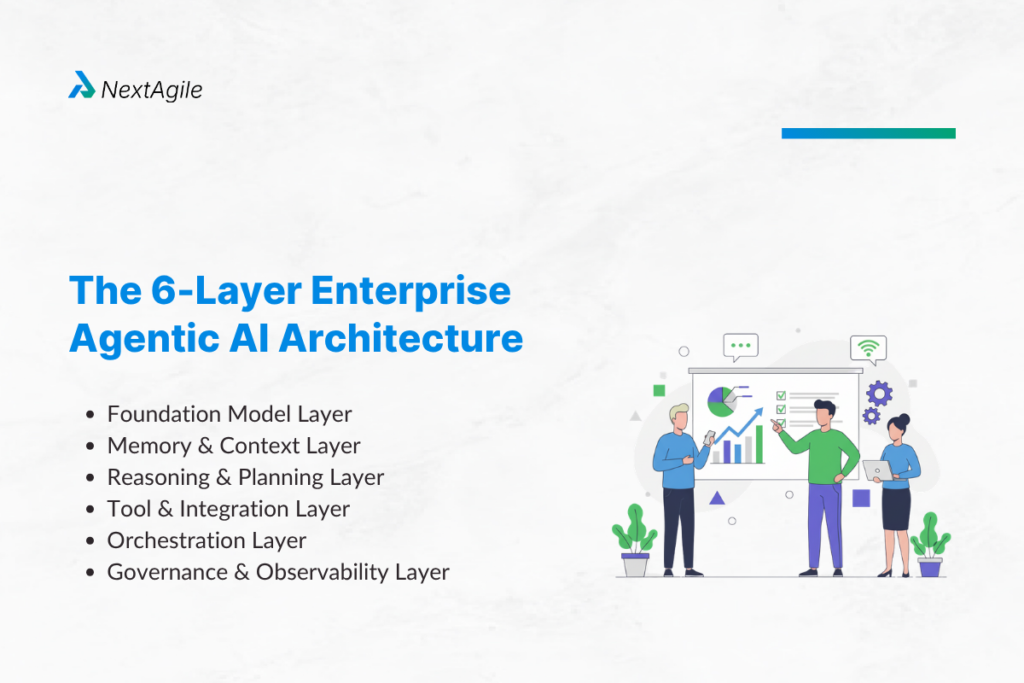
The 6-Layer Enterprise Agentic AI Architecture Layer 1: Foundation Model Layer The LLM backbone providing language reasoning to all agents. Enterprise architectures typically integrate 2 to 3 models optimized for different task types.
Key decisions:
Cost optimization: smaller models (GPT-4o mini, Claude Haiku) for high-volume routine tasks; larger models (Claude Opus, GPT-4o) for complex reasoning Data sovereignty: for India’s enterprise sector, evaluate models supporting regional data processing under the DPDP Act 2023 Fallback routing: if the primary model is unavailable, automatic routing to a backup model Prompt management: centralized prompt library with version control and performance tracking Layer 2: Memory and Context Layer Memory makes agentic systems intelligent over time. Two types are required:
Short-term memory (working memory):
Maintains context within a single task or conversation Stored in the LLM context window or a fast in-memory store (Redis) Cleared when the task completes Long-term memory (organizational memory):
Persists semantic knowledge, organizational context, and learned patterns Stored in vector databases (Pinecone, Weaviate, pgvector) for semantic retrieval Subject to data governance policies Layer 3: Reasoning and Planning Layer The reasoning layer translates goals into step-by-step plans and adapts when plans encounter obstacles.
Key reasoning patterns in 2026:
ReAct (Reason + Act): Alternates between reasoning steps and action calls. Most widely deployed pattern.ReWOO (Reasoning Without Observation): Generates the complete plan upfront before executing. Reduces LLM calls by 30 to 40% Tree of Thoughts: Explores multiple reasoning branches before committing to a path. Best for strategic decisions.Chain of Thought (CoT): Step-by-step reasoning transparency. Best for auditable analytical tasks. Layer 4: Tool and Integration Layer Tools are the actions agents can take in the real world.
Enterprise tool categories:
Tool Category Examples Governance Requirement Read-only data CRM lookup, HR records Role-based access, PII masking Write/transactional Order creation, ticket updates Human-in-the-loop for high-value actions Code execution Python interpreter, SQL runner Sandboxed execution environment External web Browser, search, news feeds Content filtering, source validation Internal knowledge RAG over company documents Document access controls
The Model Context Protocol (MCP): Developed by Anthropic and adopted as an open standard in 2024, MCP
Layer 5: Orchestration Layer The orchestration layer decomposes goals into sub-tasks, coordinates agent execution, and adapts when steps fail.
Three orchestration patterns:
Sequential chain: Tasks execute in fixed sequence. Output of Agent A becomes input of Agent B. Best for linear processes.Parallel execution: Multiple agents run simultaneously. Results merge at completion. Best for independent sub-tasks.Supervisor-worker hierarchy: A supervisor agent decomposes the goal, delegates to specialist workers, evaluates outputs, and decides whether to iterate or complete. Best for complex, adaptive workflows and the standard pattern for production enterprise deployments. Layer 6: Governance and Observability Layer Governance is what makes agentic AI deployable in enterprise production environments.
5 mandatory governance capabilities:
Human-in-the-loop (HITL) checkpoints: Define the confidence threshold below which an agent escalates to a human rather than acting. Define per workflow, not globally (financial transactions: 95% confidence; email drafts: 70% confidence).Audit logging: Every agent action, tool call, reasoning step, and decision must be logged with: timestamp, agent identity, triggering input, and output. Mandatory for RBI IT framework compliance in India’s BFSI sector.Rollback mechanisms: Define which actions are reversible and which are not. Irreversible actions (sent emails, financial settlements) require higher confidence thresholds and explicit human approval.Prompt injection defense: Prompt injection ranked #1 on OWASP Top 10 for LLM Applications 2025, with attack success rates of 84% in agentic systems. Required defenses: input validation, context isolation, output verification, least-privilege tool permissions.Autonomy graduation model: Deploy agents at progressive autonomy levels:
Level 0: Human does everything, agent suggests Level 1: Agent acts, human approves before execution Level 2: Agent acts, human reviews within 1 hour Level 3: Agent acts, human reviews in daily batches Level 4: Agent acts, anomaly detection triggers human review Level 5: Full autonomy with governance guardrails only Most enterprise use cases in 2026 operate at Levels 1 to 2 for high-risk actions.
Enterprise Framework Comparison Framework Architecture Type Best Enterprise Use Case Governance Controls LangGraph Stateful graph workflows Complex conditional multi-step workflows Manual (build yourself) AutoGen Multi-agent conversation Research, analysis, cross-functional tasks Moderate (Microsoft ecosystem) CrewAI Role-based multi-agent Document processing, content pipelines Good (structured roles) Microsoft Copilot Studio Low-code visual builder Microsoft 365 enterprise workflows Excellent (enterprise DLP, RBAC) Akka Event-driven reactive High-volume, real-time enterprise agents Good (resilient by design) IBM watsonx Orchestrate Enterprise LLM platform Regulated industries, hybrid cloud Excellent (enterprise compliance)
Selection guidance:
Python teams building custom workflows: LangGraph or CrewAI Microsoft-centric enterprises: Copilot Studio (fastest time to value) Regulated industries (BFSI, healthcare): IBM watsonx Orchestrate High-volume, real-time processing: Akka NextAgile’s Agentic AI Workshop provides hands-on framework evaluation sessions for enterprise architecture teams.
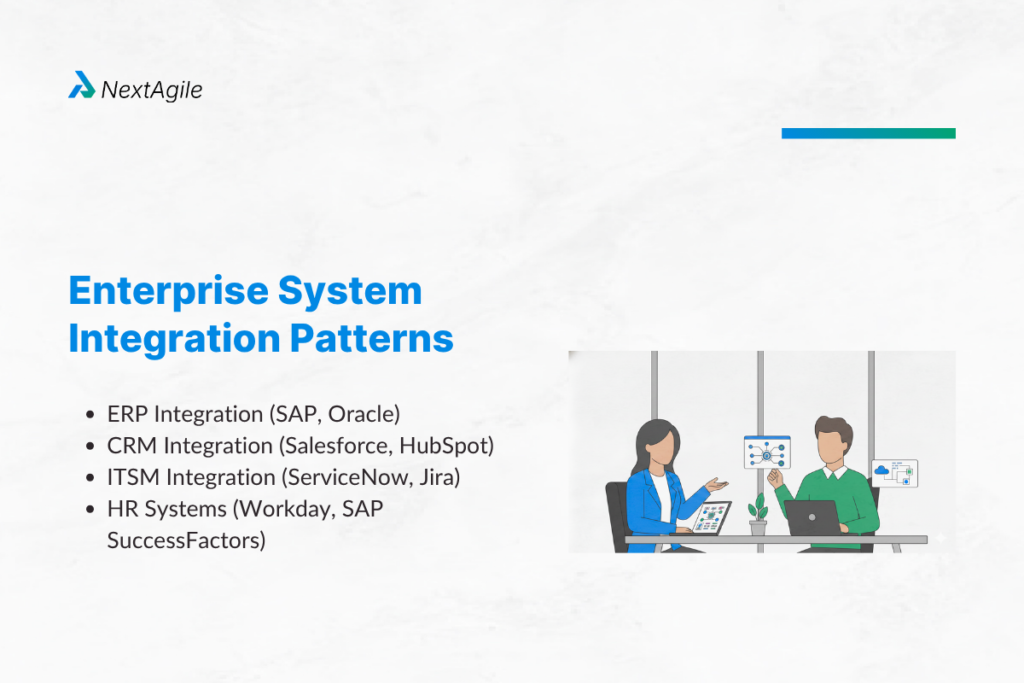
Enterprise System Integration Patterns ERP Integration (SAP, Oracle): Read master data via API with least-privilege access. Write actions (purchase orders, record updates) require HITL approval at Level 1 autonomy minimum.
CRM Integration (Salesforce, HubSpot): Customer-facing agents read account history and deal stage. Write actions require confidence thresholds and full audit logging.
ITSM Integration (ServiceNow, Jira): IT support agents triage, classify, and resolve tickets. Ticket creation and status updates operate at Level 3 autonomy. Escalation to on-call engineer triggers explicit escalation logic.
HR Systems (Workday, SAP SuccessFactors): Onboarding agents create accounts and assign training. PII handling requires strict data masking and retention policy enforcement.
For agile delivery teams integrating agentic AI into sprint workflows, NextAgile’s AI for Agility Workshop covers Jira-integrated agentic workflows for sprint planning, retrospective analysis, and release management.
ROI Measurement Framework Define ROI metrics before deployment in 3 categories:
Category 1: Labor efficiency
Baseline: Hours per week on the target workflow Metric: Percentage of workflow hours automated at each autonomy level Example: IT support hours reduced from 40 to 12 per week Category 2: Quality improvement
Baseline: Error rate, resolution rate, or CSAT pre-deployment Metric: Change in quality metric at 30, 60, 90 days Example: First-call resolution increases from 42% to 68% Category 3: Speed acceleration
Baseline: End-to-end workflow cycle time Metric: Cycle time reduction percentage Example: Employee onboarding time reduced from 5 days to 1 day Enterprises that define ROI metrics before deployment report average ROI of 171% within 18 months. Those that deploy without defined metrics rarely demonstrate sufficient value to sustain investment beyond 12 months.
Conclusion The agentic AI architecture framework for enterprises is a 6-layer design problem, not a tool selection problem. Most enterprise deployments that fail do so because teams select a framework before designing the governance, memory, and integration layers that determine whether any framework can operate safely in production.
The 6 layers to design before deployment:
Foundation Model Layer: LLM selection, fallback routing, cost optimization Memory and Context Layer: Short-term and long-term memory with governance Reasoning and Planning Layer: ReAct, ReWOO, or Tree of Thoughts Tool and Integration Layer: MCP-compliant connectors with least-privilege controls Orchestration Layer: Sequential, parallel, or supervisor-worker Governance and Observability Layer: HITL checkpoints, audit logging, autonomy graduation For enterprise teams starting or scaling agentic AI deployment, NextAgile’s Agentic AI Workshop provides hands-on architecture design sessions in your specific technology environment. Contact us at consult@nextagile.ai .
Frequently Asked Questions Q1. What is an agentic AI architecture framework? An agentic AI architecture framework is the technical structure defining how AI agents are designed, connected, coordinated, and governed within an enterprise environment. It specifies 6 architectural layers: foundation model, memory, reasoning, tool integration, orchestration, and governance. Without this framework, individual agent deployments produce inconsistent governance, duplicated infrastructure, and unmanageable technical debt as the deployment scales.
Q2. What is the difference between traditional AI architecture and agentic AI architecture? Traditional AI follows a stateless pipeline: human sends a prompt, model returns a response. Agentic AI supports stateful, multi-step autonomous workflows: the agent receives a goal, plans steps, calls external tools, manages persistent memory, coordinates with other agents, and adapts when steps fail. The infrastructure required is fundamentally different. Agentic AI needs orchestration layers, memory stores, tool registries, and governance mechanisms that do not exist in traditional AI deployments.
Q3. Which agentic AI framework is best for enterprise use in 2026? The best framework depends on technical context and governance requirements. Microsoft-centric organizations get the fastest time-to-value from Copilot Studio. Python-first technical teams building custom workflows should evaluate LangGraph (complex stateful logic) or CrewAI (role-based multi-agent coordination). Regulated industries (BFSI, healthcare) should evaluate IBM watsonx Orchestrate for enterprise compliance. High-volume, real-time requirements are best served by Akka’s event-driven architecture.
Q4. What is the Model Context Protocol (MCP) and why does it matter? MCP is an open standard developed by Anthropic in 2024 that defines how AI agents connect to external tools. Before MCP, every agent framework used a proprietary tool integration format, making it impossible to reuse tools across frameworks. MCP standardizes the agent-to-tool interface so that a Salesforce connector built for LangGraph works equally well with AutoGen or Copilot Studio. For enterprises building multi-vendor agent ecosystems, MCP compliance is now a baseline integration requirement.
Q5. How do you govern agentic AI in enterprise production? Enterprise agentic AI governance requires 5 capabilities:
Q6. How do you calculate ROI for an enterprise agentic AI investment? Calculate across 3 categories: labor efficiency (baseline hours on target workflow vs hours post-deployment), quality improvement (error rate, CSAT, or resolution rate change), and speed acceleration (cycle time reduction). Define these metrics before deployment, measure at 30, 60, and 90 days, and use the data to justify continued investment. Enterprises that define metrics before deployment report average ROI of 171% within 18 months; those that don’t rarely sustain investment beyond 12 months.
Rahul seasoned technology leader with 20+ years of experience, now dedicated to mentoring and training individuals and groups in Generative AI, advanced AI/ML system design, and production best practices. He is a hands-on tech entrepreneur and has deep industry experience in building cutting-edge AI products.
 Skip to content