Key Highlights Of AI Integration Consulting
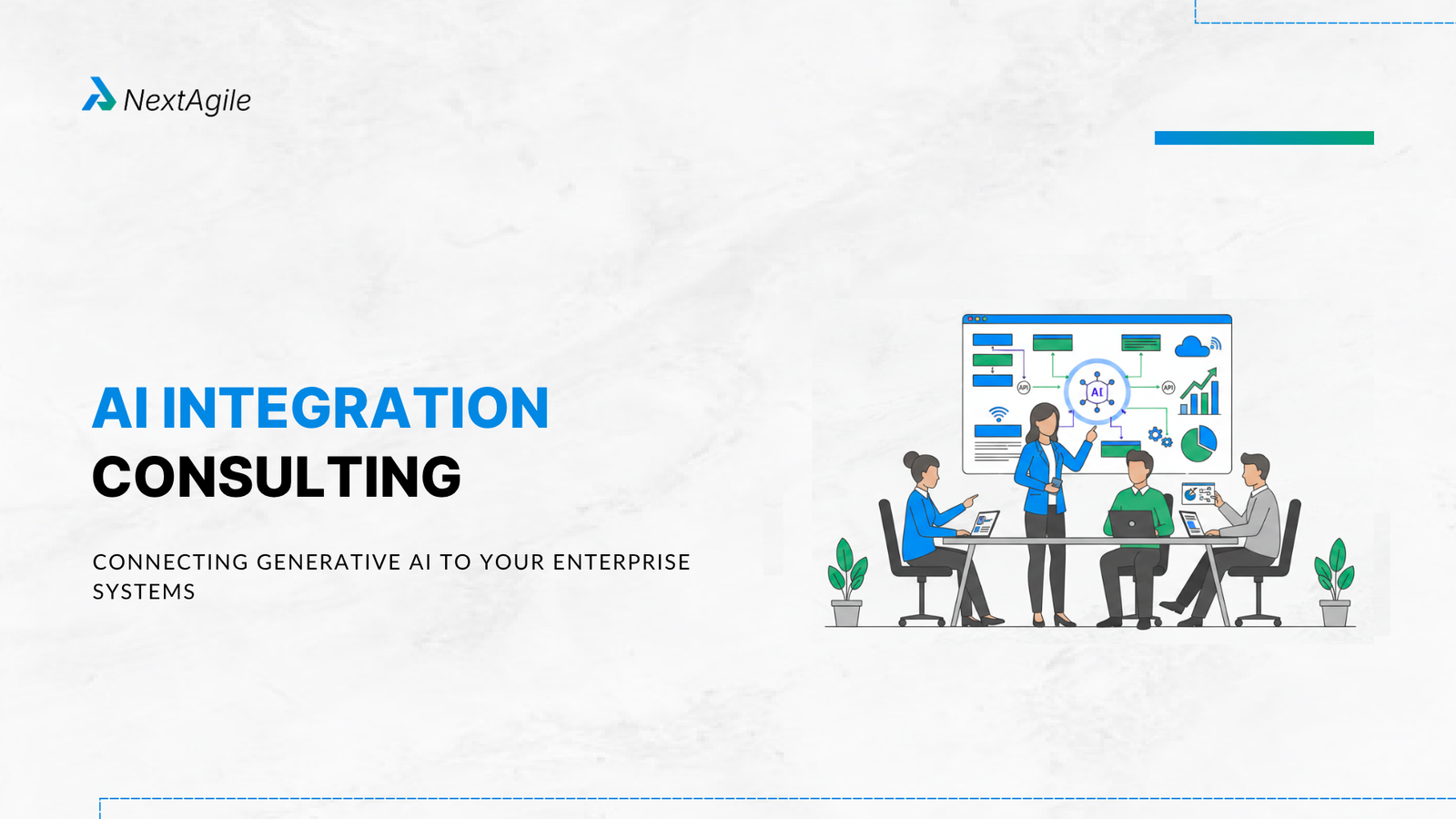
Most enterprises have spent the last two years experimenting with generative AI. ChatGPT pilots. Copilot deployments. Internal chatbots. Teams are excited about what’s possible. But few organizations have actually integrated AI into their core enterprise systems where it could drive real business value. This gap between experimentation and integration is where enterprises get stuck. AI integration consulting helps you move beyond pilots into production systems that genuinely transform how work gets done.
Why AI Integration Is Harder Than People Think?
The first generative AI experiments were easy because they were disconnected from everything else. A team spins up ChatGPT or Claude, writes some prompts, and shows it to colleagues. It’s impressive. It feels transformative. But when you try to integrate that same AI capability into your actual business processes and systems, complexity explodes.
- Deterministic vs Probabilistic
The problem is that enterprise systems are built on assumptions that don’t work well with AI. Most enterprise applications need deterministic results. You input data, you get predictable output. AI models are probabilistic. They generate different outputs even for the same input. They hallucinate. They make mistakes. They need human judgment to verify their work. This fundamental mismatch between how enterprise systems work and how AI works creates integration challenges that pure technical solutions can’t solve.
- Data Integration
Your enterprise systems have data scattered across multiple platforms. Customer data in your CRM. Product data in your ERP. Financial data in your accounting system. Operational data in specialized tools. Getting AI systems to work with data that’s fragmented and siloed requires integration work. You need APIs. You need data pipelines. You need governance over how AI systems access sensitive data. This takes time and money.
- Ownership and Accountability
When an AI system integrated into your workflow makes a recommendation that a human implements and something goes wrong, who’s responsible? The person who built the AI system? The person who implemented its recommendation? The business leader who deployed it? Without clear accountability structures, enterprises either block AI integration or create risks they don’t understand.
The enterprises that succeed at AI integration take time to think through these challenges before they start building. Many organizations formalize this through an AI operating model for enterprise transformation, ensuring integration is aligned with business architecture. They work with AI consulting companies who understand both AI and enterprise systems integration. They recognize that connecting AI to systems that are critical to business operations requires discipline and rigor, not just technical capability.
These challenges are also closely tied to why AI transformation projects fail in most enterprises despite strong pilots.
The Architecture Decisions That Matter Most
When you’re integrating AI into enterprise systems, several architectural decisions have enormous implications for success or failure.
- At what Layer do we integrate AI
The first decision is whether to integrate AI at the data layer or at the application layer. At the data layer, you’re building AI capabilities that operate on your enterprise data and feed results back into your systems. An example would be an AI system that analyzes customer behavior data and automatically updates your CRM with predicted lifetime value. At the application layer, you’re building AI capabilities that users interact with directly. An example would be an AI assistant that helps customer service representatives by summarizing customer history and suggesting responses.
Data layer integration is more powerful but more complex. It requires careful governance over data access and accuracy. If your AI system is updating your CRM and it’s wrong, it corrupts your single source of truth. Application layer integration is safer because humans remain in the loop making final decisions, but it’s less transformative because it requires human judgment rather than automating decisions.
The best enterprises use both approaches.
- They integrate AI at the data layer for low-risk, high-volume decisions where speed and consistency matter.
- They integrate at the application layer for decisions where human judgment needs to remain involved. They’re clear about which approach they’re using for each use case and why.
- Proprietary AI services vs Open source models
The second decision is whether to use proprietary AI services or open-source models. Cloud providers offer integrated AI services that work nicely with their other services. You pay for convenience and integration. Open-source models give you more control and potentially lower costs, but you own the infrastructure and maintenance. Most enterprises end up in a hybrid state where they use proprietary services for some capabilities and open-source models for others.
The key is evaluating tradeoffs explicitly.
- If you’re integrating AI into a customer-facing application where latency matters, proprietary services with global infrastructure might be worth the cost.
- If you’re doing batch processing of internal documents, open-source models you host yourself might be more cost-effective. The decision should be made consciously based on your specific requirements, not by default.
Enterprises often evaluate different generative AI tools for enterprises before deciding their integration architecture.
- Custom AI models vs Pre-built models
Pre-built models like GPT-4 or specialized models for document processing are available and relatively easy to integrate. Custom models trained on your data can be more accurate for your specific use cases but require more development effort and data science expertise.
- The best enterprises start with pre-built models where they exist because they’re fast to integrate and often good enough.
- As they mature and understand their specific needs better, they invest in custom models for differentiation.
This staged approach lets you get value quickly while building toward more sophisticated capabilities.
The Data Integration Challenge
Integrating AI into enterprise systems requires solving data integration problems that many organizations have been struggling with for years. Most enterprises have data scattered across multiple systems that don’t talk to each other cleanly. Integrating AI means you need clean, accessible data flowing where AI systems need it.

- The best data integration approaches for AI start with understanding your specific AI use cases and what data they need. Don’t try to create a unified data platform for all possible AI uses.
- Start with your highest-priority use cases, understand their data requirements, and build pipelines to support them. You can always extend to other use cases later.
- This requires practical decisions about data freshness. Does your AI system need real-time data? Can it work with data that’s a few hours old? Can it work with daily snapshots? Real-time data integration is complex and expensive. If your AI system can operate effectively on stale data, you save enormous engineering effort.
- It also requires decisions about data completeness. Most enterprise data has missing values. Your AI system will need to handle that. Do you impute missing data, or do you build the model to work with incomplete data? This affects both technical integration and the accuracy of your AI systems.
Many enterprises discover during AI integration work that their data is messier than they thought. Column names are inconsistent. Data quality is worse than expected. Data definitions are ambiguous across systems. These data quality issues don’t matter much for reporting and analytics. They matter a lot for AI systems.
You can’t train an effective AI model on garbage data. You need to invest in data cleaning and quality improvement before or during AI integration.
API Design for AI Integration
When you’re integrating AI into systems, you’re often building or using APIs that expose AI capabilities to other systems. Getting API design right is critical because it determines how easy or hard it is to use AI capabilities and whether you can scale them.
- The best API design for AI capabilities includes versioning because AI models change over time and you need to be able to update them without breaking downstream systems.
- It includes clear documentation of what the model does well and what it does poorly.
- It includes error handling and fallback strategies for when the model fails or returns an uncertain result.
- It includes monitoring and logging so you can see how the API is being used and whether it’s performing as expected.
- It also includes rate limiting and access controls because AI systems can be expensive to run and you need to prevent misuse.
- It includes SLAs around availability and latency because downstream systems are depending on the API to function.
- It includes clear documentation about what data the model was trained on and what biases or limitations it might have.
Most importantly, the API design needs to acknowledge that AI systems are probabilistic. The API should return not just predictions but confidence scores. It should make clear what data was used to generate the prediction and whether there are any concerns about the data quality or model applicability to this specific case. Downstream systems need this information to decide whether to use the prediction or escalate to a human.
Managing Risk in AI Integration
Integrating AI into critical business systems creates risks that need to be actively managed.
- Accuracy Degradation & Continuous Monitoring
The first risk is accuracy degradation. Your AI model was accurate when you trained it, but as real-world data flows through your system, the model’s performance might degrade. Customer behavior might change. Data quality might decline. Your model might be making predictions on data types it wasn’t trained on. Without monitoring, you might be making bad decisions based on degraded models and not realize it for weeks or months.
The solution is continuous monitoring of model performance. Track metrics like prediction accuracy, prediction distribution, and input data characteristics. Set up alerts when these metrics drift outside expected ranges. Build processes to quickly retrain models or roll back to previous versions when performance degrades.
- Integration Failure Handling
The second risk is integration failures. If your AI system is integrated into a critical workflow and it fails, what happens? Does the whole system go down? Does work back up? Does a human take over? You need to think through failure scenarios and have graceful degradation strategies. Sometimes that means falling back to a previous process that doesn’t use AI. Sometimes it means escalating to a human for decisions. But you should have a plan, not discover it when failure actually happens.
- Data Leakage & Misuse Prevention
The third risk is data leakage or misuse. If your AI system is integrated into multiple systems and has access to sensitive data, how do you prevent that data from leaking or being misused? You need clear governance over what data AI systems can access, audit trails showing how data was used, and technical controls preventing inappropriate access.
- Model Bias
The fourth risk is model bias producing biased decisions at scale. A biased AI model integrated into a system that makes thousands of decisions could systematically disadvantage certain groups of people. This risk is high enough that you need active testing for bias before integration and ongoing monitoring for bias after deployment.
Change Management in Integration Projects
AI integration projects fail as often because of change management issues as technical issues. You’re changing how work gets done. Some jobs are going to change fundamentally. Some roles might disappear. Some people will be asked to work differently with AI assistance.
- The best change management approaches start with honesty about what’s changing. Don’t pretend everything will stay the same. Tell people clearly what’s going to change, why it’s changing, and what opportunities and challenges that creates. Some people will embrace the change. Some will resist. Both reactions are understandable and need to be managed.
- The change management needs to include training that’s specific to the roles being affected. Your customer service representatives need different training than your loan officers. Your operations managers need different training than your finance team. The training needs to be hands-on and ongoing, not just a one-time classroom session.
- It also needs to include early access for people in affected roles so they can learn how to work with AI systems before go-live. You want them to discover issues, provide feedback, and build confidence in the system before it goes into full operation. People who feel heard and included in the integration process are much more likely to make it successful.
The change management should celebrate early wins and learn from setbacks. When an AI integration delivers value, share the story. When something doesn’t work as expected, discuss openly what happened and what was learned. This builds momentum and helps people see the integration as a journey of continuous improvement rather than a big bang rollout that either succeeds or fails.
Vendor and Partnership Strategy for Integration
AI integration projects are complex enough that most enterprises benefit from external help. The decision is whether to do the integration yourself with consulting support, rely heavily on system integrators to do the work, or use managed services where a vendor handles the integration and operation.
Each approach has tradeoffs. Internal integration with consultant support gives you the most control and builds internal capability, but it requires your team to drive the work and learn from failures. System integrators bring deep expertise in integration projects but might not understand your business context as well as internal teams. Managed services are easiest operationally but lock you into a vendor relationship for ongoing operation.
The best approach is often layered. Use internal teams and consultants to drive your integration strategy and make key architectural decisions. Use system integrators for heavy lifting around data pipelines and infrastructure. Use managed services for commodity AI capabilities that aren’t strategic differentiators. This mix keeps you in control while leveraging expertise where it matters most.
Many enterprises accelerate this journey using generative AI consulting services for enterprise-scale implementation. You can also reach out to us at consult@nextagile.ai to explore how we can support your AI transformation journey.
Frequently Asked Questions
1.How long does a typical AI integration project take?
It depends on complexity, but three to six months is realistic for a moderately complex integration. Simple integrations might take six weeks. Complex integrations might take 12 months. The timeline depends on data readiness, complexity of systems being integrated, and how much change management is needed. Many enterprises underestimate change management and assume projects take longer than they planned.
2. What’s the minimum viable product for AI integration?
Start with a specific, high-value use case. Don’t try to integrate AI across your entire operation. Pick one workflow that would benefit from AI, integrate AI into that workflow, get it working well, then expand to other workflows. This staged approach lets you learn and build confidence incrementally.
3. How do we measure whether an AI integration is successful?
Look at both operational metrics and business metrics. Operational metrics include API uptime, latency, and error rates. Business metrics include how much the AI integration is used, whether it reduces work, whether it improves decision quality, and what the return on investment is. The best measure is whether the integration delivered the business value it was supposed to deliver.
4. What happens if our AI system makes a mistake in production?
You should have a process for detecting, understanding, and fixing the mistake. This includes monitoring to catch the mistake, root cause analysis to understand why it happened, a fix (either retraining the model or adjusting the integration), and communication to affected stakeholders. You should also have a rollback plan in case you need to turn off the AI system while you’re fixing the problem.
5. How do we prevent our integrated AI systems from creating new problems?
By thinking proactively about failure modes and edge cases during integration planning. By building in monitoring and alerts. By having human oversight and controls. By being transparent about what the AI system does and doesn’t do well. By testing thoroughly before production deployment. By being willing to restrict the AI system’s autonomy in cases where the risk of getting it wrong is high.