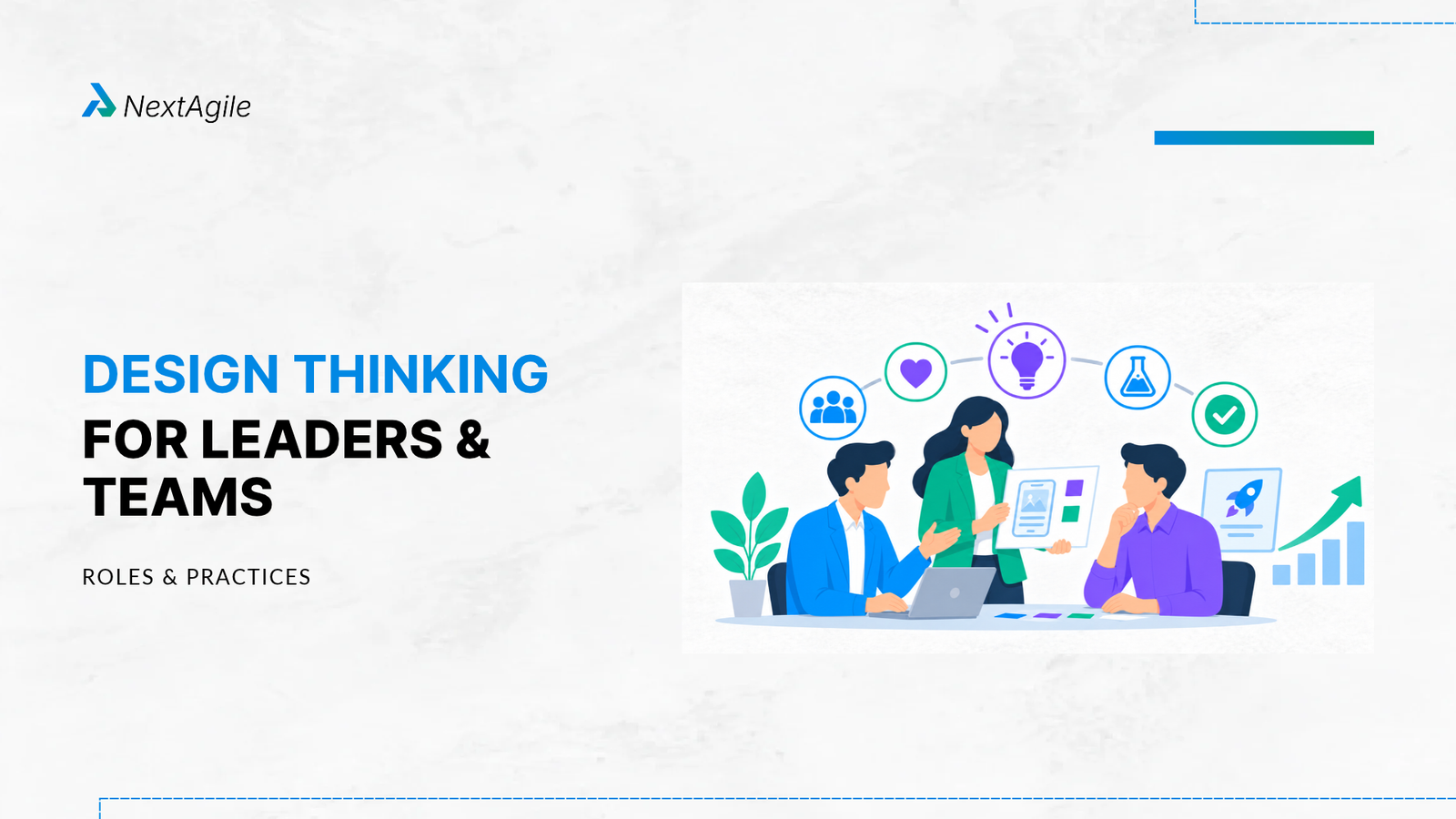
Design thinking for leaders and teams is a human-centred approach to solving business problems, improving experiences and developing practical solutions through collaboration and experimentation. While leaders establish strategic direction, allocate resources and create an environment for innovation, teams investigate user needs, challenge assumptions, develop ideas and test potential solutions.
The distinction is important because successful innovation requires more than creative thinking. Leaders must identify the right problems and give teams the autonomy to explore solutions. Teams must translate those priorities into meaningful improvements supported by user research, experimentation and evidence.
When both roles work together, design thinking becomes more than an innovation exercise. It becomes an organisational capability that helps businesses improve customer experiences, strengthen internal processes and respond to changing market expectations.
Key Takeaways From This Blog Leaders establish strategic priorities, sponsor innovation and create the conditions for experimentation. Managers connect leadership expectations with team activities, resources and implementation responsibilities. Teams use research, empathy mapping, problem reframing and prototyping to develop user-centred solutions. Cross-functional collaboration helps organisations solve problems that cannot be addressed effectively by individual departments. Design thinking initiatives should be measured through validated learning, user outcomes and business improvements. Leadership support is essential for moving successful experiments from prototypes into everyday operations. Why Leaders and Teams Need Different Approaches to Design Thinking Consider an organisation experiencing declining customer satisfaction. Senior management believes a new digital platform will improve the customer experience, while customer service employees believe the real problem is slow complaint resolution.
The technology team starts exploring possible solutions, operations identifies process bottlenecks and customer service highlights communication gaps. Everyone wants to improve the experience, but each department sees the problem differently.
This is where design thinking becomes valuable. It helps leaders establish the business challenge while enabling teams to investigate actual user experiences before committing to solutions. Instead of assuming what needs to change, the organisation develops a shared understanding of the problem.
Design thinking is therefore not limited to product designers or innovation specialists. It is equally relevant to executives making strategic decisions, managers coordinating teams and employees working directly with customers and internal processes.
Leadership and Team Responsibilities in Design Thinking Although leaders and teams follow the same overall approach, their responsibilities differ at each stage.
Responsibility Leaders and executives Managers and teams Problem identification Identify strategic business challenges. Investigate specific user and operational problems. User understanding Provide access to customers and stakeholders. Conduct interviews, observations and research. Problem framing Establish business context and desired outcomes. Translate insights into actionable problem statements. Ideation Encourage exploration and challenge assumptions. Generate and evaluate potential solutions. Experimentation Allocate resources and establish boundaries. Build prototypes and test assumptions. Decision-making Make strategic and investment decisions. Recommend improvements based on evidence. Implementation Remove organisational barriers and establish priorities. Collaborate with delivery teams to implement validated solutions.
The distinction is important because leadership without team involvement can produce solutions based on assumptions. Similarly, teams without leadership support may develop promising ideas but struggle to secure resources or implement them.
Understanding the design thinking principles for business problem-solving helps organisations establish a common approach to identifying opportunities, understanding users and evaluating solutions.
What Leaders Own in Design Thinking Design thinking for leaders involves creating the conditions in which innovation can happen consistently. Leaders are not expected to generate every idea or participate in every research activity. Their responsibility is to ensure that teams are solving meaningful problems and have the support needed to explore possible solutions.
Effective leadership also requires knowing when to provide direction and when to step back. Too little involvement can leave teams without clarity, while excessive control can discourage experimentation and prevent employees from exploring alternative approaches.
Sponsoring Innovation and Protecting Time for Experimentation Innovation requires more than asking employees to think creatively. Teams need time, resources and access to relevant information before they can investigate problems and test potential improvements.
Leaders should protect time for experimentation, provide access to customers and employees, and remove approval barriers that unnecessarily delay small experiments. They should also make sure that teams have the right combination of business, operational and technical expertise.
For example, an organisation experiencing high employee turnover may initially consider introducing a new onboarding platform. Leadership can instead sponsor an investigation into employee experiences, allowing the team to identify whether unclear responsibilities, inconsistent communication or limited manager support are the real issues.
This approach helps organisations avoid investing in solutions before understanding the problem. It also creates opportunities to test smaller improvements before committing to larger initiatives.
Design Thinking for Executives: Setting Direction and Decision Rights Design thinking for executives requires connecting human-centred problem-solving with organisational strategy. Executives must determine which challenges deserve attention and establish the boundaries within which teams can experiment.
This includes defining strategic priorities, approving appropriate budgets, clarifying decision-making authority and agreeing on how outcomes will be evaluated. Teams should understand which decisions they can make independently and which require leadership involvement.
For example, an executive may identify customer retention as a strategic priority without prescribing a particular technology or service improvement. Cross-functional teams can then investigate customer experiences and recommend solutions based on their findings.
This balance gives employees the freedom to explore alternatives while ensuring that innovation remains connected to business objectives.
Reviewing Research Findings, Prototypes and Business Opportunities Leaders must evaluate evidence rather than favouring ideas simply because they appear innovative or align with existing assumptions. Research findings and prototype feedback should form the basis of investment and implementation decisions.
A useful approach is to evaluate potential solutions through three dimensions:
Decision factor Question leaders should ask Desirability Does the solution address a genuine customer or employee need? Feasibility Can the organisation realistically develop and implement it? Viability Does the solution support business priorities and long-term value?
For instance, a prototype may receive positive feedback from a small group of customers but require substantial operational investment. Leaders should consider whether the opportunity justifies further testing before approving a wider rollout.
The objective is not to select the most impressive idea. It is to identify solutions that create user value, can be implemented effectively and make business sense.
Creating Psychological Safety for Innovation Employees are more likely to identify problems and suggest improvements when they feel comfortable expressing different opinions. This is particularly important when design thinking requires teams to challenge established processes or question decisions made by senior stakeholders.
Leaders can encourage this behaviour by welcoming constructive disagreement, asking open questions and treating unsuccessful experiments as opportunities to learn. Building emotional intelligence for leaders also helps them respond to disagreement with curiosity rather than defensiveness. They should also recognise employees who identify overlooked problems rather than rewarding only successful implementations.
Psychological safety does not remove accountability. It allows employees to investigate ideas, share evidence and learn from mistakes without fearing unfair criticism.
The Leadership Balancing Act: Control Versus Autonomy One of the biggest challenges in design thinking in leadership is finding the right balance between organisational control and team autonomy. Leaders must maintain accountability while allowing employees enough freedom to discover solutions.
Three common leadership dilemmas illustrate this challenge.
Leadership dilemma Recommended approach Business targets versus experimentation Protect limited time and resources for structured experiments. Strategic control versus team autonomy Set clear boundaries but allow teams to develop solutions. Speed versus user validation Encourage rapid testing instead of premature implementation.
Managers play an important role in maintaining this balance. They translate strategic priorities into achievable team objectives, coordinate resources and ensure that experiments do not disrupt essential business operations.
For example, a team investigating customer complaints may be allowed to test a revised service workflow with a limited customer group. Leadership establishes the scope and success criteria, while the team determines how to improve the experience.
This creates accountability without restricting problem-solving to predetermined solutions.
Five Leadership Mistakes That Stall Design Thinking Initiatives Even organisations that understand the value of design thinking can struggle to make it part of everyday work. The problem often lies in how leaders introduce the approach and whether they support it beyond the initial initiative.
The following mistakes can limit innovation and prevent teams from converting ideas into meaningful outcomes.
1. Starting With a Predetermined Solution Leaders sometimes approach an organisational challenge with a preferred solution already in mind. For example, they may decide to introduce a new customer service platform before investigating why customers are dissatisfied.
This limits exploration and encourages teams to validate an existing decision rather than understand the underlying problem. Leaders should begin with an open-ended challenge and allow research findings to guide solution development.
2. Treating Design Thinking as a One-Time Exercise A single brainstorming session can generate interesting ideas, but it cannot replace continuous research, experimentation and refinement. Without follow-up responsibilities, teams may struggle to move beyond initial concepts.
Leaders should integrate design thinking into regular business activities. Establishing checkpoints for prototype testing, feedback and implementation helps maintain momentum and creates opportunities for continuous improvement.
3. Ignoring User Research and Employee Feedback Internal assumptions do not always reflect actual customer or employee experiences. A solution that appears practical from a management perspective may introduce additional complexity for the people expected to use it.
Leaders should ensure that teams regularly interact with users through interviews, observations and feedback sessions. These insights provide a stronger basis for decisions and reduce the risk of developing irrelevant solutions.
4. Expecting Immediate Results Without Allowing Experimentation Innovation involves uncertainty, and teams may need several iterations before finding an effective solution. Expecting immediate results can encourage employees to choose familiar approaches instead of investigating alternatives.
Leaders should establish realistic experimentation timelines and measure early progress through learning, validated assumptions and user feedback. Business outcomes can then be evaluated as solutions become more mature.
5. Failing to Connect Prototypes With Implementation A prototype is useful only when its findings inform future decisions. Promising ideas can lose momentum when there is no clear ownership, implementation plan or connection with business priorities.
Leaders should define who will evaluate successful experiments, allocate implementation resources and coordinate with delivery teams. This ensures that validated solutions have a practical route towards adoption.
What Teams Do During the Design Thinking Process While leaders establish direction, teams are responsible for translating business challenges into practical solutions. This requires understanding users, identifying underlying problems and exploring different approaches before committing to implementation.
Design thinking for teams is an iterative process rather than a fixed sequence of activities. Teams may return to earlier stages when research reveals new information or testing challenges an existing assumption.
User Research and Empathy Mapping Teams begin by understanding the people experiencing the problem. Customer interviews, employee discussions, observations and feedback analysis help identify behaviours, frustrations and unmet needs.
Empathy mapping organises these findings into what users say, think, do and feel. It helps participants move beyond assumptions and develop a shared understanding of the experiences they are trying to improve.
For example, a customer service team may discover that customers are not only frustrated by delayed responses but also uncertain about whether their complaints are being addressed. This insight reveals an opportunity to improve communication and visibility.
Problem Framing and Reframing Once research findings are available, teams need to define the actual problem. A broad statement such as improve customer experience does not provide sufficient direction for developing meaningful solutions.
Teams should convert research insights into focused problem statements. For example, how might we help customers track service requests without repeatedly contacting support?
Problem reframing encourages employees to question existing assumptions and consider alternative explanations. It also prevents teams from jumping into solution development before understanding the underlying need.
Ideation and Collaborative Solution Development Ideation allows teams to explore different ways of addressing a clearly defined problem. Structured brainstorming, divergent thinking and collaborative evaluation help participants generate possibilities before selecting ideas for further investigation.
Cross-functional participation is particularly valuable because different departments understand different aspects of the same challenge. Operations, technology, marketing and customer service employees may identify opportunities that would otherwise remain unnoticed.
Teams should evaluate ideas based on user value, feasibility and business relevance. This creates a stronger foundation for selecting concepts that deserve further testing.
Prototyping and Experimentation Prototyping helps teams turn ideas into simple representations that can be evaluated by users. These may include paper models, screen layouts, workflow diagrams, service blueprints or simulated customer interactions.
Low-fidelity prototypes are particularly useful during early experimentation because they are inexpensive to create and easy to modify. Teams can test important assumptions without investing in complete solutions.
For example, an employee onboarding team could create a sample onboarding journey and ask recently recruited employees to review the information, sequence and support activities.
Testing and Refining Solutions Testing helps teams understand whether a proposed solution addresses the original problem. Participants observe user interactions, collect feedback and identify areas that require improvement.
Feedback may reveal usability issues, missing information or assumptions that need to be reconsidered. Teams can then modify the prototype, conduct another test or return to problem framing.
This iterative process helps organisations make decisions based on evidence rather than committing significant resources to unvalidated ideas.
Connecting Leadership Expectations With Team Actions The relationship between leadership and team activities becomes clearer when both roles work towards the same business outcome.
Leadership expectation What the team actually does Improve customer retention Interviews customers who discontinued the service. Reduce employee onboarding time Maps the current onboarding journey. Improve operational efficiency Identifies process bottlenecks and dependencies. Improve service quality Tests alternative service workflows.
Managers connect these activities by coordinating participants, removing day-to-day barriers and communicating progress to leadership.
This creates a clear relationship between strategic priorities and the practical work required to deliver improvements.
Design Thinking Exercises for Teams Practical exercises help employees apply design thinking concepts to real organisational challenges. They are most useful when participants work with a specific problem rather than focusing exclusively on creative idea generation.
The following exercises can be adapted for customer experience, employee engagement, operational improvement and service delivery initiatives.
Empathy Mapping: Understanding User Needs Objective: Develop a shared understanding of user experiences and challenges.
Teams identify a specific user group and organise research findings into what users say, think, do and feel. They then look for recurring frustrations, behavioural patterns and unmet needs.
For an employee onboarding initiative, the team may identify that new employees understand their job responsibilities but struggle to find information about internal systems and approval processes.
Expected output: A documented set of user insights that can guide further investigation.
Problem Reframing: Challenging Existing Assumptions Objective: Convert broad organisational challenges into actionable problem statements.
Teams begin with an initial problem, identify assumptions and review available evidence. They then explore alternative interpretations and create focused How Might We questions.
For example, the problem of low training completion may be reframed as how might we make mandatory learning more accessible and relevant to employees’ daily responsibilities?
Expected output: A focused problem statement that provides direction for ideation.
Rapid Prototyping: Testing Ideas Before Implementation Objective: Evaluate potential solutions before committing significant resources.
Teams select an idea, identify the assumption that needs testing and create a simple representation using paper, diagrams, mock-ups or process maps. Relevant users then review the prototype and provide feedback.
An onboarding team could create a sample employee checklist to test whether new recruits can easily understand their first-week responsibilities.
Expected output: Initial feedback about usability, relevance and improvement opportunities.
Design Thinking Team Building Through Cross-Functional Collaboration Objective: Bring employees from different functions together to solve shared organisational challenges.
Participants describe how the problem affects their departments, map dependencies and identify opportunities for improvement. They then develop a shared problem statement and select an idea for further testing.
For example, HR, IT and department managers may collaborate to improve employee onboarding. Each function contributes knowledge about recruitment, system access and role-specific responsibilities.
Expected output: Shared ownership, stronger communication and a more practical approach to solving the problem.
A Practical Example: Improving Employee Onboarding Consider an organisation where new employees receive inconsistent information across departments. Some struggle to access systems, while others are unclear about their responsibilities during the first few weeks.
A cross-functional team involving HR, IT, managers and recently recruited employees can investigate the issue using the exercises discussed above.
The team begins with empathy mapping and discovers that employees experience confusion because onboarding information arrives from several different sources. Problem reframing helps identify the lack of coordinated communication as a central challenge.
The team then prototypes a standard onboarding checklist and communication sequence. After gathering feedback, leadership reviews the findings and supports implementation across departments.
The improvement is not necessarily a new technology platform. It may simply be a more coordinated process with clearer ownership and communication.
This example demonstrates how design thinking team building can help organisations move beyond departmental assumptions and develop solutions around actual employee needs.
A Half-Day Design Thinking Agenda for Leaders and Teams Organisations can introduce these practices through a structured half-day session focused on a real business challenge. The objective is to understand the problem, explore user needs and develop initial solutions that can be tested further.
The following agenda is illustrative and can be adapted according to the complexity of the challenge and the experience of participants.
Duration Activity Participants responsible Expected output 30 minutes Business problem definition Leaders and facilitators Agreed challenge and strategic context 45 minutes User insights and empathy mapping Cross-functional teams User needs and pain points 30 minutes Problem framing Teams with leadership input Clear problem statements 45 minutes Ideation Cross-functional teams Shortlisted solution ideas 45 minutes Rapid prototyping Teams Low-fidelity prototypes 30 minutes Feedback and evaluation Users and stakeholders Improvement opportunities 15 minutes Next steps and ownership Leaders and team representatives Agreed actions and responsibilities
Total duration: 4 hours.
The session should not end when participants present their ideas. Leaders should establish an implementation checkpoint, assign ownership for further testing and determine which proposals require additional resources.
This follow-through is what helps organisations convert a productive session into sustained business improvement.
How to Measure Whether Design Thinking Is Working The real measure of design thinking is not how many ideas a team generates, but how many assumptions it validates, user problems it resolves and measurable improvements it delivers.
For business leaders, innovation becomes valuable when learning translates into better customer experiences and stronger operational performance. Measurement should therefore evolve as initiatives move from exploration to implementation.
Measuring Learning and Experimentation During early stages, organisations should evaluate how effectively teams are investigating problems and testing assumptions. Useful indicators include the number of assumptions validated, user insights identified, experiments completed and prototypes tested.
Teams should also monitor how quickly they move from identifying a problem to testing an initial solution. These indicators reveal whether employees are learning efficiently and using evidence to guide decisions.
An unsuccessful prototype can still represent valuable progress if it reveals why an assumption was incorrect. Leaders should recognise this learning rather than evaluating experimentation only through successful ideas.
Measuring Business and Operational Outcomes Once solutions have been tested and implemented, organisations should assess their impact on users and operations.
Business area Potential indicators Customer experience Customer satisfaction, complaint frequency and customer effort Employee experience Employee satisfaction, onboarding completion and feedback Operational efficiency Process cycle time, error rates and manual effort Product adoption Usage rates and task completion Service delivery Response times and resolution times Implementation Time taken to move validated solutions into operational use
Metrics should reflect the specific problem being addressed. A customer service initiative and an employee onboarding initiative will require different indicators of success.
Connecting Innovation Outcomes With Business Priorities Leaders must evaluate whether tested solutions contribute to wider organisational objectives. Positive user feedback is important, but it should be considered alongside implementation feasibility and business value.
For example, improving an internal approval process may reduce employee effort and shorten turnaround times. Leaders should assess whether these improvements also support productivity and operational efficiency.
This creates a stronger connection between innovation activities and business performance. It also helps organisations prioritise solutions that offer meaningful value rather than investing in ideas simply because they are new.
When to Bring in External Design Thinking Support Internal teams may understand their business challenges but still need external expertise to manage complex discussions, improve collaboration or connect innovation activities with organisational priorities.
External support becomes particularly valuable when initiatives involve several departments, conflicting stakeholder expectations or significant changes to existing ways of working.
When Internal Teams Need Facilitation Teams may struggle to agree on the underlying problem, challenge established assumptions or manage discussions involving senior stakeholders. In such situations, an experienced facilitator can provide structure and encourage balanced participation.
A structured design thinking workshop can help employees understand the methodology and apply practical problem-solving techniques to relevant organisational challenges.
When Organisations Need Leadership Alignment Innovation initiatives can lose momentum when executives, managers and delivery teams have different expectations. External support can help clarify strategic priorities, decision-making responsibilities and success criteria.
Organisations can also strengthen leadership capabilities through relevant leadership development programmes that support collaboration, effective decision-making and organisational change.
Connecting Design Thinking With Wider Transformation Initiatives Design thinking can contribute to wider transformation when it becomes part of how organisations identify opportunities and improve existing processes.
It complements Agile by helping teams understand which problems are worth solving, while Agile supports iterative development and continuous delivery. Business agility extends this capability across the organisation, helping it respond to changing customer and market expectations.
Organisations pursuing enterprise Agile transformation can use design thinking to strengthen customer understanding, cross-functional collaboration and evidence-based decision-making.
The Agile culture transformation case study also provides a relevant perspective on the importance of developing collaborative and adaptive organisational behaviours.
Conclusion Organisations do not build innovation capabilities simply by teaching employees to generate better ideas. They build them by changing how leaders define problems, how teams challenge assumptions and how decisions are made across functions.
Leaders establish direction, provide resources and create the conditions for experimentation. Managers connect strategic expectations with everyday activities, while teams translate user insights into practical solutions through research, prototyping and testing.
When these responsibilities work together, design thinking moves beyond an innovation initiative and becomes an organisational capability. It helps businesses make informed decisions, improve experiences and respond more effectively to complex challenges.
At NextAgile, we help organisations strengthen design thinking and business agility capabilities through practical interventions that connect people, processes and business priorities. If your organisation wants to build a stronger culture of innovation, improve collaboration and solve complex business challenges, adopting design thinking can make a meaningful difference. NextAgile’s design thinking and business agility consulting can help you co-create practical approaches that align leadership priorities with team capabilities and business objectives. Reach out to us at consult@nextagile.ai , and we would be happy to explore how we can support your organisation’s transformation journey.
Frequently Asked Questions 1. Is design thinking still relevant in the AI era? Yes. Design thinking remains relevant because technology does not eliminate the need to understand human needs, define meaningful problems and evaluate potential solutions.
AI can support user feedback analysis, idea generation and prototype development. However, people must still interpret insights, challenge assumptions and evaluate ethical and business implications.
Design thinking helps ensure that AI-enabled solutions address genuine user problems rather than introducing technology without a clear purpose.
2. Design thinking vs Agile: Which should organisations use first? Design thinking helps organisations understand user needs, identify the right problems and explore possible solutions. Agile provides an iterative approach to developing, delivering and improving those solutions.
A common approach is to use design thinking before and alongside Agile delivery. Teams can investigate user needs and validate initial concepts before committing to development.
However, the two approaches are complementary rather than strictly sequential. Design thinking can continue throughout Agile delivery as teams gather feedback and discover new opportunities.
3. Can design thinking work for remote or hybrid teams? Yes. Remote and hybrid teams can apply design thinking through virtual interviews, collaborative digital whiteboards, online ideation sessions and digital prototypes.
Organisations should establish clear participation guidelines and ensure that research findings and decisions are accessible to everyone.
Combining live discussions with asynchronous collaboration also helps distributed teams contribute effectively across different schedules and locations.
4. Does design thinking apply outside product teams? Yes. Design thinking is relevant wherever organisations need to understand problems and develop better solutions.
HR teams can improve employee onboarding, operations teams can identify process inefficiencies, and customer service teams can improve support experiences. Marketing, finance and leadership functions can also use the approach to understand stakeholder needs and simplify internal processes.
Its human-centred nature makes it applicable across departments rather than limiting it to product development.
5. Do leaders need a design background to lead design thinking initiatives? No. Leaders do not need formal design qualifications to support design thinking.
Their responsibility is to establish strategic direction, encourage collaboration, provide resources and ensure that innovation initiatives remain connected to business priorities.
Understanding the fundamental principles of empathy, problem framing, ideation, prototyping and testing is useful. More importantly, leaders should be willing to listen to different perspectives and make decisions based on evidence.
6. What is the difference between design thinking and human-centred design? Design thinking is a structured approach to understanding problems, exploring opportunities and developing solutions through experimentation.
Human-centred design is a broader design philosophy that places people’s needs, experiences and contexts at the centre of the design process.
The two are closely connected. Design thinking commonly applies human-centred design principles through user research, empathy mapping, problem reframing, prototyping and testing.
Alok Dimri is the co-founder and leads the overall business at NextAgile, where he is responsible for strategy, client and consultant partnerships, and a whole lot of other core business activities like solutioning, branding, and customer engagement.
Over the past 16 years, he has worked extensively in business strategy, new business development, and key account management initiatives across process consulting and training domains.
 Skip to content