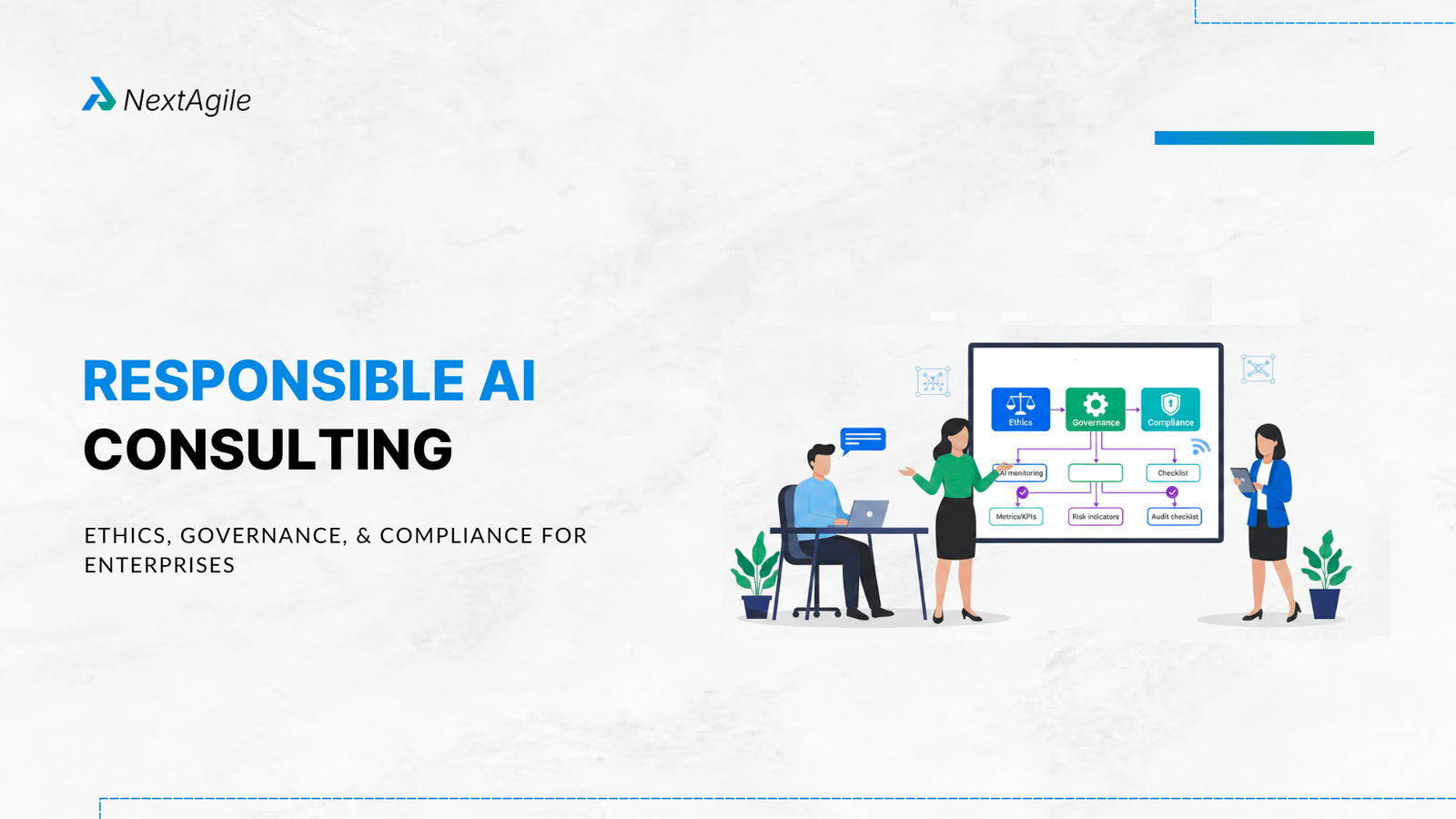
Key Takeaways Responsible AI is not optional. It is required by law, expected by customers, and essential for building trustworthy systems. The three pillars of responsible AI are ethics and fairness, compliance and governance, and transparency and explainability. Building responsible AI requires expertise that most organizations need to develop or acquire from external partners. The organizations that invest in responsible AI now will lead in the future.
Introduction The most dangerous assumption an enterprise can make about AI is that it only needs to work. It needs to be accurate. It needs to be fast. It needs to deliver business value. Those things are necessary but they are not sufficient. An AI system that works perfectly but discriminates against protected groups is not acceptable. An AI system that is accurate but opaque about how it makes decisions is not acceptable. An AI system that delivers business value but exposes customer data is not acceptable.
Responsible AI is not a nice-to-have. It is a business imperative. It is a legal imperative. It is a governance imperative. Enterprises that deploy AI systems without thinking through ethics, fairness, transparency, and compliance are taking risks that range from regulatory fines to reputational damage to loss of customer trust.
Most enterprises do not yet have a clear framework for thinking about responsible AI. They have procurement processes for AI tools. They have technology teams implementing AI solutions. But they do not have structured thinking about whether those solutions are responsible. That gap is what responsible AI consulting addresses.
Enterprises often extend their capabilities through generative AI consulting services to design scalable and governed AI ecosystems aligned with business risk and compliance needs.
Why Responsible AI Matters More Now Than Ever The conversation about AI ethics has been abstract. Philosophers and academics have discussed whether AI can be fair or whether algorithms can be transparent. Those discussions were interesting but felt disconnected from how enterprises actually build and deploy AI systems.
That distance has collapsed. Regulation is now concrete. The European Union AI Act went into effect in 2024. It defines categories of AI risk and specifies requirements for high-risk AI systems. Those requirements include impact assessments, human oversight, documentation, and transparency. This is not optional. This is law. If your enterprise operates in Europe or serves European customers, you need to comply.
Regulation is spreading. The United States has not passed comprehensive AI legislation, but individual states and industry regulators are moving. California has AI transparency regulations. The FDA has released guidance on AI in healthcare. The SEC has rules about AI in financial services. Compliance requirements are materializing in real time.
Fairness is now a business risk. If your AI system makes hiring decisions and discriminates against women or minorities, you face legal action from applicants. If your system makes lending decisions and has discriminatory impacts, you face action from regulators. If your system makes insurance decisions and treats customers unfairly, you face reputational damage and loss of customers. Fairness is not just ethics. It is risk management.
Transparency is now a customer expectation. Customers want to know how companies are using AI. They want to know what data is being used. They want to know how decisions that affect them are being made. Companies that cannot answer these questions are seen as untrustworthy. Companies that can answer these questions build customer loyalty.
The bottom line is that responsible AI is no longer optional. It is expected by regulators, required by law, and demanded by customers. Enterprises that ignore it are taking unnecessary risk.
A strong AI operating model for enterprise transformation ensures that governance, delivery, and accountability are embedded into AI adoption rather than treated as separate layers.
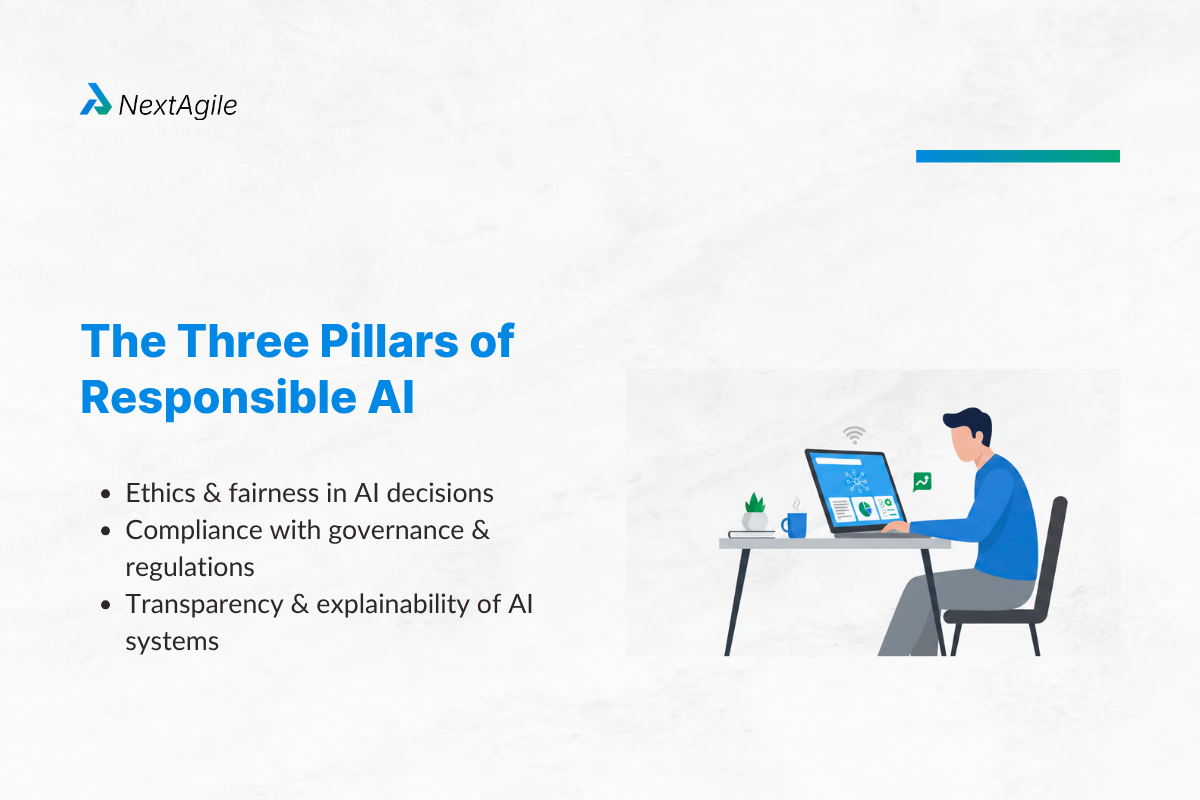
The Three Pillars of Responsible AI
Responsible AI rests on three pillars. Ethics and fairness, which is about whether the AI system treats people justly. Compliance and governance, which is about whether the system meets legal and regulatory requirements. Transparency and explainability, which is about whether humans can understand how the system makes decisions.
These three pillars are interconnected. You cannot have true compliance without ethics. You cannot have ethics without transparency. You cannot build trust without all three. But it is useful to think about them separately because each requires specific approaches and expertise.
Ethics and fairness is about ensuring that AI systems do not perpetuate or amplify human bias and discrimination. This sounds straightforward but it is not. Bias can come from many sources. It can come from training data that reflects historical discrimination. It can come from how you define the problem you are trying to solve. It can come from the metrics you use to evaluate the system. It can come from how you collect data. Responsible AI consulting helps identify where bias might be hiding and how to mitigate it.
Compliance and governance is about ensuring that your AI systems meet legal requirements and adhere to your organization’s values. This includes privacy compliance like GDPR and data protection laws. It includes industry-specific regulations like healthcare and finance rules. It includes internal governance frameworks that define what AI systems are allowed to do. Responsible AI consulting helps you understand what applies to your systems and how to build compliance into the system design.
Transparency and explainability is about ensuring that humans can understand why AI systems make the decisions they make. Some AI systems like decision trees or rule-based systems are inherently transparent. You can see exactly why they made a decision. Other systems like deep learning neural networks are opaque. You cannot easily explain why they made a specific decision. Responsible AI consulting helps you choose models that are appropriate for your use case and build explainability into systems that would otherwise be black boxes.
The Ethical Foundations of Responsible AI Ethics is the foundation. Everything else builds on it. But what does it mean to build AI ethically?
The first principle is fairness. Your AI system should not discriminate against individuals or groups based on protected characteristics like race, gender, age, or disability. This sounds simple but fairness in AI is genuinely complex. You can have a system that is fair in aggregate but unfair for specific subgroups. You can have a system that is fair on one metric but unfair on another. You can have a system that is fair by the metrics you chose but unfair by other metrics you did not consider.
Responsible AI consulting includes fairness audits that examine your systems for bias. This is not a checkbox exercise where you run some bias detection code and declare yourself fair. It is a substantive examination of where bias might exist and how to address it. This includes examining training data for bias. It includes examining model performance across different demographic groups. It includes examining the business logic around how predictions are used. All of these are potential sources of unfairness.
The second principle is accountability. Someone should be responsible for the outcomes of the AI system. If the system makes a bad decision that harms someone, that person should be able to appeal the decision and have a human review it. If the system is making decisions in a domain where individuals have rights, those individuals should have the right to know why a decision was made about them. This is not just ethics. This is law in many jurisdictions. But it is also common sense. If you are going to use AI to make decisions that affect people, people should have recourse when those decisions are wrong.
Accountability means building human oversight into your processes. Not just token oversight where humans review decisions after the fact. Real oversight where humans can understand the system, challenge its outputs, and make final decisions in consequential cases. This slows down the system compared to fully automated AI, but it preserves human agency and responsibility.
The third principle is transparency. Your organization should be able to explain how your AI systems work and why they make the decisions they make. This is different from explainability, which is about whether humans can understand individual decisions. Transparency is about whether you can describe the system at a high level. What data does it use? What is it trying to optimize? What assumptions does it make? What are the known limitations? If you cannot answer these questions about your own system, you have a transparency problem.
The fourth principle is privacy. AI systems handle data about individuals. That data has to be protected. Privacy is both an ethical principle and a legal requirement. Responsible AI consulting helps you understand what data you need, how to minimize data collection, how to protect data you do have, and how to comply with privacy regulations.
Regulatory Landscape and Compliance Requirements The regulatory landscape is becoming more complex. Different jurisdictions have different requirements. Different industries have different rules. But several themes are consistent.
The European Union AI Act is the most comprehensive AI regulation in the world. It categorizes AI systems into risk levels and applies different requirements to each level. Prohibited risk includes AI systems that manipulate people or allow government to bypass due process. High-risk AI includes systems that make decisions affecting fundamental rights like hiring, lending, or law enforcement. Medium-risk includes systems that generate synthetic content or interact with humans. Low-risk includes systems that do not create significant harm. Each risk level has different requirements for impact assessments, documentation, human oversight, and transparency. If you operate in Europe or serve European customers, you need to comply.
The United States does not have comprehensive AI legislation yet, but industry-specific regulations apply. Healthcare has FDA guidance on AI in medical devices. Finance has SEC rules on AI disclosures. Housing has Fair Housing Act requirements about AI in lending and rental. Employment has EEOC guidance about AI in hiring. Each of these applies specific requirements to AI systems in those domains. The trend is toward more regulation, not less.
Privacy regulations like GDPR and California Consumer Privacy Act impose requirements on how AI systems can use personal data. GDPR gives individuals the right to know if automated decision-making is being used about them and the right to human review of significant decisions. CCPA gives individuals the right to know what data is collected and how it is used. These regulations constrain how you can build AI systems and require transparency about system usage.
Responsible AI consulting helps you understand what regulations apply to your specific systems and what compliance looks like in practice. It helps you build compliance into system design rather than trying to retrofit it later. It helps you document your compliance so you can demonstrate it to regulators if needed.
Fairness, Bias, and Discrimination in AI Systems Fairness is one of the most complex aspects of responsible AI because fairness itself is a complex concept. What does it mean for an AI system to be fair?
One definition of fairness is that predictions should be equally accurate across demographic groups. If your AI system predicts customer churn, it should be equally accurate for men and women, for different age groups, for different ethnic groups. But there are mathematical trade-offs here. You cannot always have high accuracy for all groups. Sometimes improving accuracy for one group comes at the cost of accuracy for another group.
Another definition of fairness is equal impact. All demographic groups should have the same probability of positive outcomes. If your hiring AI recommends candidates at a sixty percent rate for men and forty percent rate for women, that is unequal impact. But this definition has problems too. If you have equal impact on hiring recommendations but the qualified candidate pools have different compositions, you might be making it harder for the qualified candidates from underrepresented groups to get jobs.
A third definition of fairness is equal opportunity. All qualified candidates should have equal probability of being selected. This sounds right but it requires you to define qualified, which is subjective.
The reality is that there is no single definition of fairness that is appropriate for all contexts. Different contexts require different fairness definitions. The job of responsible AI consulting is to help you choose the right fairness definition for your context and then build systems that achieve that definition.
The process starts with identifying where bias might exist. Training data often reflects historical bias and discrimination. If you train a hiring AI on historical hiring decisions from a company that historically discriminated against women, the AI will learn that discrimination. If you train a lending AI on historical lending decisions that reflected discriminatory practices, the AI will perpetuate those practices.
But bias is not just in the data. It is also in the problem definition. If you are predicting employee performance and you use tenure as a variable, you are biasing against people who have been discriminated against in the past because they have less tenure. If you are predicting credit risk and you use zip code as a variable, you are biasing against people in certain neighborhoods which is a proxy for race.
Responsible AI consulting includes audits that examine these potential sources of bias and help you design systems that mitigate them. This might mean excluding certain variables from the model. It might mean reweighting training data to correct for historical bias. It might mean monitoring model performance across demographic groups and retraining when performance degrades. It might mean having humans review high-stakes decisions rather than relying on the model entirely.
Building Transparency and Explainability Into AI Systems Transparency is about your organization understanding its systems. Explainability is about whether anyone can understand how a specific decision was made.
Some AI systems are inherently transparent. A decision tree is transparent. You can see exactly what conditions triggered a specific outcome. A linear regression model is transparent. You can see which variables influenced the prediction. Rule-based systems are transparent. You can see the rules that were applied.
Other AI systems are opaque. Deep learning neural networks are black boxes. You feed in data and get out predictions, but you cannot easily see why the network made that specific prediction. Large language models are opaque. You send in a prompt and get back text, but you cannot see which parts of the training data influenced the response.
Responsible AI consulting helps you choose models that balance accuracy with explainability. Sometimes a less accurate but more explainable model is better than a more accurate but opaque model. This is especially true when the decisions are consequential. If an AI system is helping approve loans, transparency about why someone was denied is important. If an AI system is helping screen job candidates, transparency about why someone was rejected is important.
For systems that are inherently opaque, responsible AI consulting includes building explainability tools. LIME and SHAP are two popular techniques that help explain individual predictions from opaque models. These techniques are imperfect but they give you insight into what variables influenced a specific prediction.
Responsible AI consulting also includes helping you document your systems. You should have documentation about what data your AI system uses, what the system is trying to optimize, what assumptions it makes, what the known limitations are, and how it performs across different populations. This documentation is valuable for internal understanding and it is often required for compliance.
Organizations often rely on Gen AI training services to upskill teams on responsible model design, explainability techniques, and ethical AI implementation practices.
Governance Frameworks and Human Oversight Ethics and fairness and transparency have to be operationalized through governance. Governance is the set of processes and controls that ensure AI systems are built and used responsibly.
Governance includes a review process for new AI systems before they are deployed. This review process assesses whether the system is fair, whether it complies with regulations, whether it has appropriate safeguards, and whether human oversight is built in. Not all systems pass review. Some systems need modifications before they can be deployed. Some systems should not be deployed at all.
Governance includes monitoring and auditing of deployed systems. After a system is deployed, you should regularly check whether it is still performing fairly. Data distributions change. User behavior changes. Over time, a fair system can become unfair. Regular auditing catches this.
Governance includes incident response processes. When an AI system makes a mistake or behaves unexpectedly, you need processes to investigate what went wrong, address the immediate problem, and prevent it from happening again.
Governance includes human oversight mechanisms. For high-stakes decisions, humans should be in the loop. This might mean humans reviewing every decision or it might mean humans reviewing decisions that exceed certain thresholds. The key is that consequential decisions have human accountability.
Governance includes training and culture. Your team needs to understand responsible AI principles. Your organization needs to value responsibility, not just functionality. This is cultural work, not just process work. It requires leadership commitment and organizational alignment.
A generative AI workshop for enterprise helps leadership and technical teams align on governance workflows, risk frameworks, and deployment safeguards for AI systems.
Common Pitfalls in Responsible AI Implementation
Pitfall one is treating responsibility as a compliance checkbox. You run a bias detection tool, declare yourself compliant, and move on. This is not responsible AI. This is theater. Responsible AI requires ongoing attention and continuous improvement.
Pitfall two is only thinking about fairness and ignoring transparency and privacy. These three pillars are interconnected. You need to address all of them, not just the one that feels most urgent.
Pitfall three is assuming that technical solutions alone will make you responsible. You cannot train away bias in data. You cannot build a model that is perfectly fair. You cannot explain away all the limitations of AI systems. Responsibility requires technical work combined with human judgment, governance processes, and organizational culture.
Pitfall four is deploying AI systems without understanding what they are optimizing for. If you are optimizing for prediction accuracy alone, you might build a system that is accurate but unfair or opaque. You need to explicitly optimize for fairness and explainability, not just accuracy.
Pitfall five is treating responsibility as the responsibility of the AI team alone. Everyone in the organization is responsible. The teams that use AI systems are responsible for using them appropriately. Leadership is responsible for setting the culture. Procurement is responsible for evaluating systems. This is an organizational commitment, not a technical one.
Many enterprises accelerate adoption through structured AI consulting services that integrate governance, ethics, and compliance into their AI strategy from the start.
Conclusion Responsible AI is no longer just a technical consideration, it is a business necessity shaped by ethics, compliance, and governance. Enterprises that embed responsible AI practices early are better positioned to reduce risk, build trust, and scale AI systems safely in an evolving regulatory landscape. The real advantage lies in moving from reactive compliance to proactive AI governance that supports innovation while keeping accountability intact.
Frequently Asked Questions 1. Do we really need responsible AI if our system is accurate? Yes. Accuracy and responsibility are different things. A system can be accurate in aggregate but unfair to specific groups. A system can be accurate but opaque. A system can be accurate but in violation of regulations. Accuracy is necessary but not sufficient for responsible AI.
2. What regulations apply to our AI systems? That depends on your industry, your geography, and what your system is used for. If you operate globally, EU AI Act likely applies. If you are in finance, SEC rules likely apply. If you are in healthcare, FDA guidance likely applies. If you use AI in hiring, employment law applies. You need to audit your systems against applicable regulations.
3. How do we know if our AI is biased? You conduct a fairness audit. This includes examining your training data for bias. It includes measuring model performance across demographic groups. It includes examining how predictions are used in practice. It includes gathering feedback from people affected by the system. Bias is usually not obvious. It requires deliberate examination.
4. Can we use AI to make hiring decisions? You can, but with careful constraints. Hiring decisions are high-risk because they affect fundamental rights and livelihood. If you use AI in hiring, you need to ensure fairness across demographic groups. You need human review of decisions. You need transparency about how the system works. You need audit trails so you can investigate if issues emerge. Many organizations are moving away from fully automated hiring AI because the risk is high relative to the benefit.
5. What is the cost of responsible AI consulting? It varies based on the complexity of your systems and the scope of the audit. A fairness audit for a single system might cost fifty to one hundred thousand dollars. Building responsible AI into your organizational processes and culture might cost several hundred thousand dollars. But the cost of getting responsible AI wrong is much higher. Regulatory fines, reputational damage, and loss of customer trust are expensive.
6. How long does a responsible AI assessment take? For a single system, a fairness and compliance assessment typically takes four to twelve weeks depending on complexity. Building organizational governance and processes typically takes four to six months. Building a culture of responsible AI is ongoing work that never really ends.
7. Should we halt AI projects while we implement responsible AI practices? You do not need to halt all projects, but you should have a process for evaluating new projects before they launch. Some projects might need to be paused while fairness and compliance issues are addressed. Other projects might be able to proceed with modifications. The point is that responsibility is built in from the beginning, not added afterward.
8. What should we do if we discover that our AI system is unfair? First, stop using it if it is causing harm. Second, investigate what went wrong. Third, fix the underlying issues. Fourth, audit the outputs from the system to identify individuals or groups that were harmed. Fifth, consider remediation for those people if appropriate. Sixth, communicate transparently about what happened and how you fixed it. This is difficult but it builds more trust than hiding the problem.
9. How do we explain our AI systems to customers? You explain it clearly and honestly. You tell them what the system is, what data it uses, and how it makes decisions. You tell them what its limitations are. You tell them how they can appeal if they disagree with a decision. You ask for feedback about whether their experience with the system was fair. This transparency builds trust.
10. What is the relationship between responsible AI and competitive advantage? Companies that deploy AI responsibly build customer trust and reduce regulatory risk. This is valuable. Companies that cut corners on responsibility might move faster initially but they build customer distrust and they are exposed to regulatory action. Over time, the companies that invest in responsible AI win.
11. The Strategic Imperative for Responsible AI Responsible AI is not a burden. It is an opportunity. Organizations that build AI responsibly are better positioned to trust their systems, to use them effectively, and to gain competitive advantage. Organizations that cut corners are exposed to risk that outweighs any short-term speed benefits.
The reason enterprises need responsible AI consulting is that building responsible AI is complex. It requires expertise in AI, in ethics, in law, in governance. Most organizations do not have all of those competencies internally. Working with consultants who bring those competencies helps you build systems that work, that are fair, that are compliant, and that your organization can trust.
The future will favor organizations that have thought through responsible AI seriously. Regulators will tighten requirements. Customers will demand transparency. Your team will be more confident in systems that are known to be fair. Consulting that helps you build that foundation now is consulting that pays dividends for years to come.
Alok Dimri is the co-founder and leads the overall business at NextAgile, where he is responsible for strategy, client and consultant partnerships, and a whole lot of other core business activities like solutioning, branding, and customer engagement.
Over the past 16 years, he has worked extensively in business strategy, new business development, and key account management initiatives across process consulting and training domains.
 Skip to content