...

Data and AI Consulting: How to Build the Right Foundation for Enterprise Intelligence

Data and AI Consulting How to Build the Right Foundation for Enterprise Intelligence

Key Takeaways

  • Data and AI consulting helps enterprises fix data quality, governance, and accessibility issues to unlock AI ROI
  • Poor data foundations, not algorithms, are the biggest bottleneck in scaling AI initiatives
  • Strong data governance with clear ownership and accountability accelerates AI development and decision-making
  • High-quality, integrated data enables more accurate models and faster deployment of AI systems
  • Embedding data privacy, security, and compliance into AI workflows reduces risk and builds trust
  • Enterprises that prioritize data foundations gain faster innovation, better insights, and long-term competitive advantage

The enterprises that dominate in an AI-driven world won’t be the ones with the fanciest AI algorithms. They’ll be the ones with the best data and the discipline to use it responsibly. Most enterprises understand this intellectually but struggle with the execution.

They have data scattered across systems. Data quality is inconsistent. Nobody is clear on data ownership. Getting data is slow and painful. This foundation problem is why data and AI consulting has become so critical. Many enterprises work with expert Generative AI Consulting Services partners to align data readiness with AI execution.

Why Data Is The Real Bottleneck

Enterprises often assume their data challenges will be solved by technology. They buy data platforms. They implement data lakes. They set up pipelines. But technology alone doesn’t solve data problems. The real bottleneck is organizational and process-oriented.

Most enterprises don’t have clear data governance. Nobody is accountable for data quality in different systems. Nobody is clear about who owns different data assets. Nobody understands what data exists or how to access it. This lack of clarity creates friction every single time you try to use data for anything important.

When you’re trying to build AI, this friction becomes paralyzing. You want to build a model using customer data. But customer data is scattered across three different CRM systems with different data models and different quality levels. Reconciling this data takes weeks. So you build your model on just one system’s data, acknowledging that you’re not getting the full picture. This results in a model that’s less accurate than it could be because you don’t have complete information.

You want to integrate your model into your operations. But the operational systems have their own data standards that don’t match the data you used to build the model. So you build translation layers and manual processes. Your AI system becomes fragile and expensive to maintain.

This kind of friction doesn’t just delay AI projects. It makes them fail more often. Many stalled initiatives follow the same pattern. We break this down in AI Transformation Failure: 3 Root Causes and How to Fix Them.  The enterprises that build data and AI foundations right solve this friction upfront.

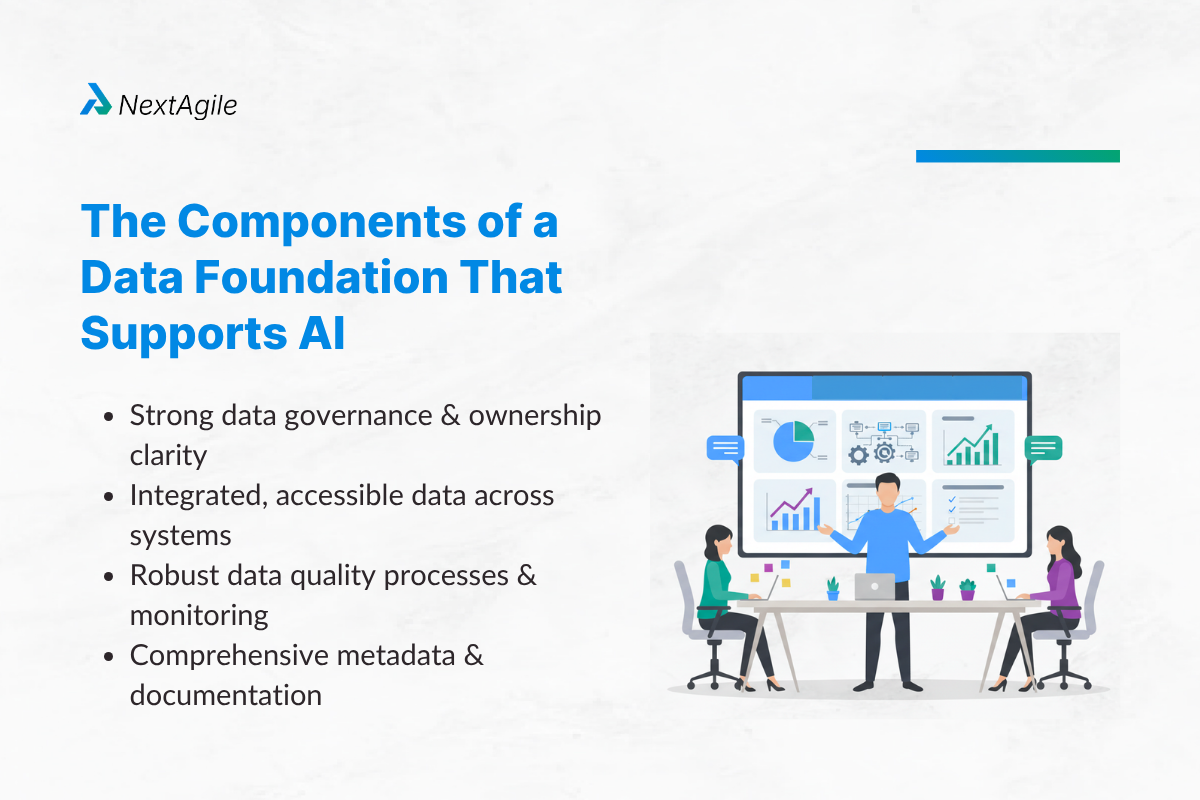
The Components of a Data Foundation That Supports AI

The Components of a Data Foundation That Supports AI

A data foundation that supports AI is different from a data foundation that just supports analytics and reporting.

The first component is clear data governance. You need to answer questions like: who owns each data asset? Who’s accountable for data quality? What are the standards for data formatting and completeness? How do we prevent unauthorized access while enabling appropriate access? These questions aren’t fun to think about, but the organizations that answer them clearly move faster on everything data-related.

Data governance in the context of AI is even more critical because AI systems are sensitive to data quality problems that people might not notice. A report might look fine even if 5% of the data is wrong. An AI model trained on that data will learn the errors and potentially make bad decisions at scale. This sensitivity means you need higher standards for data quality when you’re using data for AI.

The second component is data integration and accessibility. You need clean data flowing to where it’s needed. This usually means extract-transform-load pipelines that move data from source systems, clean it, and make it available in systems where it can be used. This might be a data warehouse for analytics. It might be an AI serving infrastructure for models. It might be operational systems that use data to make decisions.

This integration challenge is bigger for enterprises with lots of legacy systems because old systems have different data models and different ways of identifying entities. Reconciling customer data across a legacy mainframe system and a cloud CRM system takes real work.

The third component is data quality infrastructure. You need processes and systems that ensure data is accurate and complete. This includes data validation at the point of entry. It includes duplicate detection and resolution. It includes consistency checks across systems. It includes monitoring data quality over time to catch when quality declines.

Most enterprises underestimate the work required here. Data quality work is unglamorous. It doesn’t produce flashy results. But it’s absolutely foundational. Enterprises that invest heavily in data quality have better AI systems, make better decisions, and operate more efficiently.

The fourth component is metadata and documentation. What does each data field mean? What systems is it stored in? Who uses it? How current is it? Is there bias or limitations in how it was collected? This metadata seems like overhead until you need to use data and realize nobody knows what it actually means.

The best enterprises build metadata infrastructure where data teams contribute metadata as they work with data. When someone uses a data field in a new way, they document it. When someone finds a quality issue or limitation, they document it. When someone discovers what data means, they document it. This accumulated knowledge becomes invaluable.

The Data Assessment That Changes Everything

Before embarking on a data and AI strategy, most enterprises benefit from a comprehensive data assessment. This isn’t a high-level scan. It’s detailed investigation into what data you actually have, where it lives, what quality it’s in, and how accessible it is.

A good assessment includes interviews with data users across the organization to understand what data they need and how much friction they face getting it. It includes technical inventory of systems and data assets. It includes data quality testing to understand actual quality, not assumed quality. It includes analysis of data governance to see how many organizations have clarity around data ownership and responsibility.

The assessment usually uncovers surprises. You discover data assets you forgot you had. You discover data quality is worse than you thought. You discover access controls are either too loose or too restrictive. You discover you’re storing the same data in multiple systems with inconsistent values.

These discoveries are uncomfortable in the moment but invaluable for understanding what needs to change. The assessment becomes the foundation for your data strategy.

Building a Prioritized Data Foundation

You can’t fix everything at once. You need to prioritize what to fix based on business value and feasibility.

The best prioritization approach maps data to business outcomes. Which data is most critical for your highest-priority business initiatives? If you’re focused on improving customer retention, what data do you need to do that? If you’re focused on cost reduction, what data do you need? Once you identify data that’s critical for business outcomes, you can prioritize fixing and improving that data.

This business-driven approach ensures you’re investing in data infrastructure that matters for your business. Leading enterprises often connect data priorities with measurable outcomes using frameworks like How CXOs Align OKRs with AI Strategy.

You also need to sequence work smartly. Some fixes are prerequisites for others. You can’t build effective customer segmentation models if your customer data isn’t integrated across systems. So customer data integration becomes a prerequisite. Once you’ve done customer data integration, you can build segmentation models. Once you’ve built segmentation models, you can use them to personalize customer experience. If you’re evaluating how external experts accelerate enterprise AI adoption, read What Is Generative AI Consulting?.

This sequencing creates momentum where each completed project enables higher-value projects next.

The Skills and Organizational Structure Question

Building a strong data foundation requires people with different expertise working together. Data engineers who understand how to build pipelines and infrastructure. Data analysts who understand business problems and how data can help solve them. Data scientists who know how to build models. Data governance professionals who understand how to structure governance. Business users who understand what data they need and how to use it.

Most enterprises struggle with how to organize these different skills. Do you have a centralized data organization or distributed data teams in business units? Do you have specialists for different types of work or generalists?

The answer is different for different enterprises, but the best approach is usually a hub and spoke model where you have central data infrastructure and governance owned by specialists, but business units have their own analytical and engineering capacity to use the data and build models for their specific needs.

This structure requires clear agreements about what the central team owns and what business units own. The central team owns core data infrastructure, data governance, and shared data assets. Business units own their own analytics and specialized models. The central team sets standards and provides self-service tools that business units use.

Data Privacy and Security in the AI Context

Data enables AI, but data contains sensitive information about customers, employees, and your business. Protecting this data while enabling its use is a constant tension.

Traditional approaches to data privacy focus on preventing unauthorized access. You control who can see what data. You encrypt data. You audit access. These controls are necessary but not sufficient for AI because AI creates new risks.

In AI context, privacy risks include model inversion where someone attempts to reconstruct training data from the model. Privacy risks include membership inference where someone tries to determine whether a specific individual’s data was used for training. Privacy risks include differential privacy violations where the model exposes information about specific individuals.

Responsible data and AI consulting helps you think through these risks and build appropriate protections. Sometimes that means using differential privacy techniques that add noise to training data so the model doesn’t overfit to specific individuals. Sometimes it means restricting who can see model outputs if those outputs could reveal sensitive information. Sometimes it means limiting what data can be used to train certain types of models.

The best enterprises integrate privacy thinking into data and AI development from the beginning, not as an afterthought.

The Build Versus Buy Decision for Data Infrastructure

Every enterprise needs to decide what data infrastructure to build internally versus what to buy from vendors. The tradeoffs are familiar: building gives you exactly what you need but requires ongoing maintenance. Buying is easier to get started but locks you into vendor choices.

For foundational infrastructure like data warehousing or data lakes, most enterprises benefit from using mature vendor solutions. Building this from scratch is a huge undertaking and vendors have already solved many of the hard problems.

But for your specific data pipelines and business logic around how data flows to support your specific business, you usually need custom work. Vendors can provide templates and examples but each enterprise’s needs are specific.

The best strategy is usually using vendor platforms for the hard infrastructure problems and building your own data pipeline logic on top. This gives you the benefits of proven infrastructure with the flexibility to customize for your specific needs.

Conclusion

AI success depends less on algorithms and more on the strength of your data foundation. Enterprises that improve governance, quality, and accessibility create faster, smarter, and more scalable AI outcomes.

Data and AI consulting helps organizations remove friction, prioritize the right investments, and build long-term competitive advantage.

Ready to strengthen your AI foundation? Explore our Generative AI Consulting Services or join the Generative AI for Enterprise Workshop to accelerate enterprise intelligence.

Frequently Asked Questions

Q1: How long does a typical data assessment take?

A comprehensive data assessment for a mid-sized enterprise usually takes four to eight weeks. A larger enterprise with more complex data environments might take 12 weeks. A smaller organization might complete it in two weeks. The timeline depends on how much systems you have, how complex the data environment is, and how much data documentation already exists.

Q2: What’s the typical investment required to build a strong data foundation?

This varies enormously based on enterprise size and current state. A small enterprise might invest 500,000 to 2 million dollars. A mid-market enterprise might invest 2 to 10 million dollars. A large enterprise might invest 10 to 50 million dollars or more. The key is viewing this as investment in business capability, not just technology spending. If you’re going to invest 100 million dollars annually in AI initiatives, spending 10 million on data foundation is reasonable insurance.

Q3: Can we improve our data foundation while running AI projects, or do we need to pause to fix it?

You can do both if you prioritize deliberately. Pick your highest-priority AI projects and invest in the data infrastructure needed to support them. Don’t try to fix everything or support every possible AI project. Focus on high-impact use cases and build data infrastructure to support them. As you complete projects, you build reusable infrastructure that enables future projects.

Q4: How do we know when our data foundation is good enough?

When teams can access the data they need without excessive friction. When new analytical and AI projects move faster because data is available and clean. When you have confidence in data quality. When data governance is clear and people understand their responsibilities. When you have fewer data-related delays and surprises. These indicators suggest your foundation is strong enough.

Q5: What should we do if we discover our data quality is worse than we thought?

Don’t panic. Most enterprises discover data quality is worse than they thought. The enterprises that succeed are the ones that acknowledge this and invest in improvement. Start with the data that’s most critical for your business priorities. Improve quality progressively. Build processes to maintain quality going forward. Use this discovery as motivation to build better data practices.