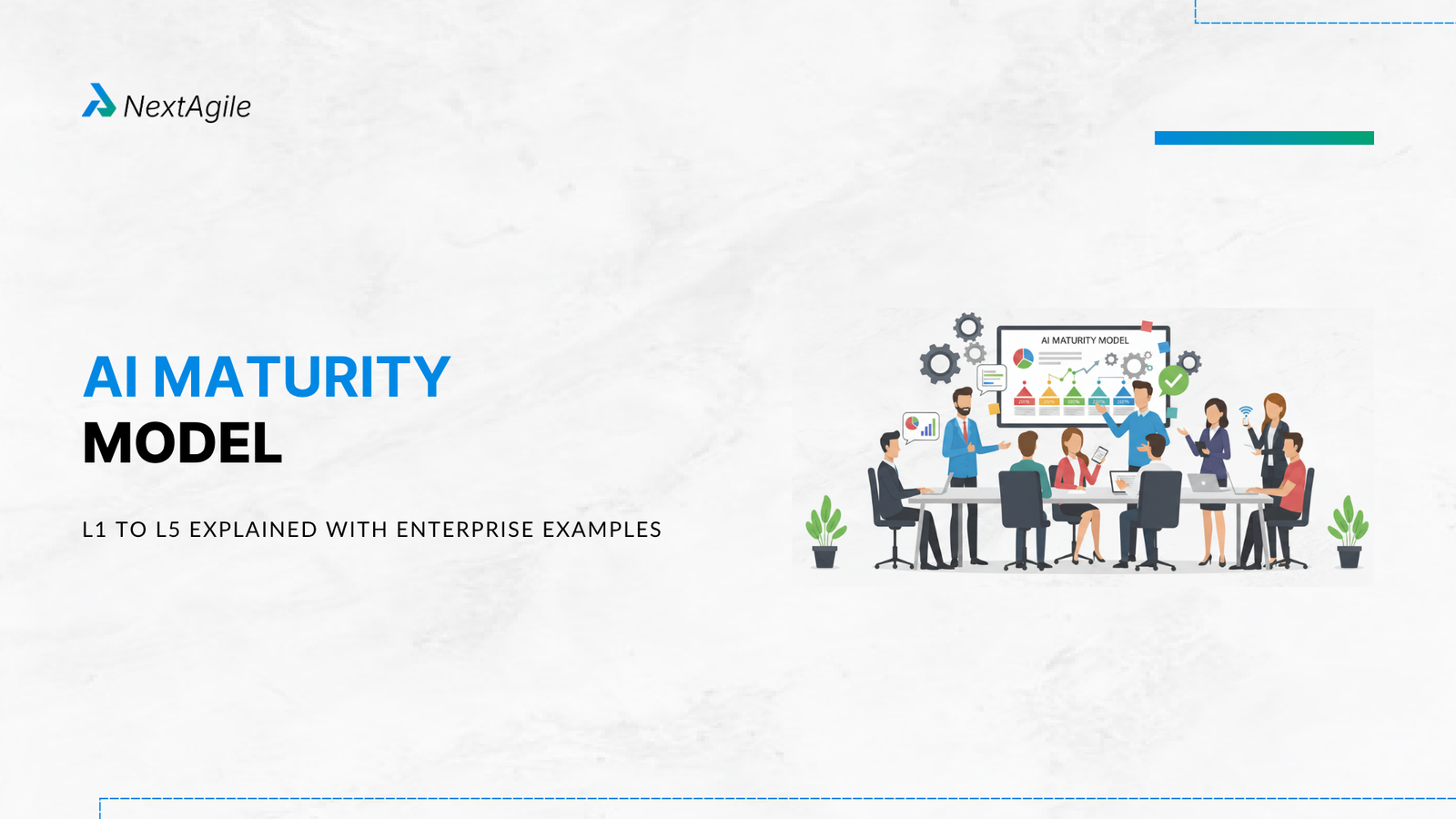
Key Highlights of AI Maturity Model Fewer than 12% of enterprises globally have reached L4 (Strategic) maturity or higher, according to Accenture’s AI maturity research. The L2 to L3 transition remains the most common failure point because organizations underestimate the operational complexity of moving AI from demos into production systems. People and culture are still the most underfunded dimensions in enterprise AI transformation, even in technically strong organizations. L3 is the minimum practical maturity level for sustainable production AI deployment with governance in place. Infrastructure expectations change dramatically across levels, from spreadsheets and disconnected APIs at L1 to agent orchestration and self-healing systems at L5. The AARI framework uses weighted scoring across 8 dimensions to produce a maturity score from 1.0 to 5.0 tied directly to operational capability. What is an AI Maturity Model? An AI maturity model is a structured framework that measures how prepared an organization is to adopt, operationalize, govern, and scale AI systems.
At the lowest level, AI usage is fragmented and mostly reactive.
At the highest level, AI becomes embedded into how the organization operates, makes decisions, serves customers, and builds products.
The reason maturity models matter is simple: most leadership teams are making AI investment decisions without a shared understanding of current capability.
One team thinks the company is “advanced” because they launched a chatbot.
Another team knows the data infrastructure is still broken.
Security teams are worried about governance.
Operations teams are still managing workflows manually.
Without a maturity framework, everyone is describing different realities.
Gartner’s AI Maturity Model Toolkit frames maturity assessment as a benchmarking mechanism for CIOs and enterprise leaders. Accenture’s research similarly shows that organizations with structured transformation roadmaps significantly outperform companies running isolated AI initiatives.
But there is an important distinction here.
Many maturity models are descriptive.
Very few are operational.
That is the gap the AARI framework tries to address.
Instead of only assigning maturity labels, AARI maps:
weighted scoring across 8 enterprise dimensions • stack expectations at each maturity stage • governance requirements by level • operational readiness indicators • 90-day progression plans between levels For the detailed scoring methodology and assessment checklist, see the companion AI Readiness Assessment guide.
Why AI Maturity Models Matter in 2026 The AI market has split into two very different groups.
The first group has operational AI systems already embedded into business workflows. These organizations are deploying multi-agent systems, building AI-assisted delivery models, and creating entirely new operational efficiencies.
The second group is still stuck in pilot mode.
Lots of demos. Lots of internal excitement. Very little production impact.
EY’s Generative AI maturity research reflects this pattern clearly. Organizations that invested early in governance, data quality, MLOps, and operational infrastructure are now scaling faster. Organizations that skipped foundations are spending 2026 retrofitting governance into systems that were never designed for production.
MITRE’s AI maturity framework also highlights another issue that shows up constantly during enterprise assessments:
Most organizations overestimate their maturity.
Usually by one or two levels.
That happens because AI maturity is often judged by visible outputs instead of operational capability.
A chatbot demo is visible.
A retrieval evaluation framework is not.
A flashy pilot gets attention.
A governance workflow does not.
But the second category is what determines whether systems survive in production.
The 5 AI Maturity Levels: Detailed Breakdown L1: Initial (AARI Score 1.0 to 1.9) Characteristics At L1, AI is mostly theoretical inside the organization.
Leadership is aware of AI from industry news and competitor conversations, but there is no coordinated strategy, no production deployment, and usually no clear ownership.
Data exists everywhere but behaves like disconnected islands.
Teams export CSVs manually. Reporting is inconsistent. Documentation is fragmented. There is no unified governance layer.
Most processes remain fully manual or rules-based.
Technology stack Excel spreadsheets CSV exports Basic reporting tools No centralized ML infrastructure No vector database capability No API-driven architecture Governance No formal AI governance exists.
Usually there is also no assigned data ownership, no AI usage policy, and no approval process for external AI tool usage.
Real enterprise example A mid-sized BFSI organization using legacy automation for loan processing while customer data lives across multiple disconnected systems with no shared governance layer.
AI conversations happen internally, but operational readiness does not exist yet.
What to do at L1 Do not start with GenAI deployment.
That usually creates technical debt immediately.
The priority at L1 is fixing data foundations first:
Assign data ownership Establish governance policies Audit document quality Identify fragmented systems Standardize access controls Organizations at L1 should focus on understanding the architecture of production AI systems before attempting implementation.
NextAgile’s Generative AI Tools overview and AI Operating Model blog help teams understand where enterprise AI infrastructure is actually heading before investment begins.
L2: Developing (AARI Score 2.0 to 2.9) Characteristics This is where most enterprises currently sit.
Some teams are experimenting aggressively while the rest of the organization has no visibility into what is happening.
There are internal copilots, isolated RAG pilots, and disconnected API integrations being built by different teams independently.
The demos often look impressive.
Production readiness is usually weak.
Prompting is inconsistent. Governance is informal. Retrieval quality is rarely measured. Nobody owns evaluation standards centrally.
The organization has momentum but lacks coordination.
Technology stack Initial API integrations Single-team vector database deployments Manual prompt management Limited retrieval pipelines No standardized evaluation workflows Governance A draft AI policy may exist, but enforcement is inconsistent.
HITL workflows are usually missing.
Bias audits and monitoring frameworks are rare at this stage.
Real enterprise example A GCC-based engineering organization where multiple teams independently built internal AI assistants using OpenAI APIs.
Each team selected different models, different prompts, and different governance assumptions.
The pilots work internally but cannot safely scale because there is no shared operational framework.
What to do at L2 The goal at L2 is not more experimentation.
It is operational discipline.
Organizations should:
Pick one high-value use case Deploy a production-grade RAG workflow Build HITL approvals Standardize prompt management Create evaluation baselines Establish governance ownership This is the level where teams should stop treating prompts as disposable experimentation and start treating them as governed production assets.
NextAgile’s Advanced Prompt Engineering Workshop focuses heavily on this transition from ad-hoc prompting to enterprise prompt governance.
For the underlying architecture, the What is RAG guide explains the production retrieval stack most L2 organizations need next.
L3: Defined (AARI Score 3.0 to 3.4) Characteristics L3 is where organizations finally begin operating AI systems like production infrastructure.
RAG systems are live.
Governance workflows exist.
MLOps tooling is operational.
Prompts are version-controlled.
Evaluation is continuous instead of reactive.
At this stage, AI stops being an innovation project and becomes part of operational delivery.
This is also the minimum viable maturity level for sustainable enterprise AI deployment.
Technology stack Production vector databases LLM evaluation frameworks LangSmith, MLflow, or equivalent MLOps tooling Centralized data platforms Prompt version control systems Production monitoring pipelines Governance HITL review is enforced for high-risk outputs.
Bias audits and evaluation pipelines are integrated into deployment workflows instead of handled manually afterward.
Real enterprise example An insurance organization running a claims documentation assistant across thousands of claims handlers.
The system retrieves policy data through RAG, generates summaries, routes outputs through manager approval workflows, and tracks hallucination rates continuously.
The difference between this and an L2 pilot is operational reliability.
What to do at L3 Organizations at L3 should begin identifying workflows where AI orchestration can reduce human coordination overhead.
The focus shifts toward:
multi-agent orchestration workflow automation organization-wide observability centralized LLMOps governance retrieval quality optimization NextAgile’s LangChain Mastery Workshop focuses specifically on the LangGraph and LangFuse stack many L3 teams need to operationalize agentic systems safely.
L4: Strategic (AARI Score 3.5 to 4.4) Characteristics At L4, AI is no longer isolated inside individual workflows.
It becomes embedded into business operations across functions.
Organizations at this level are running multi-agent systems, real-time monitoring pipelines, automated governance checks, and coordinated orchestration across teams.
The biggest shift here is governance maturity.
Manual governance no longer scales.
Policy enforcement becomes automated.
Technology stack LangGraph orchestration CrewAI collaboration systems Semantic caching layers LLMOps monitoring platforms Drift detection systems Real-time evaluation infrastructure Governance Policy-as-code becomes operational.
Instead of relying on humans to manually review everything, governance rules are encoded directly into deployment pipelines and runtime systems.
Real enterprise example A healthcare GCC running specialized AI agents across prior authorization workflows:
one agent retrieves patient records • another validates clinical evidence • another drafts authorization documents • another manages insurer communication • another tracks workflow exceptions Human teams supervise escalation paths rather than manually coordinating every step.
What to do at L4 The next challenge becomes resilience and adaptability.
Organizations should focus on:
self-healing data pipelines ethics-as-code implementation dynamic orchestration reliability agent governance frameworks advanced observability systems NextAgile’s Agentic AI Workshop helps L3 and L4 organizations scale from isolated automation into governed multi-agent systems without losing operational control.
L5: AI-Native (AARI Score 4.5 to 5.0) Characteristics At L5, AI is not an add-on capability.
It is embedded into the business model itself.
Agent systems operate autonomously across functions. Infrastructure continuously self-optimizes. Data quality remediation happens automatically. Human teams focus primarily on governance, strategic oversight, and exception handling.
Organizations at this level are still rare.
Very few enterprises globally operate here today.
Technology stack Agent mesh architecture Dynamic agent communication systems Hybrid edge-cloud orchestration Self-healing infrastructure Autonomous optimization loops Governance Governance becomes infrastructure-native.
Ethics-as-code and automated policy enforcement operate continuously across systems with minimal manual intervention for low-risk workflows.
Real enterprise example A platform company where AI agents manage onboarding, service coordination, customer retention workflows, and operational optimization autonomously for the majority of interactions.
Human involvement is focused on strategy, oversight, and complex exceptions.
How AI Maturity Models Compare: AARI vs Gartner vs Accenture vs EY Framework Levels Scoring Tech Stack per Level Governance per Level Action Plan AARI (NextAgile) 5 (L1 to L5) Weighted scoring across 8 dimensions Defined operational stack expectations Defined governance requirements 90-day progression plans Gartner AI Maturity Model 5 stages Primarily qualitative Generalized guidance Generalized guidance Gated toolkit Accenture AI Maturity 5 maturity paths No operational scoring formula Limited stack specificity Strategic guidance only Advisory recommendations EY GenAI Maturity 4 stages Qualitative assessment Limited technical detail High-level governance guidance Consulting-led pathways MITRE AI Maturity 5 levels Open framework Technical orientation Strong compliance focus Government-oriented guidance
The 3 Most Common Maturity Stall Points Stall Point 1: L2 to L3 (the production gap) This is the most common enterprise failure point.
The organization has promising pilots but no operational infrastructure behind them.
The demo succeeds.
Production deployment collapses.
Usually because:
governance was ignored evaluation pipelines were missing data quality was inconsistent retrieval systems were unreliable nobody defined ownership clearly NextAgile’s AI Transformation Failure blog goes deeper into these recurring failure patterns.
Stall Point 2: L3 to L4 (the governance gap) At this level, organizations already have production AI.
The problem becomes scalability.
Manual governance stops working once multiple agent systems and workflows begin operating simultaneously.
Organizations need:
automated guardrails • policy-as-code • runtime validation systems • centralized governance orchestration The AI Governance Framework blog explains the policy, operational, and technical governance layers required at this stage.
Stall Point 3: L4 to L5 (the culture gap) This transition is less technical and more organizational.
The infrastructure exists.
The operating model does not.
Organizations struggle because talent models, leadership structures, and workflow ownership still reflect pre-AI operating assumptions.
Roles like:
Agent Reliability Engineer AI Product Manager LLMOps Specialist Ethics-as-Code Architect become critical at this stage.
NextAgile’s Gen AI Training Services include the GenAI Developer Program designed specifically to help enterprises build these capabilities internally.
Conclusion: Score Your Organization and Build a Roadmap Most enterprises do not fail at AI because the models are weak.
They fail because operational maturity never catches up to experimentation.
The fastest way to improve is not chasing more pilots.
It is honestly assessing current capability.
Use the AARI scoring framework to identify where your organization actually sits across all 8 dimensions.
Then focus on the lowest-scoring areas first.
That is usually where scale breaks later.
For most organizations in 2026, the real goal should not be becoming “AI-native” immediately.
The goal should be reaching L3 reliably:
governed systems production infrastructure operational monitoring HITL workflows scalable data foundations That is the level where AI transformation stops being performative and starts becoming sustainable.
For the full scoring checklist and 90-day action planning framework, see the companion AI Readiness Assessment guide or connect with NextAgile at consult@nextagile.ai .
Frequently Asked Questions Q1. What is the difference between an AI maturity model and an AI readiness assessment? An AI maturity model defines the progression levels and describes what capability looks like at each stage.
An AI readiness assessment measures where your organization currently sits within that framework.
The AARI framework combines both by defining maturity levels while also providing weighted scoring across operational dimensions.
Q2. How long does it take to advance from one AI maturity level to the next? It depends heavily on existing infrastructure and leadership alignment.
In most enterprise environments:
L1 to L2 takes roughly 3 to 6 months L2 to L3 often takes 6 to 12 months L3 to L4 can take 12 to 18 months L4 to L5 is typically a multi-year transformation effort The biggest delays usually come from governance and data quality issues, not model selection.
Q3. Which AI maturity level should enterprises target in 2026? L3 is the most important target for most enterprises right now.
It represents the minimum maturity required for sustainable production AI deployment with proper governance and operational oversight.
Organizations in regulated industries should prioritize achieving L3 governance standards before scaling aggressively into multi-agent workflows.
Q4. Is the AI maturity model applicable to both large enterprises and mid-sized companies? Yes.
The underlying maturity principles remain the same regardless of company size.
The implementation complexity changes, but the operational progression from fragmented experimentation toward governed AI systems applies equally to mid-sized firms, GCCs, and large enterprise groups.
Rahul seasoned technology leader with 20+ years of experience, now dedicated to mentoring and training individuals and groups in Generative AI, advanced AI/ML system design, and production best practices. He is a hands-on tech entrepreneur and has deep industry experience in building cutting-edge AI products.
 Skip to content