What Is Databricks? A Complete Guide for Beginners and Businesses (2026)
Rahul Singh
Talk to Expert for Free
Table of Contents
Databricks is a unified, open analytics platform that lets organizations store, process, analyze, and build AI on all their data from a single place. It was founded by the original creators of Apache Spark, Delta Lake, MLflow, and Unity Catalog, the open-source projects that power most modern big data infrastructure. At its core, Databricks delivers what it calls a Lakehouse Platform: a combination of a data lake’s flexibility and cost efficiency with a data warehouse’s reliability and query performance. According toGartner’s research cited by Prolifics, by 2026 more than 50% of enterprises will adopt a data lakehouse architecture as their analytics and AI foundation, up from less than 15% in 2022. That shift is what Databricks was built to lead. If your organization deals with large volumes of data and wants to use that data for both analytics and AI without managing two separate systems, Databricks is the answer most enterprise teams land on.
Gartner predicts more than 50% of enterprises will adopt lakehouse architecture by 2026, up from less than 15% in 2022
Forrester Research found organizations on unified data/AI platforms report 40% faster time-to-insight and up to 35% reduction in data infrastructure costs vs separate lake and warehouse environments
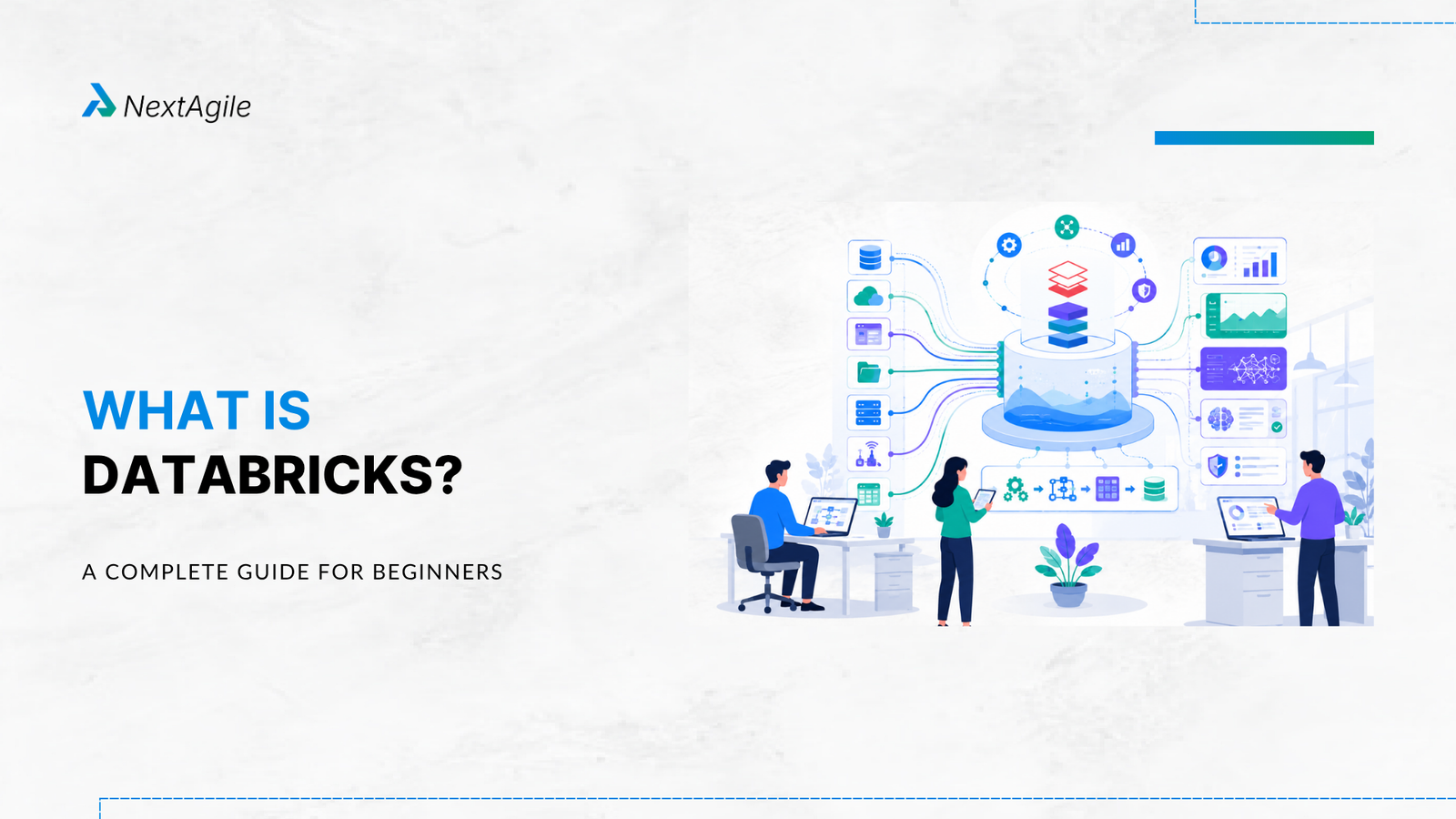
The Databricks Lakehouse Platform eliminates the need for separate data lakes, warehouses, and ML infrastructure, replacing three stacks with one unified environment
Five core layers make up the platform in 2026: Delta Lake (storage), Unity Catalog (governance), SQL Warehouse (compute/analytics), Notebooks and Jobs (engineering), and AI/BI Genie (AI analytics)
Databricks is a data and AI platform that organizations use to run their entire data lifecycle, from raw ingestion to production machine learning, in one connected environment. The simplest way to understand it: before Databricks, most enterprise data teams managed two completely separate systems. A data lake for storing large volumes of raw, unstructured data cheaply. A data warehouse for running fast, reliable SQL queries on structured data. And a third set of tools for machine learning. Each system had its own team, its own governance, and its own data copy. The cost and coordination overhead was enormous.
Databricks eliminates that split. It introduced the Lakehouse concept, a single architecture that handles data lake storage costs, data warehouse performance, and ML workloads in one place. Understanding Databricks matters in 2026 because it is increasingly showing up in enterprise AI strategy conversations alongside decisions about generative AI, agentic AI, and data governance. If your organization is thinking aboutbuilding an AI operating model or exploringdata and AI consulting, Databricks is almost certainly part of that conversation.
Why Databricks Was Created: The Problem It Solved
The Pain of Choosing Between a Lake and a Warehouse
Before lakehouse architecture, data teams faced what the industry called an impossible choice.Abhishek Jain’s February 2026 deep-dive on modern data architecture describes it this way: “That painful binary choice is finally dead.” On one side sat data warehouses: fast, reliable, ACID-compliant, and expensive. Great for SQL analytics, terrible for storing raw logs, images, unstructured text, and the kind of data that machine learning models need. On the other side sat data lakes: cheap, flexible, and capable of storing anything, but famously unreliable, hard to query, and lacking the governance controls regulated industries require.
Databricks’ founders, who had already built Apache Spark as a distributed processing engine, recognized that the real problem was not choosing one or the other. It was the absence of a unified architecture that gave you both. That recognition became Delta Lake, and Delta Lake became the foundation of the Databricks Lakehouse.
The M x N Problem in Data Infrastructure
Teams running both a lake and a warehouse did not just pay twice for storage. They paid for data duplication between systems, pipeline maintenance costs for keeping data synchronized, separate governance policies, separate access controls, and the productivity cost of engineers who had to understand two completely different paradigms.Flexera’s 2026 Delta Lake guide describes the core insight: “Databricks delivers a comprehensive Lakehouse Platform that combines the best aspects of data lakes and data warehouses.”
What Databricks Actually Does: The Five Core Layers
Delta Lake is the open-source storage layer that sits below everything else. It adds reliability to your data lake by enabling:
ACID transactions: Changes to your data either fully complete or do not happen at all. No more corrupted data from failed pipeline runs.
Schema enforcement: Delta Lake validates data against a defined schema before writing. Bad data is rejected rather than silently accepted and corrupting downstream analytics.
Time travel: Every change to a Delta table is versioned. You can query any historical version of your data by timestamp or version number, a capability that is invaluable for debugging, auditing, and model reproducibility in ML workflows.
Z-ordering and data skipping: Databricks organizes data within Delta files so that SQL queries skip irrelevant data blocks automatically, dramatically accelerating analytical query performance.
Delta Lake is open-source, which means the data stored in it is not locked to Databricks. You could, in principle, read Delta Lake tables from other engines, a vendor independence that matters significantly for enterprise procurement decisions.
 Skip to content