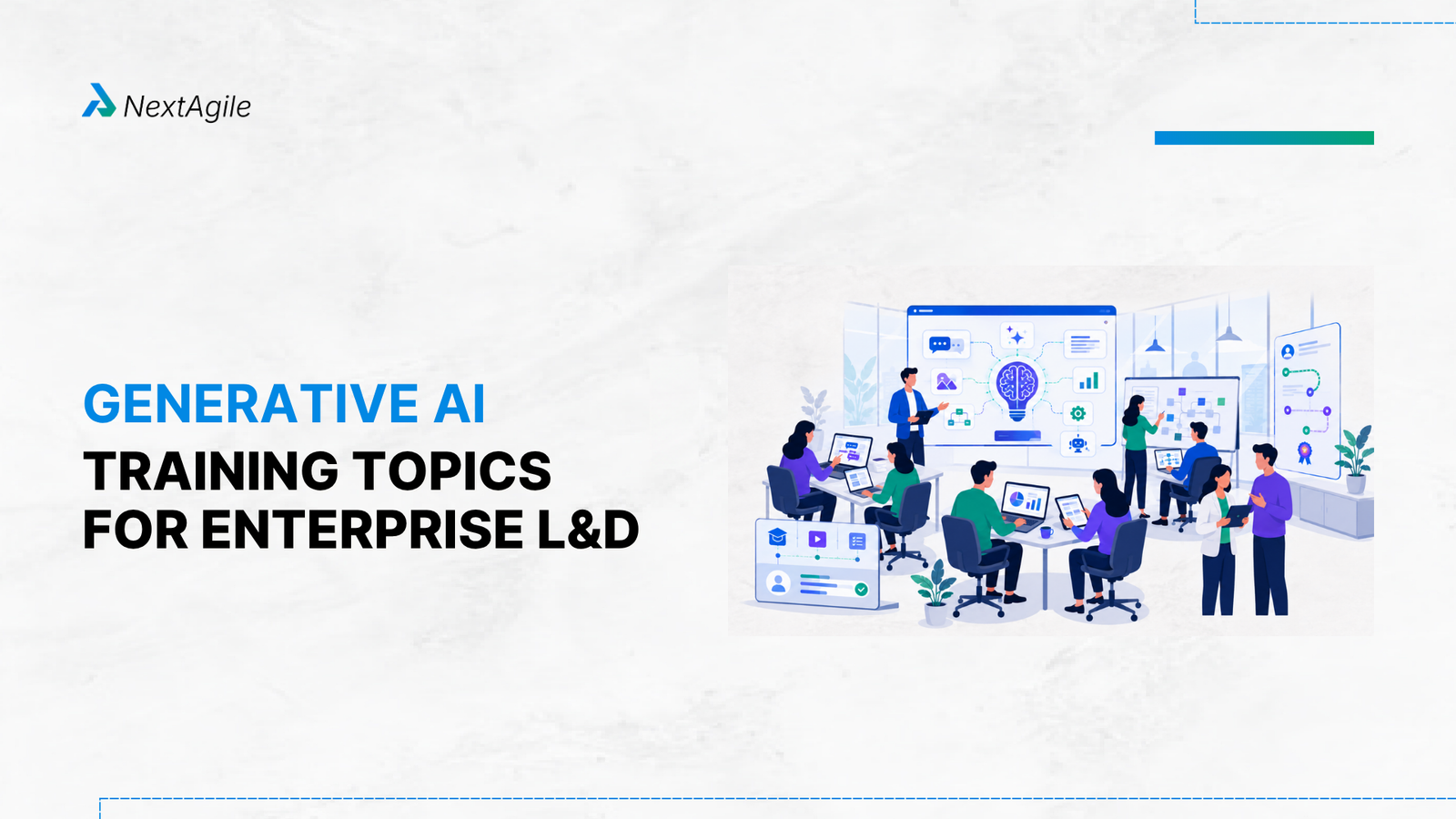
Generative AI Training Topics for Enterprise L&D in 2026
Alok Dimri
Talk to Expert for Free
Table of Contents
The most effective Generative AI training topics for enterprise L&D in 2026 are not the same for every role or every organization. Executives need AI strategy and governance literacy. Managers need AI tool evaluation and change leadership skills. Individual contributors need role-specific prompt engineering and workflow integration. Developers need LLM fundamentals, context engineering, and agentic AI design. According to an enterprise L&D survey cited by Intellum, 61% of organizations have fully or partially adopted AI into their L&D programs or are testing it, but adoption is hindered by gaps in AI literacy, unclear implementation plans, and weak infrastructure. According to ClearCompany’s 2026 L&D trends research, GenAI tutors now deliver 32% better personalization and 17% more relevant feedback compared to traditional classroom training. The training gap is real, expensive, and growing. The organizations closing it fastest are not the ones building the most comprehensive AI curriculum, they are the ones matching topics to roles and measuring whether application actually happens.
ClearCompany’s 2026 L&D research citing Harvard Business Review found GenAI tutors deliver 32% better personalization and 17% more relevant feedback than traditional classroom training
LinkedIn’s 2026 Workplace Learning research shows organizations investing deeply in AI-aligned career development are more likely to be at the “accelerating” or “leading” stages of GenAI adoption
The three most in-demand skills organizations predict needing by 2026 are strategic/critical thinking, digital fluency, and leadership — all of which interact directly with GenAI adoption
Intellum’s 2026 analysis found AI use in L&D is still largely early-stage and concentrated in content creation and efficiency work rather than deeper learning transformation
Designing AI training for specific roles rather than generic “AI awareness” produces significantly higher Level 3 behavior transfer (Kirkpatrick Model) — a principle NextAgile’s enterprise GenAI workshops are built around
Generative AI training topics for enterprise L&D in 2026 cover a much wider range than most organizations initially plan for. The first instinct is to run an “AI awareness” program: a half-day session explaining what generative AI is and showing a few ChatGPT demos. That program produces high Level 1 satisfaction scores and almost no Level 3 behavior change.
The organizations actually closing the GenAI adoption gap are building training around specific job workflows, specific decision-making scenarios, and specific tools their teams use daily. They are measuring whether behavior changes 30 days after the program, not whether attendees smiled on the exit survey.
This guide organizes GenAI training topics by audience, because the right content for an executive is entirely different from the right content for a software developer or a customer service team lead. It also covers sequencing, because most organizations try to run advanced topics before their teams have the foundational literacy to apply them. And it covers the organizational conditions that must exist for GenAI training to produce real adoption, not just awareness.
NextAgile’s Gen AI Training Services cover this full range, from foundational literacy workshops to advanced agentic AI programs for engineering teams, with content designed around specific roles rather than generic AI overviews.
Why Most Enterprise GenAI Training Fails Before It Starts
Before covering specific topics, understanding why current programs underperform matters. According toIntellum’s 2026 enterprise L&D analysis, the three most common failure modes are:
Gap 1: Training without a workflow anchor. Employees learn what generative AI is but not how it applies to their specific job. Three weeks later, they are back to their old workflow because nothing in the training connected to their actual daily tasks.
Gap 2: Generic content for heterogeneous audiences. A finance analyst, a software developer, and a customer success manager all attend the same “AI fundamentals” session. The examples make sense to none of them specifically, and all three walk away feeling that the content was interesting but not actionable.
Gap 3: No Required Drivers after training ends. Managers are unaware their direct reports attended AI training. There are no follow-up prompts, no accountability for trying the new tools, and no feedback channel when employees hit frustration trying to apply what they learned. The behavior window closes within 2 to 3 weeks.
Solving all three gaps requires designing AI training as a workflow change initiative, not as a knowledge transfer session. That reframe changes every decision about content, delivery format, audience segmentation, and post-training support.
For organizations going through broaderAI transformation programs, GenAI L&D is one of the highest-leverage interventions when designed correctly, and one of the most wasteful investments when designed as a generic awareness exercise.
GenAI Training Topics by Audience Level
Audience 1: Executive and Board Level
Primary objective: Enable executives to make informed strategic decisions about AI investment, governance, and organizational capability building.
Key training topics:
AI strategy and competitive positioning. What is the realistic impact of generative AI on your industry and competitive landscape? How are comparable organizations deploying AI today? What are the business models that AI enables or disrupts? Executives need the mental model to evaluate AI investment proposals rather than defer entirely to technical advisors.
AI governance and risk management. What are the real risks of GenAI in enterprise contexts, copyright exposure, data privacy, hallucination, bias, security, and regulatory compliance? What governance structures (AI councils, usage policies, vendor evaluation frameworks) should an organization have in place? This topic is particularly critical in 2026 given EU AI Act compliance requirements.
AI-driven business model change. How do organizations restructure workflows when agents automate tasks previously done by humans? What is the leadership approach to managing that transition without triggering fear and resistance?
Leading AI adoption as a change management challenge. AI technology adoption is aleadership change management challenge, not a technology deployment challenge. Executives need frameworks for building adoption rather than mandating it.
Recommended delivery format: Half-day facilitated workshop with case studies from comparable industry organizations. No demos of AI tools. Executive time is too scarce to spend on tool tutorials. Focus on decision frameworks and strategic questions.
Audience 2: People Managers and Team Leads
Primary objective: Enable managers to lead AI adoption within their teams, evaluate AI tools for their specific context, and model effective AI usage.
 Skip to content