Conflict resolution is a structured way to address disagreement, understand what is driving it, and reach a workable outcome. In the workplace, effective conflict resolution is not about forcing people to agree. It is about creating enough clarity, accountability, and shared understanding for productive work to continue.
A practical conflict resolution process includes seven steps: identify the conflict, understand each perspective, separate positions from interests, establish common ground, generate solutions, agree on the resolution, and follow up.
The right approach depends on the situation. A simple disagreement may need a direct conversation. A recurring cross-functional dispute may require negotiation or facilitation. A serious interpersonal dispute may require mediation, while policy or conduct concerns may require formal escalation.
Key Highlights of Conflict Resolution Workplace conflict is not always a people problem. It can come from unclear roles, competing priorities, decision rights, or organizational systems. Conflict resolution focuses on resolving a specific disagreement, while conflict management focuses on containing and preventing recurring conflict. The most effective process moves from diagnosis to understanding, reframing, resolution, and reinforcement. Positions explain what people want. Interests explain why they want it. Direct conversation, facilitation, negotiation, mediation, manager intervention, and formal resolution serve different situations. Strong conflict resolution skills include active listening, emotional regulation, perspective-taking, questioning, clear communication, and accountability. Recurring conflict is often a signal that the organization needs to change the system around the people involved. Mediation is useful when direct conversations have failed and a neutral third party can help rebuild productive communication. Formal escalation may be necessary for serious conduct, policy, safety, harassment, discrimination, retaliation, or other organizational concerns. A successful resolution should not only close the current disagreement. It should reduce the chance of the same conflict returning. Introduction A product team wants to launch a feature this month. Operations says the support process is not ready. Engineering believes the timeline creates unacceptable technical risk.
The meeting ends without agreement, but the launch date remains unchanged.
This may look like a personality conflict. It may not be. Underneath the disagreement are competing priorities, different measures of risk, unclear decision rights, and pressure to deliver.
That distinction matters because better communication alone will not solve every workplace conflict.
Some conflicts are interpersonal. Others are created by the way work is designed. If leaders treat every disagreement as a people problem, they can spend months coaching employees around a problem that actually sits inside the operating model.
Effective conflict resolution starts by finding out what kind of conflict you are dealing with.
What Is Conflict Resolution? Conflict resolution is the process of addressing a disagreement and working toward an outcome that allows the people involved to move forward productively.
In the workplace, this can involve direct conversations, negotiation, facilitation, mediation, manager intervention, or formal organizational processes.
The goal is not necessarily complete agreement.
Two people can leave a conversation with different opinions and still have a successful resolution if they understand the decision, accept their responsibilities, and know how to work together going forward.
Conflict Resolution in Simple Terms A useful way to think about conflict resolution is:
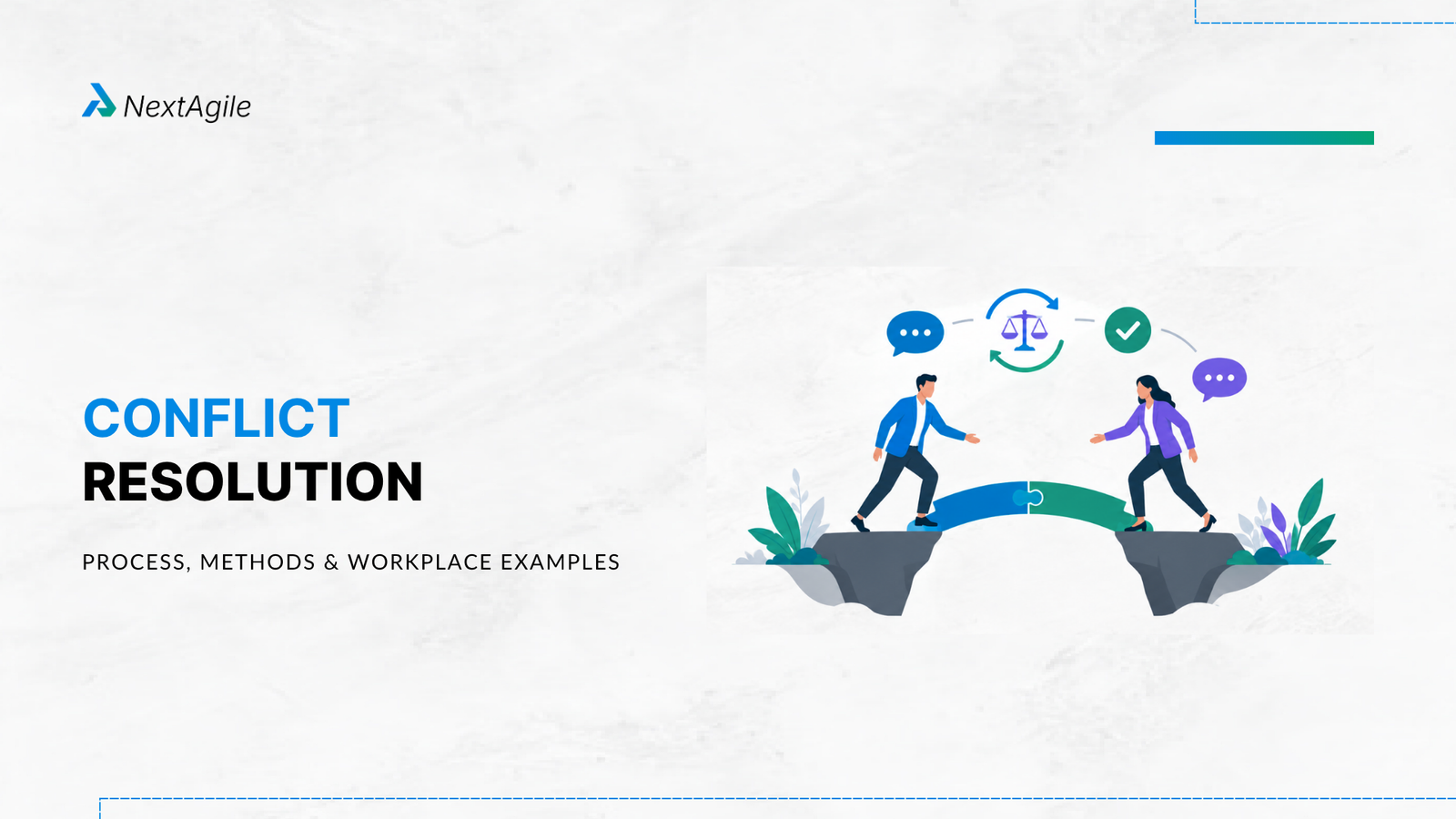
Diagnose → Understand → Reframe → Resolve → Reinforce
First, identify what is actually happening.
Next, understand the perspectives and interests behind the disagreement. Then reframe the issue around the outcome that both sides need to protect.
After that, agree on a decision, trade-off, or way forward. Finally, reinforce the resolution by changing the behavior, process, or system that allowed the conflict to emerge.
This makes conflict resolution more than a difficult conversation. It becomes a repeatable leadership process.
Conflict Resolution vs. Conflict Management Conflict resolution focuses on a specific disagreement and seeks a workable outcome.
Conflict management is broader. It focuses on reducing the damage caused by conflict and creating conditions where disagreement can be handled productively.
For example, two functions may repeatedly argue over engineering capacity every quarter. Conflict resolution may help them agree on this quarter’s allocation. Conflict management may require a stronger prioritization system, clearer decision rights, and agreed criteria for allocating scarce resources.
The difference matters because not every recurring conflict can be solved through another conversation. Sometimes the system is producing the conflict.
Why Conflict Resolution Matters in the Workplace Workplace conflict has an operational cost.
When people stop communicating openly, decisions slow down. When teams stop trusting one another, information becomes harder to access. When ownership is unclear, problems are pushed from one function to another.
The result is often visible in places that do not initially look like conflict.
Projects miss deadlines. Meetings become repetitive. Escalations increase. Customer issues take longer to resolve. Managers spend more time settling disputes instead of improving execution.
How Unresolved Conflict Affects Teams and Execution Unresolved conflict can create a predictable pattern.
First, people avoid the difficult conversation. Then they begin working around one another. Eventually, they involve managers or senior leaders in issues that could previously have been handled by the people closest to the work.
Over time, the conflict becomes part of the operating rhythm. The same people argue in the same meetings. The same decisions get revisited. The same complaints appear in performance discussions.
The cost is no longer interpersonal. It is organizational.
When Workplace Disagreement Becomes a Problem Disagreement is not automatically unhealthy.
Strong teams should be able to challenge assumptions, question decisions, and raise concerns without being treated as difficult, which depends on a culture of psychological safety .
The problem begins when disagreement becomes persistent, personal, disruptive, or destructive.
Warning signs include repeated escalation, information withholding, defensive meetings, delayed decisions, avoidance between employees, unclear accountability, and declining collaboration.
The important question is not whether people disagree. It is whether the disagreement is helping the organization make a better decision or preventing people from working effectively.
Diagnose the Conflict Before Trying to Resolve It One of the most common mistakes in workplace conflict resolution is starting with the solution.
Leaders often tell people to communicate better, collaborate more, or find common ground before understanding what created the disagreement.
A better approach is to diagnose the conflict first.
Person-Level Conflict This conflict is primarily driven by behavior, communication patterns, trust, emotional reactions, or interpersonal history.
Examples include repeated misunderstandings, abrasive communication, defensiveness, or a breakdown in trust.
These situations may benefit from direct conversation, coaching, facilitation, or mediation.
Process-Level Conflict Process conflict develops when the way work is organized creates confusion.
Examples include unclear responsibilities, poor handoffs, overlapping ownership, inconsistent expectations, or missing escalation paths.
A conversation may resolve the immediate issue, but the process also needs to change.
Priority-Level Conflict Priority conflict happens when people are working toward legitimate but competing outcomes.
Sales may want speed. Engineering may want stability. Finance may want cost control. Operations may want predictability. The problem is not necessarily that one team is unreasonable.
The organization has not created a clear mechanism for resolving the trade-off.
A Simple Diagnostic Question Before asking who is responsible for the conflict, ask:
Is this primarily a person problem, a process problem, or a priority problem?
That question changes the intervention.
If it is a person problem, work on behavior and communication. If it is a process problem, redesign roles, workflows, or decision rights. If it is a priority problem, establish shared criteria for making trade-offs. Common Workplace Situations That Require Conflict Resolution Interpersonal Disagreements Two employees may have different communication styles or different expectations about professional behavior.
The mistake is to label one person difficult and move on. Instead, identify the specific behavior, the impact it is creating, and what both people need to change.
Role and Responsibility Disputes Conflict often begins when ownership is unclear.
Two employees may believe they own the same decision, or both may assume the other person is responsible for an important task.
Clear ownership, decision rights, and accountability can prevent these disputes from becoming personal.
Cross-Functional Conflicts Cross-functional conflict is common because different teams optimize for different outcomes.
Product may prioritize market opportunity. Engineering may prioritize technical quality. Operations may prioritize reliability.
Effective resolution requires a shared business objective and strong cross-functional coordination .
Leadership and Employee Disagreements Employees can disagree with managers about priorities, workload, performance expectations, decisions, or communication.
These situations require additional care because the manager has formal authority.
The goal should be to create a structured conversation where concerns can be raised while expectations and accountability remain clear.
Resource and Priority Conflicts Limited people, budget, technology capacity, and management attention can create unavoidable competition.
The answer is not to eliminate disagreement. It is to establish transparent criteria for deciding what receives priority and why.
The Conflict Resolution Process Step 1: Identify the Conflict Start with facts and observable behavior.
Instead of saying someone is difficult, identify what happened, what decision is disputed, what behavior created the issue, and what impact it is having.
This moves the conversation away from personality judgments.
Step 2: Understand Each Perspective Give each person enough space to explain the situation from their perspective.
Ask what happened, what concerns them, what outcome they were trying to achieve, and what they believe the other person does not understand.
Listening is not the same as agreeing. It is a way of gathering information before deciding what needs to change.
Step 3: Separate Positions From Underlying Interests A position is what someone says they want. An interest explains why they want it. For example, one team may say the project must launch Friday while another says Friday is impossible.
The underlying interests may be a customer commitment on one side and quality or operational risk on the other.
Once those interests are visible, more solutions become possible.
Step 4: Establish Common Ground Common ground does not mean forcing people to agree. It means identifying the outcome both sides have a reason to protect.
Both teams may disagree about timing but agree that customer trust, product quality, and commercial impact matter.
That shared outcome becomes the basis for the next conversation.
Step 5: Generate Possible Solutions Do not rush toward the first solution.
Generate multiple options and examine the trade-offs.
A launch dispute might lead to reduced scope, phased release, additional testing, a limited customer launch, or a changed timeline.
The purpose is to move from competing positions to workable choices.
Step 6: Agree on the Resolution A resolution should be specific.
Clarify what has been decided, who owns each action, what remains open, and what happens if conditions change.
A vague agreement creates room for the conflict to return.
Step 7: Follow Up and Prevent Recurrence The final step is often ignored.
Check whether the agreement worked. If the same conflict returns, examine what caused it. Was ownership unclear? Were incentives misaligned? Did priorities change? Was a decision right missing?
Resolution is complete only when the organization has enough clarity to move forward.
Conflict Resolution Methods 1. Direct Conversation Use a direct conversation when the conflict is contained and both people can communicate constructively.
The people involved discuss the issue, listen to each perspective, and agree on what needs to change.
2. Facilitation Facilitation introduces a neutral person who structures the discussion.
The facilitator can clarify the agenda, ensure both perspectives are heard, surface assumptions, and keep the conversation focused.
3. Negotiation Negotiation is useful when people have competing interests but enough flexibility to reach a trade-off.
The focus should be on interests, constraints, options, and consequences rather than on proving who is right.
4. Mediation Conflict mediation introduces a neutral third party to help people work through a dispute.
The mediator helps participants communicate, understand the issues, explore options, and develop a workable agreement.
Workplace mediation can be particularly useful when direct discussions have failed or the relationship has become difficult to repair without outside structure.
5. Manager-Led Resolution Managers should intervene when conflict begins affecting team performance, collaboration, or delivery.
The manager’s role is not automatically to choose a side. It may be to clarify expectations, establish accountability, resolve ambiguity, and determine what needs to change.
6. Formal Organizational Resolution Some situations require a formal process.
These may include allegations involving harassment, discrimination, retaliation, threats, serious misconduct, safety concerns, or violations of organizational policy.
Such situations should be handled through the appropriate organizational procedures and applicable requirements.
Conflict Resolution Methods Comparison Method Best suited for Who leads it? Level of formality Direct conversation Contained interpersonal disagreement People involved Low Facilitation Difficult conversation needing structure Neutral facilitator Low to moderate Negotiation Competing interests and trade-offs Parties involved Moderate Mediation Significant interpersonal or relationship dispute Neutral mediator Moderate Manager-led resolution Conflict affecting team performance Manager Moderate Formal resolution Serious conduct, policy, or organizational issues Designated organizational function High
How to Choose the Right Conflict Resolution Method Choosing the right method depends on the nature and risk of the conflict.
Start by asking whether the people involved can still have a productive conversation. If yes, direct conversation may be sufficient.
If they need structure, facilitation can help. If they need to negotiate competing interests, negotiation may be appropriate.
If trust has deteriorated or direct conversations have repeatedly failed, mediation may be more appropriate.
If the issue is affecting team performance, manager intervention may be necessary. If the matter involves serious conduct or policy concerns, formal escalation may be required.
The method should match the conflict. More intervention is not always better intervention.
Conflict Resolution Skills That Improve Outcomes Active Listening Listen to understand the concern before preparing a response.
Reflect important points back and clarify assumptions that may be driving the disagreement.
Emotional Regulation Conflict can trigger defensiveness, frustration, or anger.
The ability to pause and respond deliberately can prevent a disagreement from becoming a relationship problem.
This is closely connected to emotional intelligence for leaders .
Perspective-Taking Ask what the situation looks like from the other person’s position.
You do not need to agree with their interpretation to understand what is influencing their behavior.
Clear Communication Use observable facts and specific impact.
Instead of saying that someone never communicates, identify which information was missed, when it was needed, and what consequence followed.
Questioning Good questions uncover the real issue.
Ask what outcome the person is trying to protect, what constraint they are working under, and what would make a solution workable.
Accountability A resolution without ownership is only a temporary pause.
Every important agreement should identify who will do what and by when.
Conflict Resolution Techniques in the Workplace Practical conflict resolution techniques can make difficult conversations more productive.
Use a pause when emotions are escalating. Summarize the other person’s point before presenting your own. Ask questions before making assumptions. Separate facts from interpretations. Bring the conversation back to the shared outcome when it becomes personal. Write down important agreements before the meeting ends. These techniques are simple, but they become powerful when leaders use them consistently.
Conflict Resolution Conversation: Say This, Not That The words used during a conflict can change the direction of the conversation.
Instead of saying Try saying You are blocking the project. What risk are you trying to protect? You never communicate. Which information do you need earlier? This is your responsibility. Can we clarify where ownership currently sits? You always change priorities. What should be treated as the priority when these requests compete? We already discussed this. What remains unresolved from the previous discussion?
The objective is not to use softer language for its own sake.
The objective is to replace blame with information that can be acted upon.
When to Use Mediation, Negotiation, or Escalation Use direct conversation when the issue is contained, low risk, and both people can communicate productively.
Use negotiation when both sides have legitimate interests and a trade-off can address those interests.
Use mediation when direct conversations have failed, trust has deteriorated, or a neutral third party can improve the discussion.
Use manager intervention when conflict is affecting team performance, delivery, or accountability.
Use formal escalation when the issue involves serious conduct, policy, safety, harassment, discrimination, retaliation, or another matter requiring an established organizational process.
Escalation should not be viewed simply as punishment. It is a mechanism for bringing the right level of authority and process to a problem.
The Conflict Escalation Ladder Conflict often develops gradually.
Difference → Disagreement → Friction → Breakdown → Escalation
At the difference stage, people simply see something differently.
At the disagreement stage, they begin challenging one another’s positions.
Friction appears when the disagreement starts affecting communication and collaboration.
Breakdown occurs when people stop resolving issues directly and begin avoiding, blaming, or escalating.
Escalation becomes necessary when the conflict can no longer be handled effectively at the existing level.
The earlier a suitable intervention is used, the more options people usually have.
Five Mistakes That Make Workplace Conflict Worse Trying to Solve the Conflict Too Quickly Leaders sometimes jump to solutions before understanding what the disagreement is actually about.
The result is a solution to the visible symptom rather than the underlying problem.
Taking Sides Too Early Choosing a winner before hearing the relevant perspectives can deepen the conflict.
Start with facts, impact, and interests.
Treating Every Conflict as a Personality Problem Not every recurring disagreement means two people cannot work together.
The organization may have unclear ownership, conflicting metrics, or poor decision processes.
Forcing Agreement People do not always need identical opinions.
They need clarity about the decision, responsibilities, trade-offs, and expectations.
Ending Without Accountability A conversation can feel productive and still fail if nobody knows what happens next.
Every resolution needs clear ownership.
Workplace Conflict Resolution Examples Two Employees Disagree Over Responsibilities Situation: Two employees both believe the other person owns a critical client report.
Conflict: The report is delayed and both employees blame each other.
Resolution Approach: The manager maps the responsibility from preparation through approval and identifies the ownership gap.
Outcome: One person owns preparation, another owns review, and the manager confirms the escalation path for future reports.
The resolution addresses both the immediate disagreement and the process that created it.
Product and Operations Disagree Over a Launch Situation: Product wants to launch quickly because of a customer commitment. Operations believes support readiness is insufficient.
Conflict: Product sees Operations as slowing the launch. Operations sees Product as underestimating risk.
Resolution Approach: Both teams identify their underlying interests and agree on a limited launch with defined support preparation and review checkpoints.
Outcome: The organization protects the customer opportunity while reducing operational risk.
The important shift is from who is right to what combination of speed and risk the business can accept.
Manager and Employee Disagree Over Expectations Situation: A manager believes an employee is not taking enough ownership. The employee believes priorities have changed repeatedly.
Conflict: Both sides have different interpretations of the performance problem.
Resolution Approach: They review specific examples, clarify expected outcomes, agree on priorities, and define measurable responsibilities.
Outcome: The conflict becomes a clear performance and expectations discussion rather than a debate about attitude.
Two Teams Compete for Limited Resources Situation: Two teams need the same engineering capacity.
Conflict: Each team believes its initiative should receive priority.
Resolution Approach: Leadership establishes criteria based on business impact, customer commitments, risk, dependencies, and strategic importance. A prioritization framework such as WSJF makes these criteria explicit.
Outcome: The decision is made against shared criteria rather than through repeated political escalation between teams.
This is a critical lesson in conflict resolution.
Sometimes the right answer is not another conversation. It is a better decision system.
How to Prevent the Same Conflict From Returning Resolving a conflict today does not guarantee that it will stay resolved. Recurring conflict is often diagnostic.
If the same issue keeps returning, examine the environment around it.
Are decision rights unclear? Are two teams measured against competing objectives? Are responsibilities overlapping? Does information reach one team too late? Are managers handling similar situations differently? Is there no clear escalation mechanism? These questions move the organization from individual conflict resolution to systemic improvement.
A useful post-conflict review can ask three questions:
What happened? Why did the system allow it to happen? What needs to change so it does not happen again? This is where conflict management becomes part of organizational effectiveness.
How NextAgile Builds Conflict Resolution Capability Conflict resolution should not depend entirely on the personality or experience of one manager.
Organizations need leaders and teams that can identify conflict early, have difficult conversations, negotiate trade-offs, and restore working relationships without unnecessary escalation.
NextAgile approaches conflict capability as a leadership and team operating skill.
The focus includes active listening, emotional regulation, perspective-taking, difficult conversations, negotiation, accountability, and the ability to identify the organizational conditions behind recurring conflict.
For teams that need a focused intervention, the Conflict Management Workshop can help leaders and teams build practical conflict-handling capability.
Where recurring conflict is connected to trust, communication, collaboration, or team dynamics, a team development workshop can address the wider conditions affecting team effectiveness.
Where disagreements are caused by unclear expectations, ownership, delegation, or feedback, the Delegation & Feedback Workshop can strengthen the management practices surrounding those conversations.
Organizations can also use broader conflict management strategies to build a more consistent approach to identifying, addressing, and preventing recurring workplace conflict.
For larger leadership capability initiatives, conflict resolution can form part of corporate leadership training that connects interpersonal capability with business execution.
The goal is not to create leaders who avoid conflict.
It is to create leaders who can enter difficult situations, diagnose what is really happening, create clarity, and move people toward productive action.
Conclusion Workplace conflict is not always a sign of a dysfunctional team.
Different perspectives, competing priorities, and constructive challenge are necessary for good decision-making.
The real problem begins when disagreement becomes personal, repetitive, disruptive, or impossible to resolve through normal working relationships.
Effective conflict resolution starts with diagnosis.
Determine whether the issue is primarily about people, processes, priorities, or some combination of the three. Then choose an intervention that fits the situation.
A direct conversation may be enough. Other situations require negotiation, facilitation, mediation, manager intervention, or formal escalation.
The final test is not whether everyone leaves the room agreeing. It is whether the organization has enough clarity, accountability, and shared understanding to move forward.
And when the same conflict keeps returning, look beyond the people involved. The conflict may be telling you something about the way the organization works.
If your teams struggle with recurring workplace conflict, difficult conversations, and unresolved disagreements, a structured conflict resolution approach becomes essential. NextAgile consulting can help you build practical conflict management capabilities that strengthen collaboration, accountability, and execution. Do reach out to us at consult@nextagile.ai and we would be happy to explore more.
Frequently Asked Questions 1.What if the other person refuses to resolve the conflict? Make a reasonable attempt to address the issue directly and focus on specific behavior and business impact. If the person continues to refuse and the conflict affects work, involve an appropriate manager, mediator, HR representative, or formal organizational process depending on the situation.
2.Can you resolve a workplace conflict without involving a manager? Yes. Many contained disagreements can be resolved directly when both people can communicate constructively. Direct resolution is often appropriate when there is no serious power imbalance, policy concern, or significant operational risk requiring additional intervention.
3.How do you resolve conflict with someone who will not communicate? Focus on the specific issue and its impact rather than forcing the person to agree with your interpretation. Make a clear opportunity for discussion and document relevant facts. If communication remains impossible and work is affected, involve an appropriate neutral or organizational authority.
4.What should you do if you disagree with your manager or boss? Clarify the specific decision or expectation and explain your perspective using facts and examples. Ask what objective the manager is trying to protect and discuss possible alternatives. If the issue involves serious conduct or policy concerns, use the appropriate organizational escalation process.
5.How do you restart a working relationship after a conflict? Acknowledge what needs to change and establish clear expectations for future interactions. Avoid repeatedly revisiting blame. Agree on practical working behaviors, responsibilities, and communication norms, then rebuild predictability through consistent actions over time.
6.Can workplace conflict be resolved if neither side agrees on what happened? Yes. Complete agreement about the past is not always necessary. Separate disputed facts from confirmed information and focus on the decisions, behaviors, and expectations needed going forward. If the disputed facts are material to a serious allegation, an appropriate formal investigation may be required.
Anuj Ojha is Co-Founder & Consulting Head at NextAgile. Anuj has designed & led multiple turnkey transformation journeys across industries, domains & geographies and has 16+ years of experience as an agile practitioner. He has worked with CXOs, CTOs & Key Leaders to translate their business objectives on the ground, contextualizing org transformations and creating buy-in across level, leading a team of coaches/consultants to implement agility across 150+ teams & trained more than 12k team members. Anuj’s core area of interest is business agility & working with leaders & teams to achieve long term sustainable, Agile culture & mindset.
 Skip to content