Skip to content


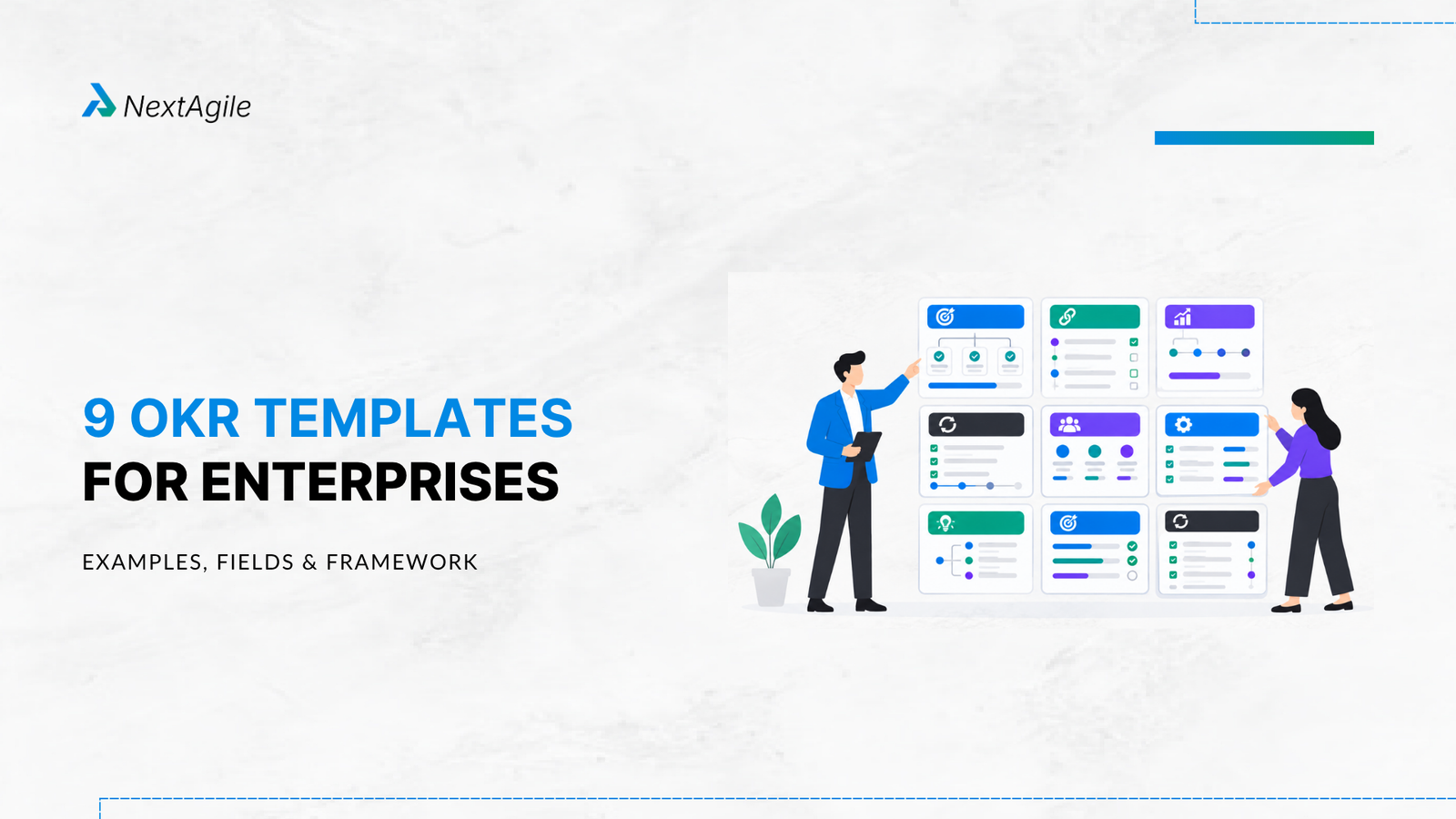
OKR templates for enterprises need to do more than capture objectives and key results. They need to connect company strategy with business unit priorities, department outcomes, team commitments, cross-functional contributions, dependencies, ownership, progress, and leadership decisions.
The most useful enterprise OKR approach uses a common structure while allowing different organisational levels to capture the context they need. This article covers nine enterprise OKR templates for planning, alignment, tracking, and review, along with the fields, governance practices, and cascading principles needed to use them effectively.
Key Highlights of OKR Templates for Enterprises
- Enterprise OKR templates should create consistency without forcing every department to use identical objectives or metrics.
- A company OKR template establishes strategic direction, while executive, business unit, department, and team templates translate that direction into measurable outcomes.
- Cross-functional OKR templates are particularly useful when one business outcome depends on several teams.
- Enterprise OKR tracking should combine progress, confidence, ownership, dependencies, and risks rather than relying only on percentage completion.
- OKR cascading works best when teams contribute to higher-level outcomes rather than simply copying objectives from leadership.
- Enterprise OKR governance determines how templates are planned, reviewed, changed, and reported across the organisation.
- A connected OKR workflow turns templates into an operating system for strategy execution rather than another collection of spreadsheets.
Introduction
An OKR template can look deceptively simple. Give people a place to enter an objective, add a few key results, assign an owner, and the framework appears ready to use.
That approach can work in a small team, where free OKR templates in Excel or Google Sheets are often enough. At enterprise scale, however, the problem changes. Hundreds or thousands of employees may be working across business units, functions, geographies, and shared initiatives. A simple template rarely provides enough context to understand how those efforts connect.
This is where enterprise OKR templates become important. The purpose is not to create more fields for the sake of administration. The purpose is to make strategic relationships visible.
A leadership team needs to know how company priorities translate into business unit outcomes. Business units need visibility into departmental commitments. Teams need to understand what they own, what they influence, and where their results depend on other teams.
A well-designed enterprise OKR methodology creates this connection without turning the organisation into a rigid top-down cascade. It gives people enough structure to align while preserving the autonomy needed to decide how outcomes will be achieved.
What Makes an OKR Template Enterprise Ready?
A template becomes enterprise ready when it can handle organisational complexity without making OKRs difficult to use.
The core fields still matter: objective, key result, baseline, target, owner, and timeframe. Enterprise environments need additional context because an OKR may sit inside several layers of strategy and involve contributors from multiple teams.
The most important question is not how many fields the template contains. It is whether the information captured helps people make better decisions about priorities, execution, dependencies, and results.
Multiple organizational levels and OKR hierarchy
An enterprise OKR hierarchy usually includes company, executive, business unit, department, team, and sometimes individual contribution levels.
The hierarchy should provide context rather than create a chain of copied goals. A team should understand which company or business priority it supports, but its objective should describe the outcome the team is responsible for influencing.
For example, a company objective focused on improving customer retention might lead to different outcomes for Product, Customer Success, Engineering, Sales, and Operations. These teams should not all repeat the company objective. They should identify the outcomes through which they contribute.
Ownership, contributors, and accountability
Enterprise OKRs often involve multiple people, but multiple contributors should not mean multiple accountable owners.
Every key result should have a clearly identified owner who is responsible for keeping the result visible, coordinating contributors, raising risks, and updating progress.
Contributors can support the outcome without carrying final accountability. This distinction prevents the common situation where everyone is involved but nobody is clearly responsible for the result.
Cross-team dependencies and alignment
Dependencies become more significant as organisations grow. A team may have a strong plan but still be unable to achieve its key result because another team controls a required system, decision, resource, or deliverable.
An enterprise OKR template should therefore capture meaningful dependencies. The purpose is not to document every interaction between teams. It is to highlight dependencies that could materially affect an outcome.
Progress, confidence, and status tracking
Progress and confidence are different signals.
Progress describes how much measurable movement has occurred against a key result. Confidence describes how likely the team believes it is to achieve the target within the cycle.
A key result can show 60 percent progress but low confidence because the remaining work is dependent on a delayed system release. Capturing both signals gives leaders better information than percentage completion alone.
Leadership roll-up and reporting
Enterprise OKR reporting should help leaders see what requires attention.
A useful roll-up shows strategic outcomes, progress, confidence, significant risks, dependencies, and decisions required. It does not simply aggregate hundreds of team updates into a larger report.
The purpose of enterprise reporting is to reduce the distance between an emerging execution problem and the leadership decision needed to address it.
9 OKR Templates for Enterprises
The nine templates below are not necessarily nine completely separate documents. In many organisations, a common enterprise OKR structure can be adapted for different purposes.
The important distinction is the information each level needs to make sound decisions.
1. Company Level OKR Template
The company OKR template defines the outcomes that matter most for the organisation during a specific period.
It should remain focused. If leadership places every strategic priority into the company OKRs, teams will struggle to distinguish what genuinely matters from what is simply important.
The company OKR template becomes the reference point for enterprise alignment. Lower levels should connect to these priorities through meaningful contributions rather than copying them word for word.
2. Executive OKR Template
An executive OKR template should provide greater strategic context than a standard team template.
Executives often manage outcomes that cross organisational boundaries. Their template should therefore capture strategic linkage, major risks, contributors, and decisions that could affect the result.
This makes the executive OKR template useful for leadership discussions, especially as CXOs align OKRs with AI and transformation strategy, rather than turning executive OKRs into a longer version of departmental task lists.
3. Business Unit OKR Template
Business units need to translate enterprise strategy into outcomes relevant to their market, product line, geography, or operating model.
A business unit OKR template should therefore connect each objective to the company priority it supports while retaining enough freedom for the business unit to define its own outcomes.
This creates alignment without requiring every business unit to use identical metrics.
4. Department OKR Template
Department OKRs translate business priorities into functional outcomes.
Finance, HR, Marketing, Engineering, Operations, and other departments may have very different measures of success. Standardisation should therefore focus on structure rather than forcing identical metrics.
The template creates consistency in how the department defines, owns, and reports outcomes while allowing finance to use measures relevant to its role.
5. Team Alignment OKR Template
A team alignment OKR template connects team outcomes with the wider organisational direction.
The most useful version makes the relationship visible without prescribing every initiative the team must execute.
The distinction between initiatives and key results is critical here. Building an onboarding guide is an initiative. Increasing successful onboarding completion is an outcome. See more OKR examples that separate the two.
6. Cross Functional OKR Template
Some outcomes cannot be achieved by one department alone. A cross functional OKR template is designed for these situations.
Consider an onboarding objective involving Sales, Product, Engineering, Customer Success, and Operations. Each group may contribute different work, but the teams need to remain aligned around the shared outcome.
The key principle is simple: shared contribution does not require shared accountability.
7. Enterprise OKR Planning Template
Planning requires more than writing objectives. Leadership needs to decide which priorities matter, what trade offs are required, and where different parts of the organisation need to coordinate.
This template should be used during OKR planning conversations, not simply distributed as a form for employees to complete independently.
8. Enterprise OKR Tracking Template
Once the quarter begins, the organisation needs a consistent way to monitor outcomes.
An enterprise OKR tracking template, built on a structured OKR sheet for goal tracking, should capture both measurable progress and execution context.
This information becomes more valuable when updated consistently. Enterprise OKR tracking should focus on meaningful changes, risks, and decisions rather than encouraging teams to write lengthy weekly narratives.
9. Enterprise OKR Review and Scorecard Template
At the end of an OKR cycle, the organisation needs to examine results and learning.
The review should not become a performance ranking exercise. Its purpose is to understand what happened, what was learned, and what should change in the next planning cycle.
How to Cascade These OKR Templates Across an Enterprise
Enterprise OKR cascading works when each organisational level understands the outcome it is contributing to.
It becomes counterproductive when leaders write objectives at the top and require every lower level to reproduce them. That creates duplicated goals, weak ownership, and a false sense of alignment.
A better approach is to use the hierarchy as context and then allow each level to define the outcomes it can genuinely influence.
Connecting company objectives to business unit OKRs
Start with a small number of company objectives that express the most important enterprise outcomes.
Business units then identify where they can materially contribute. A business unit objective should explain its own outcome, not simply restate the company objective.
For example:
Company Objective: Improve customer retention.
Business Unit Objective: Increase retention within the enterprise customer segment.
The connection is visible, but the two objectives are not identical.
Linking business unit objectives to department and team OKRs
Departments should translate business unit priorities into functional outcomes.
Suppose the business unit needs to improve enterprise retention. Product may focus on adoption, Customer Success may focus on renewal readiness, and Engineering may focus on reliability of critical capabilities.
The result is a network of contributions rather than a ladder of copied objectives.
Handling shared key results across multiple teams
A shared key result should have one accountable owner and clearly identified contributors, an approach reflected in Google’s guide to setting OKRs.
This structure prevents a common enterprise problem where a key result belongs to everyone and therefore becomes difficult to manage.
The owner coordinates progress and escalates risks. Contributors remain responsible for their agreed contribution. Dependencies are documented when another team must act for the result to progress.
Avoiding rigid top-down cascading
Rigid cascading assumes that strategy should flow downward as a series of increasingly detailed goals. John Doerr’s team describes the limits of top-down cascading OKRs.
Enterprise alignment is more effective when leadership provides strategic direction while teams contribute their knowledge of customers, processes, technology, and operational constraints.
This creates two-way alignment. Leadership clarifies where the organisation needs to go. Teams help determine the measurable outcomes and practical contributions required to get there.
Essential Fields to Add to an Enterprise OKR Template
A strong enterprise OKR template captures enough information to support alignment without becoming an administrative burden.
The following field groups provide a practical foundation.
Organizational and hierarchy fields
These fields identify where an OKR sits within the organisation.
Useful fields include company, business unit, department, team, quarter, parent objective, and strategic priority.
The parent objective field is particularly useful because it provides context without forcing lower-level teams to duplicate higher-level language.
Ownership and accountability fields
Capture accountable owners, contributors, and relevant leadership sponsors where appropriate.
The owner should be a person or clearly defined team with the authority and responsibility to manage the result.
Contributors should identify meaningful participation rather than every team that happens to interact with the work.
Dependency and contributor fields
Capture only dependencies that can materially affect the outcome.
Useful information includes dependency owner, dependency status, required decision, expected date, and impact if delayed.
This helps turn dependency tracking from passive documentation into active coordination.
Progress and confidence fields
At minimum, capture baseline, target, current value, progress, confidence, and status.
Where useful, add a short risk or commentary field. Avoid replacing measurable information with lengthy narrative updates.
Review and roll up fields
Enterprise reporting benefits from fields such as final score, outcome achieved, major learning, key constraint, leadership decision, and next cycle action.
These fields help preserve organisational learning instead of treating each quarterly cycle as an isolated reporting exercise.
How to Standardize OKR Templates Across Departments
Standardisation should create a shared language, not force every department to measure the same things.
Every department can use common core fields such as objective, key result, baseline, target, owner, contributors, confidence, status, and dependencies.
Additional fields can be added when the function has specific requirements. Engineering may need release or reliability context. Finance may need planning or reporting context. HR may need workforce or capability context, as covered in this guide to HR OKRs.
The principle is to standardise the architecture while allowing variation in the content.
A useful governance rule is to ask whether a proposed field improves planning, alignment, tracking, review, or decision making. If it does none of these, it probably does not belong in the enterprise template.
How to Use Enterprise OKR Templates for Leadership Reporting
Leadership reporting should answer a small number of important questions.
Are strategic outcomes progressing? Which results are at risk? Where are dependencies creating delays? Which outcomes have low confidence? What decisions or interventions are required?
The purpose is not to give executives visibility into every activity happening across the organisation.
Rolling up team progress to business unit level
Team results can be aggregated where the measures genuinely contribute to a broader business outcome.
However, a simple average of team scores can be misleading. Four teams showing strong progress does not necessarily mean that the business unit objective is healthy if one critical dependency is blocked.
Roll ups should therefore retain context around material risks and dependencies.
Rolling up business unit results to company level
Company reporting should focus on strategic outcomes.
Leadership may need to see progress across revenue, retention, customer experience, operational efficiency, product adoption, or other enterprise priorities. The specific measures depend on the organisation’s strategy.
The reporting structure should make it possible to move from an enterprise result into the contributing business unit or team when a deeper investigation is required.
Identifying risks, dependencies, and low confidence OKRs
A useful enterprise OKR dashboard should make exceptions visible.
Low confidence, stalled progress, unresolved dependencies, and deteriorating trends are often more important than another list of completed initiatives.
This allows leadership conversations to move from What did everyone work on? to What is preventing the outcomes that matter from being achieved?
Preparing quarterly leadership reviews
A quarterly leadership review should examine results, not simply collect status updates.
A practical review can cover four areas:
- What outcomes were achieved?
- What outcomes were missed or remain at risk?
- What did the organisation learn?
- What needs to change in the next cycle?
This creates a connection between OKR scoring and future planning.
How to Turn Enterprise OKR Templates Into an Operating Workflow
Templates become significantly more valuable when they are connected through a repeatable operating cycle.
A practical enterprise workflow is:
Plan → Align → Commit → Track → Review → Recalibrate
During planning, leadership establishes strategic priorities and company objectives.
During alignment, business units and departments identify meaningful contributions. During commitment, teams finalise measurable outcomes, owners, contributors, and dependencies.
During tracking, teams update progress and confidence while escalating material risks. During review, the organisation evaluates results and learning. Recalibration then feeds those insights into the next cycle.
This prevents the OKR template from becoming a document that is completed once and forgotten.
How to Choose the Right Enterprise OKR Template
Not every organisation needs to deploy all nine templates immediately.
The right starting point depends on the problem the organisation is trying to solve.
| If you need to… | Use this template |
| Establish enterprise priorities | Company OKR Template |
| Align senior leadership | Executive OKR Template |
| Translate strategy into business outcomes | Business Unit OKR Template |
| Align functional outcomes | Department OKR Template |
| Connect teams with strategic priorities | Team Alignment OKR Template |
| Manage shared outcomes | Cross Functional OKR Template |
| Structure quarterly planning | Enterprise OKR Planning Template |
| Monitor execution | Enterprise OKR Tracking Template |
| Review results and learning | Enterprise OKR Review and Scorecard Template |
For organisations starting an enterprise OKR programme, a common core template can be introduced first. Additional fields and views can then be added as the operating model matures.
When Spreadsheets Stop Being Enough for Enterprise OKRs
Spreadsheets can be useful during an initial OKR pilot. They become harder to manage as the number of teams, objectives, dependencies, and reporting requirements increases.
Enterprise environments often need hierarchy visibility, automated roll ups, permissions, dependency tracking, confidence reporting, dashboards, historical records, and consistent review workflows.
The decision should not be based simply on the number of employees. Complexity matters more than headcount. A smaller organisation with several business units and highly interdependent teams may need stronger OKR infrastructure earlier than a larger organisation with a simple operating model.
The real test is whether the organisation can still answer basic questions quickly and reliably.
Which company objectives are at risk? Which teams contribute to them? What dependencies are blocking progress? Who owns the response? What decision does leadership need to make?
If answering those questions requires manually combining multiple spreadsheets and asking teams for separate updates, the organisation has likely outgrown a basic template approach and should evaluate dedicated OKR software tools.
Enterprise OKR Governance: What Keeps the System Working
Templates alone do not create an effective OKR system. Governance determines how the organisation uses them.
Enterprise OKR governance should define who owns the framework, how planning is conducted, how objectives are reviewed, how changes are approved, and how leadership receives reports.
It should also establish basic quality standards. Objectives should describe meaningful outcomes. Key results should be measurable. Owners should be explicit. Dependencies should be visible. Updates should be timely enough to support decisions.
Governance should provide guardrails without turning OKRs into bureaucracy. Weak governance is behind many OKR implementation failures.
The strongest governance models make it easier for teams to focus on outcomes while giving leadership enough visibility to intervene when strategic execution is at risk.
Conclusion
Enterprise OKR templates are most effective when they form a connected system rather than a collection of forms.
The company template establishes strategic direction. Executive and business unit templates provide leadership context. Department and team templates translate priorities into measurable outcomes. Cross functional templates make shared accountability visible. Planning, tracking, and scorecard templates create the operating rhythm around those OKRs.
The central principle is consistency without unnecessary rigidity.
Every level should understand how its outcomes contribute to broader priorities, but teams should retain enough autonomy to define results they can genuinely influence. Ownership, dependencies, confidence, and progress should remain visible so that OKRs support decisions rather than simply document activity.
For organisations looking to build this capability with expert support, NextAgile provides OKR consulting and implementation to help establish practical OKR structures, planning processes, governance, and enterprise alignment.
If your teams struggle with disconnected goals, unclear ownership, and limited visibility across business units, a structured enterprise OKR framework can help create stronger alignment and accountability. NextAgile consulting can help you co create and implement practical OKR templates, governance, and processes that connect strategic priorities with measurable outcomes across the organisation. Do reach out to us at consult@nextagile.ai and we would be happy to explore more.
Frequently Asked Questions
1. What should an enterprise OKR template include?
An enterprise OKR template should typically include objective, key results, baseline, target, owner, contributors, timeframe, confidence, status, dependencies, and hierarchy information.
Additional fields can support strategic linkage, risks, leadership decisions, and review outcomes. The template should contain enough information to support alignment and decision-making without becoming unnecessarily complex.
2. How many OKR templates does an enterprise need?
There is no fixed number that every enterprise needs.
A company may use different views or versions for company, executive, business unit, department, team, cross-functional, planning, tracking, and review purposes. These do not always need to be separate documents.
A common core template with role-specific fields and views can provide consistency while keeping the system manageable.
3. Should every department use the same OKR template?
Departments should generally use the same core OKR structure, but they do not need identical metrics or supporting fields.
A shared structure creates consistency around objectives, key results, ownership, baselines, targets, confidence, and progress. Function-specific fields can then be added where they improve decision-making.
The goal is standardisation of the OKR architecture, not uniformity of departmental outcomes.
4. How do enterprise OKR templates support cascading?
Enterprise OKR templates support cascading by making relationships between organisational levels visible.
A company objective can provide strategic context for a business unit objective, which can then inform department and team outcomes. The lower-level OKR should describe the contribution that the team can influence rather than simply copy the higher-level objective.
This creates alignment while avoiding rigid top-down goal duplication.
5. How should shared OKRs be represented in an enterprise template?
A shared OKR should clearly identify the shared outcome, one accountable owner, contributing teams, dependencies, baseline, target, progress, and confidence.
The accountable owner coordinates the result and escalates risks. Contributors remain responsible for their specific contributions.
This structure preserves collaboration while avoiding the accountability gap that occurs when a key result is owned collectively by everyone and therefore by nobody in particular.

Sujith G
Sujith G. is an agile practitioner with expertise in setting up the agile environment by coaching and training teams, individuals and stakeholders in the area of lean agile software principles. He has overall 12+ years of exp out of which 9+ years have been in Agile and Scrum implementation and adoption. Sujith has coached 70+ teams on agile practices & implementation techniques and has extensive experience in setting up metrics, JIRA & Azure DevOps. Experienced in identifying gaps in the system, creating scrum awareness, piloting and scaling scrum.