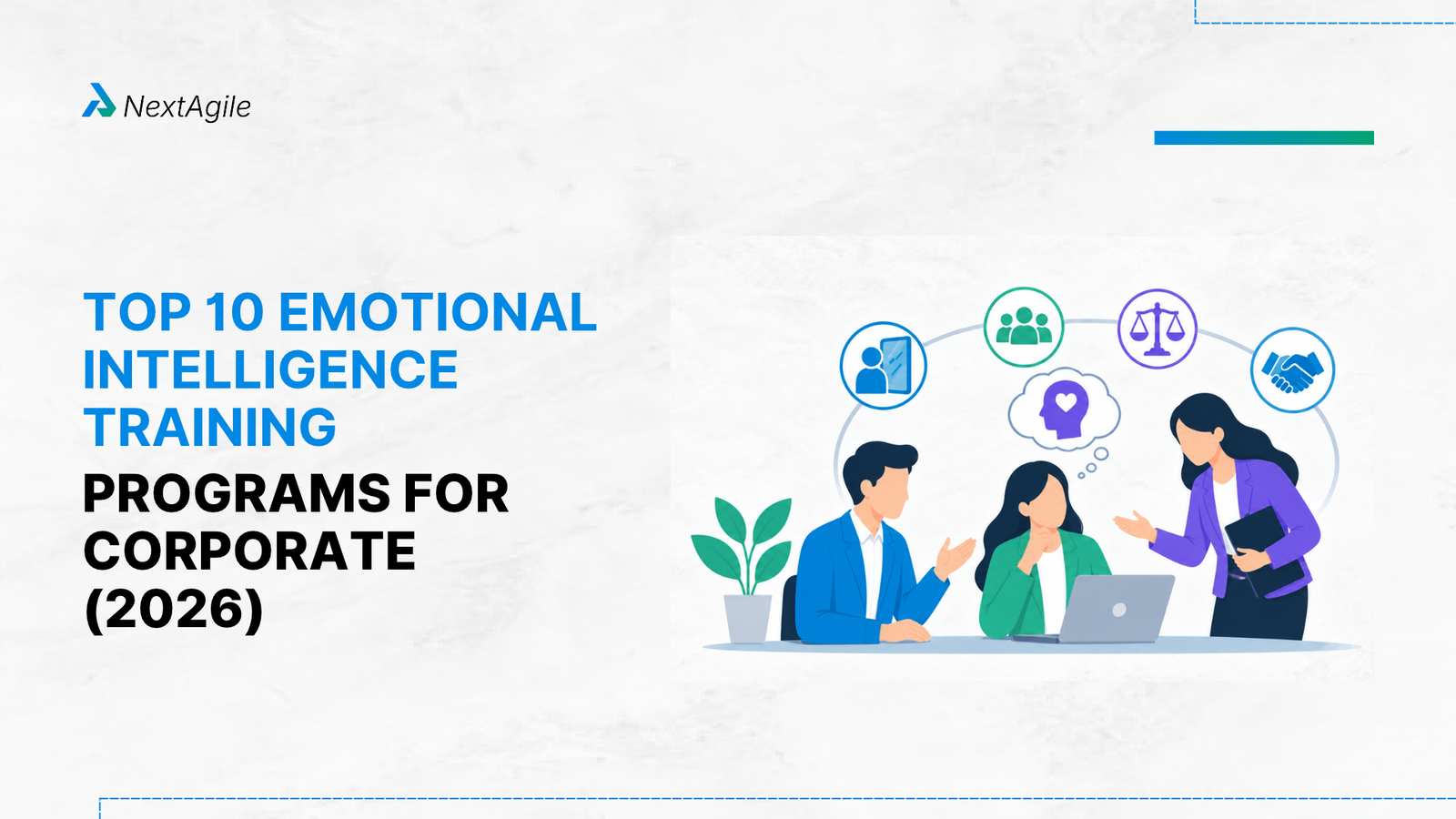
The strongest emotional intelligence training programs for corporates combine a clear assessment, hands-on practice and follow-up after the session. This guide compares ten current options: CCL, Edstellar, Euromatech, Harvard Professional and Executive Development, Korn Ferry, MDI Gurgaon, NextAgile, Six Seconds, UW-Madison Continuing Studies and Vinsys.
Key Highlights of Emotional Intelligence Training Programs for Corporate The ten programs differ more in format than in topic: half-day workshops, 16-hour cohorts, five-day courses and practitioner certifications all carry the label “emotional intelligence”. Some entries train participants. Others, such as the Korn Ferry certification, train internal practitioners to deliver assessments and feedback. Decide which one you need before comparing prices. Only some providers publish a price. Where a price is listed, it is quoted below with the date it was checked. The Consortium for Research on Emotional Intelligence in Organizations recommends evaluating on-the-job change with follow-ups of at least two months. Ask every provider how they support that. The list is in alphabetical order by provider. It is not a ranking. What Are Emotional Intelligence Training Programs? Emotional intelligence (EI) training programs teach people to notice their own emotions, manage their reactions, read other people accurately and handle relationships well. In a corporate setting, the aim is a change in daily behaviour: how a manager runs a difficult conversation, gives feedback or responds under pressure.
The idea reached business readers through Daniel Goleman’s article What Makes a Leader? , published in Harvard Business Review (republished in the January 2004 issue), which argues that emotional intelligence is essential to leadership alongside IQ and technical skill. If you want the concept explained before you compare providers, start with our guide to emotional intelligence in leadership and career growth . This article does something different: it compares programs so you can choose one.
How We Chose These Programs This article compares ten publicly described emotional intelligence learning and development offerings relevant to corporate audiences.
The comparison includes individual executive education, corporate workshops, customized development programs, facilitator training, and assessment practitioner certification. These offerings serve different needs and should not be considered directly interchangeable.
We considered programs with a publicly described emotional intelligence focus, an identifiable audience, and sufficient information to understand the offering.
We compared them across five dimensions:
Intended audience: Individual managers, senior leaders, teams, internal facilitators, or development professionals. Learning approach: Published assessments, exercises, simulations, coaching, or other opportunities for practical application. Program structure: Delivery format, duration, and available follow-up support. Purchasing model: Open enrolment, private cohorts, organizational programs, or practitioner certification. Evidence and transparency: Published information about assessment instruments, outcomes, pricing, and limitations. Providers are presented alphabetically, not ranked by effectiveness. The “Best for” descriptions are editorial assessments of likely suitability, not independently verified superiority.
Publisher disclosure: NextAgile publishes this comparison and offers one of the programs included. Its offering is evaluated using the same published-information criteria as the other providers.
Program information was reviewed on 2 November 2026, according to the underlying research record. Readers should reconfirm current prices, dates, delivery arrangements, and program features directly with each provider.
Emotional Intelligence Training Programs at a Glance Provider Program Format Audience Duration (if published) Best for NextAgile Emotional Intelligence for Leaders Small-cohort workshop, with optional coaching journey Leaders making high-stakes calls under pressure Typically one day, with follow-ups at 21, 42 and 84 days Leadership teams who want simulation-based practice Center for Creative Leadership (CCL) Emotional intelligence training (facilitator course, Passport subscription or custom module) Online or in person; you deliver or CCL delivers All levels, with people managers singled out Half-day for the facilitator course; others not stated Building an in-house EI workshop at scale Edstellar Emotional Intelligence at Work Virtual, onsite or hybrid Individual contributors, team leads, managers, HR About 16 hours Cohort training with a practice focus, including in India Euromatech Mastering Emotional Intelligence (MG100) Classroom or live online Senior executives, managers, team leaders 5 days An intensive public course for individual leaders Harvard Professional and Executive Development Emotional Intelligence in Leadership Online or on campus Mid-level managers Online: four 3.5-hour sessions; on campus: 2 days Managers who want a 360-degree assessment and a Harvard certificate Korn Ferry Emotional and Social Competency Inventory (ESCI) certification Blended: eLearning plus one live virtual session Development and coaching professionals About 4 hours eLearning plus about 2.5 hours live Certifying internal coaches and HR to use a validated EI assessment Management Development Institute (MDI) Gurgaon Leading with Emotional Intelligence for Stress Management Residential or non-residential, on campus Executives and managers nominated by their organisations 3 days Indian corporates sending managers to a campus programme Six Seconds Emotional intelligence for business (training, assessments, coaching) Interactive training, assessments and coaching, customised Leaders, managers and teams Not stated Organisations that want a blend of training, assessment and coaching UW-Madison Continuing Studies Emotional Intelligence for Leaders: From Insight to Impact Live online Managers 6 instructional hours over three sessions Individual managers wanting a short, low-cost course with an EQ-i 2.0 report Vinsys Emotional Intelligence Certification Training Live online, or customised corporate training Leaders, managers, HR, team members Not stated Indian employers wanting a broad eight-module course
The 10 Emotional Intelligence Training Programs Each entry follows the same template: what it is, format and audience, what participants get, best for, and things to check before you buy. All facts were read from the provider’s page on 2 November 2026.
1. NextAgile: Emotional Intelligence for Leaders What it is. A practitioner-led, simulation-driven workshop that treats EI as an operating skill. NextAgile is the publisher of this article, so we describe the program only from its own page and apply the same criteria as to every other entry. Details are on the workshop page for leaders who decide under pressure .
Format and audience. Small cohorts, typically one day, and it can extend into a cohort-based journey with coaching reinforcement. The page names reinforcement points at 21, 42 and 84 days. The audience is leaders who make high-stakes calls under pressure.
What participants get. Practice on real escalation, conflict and feedback scenarios with direct facilitator input, and pre- and post-program EQ diagnostics. The page lists the outcomes it targets, including faster decisions under pressure, accurate reading of team signals, difficult conversations held on time and higher trust and psychological safety.
Best for. Senior or experienced leaders and leadership teams who want behaviour practice rather than a lecture-style course.
Things to check before you buy. The page does not name the EQ diagnostic instrument, publish a price or list public dates, and its outcomes are the provider’s own statements. Ask for the instrument, sample reports and how the 21, 42 and 84 day follow-ups are run. Pricing starts from a discovery call.
2. Center for Creative Leadership (CCL): Emotional Intelligence Training What it is. CCL, a leadership research and development organisation, offers emotional intelligence training through three routes: a Workshop Facilitator Course that prepares your people to host a half-day workshop, a CCL Passport subscription that gives access to this module and its wider workshop library, and a custom module that CCL delivers as part of a learning journey.
Format and audience. The facilitator route runs online or in person. CCL says individuals at every level benefit, and it singles out people managers.
What participants get. The content centres on four skills: self-awareness, self-management, social awareness and relationship management. CCL also lists empathy, active listening and building psychological safety and inclusion.
Best for. L&D teams that want to run EI workshops themselves across many managers, rather than send people to a public course.
Things to check before you buy. The page states a duration only for the facilitator workshop. No price is published. CCL describes benefits such as engagement and productivity as general organisational gains, not measured results of this program, and its client figures are self-reported.
3. Edstellar: Emotional Intelligence at Work What it is. A corporate training course in six modules, with four guided practice sessions and a capstone in which participants present a 30-day EI action plan.
Format and audience. Instructor-led group training delivered virtually, onsite or in hybrid mode. The page lists more than ten delivery languages, including Hindi, and says India is among the countries where Edstellar has delivered it. It targets individual contributors, team leads and managers, plus HR, sales and customer service teams, and recommends 8 to 20 participants per cohort.
What participants get. About 16 hours, typically as two full days or four half-day sessions. Topics include the components of EI, self-regulation and resilience, empathy and active listening, feedback, and EI in teams and conflict. The provider says practice accounts for about 65 percent of the time. A self-awareness baseline is taken at the start and a behaviour check-in follows the program. Completers receive a certificate.
Best for. Indian and global employers who want a cohort course for a mixed group of managers and team members, delivered on their own premises or online.
Things to check before you buy. Pricing is by licence package (for example, a Starter package of 120 trainee licences and 64 group training hours) with a custom quote, so ask what a single cohort costs. The page does not name the assessment used for the baseline.
4. Euromatech: Mastering Emotional Intelligence (MG100) What it is. A five-day intensive course titled “Bringing Out the Best in Others”.
Format and audience. Classroom or live online. The audience is senior executives, managers and team leaders, high-potential and emerging leaders, project managers and client-facing professionals. Scheduled classroom dates run in Dubai, London and Bangkok, and live online dates run from December 2026.
What participants get. A day-by-day agenda: the importance of EI and communicating with high EQ (day 1), conflict resolution and handling pressure (day 2), stress, resilience and body language (day 3), emotional impulses and inspiring teams (day 4), and empathetic and authentic leadership with a personal action plan (day 5). Outcomes include greater self-awareness of triggers and communication style, and building resilience.
Best for. Individual leaders or small groups who can step away for a full week.
Things to check before you buy. The listed prices are US $5,950 for classroom and US $4,950 for live online. Classroom lists 30 CPE credits. The page names no assessment instrument and describes the course as open to a wide audience, so ask how content is adjusted for a corporate group.
5. Harvard Professional and Executive Development: Emotional Intelligence in Leadership What it is. A program from the Harvard Division of Continuing Education that leads to a Certificate of Completion and counts toward its Certificates of Leadership Excellence.
Format and audience. Online or on campus, aimed at mid-level managers. Online sessions run 3.5 hours; the on-campus option is two consecutive days.
What participants get. Topics include what EI is, developing it individually and in groups, an assessment debrief, and applications such as building trust, managing difficult decisions, building resilience and improving team performance. Participants complete a 360-degree EI assessment beforehand, gathering feedback from at least four colleagues at least five business days before the start. The assessment is included in the fee.
Best for. Mid-level managers who want a recognised credential and a 360-degree view of their own EI.
Things to check before you buy. Listed prices are US $3,050 for the online program starting 30 November 2026 and US $3,400 for on-campus dates in 2027. The page is open enrolment, so confirm whether Harvard offers a customised version for your company. The page’s online schedule is not fully consistent (it mentions both two weeks and four weeks), so check the calendar before booking.
6. Korn Ferry: ESCI Certification What it is. Certification in the Emotional and Social Competency Inventory (ESCI), an EI assessment. The page credits Daniel Goleman as a co-designer with Korn Ferry.
Format and audience. Blended: five self-paced eLearning modules of about four hours in total, then one live virtual session of about 2.5 hours called Coaching Practice. The page says anyone is welcome, and certification is required to deliver ESCI feedback sessions. In practice it is for coaches and development professionals.
What participants get. The science behind ESCI, a deep dive into the competencies, how to read ESCI reports, and practice giving feedback. Completers qualify as approved practitioners and can receive ESCI reports from Korn Ferry.
Best for. HR and L&D teams building an in-house capability to run a validated EI assessment and feedback conversations.
Things to check before you buy. This certifies a practitioner. It is not a workshop for a team of managers. Assessments are bought separately under a contract with Korn Ferry, and the page lists no price.
7. Management Development Institute (MDI) Gurgaon: Leading with Emotional Intelligence for Stress Management What it is. A three-day management development programme on the MDI campus in Gurugram, scheduled for 7 to 9 December 2026.
Format and audience. Residential, with a non-residential option. Participants are executives and managers from corporate organisations, including public sector enterprises, private companies, multinationals, banks and financial institutions, and they must be nominated by their employer.
What participants get. Sessions on the concept and measurement of EI, EI and leadership styles, teamwork, mental well-being, and decision-making and problem-solving. The content also covers the role of personality, values and organisational culture, Indian perspectives on EI, and potential downsides of EI.
Best for. Indian employers who want to send managers to a business-school campus, particularly where stress and well-being are the main concern.
Things to check before you buy. The page lists fees excluding GST of Rs. 45,000 (single room), Rs. 42,000 (double sharing) and Rs. 40,500 (non-residential), with a nomination deadline of 24 November 2026. It does not name an assessment tool or a post-program follow-up.
8. Six Seconds: Emotional Intelligence for Business What it is. Six Seconds describes itself as a global nonprofit. Its business page groups its work into leadership development, talent management, engagement and culture, change and AI adoption, customer experience, and sales. It delivers through interactive training, validated assessments (self, 360 and group reports) and coaching and consulting.
Format and audience. Customised. The page says it recommends a “right-sized blend” of training, coaching and measurement. It does not define a single audience or program length.
What participants get. The page links each area to a case study, including FedEx Global Leadership Institute, Siemens, UK NHS and Kuehne + Nagel. Separately, its certification page lists an entry course called Unlocking EQ and certifications for facilitators, coaches and consultants, which suit internal trainers.
Best for. Organisations that want a measured, blended program and are comfortable with a consultative scoping process.
Things to check before you buy. No named corporate program, duration or price is published on the business page. The outcomes shown are stated goals, not reported measured results, so ask for evidence from comparable clients.
9. UW-Madison Continuing Studies: Emotional Intelligence for Leaders, From Insight to Impact What it is. A short live online course from the University of Wisconsin-Madison, described on its page as emotional intelligence training for managers.
Format and audience. Three live sessions on 4, 11 and 18 March 2027 (1 to 3 p.m. Central Time), 6 instructional hours in total, with online materials available beforehand.
What participants get. An EQ-i 2.0 self-assessment with a personalised report (included in the fee), the brain science behind common workplace behaviours, ways to help a team manage emotions during conflict and high-stakes decisions, psychological safety, and a template toolkit to apply with a team.
Best for. Individual managers or small groups who want a low-cost, short course built on a known assessment.
Things to check before you buy. The listed fee is US $530 (US $430 for government and nonprofit employees). It is an open-enrolment course, so ask whether a private cohort is possible. Six hours is a starting point, not a sustained program.
10. Vinsys: Emotional Intelligence Certification Training What it is. A certification course from Vinsys, listed in the India section of its site, offered as live online training or as customised corporate training.
Format and audience. Open to leaders, managers, team members, HR, project managers, trainers and client-facing staff, with no prerequisites.
What participants get. Eight modules: introduction to EI, self-awareness, emotional regulation, empathy and social awareness, relationship management, effective communication, stress management and leadership with EI. Completers receive a certification. The corporate option is customised to organisational goals and includes assessments, feedback mechanisms and team exercises.
Best for. Indian employers who want a broad, modular course for a mixed group.
Things to check before you buy. The page states neither duration nor price. It claims improvements in team dynamics and productivity without supporting data, so ask for evidence and for the name of the assessment used in the corporate version.
When Emotional Intelligence Training Is Not the Entire Solution
Emotional intelligence training can help leaders recognize emotional triggers, respond more constructively under pressure, listen carefully, and handle difficult conversations. These capabilities matter, particularly when decisions involve uncertainty, conflict, or competing priorities.
However, not every leadership problem that appears emotional is primarily an emotional intelligence problem.
Consider a leadership team where disagreements repeatedly escalate because no one has clear authority to resolve cross-functional priorities. Managers may become defensive, meetings may turn confrontational, and relationships may deteriorate. Emotional intelligence training could improve how participants communicate, but it would not, by itself, resolve the ambiguity over who makes the decision.
Similarly, employees may hesitate to raise concerns because previous escalations resulted in blame or negative performance consequences. Training managers to respond with greater empathy may help, but the organization must also examine how it handles mistakes, dissent, and accountability.
Before choosing an emotional intelligence program, leaders should distinguish between three situations:
Individual capability gaps: Leaders struggle to recognize their reactions, understand others’ perspectives, or conduct difficult conversations constructively. Leadership behaviour patterns: Managers have the necessary knowledge but repeatedly respond defensively, avoid conflict, or undermine trust in practice. Organizational constraints: Decision rights, incentives, governance routines, or conflicting expectations repeatedly create the conditions for unproductive behaviour. Training may address the first problem and contribute to the second. The third often requires changes to how the organization operates.
The objective is not simply to make leaders better at managing emotions. It is to improve the quality of decisions, conversations, and working relationships when business conditions become difficult.
How to Choose an Emotional Intelligence Training Program Start with the problem, not the provider. A short course can build awareness, but changing how a manager behaves under pressure usually needs practice and follow-up. The Guidelines for Best Practice from the Consortium for Research on Emotional Intelligence in Organizations (Cherniss, Goleman, Emmerling, Cowan and Adler, 1998) set out 22 guidelines in four phases: preparation, training, transfer and maintenance, and evaluation. They include assessing the organisation’s needs and the individual, providing opportunities to practise, relying on experiential methods and building in support afterwards. The Consortium notes the guidelines are additive: programs need not follow all of them, but each one followed improves the chances of success.
Use that as a lens for the ten programs above:
Who is learning? Individual managers can join an open-enrolment course (Harvard, Euromatech, UW-Madison, MDI). A whole team or function usually needs a customised or on-site program (CCL, Edstellar, Six Seconds, Vinsys, NextAgile). Do you need training or capability? If you want to build an internal EI practice, a practitioner route such as the Korn Ferry certification or CCL’s facilitator course fits better than sending managers on a public course. How is progress measured? Look for a named assessment before and after, as in the 360-degree assessment at Harvard or the EQ-i 2.0 report at UW-Madison. How long is the support? A one-day session with scheduled follow-ups, a five-day course and a half-day workshop each give a different level of reinforcement. Is the content right for the level? Training for first-time managers is different from training for senior leaders. If you are scoping a wider leadership curriculum, see our guide to corporate leadership development training . What Does an Emotional Intelligence Assessment Actually Establish? An emotional intelligence assessment can provide a useful starting point for development, but buyers should understand what it measures and how its results are interpreted.
Self-assessments capture how participants perceive their own behaviour. Multi-rater assessments incorporate observations from colleagues and other stakeholders. These approaches offer different perspectives and have different limitations.
Before purchasing a program, ask whether the assessment has published evidence of reliability and validity, whether it is appropriate for the participant population, and whether qualified practitioners interpret the results.
A higher score after training does not automatically establish improved leadership effectiveness. Meaningful evaluation should also examine observable behaviour in real situations, including feedback conversations, conflict resolution, decision-making under pressure, and responses to difficult information.
Assessment is a developmental input. Sustained behavioural change is the outcome that organizations ultimately need to establish.
EI also overlaps with other skills. Self-awareness has its own treatment in our article on self-awareness in leadership , and conflict and feedback are covered in separate programs. If you are not sure that EI is the right gap, a coaching route may fit better: see how to choose a leadership coaching program .
What Should You Ask an Emotional Intelligence Training Provider? Use this checklist in vendor conversations. A provider that cannot answer these questions plainly is a risk, whatever its brand.
Which EI model and assessment do you use, and who developed it? Can I see a sample participant report before we commit? What share of the time is practice, and what kind (role play, live scenarios, coaching)? What happens after the session? Who follows up, when and in what format? How do you tailor the program to our managers’ level and our context? What is the ideal group size, and what is the total cost for our group, including assessments and travel? How do you measure change on the job, and over what period? Can you share evidence from similar clients, and who can I speak to? Who will actually facilitate, and what is their experience? How Do You Measure the Impact of Emotional Intelligence Training? Begin by identifying the specific leadership behaviours the organization wants to improve. These may include responding constructively to disagreement, giving difficult feedback promptly, listening without becoming defensive, or making considered decisions under pressure.
Establish a baseline using appropriate assessment tools and evidence from actual work. Depending on the program, this may include confidential multi-rater feedback, observations of leadership practices, or structured reviews of real workplace situations.
After training, examine whether participants demonstrate the intended behaviours consistently. For example, are difficult conversations occurring earlier? Are leaders acknowledging concerns before making decisions? Are recurring conflicts being resolved more effectively?
Review progress after an appropriate interval, allowing time for participants to practise new behaviours. Follow-up assessments can provide useful evidence, but should be interpreted alongside changes in responsibilities, team composition, workload, and organizational conditions.
Business indicators such as engagement, retention, or team performance may provide additional context. However, changes in these measures should not automatically be attributed to emotional intelligence training.
The most credible evaluation connects a clearly identified capability gap to an intervention, observes the resulting behaviour, and examines whether that change contributes to better leadership and business outcomes.
In short, decide what you will measure before the program starts. The Consortium’s guidelines call for on-the-job measures taken before and after training, with follow-ups of at least two months and ideally one year. In practice that means a baseline assessment, a repeat assessment, and a small set of business indicators your managers already track, such as team engagement or regretted attrition in the participants’ teams.
The Kirkpatrick model is a common way to organise this thinking, from participant reaction through to results. Our guide to the Kirkpatrick model explains the four levels, and our overview of corporate training programs covers design and ROI measurement for the wider portfolio. Ask each provider which of these measures they support and which stay with your team.
Emotional intelligence also affects the climate in which people speak up. If your goal is trust and openness in teams, pair the training with work on building psychological safety in the workplace .
How Is This List Different from Other Leadership Training Lists? This article compares programs on one topic. If you are choosing a general leadership provider for senior management in India, read our separate comparison of top leadership training companies in India , which is not topic-specific. For a deeper explanation of how triggers and reactions affect leaders, see emotional triggers and leadership .
Conclusion Emotional intelligence training can help leaders become more aware of their reactions, handle difficult conversations, and respond constructively when workplace situations become challenging. The right program depends on the participants, the capabilities they need to develop, and the opportunities available to practise and sustain those behaviours.
Organizations should distinguish between individual development, team-based learning, and the need to build internal assessment or facilitation capability before selecting a provider.
They should also examine whether the problems they want to solve arise from leadership behaviour, unclear organizational expectations, or decision-making practices that repeatedly create conflict.
NextAgile offers an Emotional Intelligence for Leaders workshop focused on practising leadership responses in situations involving pressure, conflict, and difficult conversations.
To explore whether the workshop fits your leadership team’s needs, contact consult@nextagile.ai .
Frequently Asked Questions 1.What are emotional intelligence training programs?
They are structured courses or workshops that teach people to recognise and manage their own emotions and to read and respond to others. Corporate versions usually combine an assessment, practice exercises such as role play or coaching, and a follow-up so that behaviour changes on the job and not only in the classroom.
2.How long does emotional intelligence corporate training take?
It varies by format. Among the programs compared here, durations range from a half-day workshop (CCL) and six hours over three sessions (UW-Madison) to 16 hours (Edstellar), three days (MDI Gurgaon) and five days (Euromatech). Some providers do not publish a duration.
3.What is the difference between emotional intelligence training for leaders and for managers?
Leader programs usually focus on decisions under pressure, influence and the climate a leader creates. Manager programs focus more on feedback, conflict and day-to-day team conversations. Check the audience a provider states. Harvard targets mid-level managers, while NextAgile targets leaders making high-stakes calls.
4.Do emotional intelligence programs use an assessment?
Many do. Harvard uses a 360-degree EI assessment as pre-work, UW-Madison includes an EQ-i 2.0 self-assessment, and Korn Ferry certifies practitioners in the ESCI. Others state an assessment without naming it, so ask which instrument is used and how reliable it is for your population.
5.Can emotional intelligence training be delivered to a whole team?
Yes. CCL, Edstellar, Six Seconds, Vinsys and NextAgile describe customised or on-site delivery, and Edstellar recommends 8 to 20 participants per cohort. Open-enrolment courses such as Harvard’s or UW-Madison’s suit individuals better, so ask whether a private cohort is possible for your team.
6.How do you measure the results of emotional intelligence training?
Take a baseline assessment, repeat it after the program and track a few business indicators your managers already own. The Consortium for Research on Emotional Intelligence in Organizations recommends on-the-job measures before and after, with follow-ups of at least two months and ideally one year.
7.How much does emotional intelligence training cost?
Published prices in this list range from US $530 for a six-hour online course (UW-Madison) to US $5,950 for a five-day classroom course (Euromatech), with MDI Gurgaon at Rs. 40,500 to Rs. 45,000 plus GST. Several providers publish no price and quote by group size, so request a total cost.
 Skip to content