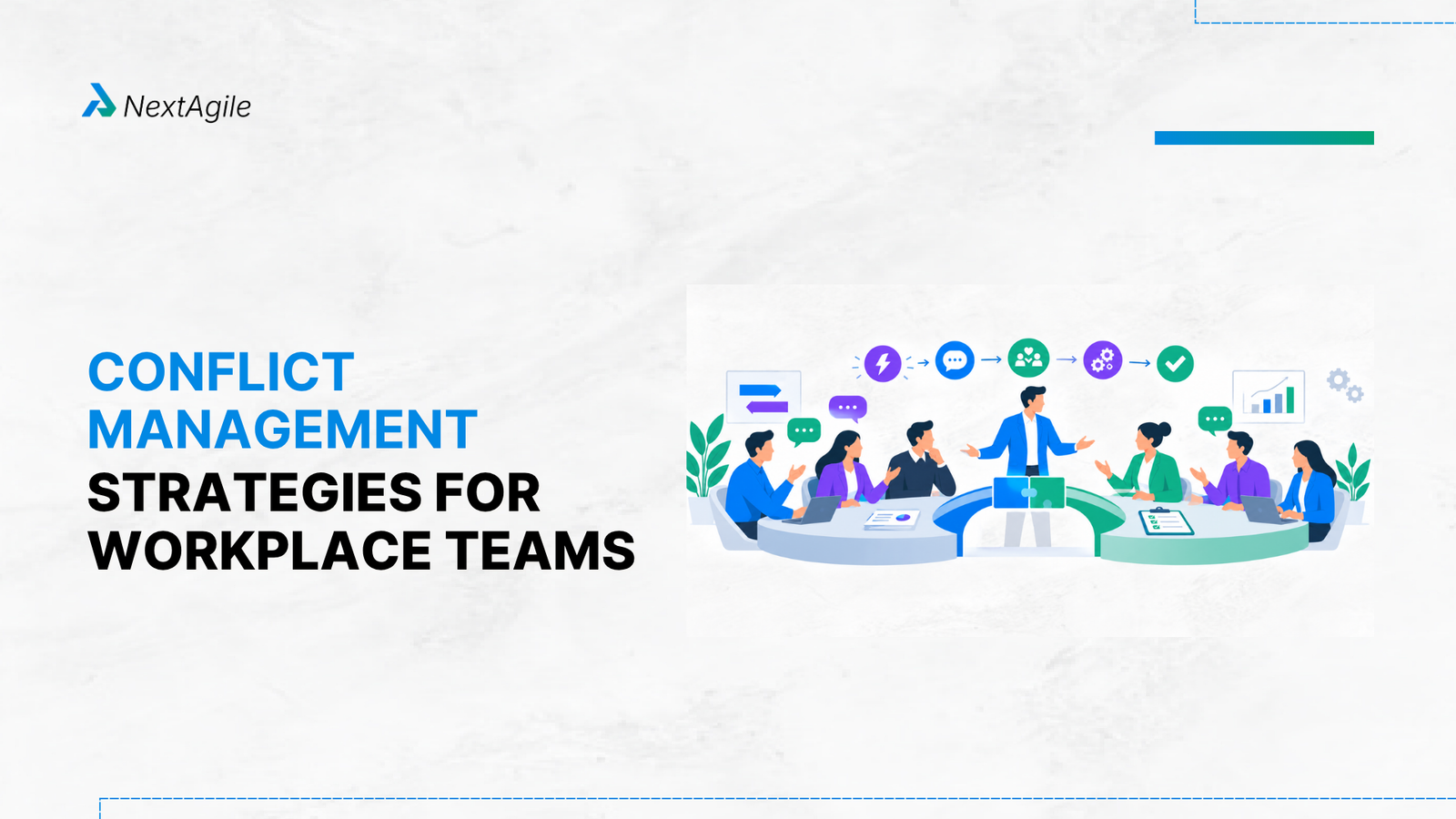
Most workplace conflict does not begin with a serious disagreement. It starts when small tensions are left unresolved until they begin affecting decisions, trust, and execution.
A manager avoids addressing a recurring issue. Two colleagues stop challenging each other directly. A functional team feels that another department keeps creating unnecessary work.
Nothing appears serious at first.
Then meetings become defensive. Information starts moving through side conversations. Decisions take longer. People become careful about what they say and who they say it to.
That is when workplace conflict stops being an interpersonal issue and starts becoming a business problem.
Effective conflict management is not about creating a workplace where everyone agrees.
Strong teams will disagree. Different functions will protect different priorities. Leaders will make decisions that some people challenge.
The real capability is knowing how to handle disagreement without allowing it to damage relationships, decision quality, psychological safety, or execution.
Conflict management strategies are practical approaches used to understand, address, and resolve disagreements between employees, managers, teams, and other workplace stakeholders.
The five conflict management strategies in the Thomas-Kilmann model are competing, accommodating, avoiding, compromising, and collaborating. Each approach can be effective when used in the right situation.
Effective workplace conflict resolution requires more than selecting a conflict style. It also depends on active listening, emotional intelligence, difficult conversations, clear expectations, healthy team norms, and appropriate manager intervention.
The goal is not to eliminate conflict.
The goal is to prevent disagreement from becoming destructive while creating an environment where people can challenge ideas, resolve tension, and continue working effectively together.
Key Highlights of Conflict Management Strategies for Workplace Teams Workplace conflict is not always harmful. Poorly managed conflict is. The right conflict management strategy depends on the situation, not the manager’s personality. The Thomas-Kilmann model provides five approaches: competing, accommodating, avoiding, compromising, and collaborating. Managers should diagnose the source of conflict before deciding how to intervene. Active listening and emotional intelligence help people manage reactions during difficult conversations. Healthy team norms make disagreement safer and easier to address. Recurring conflict can indicate deeper problems with accountability, decision rights, incentives, workload, or processes. Mediation or formal escalation may be necessary when conflict becomes serious or cannot be resolved informally. The best conflict resolution creates measurable improvement in behavior, collaboration, and execution. Conflict Management Strategies: Why Workplace Teams Need a Structured Approach Conflict is a natural part of working with other people.
People have different experiences, priorities, personalities, responsibilities, and definitions of success. A product leader may prioritize speed while a risk leader prioritizes control. A sales manager may want flexibility while operations wants predictability.
The disagreement itself is not necessarily a problem. In fact, disagreement can improve decisions when people challenge assumptions, identify risks, and bring perspectives that others have missed.
The problem begins when people stop debating the issue and start defending themselves.
A disagreement about a project can become a disagreement about competence. A discussion about priorities can become a question of respect. A manager who delays a difficult conversation may unintentionally signal that poor behavior is acceptable.
Over time, the conflict becomes harder to separate from the people involved. This is why conflict management in the workplace needs structure.
Managers need to understand what is happening before deciding how to respond. Is this a disagreement about the task? Is it a relationship problem? Is the process creating friction? Are two teams being measured against conflicting goals?
The answer determines the intervention.
Sometimes the right response is collaboration; sometimes it is compromise and sometimes a manager needs to make a firm decision.
Sometimes the conflict is a symptom of a deeper organizational problem that training or conversation alone cannot solve.
Common Types and Causes of Workplace Conflict Workplace conflict can take several forms.
Task conflict occurs when people disagree about what should be done, which priorities matter, or which approach will produce the best result.
Process conflict develops around how work gets done. It may involve ownership, timelines, workflows, resources, decision rights, or responsibilities.
Relationship conflict is more personal. It can involve distrust, communication patterns, perceived disrespect, personality clashes, or unresolved resentment.
Values-based conflict can be particularly difficult because it involves deeply held beliefs about what is right, fair, responsible, or acceptable.
There is also structural conflict, which is often missed.
Two teams may appear to have a communication problem when their incentives are actually pulling them in opposite directions.
For example, sales may be rewarded for closing deals quickly, while operations is measured on delivery reliability. Both teams can be doing what their leaders expect while creating friction for each other.
This is why managing team conflict requires more than telling people to communicate better.
Leaders need to examine the conditions surrounding the conflict.
Are responsibilities clear? Are decision rights defined? Do teams have conflicting targets? Is workload creating unnecessary pressure? Are managers reinforcing the behaviors they expect from employees? The source of conflict matters because the intervention must address the source, not simply the visible argument.
A Practical Workplace Conflict Diagnostic Before deciding how to handle conflict, managers should diagnose what they are actually dealing with.
Start with the issue itself.
Is the disagreement about a task, a process, a relationship, or a value?
Then look at the pattern.
Is this a one-time disagreement or something that keeps happening?
Next, examine the environment.
Are unclear roles, competing priorities, poor processes, or unclear decision rights contributing to the tension?
Then assess the people involved.
Can they resolve the issue themselves, or is there a power imbalance that makes direct resolution difficult?
Finally, consider the consequence.
What happens if the conflict remains unresolved for another month?
These questions quickly separate a normal disagreement from a conflict that needs intervention. They also stop managers from making a common mistake: choosing a response before understanding the problem.
Five Conflict Management Strategies Based on the Thomas-Kilmann Model The Thomas-Kilmann model identifies five approaches to conflict: competing, accommodating, avoiding, compromising, and collaborating.
The value of the model is not simply knowing the five categories.
Its real value is helping managers recognize that different situations require different responses. A manager who always competes can become controlling. A manager who always accommodates can create resentment. A manager who always avoids can allow problems to grow. A manager who always compromises can create solutions that satisfy nobody. A manager who always collaborates can spend too much time seeking consensus when a clear decision is needed. The skill is choosing deliberately.
Competing Competing involves taking a firm position and pursuing a specific outcome.
This approach is appropriate when speed matters, a clear standard must be protected, or the organization has a non-negotiable requirement.
A manager dealing with a serious safety issue cannot always wait for consensus.
A leader may also need to make a final decision when a team has reached an impasse and continued debate is delaying critical work.
The risk appears when authority becomes the default response. If employees learn that disagreement will simply be overruled, they may stop raising concerns.
Competing works best when the issue requires firmness and the reason for that firmness can be explained clearly.
Accommodating Accommodating means giving greater weight to another person’s position.
It can be appropriate when the issue matters more to the other person, when preserving an important relationship is valuable, or when the cost of pursuing your preferred position is greater than the benefit.
Consider a minor disagreement about how a presentation should be structured.
If the issue has little business consequence, allowing a colleague to take the lead may be the sensible choice.
But accommodation becomes unhealthy when it is used to avoid discomfort.
Employees who continually give in can develop resentment. Managers can also unintentionally reward difficult behavior when they accommodate someone simply because confrontation feels difficult.
Accommodation should be a conscious choice. It should not become a pattern of silent surrender.
Avoiding Avoiding means choosing not to address the conflict immediately.
This can be useful when emotions are running high, when more information is required, or when the issue is too minor to justify intervention.
A manager may pause a heated discussion and continue it the following day when everyone is able to think more clearly.
That is different from ignoring the conflict. The distinction is intention.
A deliberate pause creates space for a better conversation. Passive avoidance simply delays the problem and hopes it disappears.
Unresolved conflict usually does not disappear. It accumulates history.
Managers should therefore know why they are postponing the discussion and when they will return to it.
Compromising Compromising involves finding a solution where each side gives something up. It is useful when both sides have legitimate interests and time is limited.
Suppose one team believes a project needs four weeks while another believes six weeks is realistic. A five-week delivery with clearly defined scope may be a workable compromise.
The advantage is speed. The risk is assuming that the middle position is automatically the best position.
Some problems cannot be solved by splitting the difference.
If one team has identified a serious compliance or safety risk, compromise may simply weaken the necessary safeguard.
Use compromise when it creates a workable outcome, not merely because it feels balanced.
Collaborating Collaborating focuses on understanding the interests behind each position and developing a solution that addresses the underlying problem. It usually requires more time than the other approaches.
But when both the issue and the relationship are important, collaboration can produce stronger outcomes.
Consider a product team that wants to launch quickly and a compliance team that believes additional controls are required.
A positional discussion asks whether the launch should happen now or later.
A collaborative discussion asks what customer outcome needs to be achieved, what risks must be controlled, and what conditions would allow both objectives to be met.
That changes the conversation.
Instead of defending positions, both teams work on the problem.
Collaboration is particularly valuable when the conflict is complex and both sides have information the other side needs.
How to Choose the Right Conflict Management Strategy for the Situation Managers should not choose a conflict strategy based only on personality.
The manager who is naturally assertive may overuse competing. A manager who values harmony may overuse accommodation or avoidance.
Neither tendency is consistently effective.
Start with the importance of the issue.
If the conflict involves customer impact, safety, ethics, significant financial consequences, or critical business performance, it deserves more attention.
Then consider urgency.
A decision required today may need a different approach from a relationship issue that has developed over several months.
Next, consider the relationship. If the people involved will continue working together, a quick settlement may not be enough. The underlying relationship may need repair.
Finally, consider the cost of leaving the conflict unresolved.
A useful decision guide is:
Low importance and low urgency: consider letting the issue go. High urgency and a clear requirement: make a firm decision. High importance and an important working relationship: consider collaboration. Moderate importance with limited time: compromise may be appropriate. High emotion or insufficient information: pause, gather facts, then continue the conversation. The point is not to make managers experts in conflict theory. It is to improve their judgment.
Managing Team Conflict: Manager-Led vs. Peer-to-Peer Situations Managers do not need to become referees for every disagreement.
If two employees can disagree respectfully and resolve the issue themselves, stepping in too early can create unnecessary dependency on the manager.
A useful first response is to ask whether the people involved have spoken directly.
Managers can ask:
What are you trying to resolve? What have you already discussed? What outcome do you want? What is preventing you from resolving it together? These questions encourage ownership.
However, managers need to intervene when conflict becomes repetitive, personal, disruptive, intimidating, or damaging to team performance.
Power imbalance is another important factor.
A junior employee may not feel comfortable challenging a senior colleague directly.
Similarly, conflict involving harassment, discrimination, threats, retaliation, safety concerns, or serious misconduct should not be handled as an ordinary disagreement.
The manager’s role is not to solve every conflict.
It is to know when the team can resolve the issue, when leadership intervention is needed, and when formal organizational processes are appropriate.
A Conflict Escalation Ladder for Managers Not every disagreement requires intervention.
At the first level, there is healthy disagreement. People challenge ideas but remain respectful and focused on the work.
At the second level, there is recurring friction. The same issue keeps returning, communication is becoming strained, or decisions are repeatedly delayed.
At the third level, the relationship starts breaking down. People avoid each other, communicate indirectly, undermine decisions, or involve others unnecessarily.
At the fourth level, the situation involves serious conduct, safety, harassment, discrimination, threats, retaliation, or other matters requiring formal action.
Each level requires a different response.
The earlier levels may be handled through direct conversation, facilitation, clearer expectations, or team agreements.
More serious situations may require mediation, HR involvement, or formal escalation.
The important point is to intervene proportionately.
Managers should not escalate every disagreement.
They should also not allow serious conflict to continue simply because they hope people will eventually sort it out themselves.
Building Conflict Resolution Skills Before Conflict Happens The best time to build conflict resolution capability is before the difficult conversation.
Teams that only learn how to handle conflict after relationships have deteriorated are forced to develop capability under pressure.
Organizations can prepare people by building everyday skills that make disagreement easier to manage.
Active Listening and Emotional Intelligence Active listening is not simply staying quiet while another person speaks.
It means paying attention to what is being said, checking your interpretation, asking useful questions, and resisting the urge to prepare a counterargument before understanding the concern.
Conflict makes this difficult.
People become defensive. They hear criticism where none was intended. They interpret questions as attacks.
Emotional intelligence helps people recognize these reactions before they take control of the conversation.
A manager who notices rising frustration can slow down instead of responding sharply.
An employee who notices defensiveness can ask for clarification rather than assuming intent.
This is why emotional intelligence for leaders is a practical leadership capability.
The objective is not to remove emotion from workplace conversations. It is to manage emotion well enough to keep the conversation productive.
Structuring Difficult Conversations at Work Difficult conversations become harder when they are vague.
Telling someone that they are difficult to work with gives them little to respond to.
A stronger approach starts with observable behavior.
Explain the impact. Ask for their perspective. Clarify what needs to change. Agree on the next action. For example, a manager might say:
The last three project reviews ended without clear ownership, and two decisions were delayed. I want to understand what is causing the breakdown and agree on how we will handle ownership going forward.
That statement is specific.
It focuses on behavior and impact rather than personality. This distinction matters because people can discuss a behavior. They are much more likely to defend themselves against a label. A good difficult conversation does not need to be aggressive. It needs to be clear.
For managers, these conversations are closely connected to feedback and delegation. Clear expectations, observable behavior, and follow-through make it easier to address problems before they become recurring sources of conflict. A Delegation & Feedback Workshop can help managers build these habits into everyday leadership.
Creating Team Norms for Healthy Disagreement Teams should not wait for conflict to decide how conflict should work.
Healthy teams can agree in advance on the behaviors expected during disagreement.
For example:
Challenge ideas, not people. Raise concerns directly. Use evidence when disagreeing about business decisions. Do not interrupt. Make decisions visible. Once a decision is made, support execution unless new evidence changes the situation.
Separate intent from impact.
These norms create predictability. These norms are particularly important for psychological safety because employees need to know that raising concerns or challenging an idea will not automatically become a personal conflict.
They also give managers a basis for intervention.
Instead of saying that the team needs to communicate better, a manager can point back to an agreed expectation.
The goal is not to create a conflict-free workplace. It is to create a workplace where disagreement can happen without becoming destructive.
Healthy Conflict vs. Unhealthy Conflict Not every disagreement needs to be resolved. Some disagreement is productive.
Healthy conflict challenges assumptions, surfaces risks, improves decisions, and allows different perspectives to be heard.
It remains focused on the issue.
Unhealthy conflict looks different.
It becomes personal. The same argument repeats. People begin avoiding each other. Information moves through side channels. Trust declines.
The distinction is important because leaders should not accidentally create cultures where disagreement itself is treated as a problem.
A team that never challenges decisions may look harmonious while making poor decisions.
The goal is productive tension with professional behavior.
When Workplace Conflict Requires Mediation or Escalation Some conflicts reach a point where direct conversation is no longer enough.
Mediation can help when people have reached an impasse, the working relationship has deteriorated, or previous attempts to resolve the issue have failed.
A neutral third party can help participants clarify concerns, separate assumptions from facts, and identify possible agreements.
Workplace mediation is especially useful when the people involved need to continue working together but cannot make progress without structured support.
Escalation is different.
It may be required when conflict involves serious misconduct, harassment, discrimination, threats, retaliation, safety issues, or formal policy concerns. It may also be necessary when the manager does not have the authority to resolve the underlying issue.
Escalation should not automatically be viewed as failure.
The objective of conflict management is not to keep every problem informal. It is to use the right level of intervention for the situation.
Common Mistakes Teams Make With Workplace Conflict Resolution Waiting Until Conflict Becomes Personal Small disagreements are easier to resolve than accumulated resentment.
When managers wait too long, the conversation becomes about history, intent, and personality rather than the current issue.
Early intervention is usually easier than repairing a relationship after months of frustration.
Treating Both Sides as Equally Responsible Managers sometimes try to appear neutral by assigning equal responsibility to both people.
Fairness does not always mean splitting responsibility equally.
The manager should establish what happened, understand the impact, and respond proportionately. False balance can make someone with a legitimate concern feel ignored.
Focusing on Who Is Right Conflict resolution is not about determining a winner.
Even when one person is clearly wrong, the organization still needs to decide what happens next.
What behavior needs to change? What expectation needs to be clarified? What condition allowed the problem to occur? These questions are more useful than simply deciding who won the argument.
Using Compromise When a Decision Is Required Compromise can be useful, but not every issue requires a middle ground.
Safety requirements, ethical standards, policy violations, and certain performance expectations may require a clear decision.
Managers should not compromise simply to make the conflict disappear.
Avoiding Difficult Conversations Avoiding a difficult conversation may feel easier in the short term. Over time, it often makes the situation harder.
Employees notice when poor behavior is tolerated. They also notice when managers expect everyone else to work around a difficult colleague.
Silence can become an organizational signal.
Assuming Communication Training Will Fix Structural Conflict If two departments have competing targets, unclear ownership, insufficient resources, or conflicting priorities, communication training alone will not solve the problem.
The system producing the conflict needs attention.
This is one of the most important lessons in workplace conflict management. The visible disagreement is not always the real problem.
When recurring conflict is caused by unclear ownership rather than communication alone, teams may need to strengthen accountability and make responsibilities more visible. A Building Ownership & Accountability Workshop can complement conflict-resolution efforts by addressing the ownership gaps behind recurring friction.
Enterprise Example: When a Communication Problem Is Actually a Decision Problem Consider a product organization preparing for a major release.
The product team wants to launch quickly because customers are waiting.
The operations team believes the organization needs more preparation before launch.
Meetings become increasingly tense.
Product says Operations is slowing growth.
Operations says Product ignores operational risk.
The initial response is to recommend communication training.
A proper diagnosis asks different questions.
Who owns the launch decision? What risks is each team accountable for? What information does each team need? Which criteria determine launch readiness? What happens when the teams disagree? The analysis reveals that the conflict is partly behavioral, but there is also a structural problem. Similar patterns can appear when performance systems create competing priorities or unclear accountability. In such cases, performance management consulting can help address the goal, feedback, accountability, and execution systems surrounding the conflict.
Decision rights are unclear. Launch criteria are inconsistent. Escalation is poorly defined. The solution therefore needs more than a workshop.
The organization establishes clearer decision rights, agrees on launch criteria, creates an escalation process, and develops the communication and conflict management capabilities required to work within the new structure.
The result is more sustainable because the intervention addresses both the people and the environment.
That is the level at which enterprise conflict management becomes valuable.
How NextAgile’s Conflict Management Workshop Builds These Capabilities NextAgile’s Conflict Management Workshop focuses on the practical capabilities required to handle workplace disagreement without allowing it to damage relationships or business performance.
The emphasis is not on memorizing conflict theory.
Participants work through realistic workplace situations that require them to identify the source of conflict, manage their own reactions, listen effectively, challenge assumptions, and choose an appropriate response.
The Thomas-Kilmann model provides a useful foundation for understanding different approaches.
The practical value comes from applying those approaches to situations managers and employees actually face.
A disagreement between two peers requires a different response from a conflict between a manager and employee.
A recurring cross-functional conflict may require changes to decision rights or operating practices.
A high-emotion conversation may require emotional regulation before problem-solving can begin.
The workshop therefore connects conflict resolution with everyday leadership behavior.
Participants build capability in active listening, emotional intelligence, difficult conversations, collaborative problem solving, and constructive disagreement. These capabilities can also be reinforced through team practices, manager coaching, and workplace application.
For organizations developing broader leadership capability, the Conflict Management Workshop can complement team development workshop initiatives, Delegation & Feedback Workshop interventions, and broader corporate leadership training .
The objective is not to create managers who eliminate every disagreement.
It is to create managers who can recognize conflict early, diagnose what is driving it, choose the right response, and help people move forward.
That is what makes conflict management a leadership capability rather than simply an HR skill.
Conclusion Workplace conflict is not automatically a sign of a weak team.
People disagree because they see different risks, protect different priorities, and bring different experiences to the same problem. That disagreement can be useful.
The danger begins when people stop challenging ideas and start attacking, avoiding, blaming, or undermining one another.
Effective conflict management starts with diagnosis. Managers need to understand whether the issue is about the task, process, relationship, values, or organizational conditions.
They then need to choose the response that fits the situation.
Sometimes that means collaboration.
Sometimes it means compromise.
Sometimes it means giving people space.
And sometimes a manager needs to make a firm decision or escalate the issue.
The strongest teams are not teams where disagreement disappears.
They are teams where people can surface concerns early, challenge decisions respectfully, have difficult conversations directly, and return to execution without carrying unresolved conflict into the next meeting.
That is the real purpose of conflict management. Not avoiding disagreement but handling it well enough that the team can keep moving forward.
If your teams struggle with recurring workplace conflict, difficult conversations, or communication breakdowns, structured conflict management can help restore trust and improve collaboration. NextAgile consulting can help you build practical conflict resolution capabilities through targeted interventions that strengthen communication, emotional intelligence, and team effectiveness. Do reach out to us at consult@nextagile.ai and we would be happy to explore more.
Frequently Asked Questions 1. What are the early warning signs of unhealthy workplace conflict? Common warning signs include repeated disagreements, avoidance, reduced communication, side conversations, passive-aggressive behavior, declining collaboration, recurring complaints, and tension during meetings. Changes in team performance can also indicate that conflict has moved beyond healthy disagreement and is beginning to affect execution.
2. Can workplace conflict ever be beneficial for a team? Yes. Constructive conflict can challenge assumptions, expose risks, improve decisions, and encourage different perspectives. The important distinction is between disagreement about ideas and destructive interpersonal conflict. Strong teams create space for challenge while maintaining respect, trust, and commitment to shared outcomes.
3. How should a manager handle conflict between two high-performing employees? The manager should focus on observable behavior and business impact rather than allowing individual performance to excuse harmful conduct. Clarify the issue, understand both perspectives, establish expectations, and agree on future behavior. High performance does not justify behavior that damages collaboration or team effectiveness.
4. What should a manager do when one employee refuses to engage in conflict resolution? First, understand why the employee is refusing. Fear, mistrust, power imbalance, or previous experiences may be contributing. The manager should establish reasonable expectations for professional behavior and seek appropriate support from HR or another neutral party when informal resolution is not possible or the issue requires formal intervention.
5. How can organizations prevent the same workplace conflicts from recurring? Organizations should examine the conditions creating the conflict rather than treating every disagreement as an isolated event. Clarifying roles, decision rights, priorities, processes, incentives, and team norms can reduce recurring friction. Managers should also reinforce constructive behaviors and address patterns early.
6. What role does organizational culture play in workplace conflict? Culture strongly influences how employees respond to disagreement. A culture that punishes challenge encourages avoidance, while one that rewards aggressive behavior can normalize destructive conflict. Healthy cultures make it possible to raise concerns, challenge ideas, disagree respectfully, and address problems without turning disagreement into a personal issue.
Anuj Ojha is Co-Founder & Consulting Head at NextAgile. Anuj has designed & led multiple turnkey transformation journeys across industries, domains & geographies and has 16+ years of experience as an agile practitioner. He has worked with CXOs, CTOs & Key Leaders to translate their business objectives on the ground, contextualizing org transformations and creating buy-in across level, leading a team of coaches/consultants to implement agility across 150+ teams & trained more than 12k team members. Anuj’s core area of interest is business agility & working with leaders & teams to achieve long term sustainable, Agile culture & mindset.
 Skip to content