Key Takeaways of User Stories User stories are not tasks. They are value-driven conversations that guide delivery Most user stories fail because teams focus on features instead of outcomes A strong user story template (As–I want–So that) ensures clarity and alignment Acceptance criteria define what success looks like and not just what to build Enterprise teams must include dependencies, edge cases, and non-functional requirements Well-written user stories improve delivery speed, quality, and predictability Introduction User stories are not just a format. They are the primary mechanism through which Agile teams translate business intent into executable value.
Yet most teams struggle with them.
They write:
Tasks instead of outcomes Large, unrefined stories Stories without clear acceptance criteria The result?
Misalignment Rework Slow delivery Most user stories fail not because of poor writing but because teams confuse tasks with outcomes.
This guide goes beyond basic templates to show how enterprise teams write, refine, and scale user stories for real-world delivery.
User Story Format Explained: Template, Structure, and 3C Model If you are looking for a basic user story template, refer to our detailed user story template guide : This article goes deeper into real-world examples and enterprise use cases
Standard User Story Template (Agile) The most widely used user story template in agile format is:
As a [user persona], I want [goal], so that [benefit].
Why this works Persona → ensures user focus Goal → defines intent Benefit → connects to business value The structure works because it forces teams to think beyond implementation. Instead of immediately discussing features, the template shifts conversations toward user intent, expected outcomes, and measurable business value. Enterprise Example As a retail customer, I want real-time order tracking so that I can plan my availability for delivery.
Well-written enterprise user stories also improve cross-functional collaboration because product owners, architects, developers, testers, and business stakeholders can align around a shared understanding of intent before development begins.
Blueprint-Level Insight (Thought Leadership POV) A user story is not a requirement.
It is a decision-making tool.
Strong user stories help teams continuously evaluate trade-offs during delivery. When priorities shift, constraints emerge, or timelines compress, teams can revisit the original outcome intent and make better implementation decisions without losing business alignment.
It helps teams decide:
What to build Why it matters What success looks like Comparison Table: Scrum vs SAFe User Story Format Format Element Standard (Scrum) SAFe Variant Best For Story statement As a user… Same format All teams Acceptance criteria Recommended Mandatory Quality Story points Team-level Program-level Planning Parent container Backlog Feature/Epic Scaling
Frameworks define structure, but clarity comes from how stories are written. Many organizations mistakenly assume Agile maturity comes from adopting templates or tools. In reality, delivery quality improves when teams consistently write stories that are specific, testable, outcome-oriented, and context-aware.
The 3C Model: Card, Conversation, Confirmation Ron Jeffries’ 3C model emphasizes:
Card → Story placeholderConversation → CollaborationConfirmation → Acceptance criteria A user story is not documentation; it is a conversation starter that drives alignment.
This collaborative aspect is often lost in enterprise environments where backlogs become repositories of disconnected requirements instead of mechanisms for continuous product conversations.
User Story Examples Across Domains (Enterprise-Level) Most blogs show basic examples. They are useful for learning syntax, but enterprise delivery requires significantly richer story design. Teams must consider scalability, resilience, security, compliance, integrations, operational workflows, and stakeholder dependencies simultaneously.
Here we go deeper, adding context, complexity, and constraints.
E-commerce / Retail Example 1 (Basic)
Example 2 (Enterprise Context)
Constraint: Must process 1M+ users Dependency: Recommendation engine At enterprise scale, constraints become as important as functionality itself. Many delivery failures occur not because the feature was incorrect, but because performance expectations, scalability assumptions, or operational realities were not clarified early enough.
BFSI / Banking Example 3
Acceptance Criteria:
Given valid OTP → login success Given invalid OTP → error message Given 3 failed attempts → account lock Example 4 (Advanced)
As a user, I want instant fund transfer so that I can send money quickly.
NFR: < 2 sec response time Compliance: RBI guidelines Highly regulated industries require user stories to extend beyond customer functionality into auditability, security, risk controls, and compliance validation. This is where enterprise Agile practices differ significantly from startup-style delivery environments.
Healthcare Example 5
Example 6 (Advanced)
Constraint: HIPAA compliance Dependency: EMR system Dependencies are one of the biggest hidden drivers of delivery delays. Mature Agile teams explicitly surface dependency risks within user stories instead of discovering integration blockers late in the sprint cycle.
Enterprise IT / SaaS Example 7
Example 8 (Advanced)
NFR: Dashboard loads < 3 seconds Non-functional requirements are frequently underrepresented in Agile backlogs despite being critical to user experience and production reliability. High-performing teams treat performance, scalability, security, and resilience as first-class delivery considerations.
Example 9
HR / Internal Tools Example 10 (Enterprise)
Product & Delivery Teams Example 11
User Story Examples for SAFe Teams In SAFe, stories include:
Story Benefit hypothesis Non-functional requirements Banking Example
Story: Enable UPI payments Benefit: Increase digital transactions NFR: 10K TPS scalability IT Services Example
Story: Role-based dashboards Benefit: Faster decision-making NFR: <2s response Bad vs Good User Stories (High-Impact) Bad User Story Why It Fails Good User Story Add login button Task-focused Enable secure login so users can access accounts Create dashboard No user value Provide real-time dashboards for managers to track KPIs Build API Technical task Enable system integration so data flows seamlessly
The difference is simple: Bad stories describe work. Good stories describe value.
This shift from activity orientation to value orientation is one of the clearest indicators of Agile maturity. Teams that consistently frame work around customer outcomes make better prioritization decisions and produce more meaningful delivery metrics.
User Story Anti-Patterns in Enterprise Teams Common failures:
Technical tasks disguised as stories Oversized stories (epics in disguise) Missing acceptance criteria No clear business value Ignoring dependencies These anti-patterns lead to rework, delays, and poor quality. Over time, poor story quality creates systemic delivery problems including inaccurate estimation, sprint spillovers, testing confusion, dependency conflicts, and stakeholder dissatisfaction. Backlog quality directly influences delivery system performance.
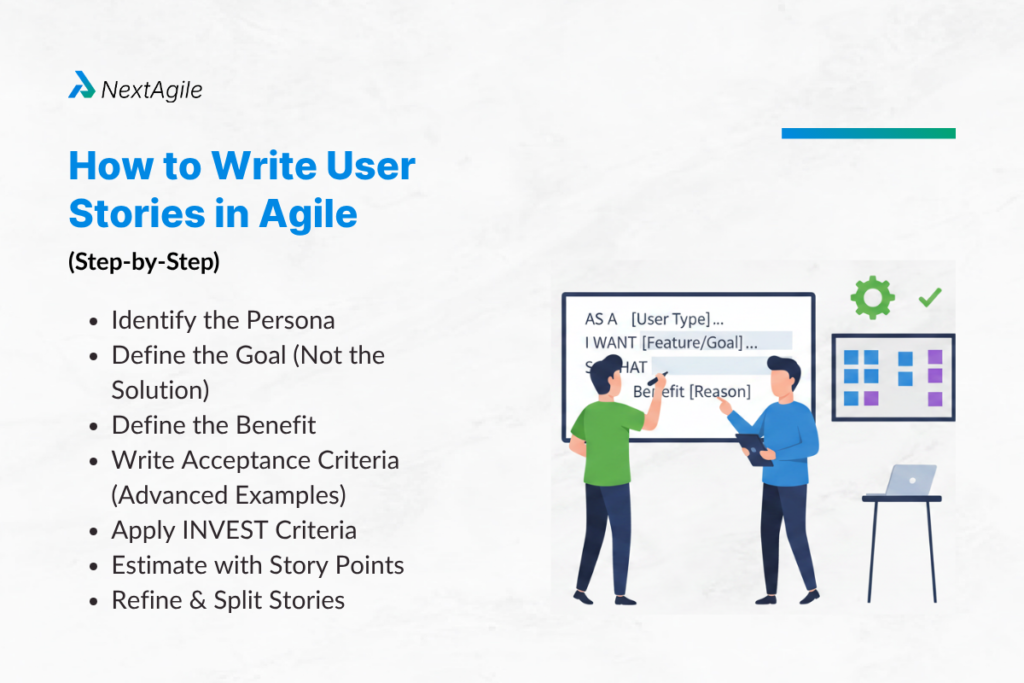
How to Write User Stories in Agile (Step-by-Step) Step 1: Identify the Persona Use user persona agile:
Customer Admin Internal user Step 2: Define the Goal (Not the Solution) Solution-first thinking is one of the most common reasons Agile teams lose flexibility. When stories define implementation too early, teams reduce opportunities for innovation, simplification, and technical optimization during execution.
Step 3: Define the Benefit This is where value is defined. Many teams skip the benefit section entirely, yet this is often the most important component of the story. Without a clearly articulated benefit, prioritization discussions become subjective and stakeholder alignment weakens.
Step 4: Write Acceptance Criteria (Advanced Examples) Basic:
Given user logs in → dashboard appears Advanced:
Given invalid input → show validation error Given system failure → retry mechanism Given high load → response < 3 seconds Strong acceptance criteria do more than validate functionality. They help uncover hidden assumptions, edge cases, operational constraints, and quality expectations before development begins.
Step 5: Apply INVEST Criteria Use INVEST criteria for writing better user stories .
Step 6: Estimate with Story Points Use story points estimation for:
Sprint planning Forecasting Estimation should improve predictability, not create artificial precision. Mature Agile teams use estimation primarily to support planning conversations, capacity alignment, and delivery forecasting rather than treating estimates as contractual commitments.
Step 7: Refine and Split Stories Learn splitting user stories into sprint-sized work:
Oversized stories are one of the leading causes of sprint instability. Teams that struggle with delivery predictability often have backlog refinement problems rather than execution problems.
How User Stories Impact Delivery Outcomes? Well-written user stories lead to:
Faster development cycles Fewer defects Better alignment Predictable delivery Clear stories reduce ambiguity and ambiguity is the biggest source of delay. Most delivery inefficiencies in enterprise Agile environments originate upstream during requirement clarification and backlog refinement rather than downstream during implementation itself.
User Story Templates, Tools, and AI-Assisted Writing Advanced User Story Template (Enterprise-Ready) As Agile maturity increases, teams often expand user story structures to include operational readiness, dependency visibility, scalability expectations, compliance considerations, and risk indicators to improve enterprise delivery coordination.
Jira & Azure DevOps Fields Title Description Acceptance criteria Story points Dependencies AI-Assisted User Story Writing (Enterprise Use Cases) AI can significantly accelerate story drafting, refinement preparation, and acceptance criteria generation. However, effective teams still validate stories collaboratively because context, business nuance, and prioritization decisions cannot be delegated entirely to automation.
Prompt 1 “Write a user story for a banking app login with acceptance criteria and edge cases.”
Prompt 2 “Convert this requirement into Agile user stories with INVEST criteria.”
Before vs After AI Example Before:
After:
AI improves formatting speed, but strong product thinking still determines story quality. Organizations that rely solely on automated generation without collaborative refinement often produce technically correct but strategically weak backlogs.
Story Mapping Basics Story mapping helps:
Visualize journeys Prioritize backlog Align stakeholders Story mapping becomes especially valuable in enterprise programs where multiple teams contribute to the same customer journey. It helps leaders identify dependencies, sequencing risks, and delivery gaps that individual user stories alone may not reveal.
Enterprise Enablement As organizations scale Agile delivery in 2026, the quality of backlog conversations increasingly determines execution performance. Teams with stronger refinement practices generally experience faster delivery cycles, fewer misunderstandings, better estimation stability, and improved stakeholder alignment.
This is why mature Agile organizations invest heavily in story-writing discipline. They recognize that unclear user stories are not simply documentation problems, they are early indicators of deeper alignment and prioritization issues inside the delivery system.
Conclusion User stories, when written well, become a decision-making tool, thus helping teams prioritize, clarify scope, and deliver measurable outcomes.
For enterprise teams, success depends on:
Strong user focus Clear acceptance criteria Continuous refinement The goal is not to write more stories.
The goal is to write better stories that drive better outcomes.
If your teams struggle with unclear requirements, rework, and inconsistent delivery, strengthening how user stories are written and managed becomes critical. NextAgile consulting can help you co‑create and implement a practical Business agility roadmap, helping your teams write better user stories, improve backlog quality, and accelerate delivery outcomes. Do reach out to us at consult@nextagile.ai and we would be happy to explore more.
Frequently Asked Questions 1. What is a user story in Agile? A short, user-focused description of a feature that delivers value.
2. How many user stories should be in a sprint? Typically 5-15, depending on size and complexity.
3. Who writes user stories? Primarily Product Owners, with team collaboration.
4. What makes a story “ready”? Clear
5. Can user stories replace documentation? No. They complement-not replace-technical documentation.
6. Are user stories enough for enterprise systems? No. They must include:
Sujith G. is an agile practitioner with expertise in setting up the agile environment by coaching and training teams, individuals and stakeholders in the area of lean agile software principles. He has overall 12+ years of exp out of which 9+ years have been in Agile and Scrum implementation and adoption. Sujith has coached 70+ teams on agile practices & implementation techniques and has extensive experience in setting up metrics, JIRA & Azure DevOps. Experienced in identifying gaps in the system, creating scrum awareness, piloting and scaling scrum.
 Skip to content