In the early 1990s, software development was going through something called “the application development crisis.” People started to notice a significant lag in the delivery of new software development applications. It was taking them too long to deliver the projects, and often when the projects were delivered, they were already out of date. Much of this was a result of the existing waterfall approach to software development. As the name suggests, this approach depicts the features of a waterfall, which is top-down with no possibility of going back to the previous stage. The Agile Manifesto emerged as a response to these challenges, highlighting the need for a more iterative and flexible approach. Additionally, this approach had other drawbacks like:
Dependency: The work would start at one point and the next task could only be picked when the previous one was complete. This gated approach severely restricted feedback incorporation, collaboration, and flexibility
Long Software Development Cycle: Since all the features were delivered at once, it had a long delivery time, fixes were difficult to implement and integrate and the final product to be shipped to the customer took forever
Productivity: It was unproductive as one could not go backward to make any fixes and different teams were dependent on each other to start their work, e.g., the testing team cannot start their work until the “entire” code is developed, the development team cannot do fixes until the testing team tests the entire code base and so on
Flexibility: Changes were costly as the entire lifecycle had to be followed even for a small change, which resulted in pushback for changes even at the cost of customer satisfaction, quality, and usability of the product
Transparency: There needed to be more transparency as the level of customer involvement was limited, and work needed to be broken into smaller units. Teams relied on big upfront planning with little or no iteration, improvement, and incremental development
Lack of Innovation – There were a lot of management bottlenecks as there was no scope to pivot and everyone was sticking to the process. This led to a siloed working culture and a top-driven command and control-led work culture
All this resulted in unhappy customers, over-budgeting of projects, burned-out and unmotivated teams with a lot of work, long delivery cycles, and lack of innovation hence there was a need for a new way of developing software to address this crisis/situation.
Agile Manifesto was created to solve this unique scenario, a document outlining the core values and principles that should guide a flexible and iterative approach to software development and project management. This article talks about the Agile Manifesto, its history, significance, principles, and impact on modern business practices. We will attempt to answer the following pointers in this blog:
What is the Agile Manifesto?
How did the Agile Manifesto impact software development?
Is the Agile Development Manifesto still relevant?
Why is the Agile methodology manifesto important?
Is the Agile Development Manifesto and the Agile Project Management Manifesto the same?
What are agile manifesto and principles?
What are the 12 principles from the Agile Manifesto?
What are the 4 values from the Agile manifesto?
What is the Agile Manifesto?
In 2001, a group of 17 software practitioners met at a ski resort in Snowbird, Utah. All of them shared their frustration over the limitations of the traditional waterfall methodology and the hardships they faced while using the methodology. They came together to discuss and define a more flexible and responsive approach to software development.
Some of the prominent names among these practitioners include Kent Beck, Mike Beedle, Ward Cunningham, Martin Fowler, and Jim Highsmith. These individuals come from diverse backgrounds and experiences within the software development industry, contributing to an all-round perspective on the challenges and opportunities in software development.
The traditional methodologies focused on documentation, meaning every requirement had to be well documented and planned in detail with all the possibilities planned upfront (well thought out and analyzed before the starting of projects) and then agreed upon by both the customer and development team. Once the document was agreed by both parties it would be the only source of truth and reference for the development team.
Since the development team worked in isolation and was hesitant to talk to the customer for clarification, there would be no scope for feedback from the customer. Almost no communication would happen between the customer and the development team regarding what was being developed. The communications or updates were restricted to the progress, in terms of the percentage of work completed and whether the project was trending to be delivered on time or not. Also, there was a lot of emphasis on the process to be followed and the tools to be used, which made the system more rigid. All these processes lead to bottlenecks and bureaucracy which reduces the ability to be flexible.
The Agile Manifesto is a document that draws on the core values and principles of the agile software development framework, focusing on an alternative to documentation-driven, gated software development processes with big upfront planning and a siloed working culture. The agile methodology manifesto emphasizes flexibility, collaboration, iterative and incremental development, and customer-centricity using closed, frequent feedback loops, which in turn creates a lightweight, more adaptive, and responsive approach to software development.
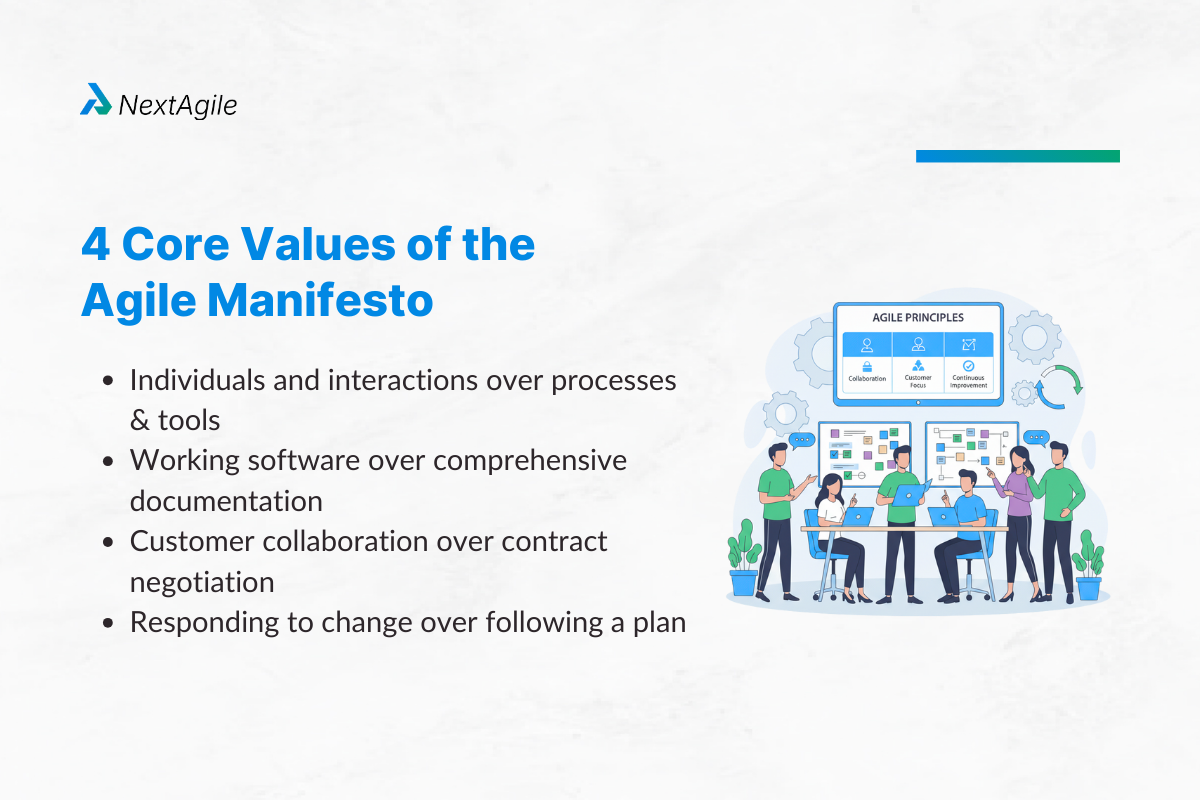
All this was based on four core values and twelve principles. Which we will discuss in detail in this blog. Let’s start with the four core values the Agile Manifesto emphasised on and try and understand the underlying reasons for adopting these four core values in the agile manifesto:
Individuals and interactions over processes and tools: While processes and tools have their place, the Agile Manifesto prioritizes the value of skilled individuals and their ability to collaborate effectively and independently.
Working software over comprehensive documentation: The manifesto emphasizes the importance of delivering working software early and often, allowing for continuous feedback from customers and iteration, rather than prioritizing exhaustive documentation, which may lose its significance over time due to changes in market requirement
Customer collaboration over contract negotiation: The manifesto advocates close collaboration with customers throughout the development process to ensure the final product aligns with their requirements. This replaces the focus on lengthy contract negotiations that often fail to capture evolving requirements
Responding to change over following a plan: Traditional methodologies like waterfall, do not generally appreciate change and teams find themselves in an uncomfortable situation with any change request. The Agile Manifesto embraces change and the ability to adapt to changing requirements and market demands, prioritizing flexibility and responsiveness
These values highlight a shift from processes and documentation to people, collaboration, and adaptability. These core values are further supported by twelve guiding principles, which provide guidance on implementing agile, which we will discuss later in this blog.
Why is Agile Manifesto Important?
The Agile Manifesto holds immense importance for its impact on how we approach projects. It provides clear guidelines on how we can attain a system in project management and software development where teams shift their focus from a traditional top-down management approach to a more collaborative and team-oriented approach. It helps in creating teams that are responsive to change and focused on delivering value to customers. Since agile emphasizes more on individuals and interactions, it encourages open communication, trust, and accountability within the teams. This, in turn, removes rigidity, excessive documentation, and a lack of responsiveness to customer needs. In fact, it fosters a culture of open communication and transparency, leading to a more productive, motivated, and engaged workforce.
The far-reaching consequences of the Agile Development Manifesto extend beyond software development. Its core principles have been adopted by various industries, transforming how projects are managed. The focus on flexibility and responsiveness empowers teams in marketing, design, or HR to deliver results in a rapidly changing world.
These principles have wide applications, for example, a marketing team iteratively testing campaign elements with real-time customer feedback, or an HR professional adapting employee onboarding based on the new employee feedback.
 Skip to content