Key Takeaways: Scrum Master vs Project Manager Scrum Master vs Project Manager is not a replacement debate. It’s a system design decision Scrum Masters optimize team performance and Agile flow, not delivery ownership Project Managers ensure delivery predictability, stakeholder alignment, and risk control In 2026, most organizations adopt a hybrid model combining both roles Scrum Master = influence without authority; Project Manager = accountability with authority Removing Project Managers too early often leads to delivery chaos at scale The right choice depends on complexity, scale, and organizational maturity Introduction As organizations scale Agile and integrate AI into delivery, a persistent question emerges: Do we still need Project Managers, or can Scrum Masters replace them?
The real answer depends on delivery complexity, organizational maturity, and how your teams are structured.
Many organizations make the mistake of treating this as a binary choice. They either:
Remove Project Managers too early → leading to coordination breakdowns Or retain rigid PM structures → slowing down Agile teams The reality is more nuanced. Understanding the difference between a Scrum Master vs Project Manager is critical to designing a delivery system that balances speed, alignment, and predictability.
One of the biggest mistakes organizations make during Agile transformation is assuming that introducing Scrum automatically eliminates the need for delivery coordination. In practice, complexity does not disappear when teams become Agile. It simply changes form. Coordination shifts from centralized task control to dependency management, stakeholder alignment, and cross-functional synchronization.
Scrum Master vs Project Manager: Key Differences (Comparison Table) Dimension Scrum Master Project Manager Framework Scrum / Agile Waterfall, Hybrid, Agile Authority No formal authority Formal authority over scope & delivery Accountability Team effectiveness & flow Delivery outcomes (scope, cost, time) Budget ownership No Yes Stakeholder reporting Minimal / indirect Direct and structured Success metric Flow efficiency, team health On-time, on-budget delivery Leadership style Servant leadership Directive + coordination Core certification CSM, PSM PMP, PRINCE2 Industries Product, tech, startups Enterprise, IT services, construction AI impact (2026) Enables AI-driven teams Manages AI-driven delivery risk
What This Means in Practice The fundamental difference is this:
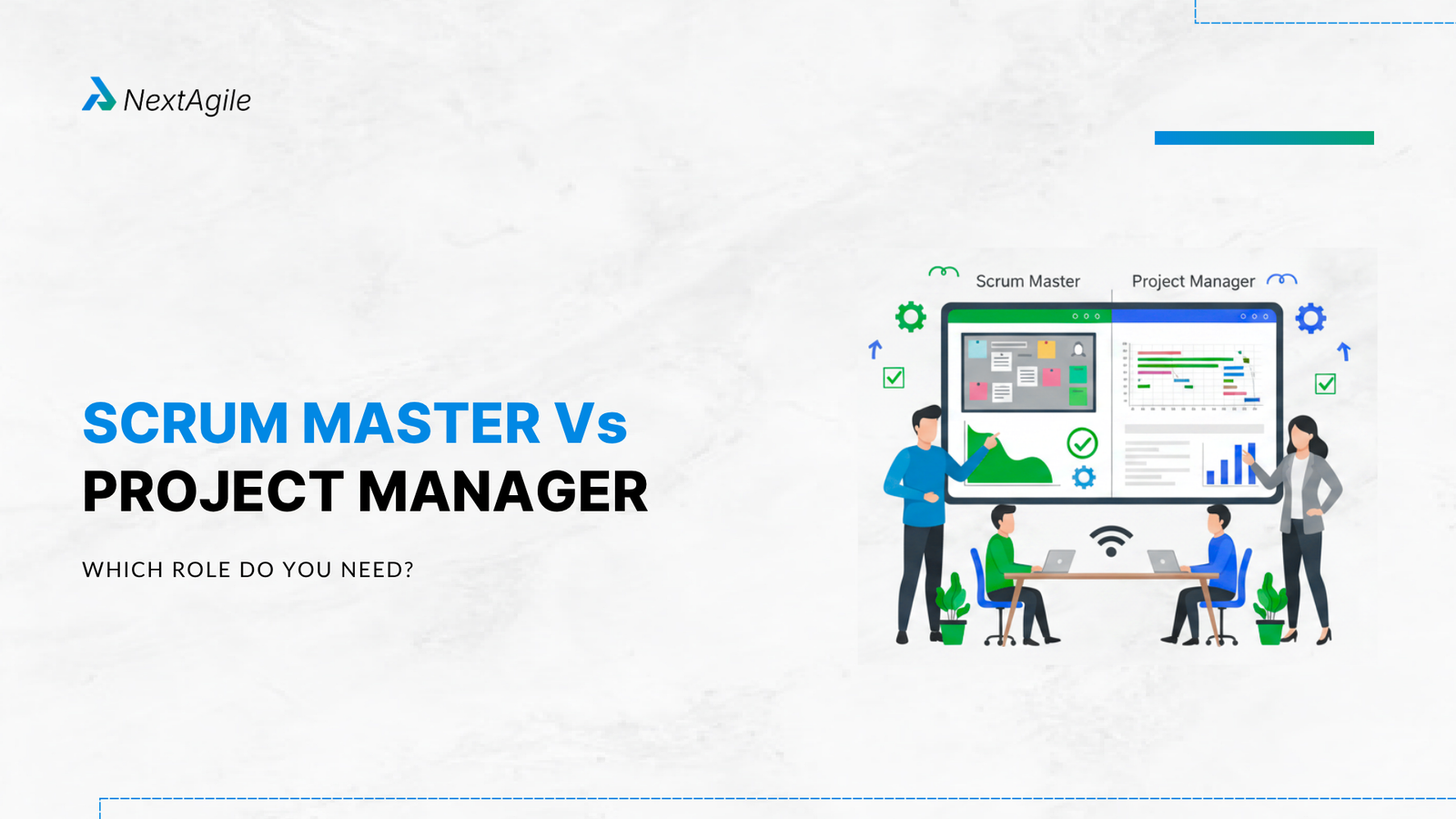
Scrum Master operates at the team system level → improving how work gets doneProject Manager operates at the delivery system level → ensuring what gets delivered meets commitments When organizations confuse these layers, they create role conflict, delivery delays, and accountability gaps. This confusion usually emerges because both roles appear to operate around “delivery,” but they influence delivery through entirely different mechanisms. Scrum Masters improve the environment in which teams operate, while Project Managers optimize the broader execution ecosystem surrounding those teams.
Teams looking to strengthen Agile execution capabilities can benefit from structured learning programs like the Agile and Scrum Masterclass workshop
What Does a Scrum Master Do in Agile Teams? A Scrum Master operates at the team system level, optimizing flow, collaboration, and continuous improvement rather than managing tasks or deadlines.
Their goal is to enable teams to deliver better. This distinction becomes especially important in enterprises transitioning from command-and-control management structures. Organizations often expect Scrum Masters to “manage teams” in the traditional sense, which creates tension because the role is fundamentally designed around facilitation, coaching, and systemic improvement rather than directive supervision.
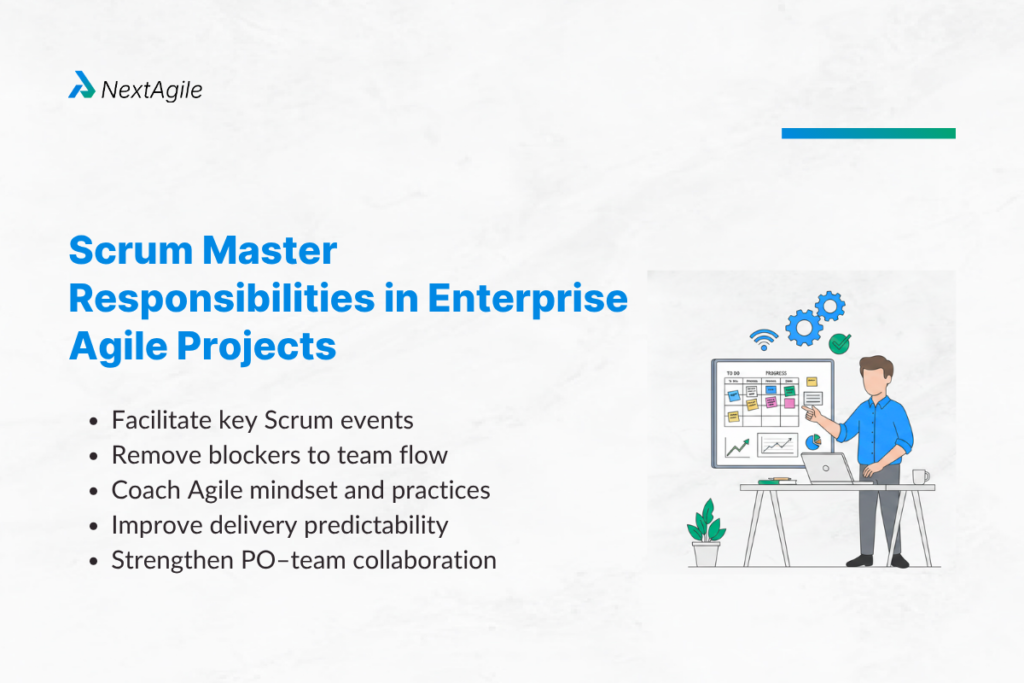
Scrum Master Responsibilities in Enterprise Agile Projects In real-world enterprise environments, Scrum Masters:
Facilitate Sprint Planning, Daily Scrum, Reviews, Retrospectives Remove blockers affecting team flow Coach teams on Agile practices and mindset Improve cycle time and predictability Enable collaboration between Product Owner and team Their success is measured by how well the system performs, not how much work gets delivered. High-performing Scrum Masters often create impact that is difficult to measure through traditional management metrics. Their contribution appears indirectly through reduced blockers, healthier collaboration patterns, improved sprint predictability, and stronger team ownership behaviors.
Strong facilitation, coaching, and dependency management capabilities are now considered essential scrum master skills checklist in enterprise Agile environments.
How Does a Scrum Master Manage Work Without Authority? This is where the role becomes powerful and often misunderstood.
A Scrum Master drives outcomes through:
Influence over authority Coaching over control Facilitation over direction Real Scenario:
A Project Manager might escalate or enforce deadlines A Scrum Master identifies systemic issues, improves coordination, and reduces dependency friction This is the essence of servant leadership in Agile. Servant leadership is frequently misunderstood as passive leadership. In reality, effective Scrum Masters intervene aggressively against systemic dysfunction while remaining non-authoritarian toward individuals. The role requires influence, facilitation skill, and organizational awareness far beyond simply running Scrum ceremonies.
What Does a Project Manager Do in Modern Organizations ? Project Managers have evolved beyond task tracking. In 2026, they act as delivery orchestrators across complex systems, ensuring alignment between teams, stakeholders, and business goals. Modern Project Management has evolved significantly from traditional status tracking models.
In complex enterprise environments, Project Managers increasingly operate as coordination architects who manage dependencies, governance expectations, financial accountability, vendor alignment, and executive communication simultaneously.
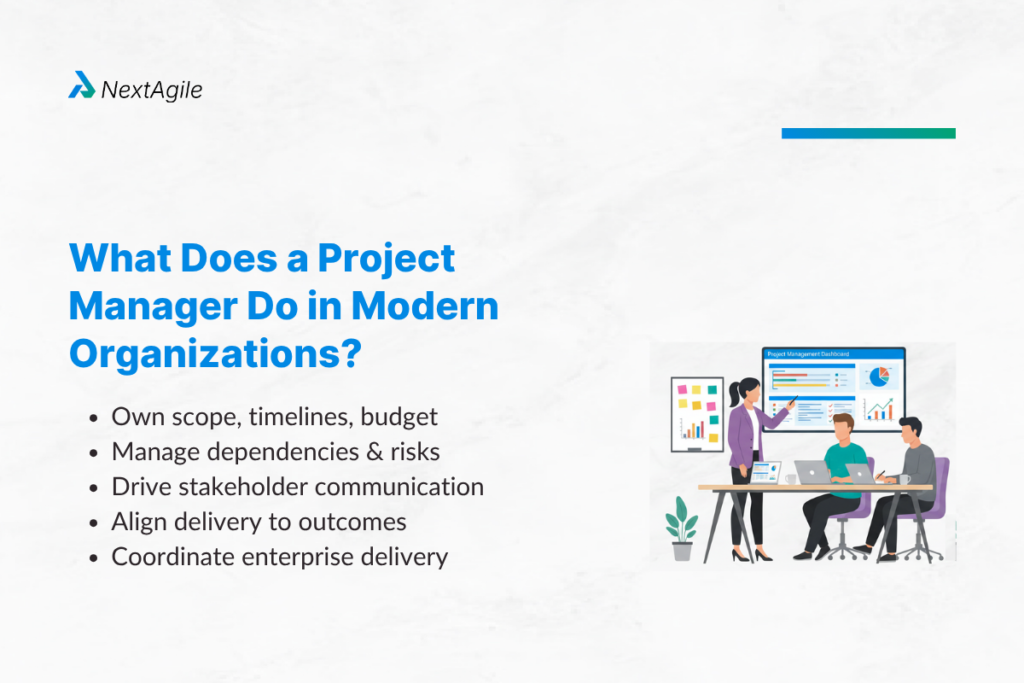
Project Manager Roles Beyond Agile Teams Modern Project Managers:
Own timelines, scope, and budget Manage cross-team dependencies and risks Drive stakeholder communication and reporting Ensure alignment with business outcomes Coordinate multi-vendor or enterprise delivery Their focus is predictability and accountability at scale. This becomes particularly important in industries where delivery risk carries operational, regulatory, or financial consequences. Agile improves adaptability, but enterprise leadership still requires visibility, governance, and confidence that strategic commitments can be executed reliably.
Modern enterprises increasingly combine Agile project management techniques
When Do You Need a Project Manager Instead of a Scrum Master? You need a Project Manager when:
Delivery spans multiple teams, vendors, or geographies There is budget ownership and financial accountability Stakeholders require structured reporting and governance Work involves fixed deadlines or regulatory constraints In short: when complexity exceeds team-level autonomy. Many Agile transformations underestimate how quickly coordination complexity grows once multiple teams, external stakeholders, and interdependent systems become involved. Team-level agility alone rarely solves enterprise-scale execution challenges without additional orchestration mechanisms.
Can One Person Be Both Scrum Master and Project Manager? In small teams, combining both roles can work temporarily but at scale, it creates conflicting incentives between facilitation and delivery accountability.
Why?
Scrum Master must remain neutral and team-focused Project Manager must enforce delivery commitments This dual responsibility often leads to:
Compromised facilitation Pressure-driven decision-making Reduced team trust The conflict is structural, not personal. Scrum Masters are expected to protect sustainable delivery practices and team health, while Project Managers are often evaluated against timelines, commitments, and stakeholder expectations. Combining both roles can unintentionally create competing incentives within the same individual.
Scrum Master vs Project Manager Use Cases: When Do You Need Each Role? Real Example: Startup vs Enterprise Startup:
Small teams, low complexity High need for speed Scrum Master (or Agile coach) is sufficient
Enterprise:
Multiple teams, high dependencies Need for governance and reporting Requires both roles
Real Example: Agile Transformation Scenario Before Transformation:
Project Managers control delivery Teams depend heavily on centralized planning After Introducing Scrum Masters:
Teams become autonomous Delivery improves but coordination gaps emerge Solution:
Retain Project Managers as program-level coordinators Use Scrum Masters for team-level optimization Outcome:
Balanced system of speed + predictability This hybrid operating model is becoming increasingly common because organizations are learning that agility and governance are not mutually exclusive. The strongest delivery systems balance adaptive execution at the team level with coordinated alignment at the enterprise level.
A structured Agile transformation roadmap
Real Example: Multi-Team Delivery (SAFe / LeSS) In scaled environments:
Scrum Masters → team-level execution Project/Program Managers → cross-team coordination Without this separation, organizations face:
Dependency bottlenecks Misaligned priorities Delivery delays Scaled Agile
Conflict Zone: Where Scrum Masters and Project Managers Clash This is where most organizations struggle.
Common conflicts include:
PM pushing deadlines vs SM protecting team capacity Stakeholder pressure vs Agile flexibility Command-control vs servant leadership The resolution lies in clarity:
Scrum Master owns how work flows Project Manager owns what must be delivered and when Most role conflicts are not caused by personalities; they emerge from unclear operating boundaries. When organizations fail to define decision rights, escalation paths, and accountability layers, teams experience overlapping ownership and contradictory expectations.
How Do You Measure Scrum Master vs Project Manager Performance? Scrum Master Metrics Cycle time / lead time reduction Team velocity trends (stability, not just increase) Team health and engagement Reduction in blockers What good looks like: Consistent flow, predictable sprint outcomes, and improving team autonomy
Project Manager Metrics On-time delivery rate Budget adherence Stakeholder satisfaction Risk mitigation effectiveness What good looks like: Predictable delivery across teams with minimal surprises
A mature Scrum Master gradually reduces dependency on themselves over time. Their success is reflected in how effectively teams self-organize, resolve conflicts independently, and continuously improve without requiring constant facilitation intervention.
Modern Agile metrics for leadership
Decision Framework: Which Role Do You Need? If your environment is… You need Single Agile team Scrum Master Multiple teams with dependencies Scrum Master + Project Manager High compliance / fixed scope Project Manager Product-led innovation Scrum Master Enterprise-scale transformation Hybrid model
Key Insight:
This insight becomes increasingly relevant in hybrid delivery models where Agile, traditional governance, compliance expectations, and AI-assisted workflows coexist simultaneously. Role clarity is now a systems design problem, not merely an HR responsibility.
How Scrum Masters and Project Managers Work Together in 2026 The most effective organizations design complementary roles not competing ones.
Modern operating model:
Scrum Master → optimizes team performance Project Manager → ensures delivery alignment Leadership → sets direction and priorities This creates a system where:
Teams move fast Delivery remains predictable Stakeholders stay aligned The goal is not to maximize process control or maximize autonomy independently. Sustainable delivery systems require calibrated balance. Too much control slows adaptation, while excessive autonomy without coordination creates fragmentation.
This is the foundation of the hybrid Agile project manager model (2026). The emergence of hybrid delivery models reflects a broader industry realization: enterprise agility is not achieved by eliminating structure but by redesigning structure to support adaptability without sacrificing alignment.
Successful Enterprise Agile transformation
The Evolution of Roles in 2026 The roles are not static; they are evolving.
Project Manager → Delivery Leader / Program Manager
Focus on value delivery, not just timelines Scrum Master → Agile Coach
Expands influence beyond one team The future is not about replacing roles but expanding capabilities. The boundaries between Agile leadership roles are becoming increasingly fluid. Scrum Masters are expected to understand organizational systems, while Project Managers are increasingly required to operate with Agile thinking, adaptive planning approaches, and facilitative leadership behaviors.
Conclusion A major shift occurring in 2026 organizations is the movement away from role-centric thinking toward capability-centric delivery systems. Enterprises are realizing that delivery success depends less on titles and more on whether the organization can simultaneously support adaptability, coordination, accountability, and learning at scale.
This is why many modern enterprises no longer ask, “Should we have Scrum Masters or Project Managers?” Instead, they ask, “What delivery capabilities are required for our level of complexity?”
The Scrum Master vs Project Manager debate is often framed incorrectly.
It’s not about choosing one over the other, it’s about designing a system where both roles operate at the right level without overlap or conflict.
At NextAgile, we’ve seen that what leaders don’t see in their delivery system is never neutral. It quietly shapes team behavior and outcomes. The most effective leaders ask, “What are we missing, and what is it costing us?” This mindset builds trust, encourages openness, and improves decision-making. Because ultimately, scaling Agile is less about roles and more about leadership clarity.
If your teams are struggling with delivery delays, unclear ownership, or role confusion, defining the right balance between Scrum Masters and Project Managers becomes critical. At NextAgile, we help organizations design and implement practical Agile operating models tailored to their context. Reach out to us at consult@nextagile.ai
Frequently Asked Questions 1. Can a Scrum Master say no to the Product Owner? Not directly, but they can challenge priorities and facilitate alignment.
2. Why do companies have both a Scrum Master and a Project Manager? Because they address different layers; team effectiveness vs delivery coordination.
3. What happens to the Project Manager when a company goes fully Agile? They evolve into roles like Program Manager, Delivery Lead, or Agile leader.
4. Can a Scrum Master work across multiple teams? Yes, but effectiveness depends on team maturity and complexity.
5. Is a Scrum Master the same as an Agile Coach? No. Scrum Masters operate at team level; Agile Coaches drive organizational transformation.
Alok Dimri is the co-founder and leads the overall business at NextAgile, where he is responsible for strategy, client and consultant partnerships, and a whole lot of other core business activities like solutioning, branding, and customer engagement.
Over the past 16 years, he has worked extensively in business strategy, new business development, and key account management initiatives across process consulting and training domains.
 Skip to content