Key Takeaways About Agile vs Scrum
- Agile is a mindset; Scrum is one of the framework to pursue agility
- All practices of Scrum intent to make team Agile, but pursuit of being Agile is not just limited to application of Scrum
- Scrum works best for small, cross-functional teams; the context of being Agile could extend across the organization (programs, portfolios, entire business)
- Teams can adopt Agile without Scrum using Kanban, Lean, or hybrid approaches
- Success comes from aligning Agile mindset & culture with Scrum execution
- The goal is not to do Scrum, but to build true business agility and deliver value continuously
“Strategy without tactics is the slowest route to victory, and tactics without strategy is the noise before defeat.” This perfectly reflects the confusion many organizations face when comparing Agile vs Scrum. Questions like which is better, how to choose, and what the difference is are common, especially for teams new to Agile. The real challenge is not choosing one over the other, but understanding what agile means in the true sense and where Scrum as one of the approaches comes into picture and also how Scrum brings agility.
In today’s fast-changing business environment, organizations must build true agility, the ability to respond, adapt, and continuously improve. Agile is the strategic mindset that enables this shift, while Scrum is one of the tactical frameworks that helps teams implement it effectively. There is no one-size-fits-all approach, as every organization must balance people, process, technology, product, and customer needs. This guide simplifies Agile vs Scrum to help you make the right choice for your context.
Agile vs Scrum: Key Differences (Quick Comparison)
| Dimension | Agile | Scrum |
| Definition | A philosophy and mindset based on the Agile Manifesto but not limited to it if you do not go with just the umbrella term | A framework to implement Agile principles for teams who work on building product that requires iterative and incremental development to adapt to continuously changing requirements |
| Nature | Abstract, principle-driven approach | Concrete, process-driven approach |
| Scope | Broad (pursued by multiple frameworks & approaches like Kanban, XP) | Specific |
| Structure | Flexible, no fixed structure | Structured with defined roles, events, and artifacts |
| Roles | No predefined roles | Defined roles: Product Owner, Scrum Master, Developers |
| Planning | Continuous and adaptive planning | Time-boxed planning within sprints |
| Delivery | Continuous or iterative delivery | Incremental delivery at the end of each sprint (iteration) |
| Framework Dependency | Not dependent on any framework | Fully defined framework with guidelines |
| Flexibility | Highly flexible and customizable | Contextual flexibility due to defined structure |
| Documentation | Minimal, value-driven | Structured artifacts (Product Backlog, Sprint Backlog) |
| Meetings / Events | No mandatory events | Defined events (Sprint Planning, Daily Scrum, Review, Retrospective) |
| Measurement | Being valuable to customer and business through ability to respond to changing requirements | Sprint goals fulfilment, velocity throughput, and increments leading to bringing value to customer and business by continuously delivering the working software |
| Use Case | Best for organizations seeking adaptability | Best for teams needing structure and discipline to adapt to changing requirements |
| Relationship | Agile can exist without Scrum | Scrum without Agile mindset is just a routine not leading to purpose |
What Is Agile? (Definition and Core Principles)
Firstly, let’s be clear that agile is not a methodology. It’s a mindset. The mindset to not rush but to realize that ‘change’ has knocked at your door for a reason. A reason that might be affecting the stability of your work and may let you out of the very home that you call a ‘product team’, ‘program’, ‘portfolio,’ or an organization as a whole. Agile mindset, when inculcated across multiple levels, from individuals, teams, business units & the entire organization, becomes culture.
Agile is misinterpreted as a methodology because of the multiple approaches, frameworks, and practices that have popularized ‘agile’ ways of doing things, and hence, Agile, from a pursuit, has ended up becoming a lipstick job. Some of the popular approaches include Scrum, Kanban, Lean, Extreme Programming, DSDM, RUP, AUP, SAFe, LeSS, Nexus and many more.
Over the decades, one thing has been common across the organizations that have gone digital: that IT is an eminent part of their ongoing and future existence. IT is the fastest evolving industry, where a technology within a couple of years becomes obsolete, and there is a continuous effort to upskill the workforce and upgrade complex systems that are running mammoth operations across various segments like healthcare, retail, manufacturing, e-commerce, entertainment, and what not.
Let’s list some of the advantages and limitations of agile along with a quick note on how it works.
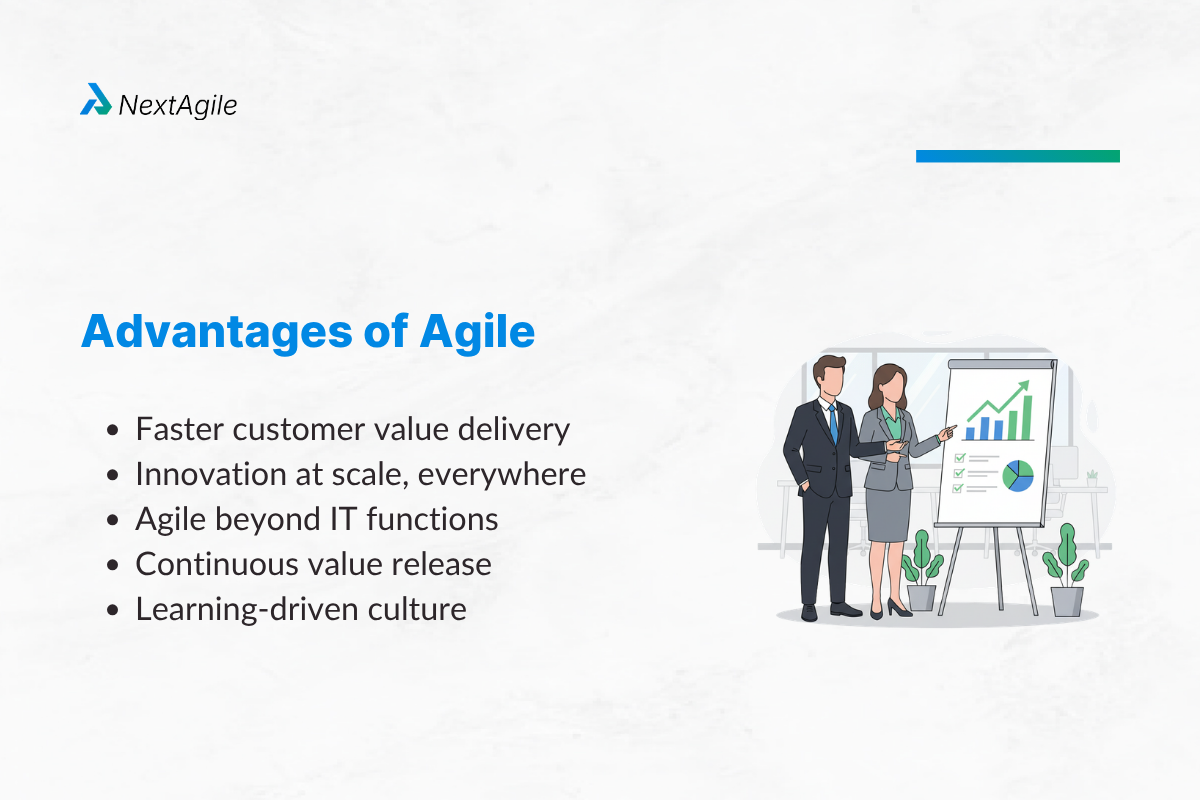
Advantages of Agile
Agile ways of working enable companies to provide the right value to their consumers ahead of the competition. Organizations that were monopolies once had to shut shops as they were resistant to change.

What are some of the most visible advantages of Agile?
- The customer gets what they want, relatively FASTER
- Innovation at lightning speed, EVERYWHERE
- Not just IT, it is applied ANYWHERE
- Releasing value ANYTIME
- Focus is more on learning culture EVERY TIME.
Limitations
With rapid development comes concerning issues. Quality is the most visible one, which gets affected as the frameworks could be easy to apply and very tough to forfeit when organizations start seeing faster ROI. There may be a tendency to compromise with compliance, security standards, infrastructure limitations, legal negligence, and other aspects due to the rush. It is important to know that agile doesn’t mean only FAST. Things need to be done rightly also. Hence, it is important to set up the aesthetics of the foundation right. And not just that, it needs to be continuously monitored so that in a rush to pursue ‘agility’, we should not end up in a crash and lose everything.
How does it work?
Every organization, program, team has their own challenges, and these challenges also change continuously. It is important to first listen, observe, and understand what the objectives are that we want to achieve and what the problems are that we want to solve. We need to factor our constraints and then build our resolve to attain that. One approach could be to apply Scrum, but it may not be helpful if it’s applied at a system where we are not building something, although the goal is to manage the continuous flow of work. The uncertainty could be so high that we do not know what is going to happen next, what work we may need to prioritize in the evening, and absolutely no idea how our next day will start. In such cases, applying Kanban could help, not Scrum.
The thumb rule is to know your customer first, understand your problems, look at the business viabilities, technological feasibility, and other limitations to start in a small but impactful way. All this is done by conducting assessments to diagnose such areas of concern and importance. Then identify practical solutions or approaches or frameworks that can address them all. At times, we need to go hybrid because the goal is not to ‘implement agile practices’ or ‘perfect framework’ but to improve the endurance of our product or firm by bringing agility with just-in-time approaches. Agile implementation demands continuous training, coaching, and monitoring the progress. Onboarding people, revisiting processes, revamping technology, embracing changing customer demands and improvising product/s.
What Is Scrum? (Framework, Roles, and Ceremonies)
Scrum is the most popular approach in the industry and also one of the most ineffectively applied approaches. Firstly, it is not an acronym, and it is introduced as a framework, while at the same time, when we review teams who are already implementing it, we see that it has been understood as having new titles, a list of artifacts, and events/ceremonies that are run as meetings that are considered sacrosanct rituals that nobody questions and are simply followed ritually!
Scrum was officially introduced to the world through Scrum Guide in 2010, authored by Ken Schwaber and Jeff Sutherland. The definition of Scrum as mentioned in the guide is ‘Scrum is a lightweight framework that helps people, teams and organizations generate value through adaptive solutions for complex problems.’
We have implemented Scrum in numerous teams as part of our enterprise agile transformation services, and one thing is very clear to us: Scrum advocates empiricism and lean thinking. There are 4 Scrum Pillars to drive the agile mindset within each sprint (a timeboxed duration), which requires no further elaboration as they are self explanatory –
- Transparency
- Inspectation
- Adaptation
- Scrum Value
The Scrum values are Commitment, Focus, Openness, Respect & Courage. The above philosophy assures that without a team becoming self-organizing, it will not be easy to bring agility. If you falter at any of the above, you are not going to maximize the outcome; instead, you need to identify the elements that are still cultivating corruption and resistance, which is a deterrent to your growth. The values give direction to the team. Hence, Scrum, when applied rightly, or let’s say, if the right environment is provided while implementing Scrum in its true form, it could bring the required empiricism to identify the right direction for the team to move forward.
Teams choosing Scrum may also evaluate Kanban vs Scrum.
Let’s list some of the advantages and limitations of Scrum along with a quick note on how it works.
Teams deciding between methods benefit from agile scrum consulting.
Advantages of Scrum

- Lightweight structure enabling self-organizing trait: The scrum team has just 3 roles and the size is less than 10 people, which is sufficient enough to avoid communication gaps
- Habit formation & empiricism: Sprinting brings rhythm, one after another; each sprint help us in imbibing the 4 values of scrum
- Just-enough plan: Sprint planning event helps in focusing on most important items to be worked upon instead of knowing the entire plan
- Frequent validation: Sprint review helps us in failing or succeeding faster and enables continuous learning trait
- Effective Team Collaboration: Daily scrum helps the team to quickly huddle every day to inspect the progress of the sprint
- Business & Scrum Team working together: The review & planning events help team in understanding the business benefits, client expectations and brings alignment
- Continuous attention to quality and effectiveness: Sprint retrospective helps Scrum Team in identifying areas for improvement
Limitations
- Scrum is primarily recommended for jobs that could be done by a small cross-functional team effectively. For big products, we may still need to rely on scaling frameworks
- Any changes in the sprint goal shouldn’t happen during the sprint; hence, it would work best for the project where at least certain predictability is there like 1 or 2 weeks of work
- The expectation is to create the valuable increment every sprint; hence, it is important that it need to be revisited for work environments where you are not creating incremental outcomes
Autonomy to scrum teams is very essential and aspiring such environment is utopian; henceforth, buy-in from leadership team is important
How does it work?
Let’s understand Scrum first. It has-
- Scrum Team has 3 roles: Product Owner, Scrum Master, Developers
- 5 Scrum Events: The Sprint, Sprint Planning, Daily Scrum, Sprint Review, Sprint Retrospective
- 3 Scrum Artifacts: Product Backlog, Sprint Backlog, Increment
It all starts with the Product Owner identifying what all needs to be added in the Product Backlog to achieve the Product Goal. This backlog is continuously managed by reprioritizing, adding or removing items, rewording them and continuously showcasing the incremental outcomes developed by Developers at the offset of each sprint. The Product Goal is a guiding force for everyone in the scrum team to align with.
The entire timeline is back-to-back sprints of fixed duration. At the start of each sprint, in a sprint planning meeting, the team comes together to plan for the next important value to be delivered through increments. Throughout the sprint, the developers work on building those increments. Developers own end-to-end aspects related to the product, like verification, maintenance, operation, experimentation, research and development, and anything else required. At the outset of a sprint, in sprint review, the increments are showcased to stakeholders to seek their feedback. While in the sprint retrospective, the scrum team finds the opportunity to improve to deliver the product effectively from the next sprint.
Is Scrum Agile? Understanding the Relationship
To summarize the difference between agile versus scrum, here are the few pointers that will help –
- Agile is the pursuit that enables organizations with capabilities to survive in the VUCA world, while Scrum is one such framework that is primarily meant for IT teams building software products who need to continuously align to product goals that may demand managing changing requirements and technology evolution.
- Agile as an umbrella term has many approaches that could help organizations attain the traits of agility, while scrum is one of such approaches
- Agile is referred to as a mindset and Scrum is a framework to pursue that mindset
When to Use Agile vs Scrum (Real-World Scenarios)
As part of NextAgile enterprise agile transformation services, our team of agile experts helps organizations to understand the symptoms, identify the problems, assess the current ways of working, know what is working well and what is not, and then curate an agile transformation plan that includes finding the right balance between constraints related to people, process, product, technology and customers.
Transformation is not immediate. It’s a gradual process where results take time to come while we have mastered the art of helping our customers with quantitative and qualitative ways of measuring their health at levels of team, program, portfolio & overall business and continuously supporting them to shift towards the point where they could attain their objectives by realizing the critical key results.
Agile cannot happen by just changing the mindset of one team. It needs an entire system to change and consulting firms could help in doing so by minimizing the blast radius.
Transformation cannot happen just by training or workshops. It demands close collaboration and empowerment of both external consultants and internal teams to experiment, evolve and find the right balance. Perseverance is the key. The long lasting problems need time to cure, but it’s definitely doable.
Hope this blog was able to explain the difference between agile and scrum and cleared some of the misconceptions. Please reach out to us consult@nextagile.ai
to know more about our agile transformation consulting services.
Can You be Agile Without Scrum?
Yes, teams can absolutely be Agile without adopting Scrum. Agile is a philosophy based on values and principles, while Scrum is just one framework to implement it. Organizations often use alternatives like Kanban, Lean, or Extreme Programming to apply Agile thinking without Scrum ceremonies.
In fact, many high-performing teams follow Agile principles, continuous delivery, customer collaboration, and adaptability without strictly following Scrum roles or events. The key is not the framework but how effectively teams deliver value and respond to change.
Conclusion
Agile and Scrum are closely related, but not interchangeable. Agile provides the mindset and guiding principles, while Scrum offers a structured way to apply them through roles, events, and artifacts to pursue agility by failing faster and shortening the feedback loop.
The real goal is not to “do Scrum” but to be Agile, focusing on delivering value, improving continuously, and adapting quickly to change. Teams that understand this distinction are better positioned to choose the right approach for their context.
If your teams are struggling with slow delivery, unclear priorities, or inconsistent outcomes, the challenge often lies in choosing and applying the right Agile approach. As an agile consulting company, NextAgile helps organizations navigate Agile frameworks like Scrum with clarity, aligning ways of working to business goals for predictable delivery. Reach out to us at consult@nextagile.ai to explore how we can support your journey toward true business agility. We also curate and deliver agile and scrum masterclass workshop based learning programs which are contextual to our clients.
Frequently Asked Questions
Q1: Is Scrum the same as Agile?
No. Agile is a philosophy, while Scrum is a framework used to implement Agile principles.
Q2: Can a team be Agile without using Scrum?
Yes. Teams can follow Agile principles using other frameworks like Kanban or even custom approaches.
Q3: What are the other Agile frameworks besides Scrum?
Common ones include Kanban, Extreme Programming (XP), Lean, SAFe, Spotify Model and many more.
Q4: Is Scrum better than Waterfall?
It’s contextual. Scrum is more flexible and adaptive, making it better suited for dynamic environments, whereas Waterfall works best for stable, predictable projects.
Q5: Is Scrum actually Agile?
We often get such questions (along with what’s better in agile versus scrum or can you apply both agile and scrum methodology or do you prefer agile methodology vs scrum or please elaborate on agile scrum difference) and that itself shows the lack of clarity about Agile. Scrum is a framework designed to bring empiricism and help in bringing agility in teams. Agile is just a pursuit of continuously moving towards the right direction, which demands continuously improving and adapting to change. Scrum provides such an opportunity and it could be applied to certain types of projects. For other types there are different approaches that could be applied.
Q6: What are the 4 values of Agile?
As mentioned in agile manifesto, following are the 4 values –
Individuals and interactions over processes and tools
Working software over comprehensive documentation
Customer collaboration over contract negotiation
Responding to change over following a plan
That is, while there is value in the items on the right, we value the items on the left more.
Q7: What is the scrum life cycle?
Please refer to the section ‘What is Scrum in Agile?’ section of this blog>
Q8: Explain what is a scrum with an example?
Imagine you need to sell your product through Instagram, where there are already a lot of such B2C & B2B sellers. Your product goal is to become a go-to place for buying cool gym wear. Definitely, there is growing awareness towards fitness, and people use e-commerce to do shopping.
To implement Scrum, first we need to form the team:
We need a product owner who understands what it takes to achieve product goals
Bunch of developers who have capabilities to implement whatever is expected of them
A Scrum Master who will create an environment where the focus is continuously on fulfillment of product goal
Next we need to start sprinting. Sprint is a timeboxed duration. Book sprints timeline for couple of months ahead of time
Start iterating and incrementally create outcomes. Focus on leading and lagging indicators. Whatever is not working, you may decommission, and whatever is working, you may evolve by pivoting your implementation. The whole goal is to be goal-focused and ensure that we maximize value through our implementation.
A few increments could be:
Increment 1: Launching only a t-shirt campaign for 18-25 year old personas, who are superhero fans, both male and female, 6 variants max, free packaging & shipping
Increment 2: Launching bottom wear options, giving the facility the ability to suggest designs, hire us for bulk customized orders
And many more till you reach your product goal.
Discover the best agile training companies dedicated to developing high-performing teams and fostering a culture of agility.