Risk Management in Agile: A Practical Framework for Enterprise Teams
Anuj Ojha
Talk to Expert for Free
Table of Contents
Key Highlights of Risk Management in Agile
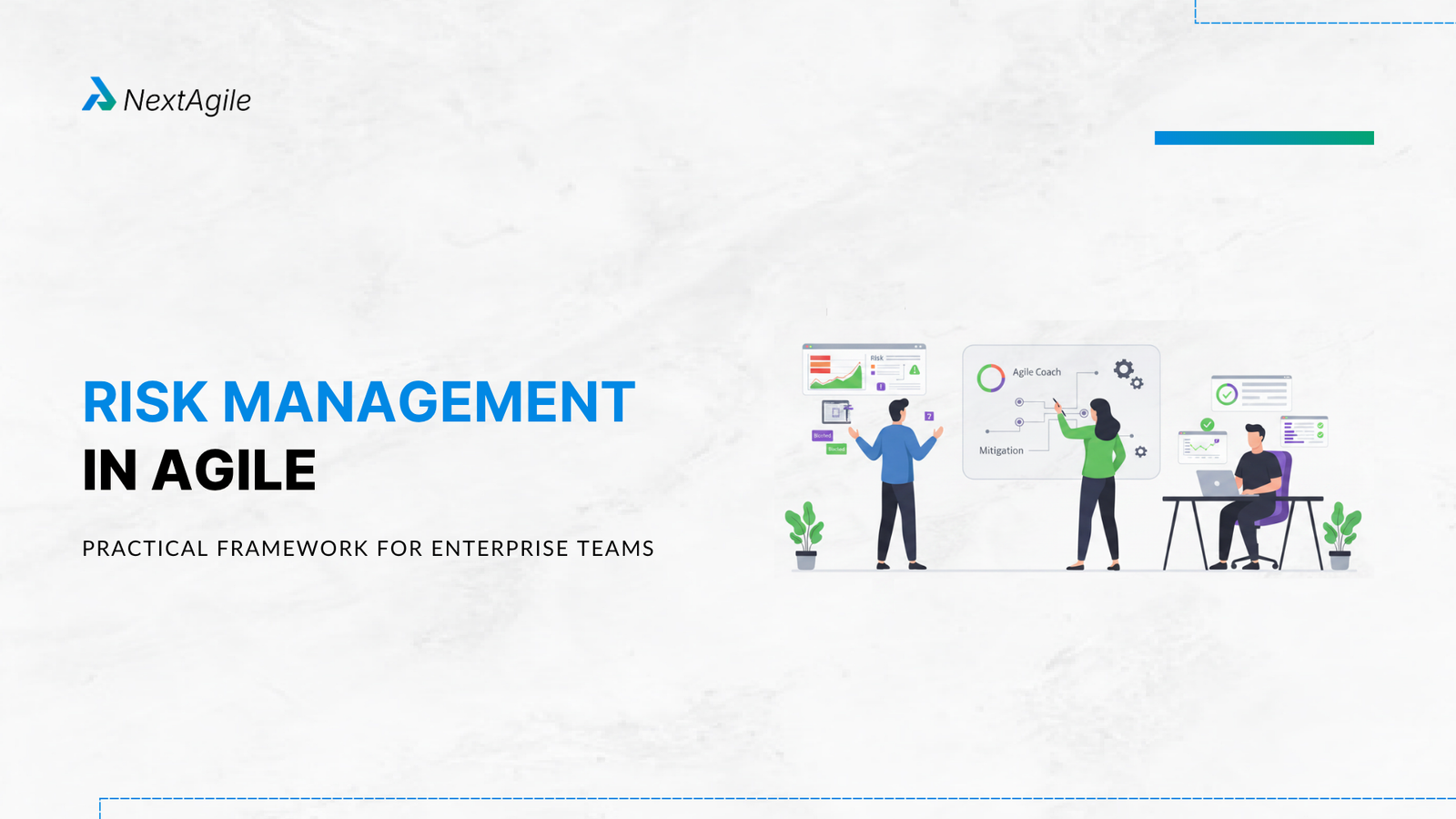
Risk management in Agile is continuous and embedded in the delivery cycle, unlike traditional project management where risk is managed in a separate phase.
The 18th State of Agile Report (2026) revealed a critical paradox: 55% of organisations claim end-to-end delivery visibility, yet 63% report declining software quality and slower delivery despite better reporting. This is what happens when risk is tracked but not acted on.
Agile teams use four core risk response strategies: avoid, mitigate, accept, and transfer.
The ROAM framework (Resolved, Owned, Accepted, Mitigated) is the most widely used risk classification tool in scaled Agile environments.
NextAgile’s agile consulting services embed structured risk management into agile transformation roadmaps for enterprises across India and Dubai.
Introduction
In traditional project management, risk lives in a register. In Agile, risk lives in every ceremony. Every sprint retrospective is a risk retrospective. EveryPI Planning event is a risk identification session. Every dependency flag in the backlog is a risk signal. The shift from periodic risk reviews to continuous risk awareness is one of the most significant and most underestimated differences between traditional and Agile delivery.
Risk management in Agile is the practice of continuously identifying, assessing, and responding to threats and opportunities throughout the delivery lifecycle, rather than treating risk as a front-loaded phase that ends after project kickoff. The18th State of Agile Report (2026) identified a critical paradox: 55% of organisations say they have end-to-end delivery visibility, yet 63% report declining software quality and teams report delivering slower despite better reporting. This paradox happens when risk is tracked but not acted on. This guide gives you the techniques to close that gap.
For teams in the middle of scaling, ourSAFe transformation guide situates risk management within the broader enterprise agility journey.
How Risk Management in Agile Differs from Traditional Approaches
Traditional project management treats risk as a planning artifact. You identify risks during project initiation, log them in a risk register, assign probability and impact scores, and review the register at milestone gates. Agile rejects the assumption that most risks are knowable upfront. Complex software delivery generates emergent risks, which are risks that only become visible as the system is built and the team learns more. A risk invisible duringPI Planning may become obvious by sprint 3.
Dimension
Traditional Risk Management
Agile Risk Management
Frequency
Monthly or milestone-based review
Continuous: sprint, daily, ceremony-level
Ownership
Project Manager or PMO
Shared: Scrum Master, PO, Team
Detection
Risk register, assumptions log
Backlog, retrospectives, dependency board
Response speed
Weeks to months
Days to one sprint
Risk attitude
Avoidance-focused
Embrace, learn, adapt
Documentation
Formal risk register
Lightweight: ROAM board, backlog tags
Types of Risks in Agile Projects
1. Technical Risks
These include architectural decisions that prove wrong, integration failures between teams, performance bottlenecks discovered late, and security vulnerabilities in new APIs. For teams incorporatingGenerative AI solutions, technical risk around model governance, hallucination rates, and data privacy adds a dimension that traditional Agile risk frameworks have not yet fully addressed. The18th State of Agile Report found that 84% of organisations are using or planning to use AI in the development lifecycle, with only 49% having clear guardrails in place. That gap is itself a category of technical risk.
2. Dependency Risks
Dependency risks occur when your team’s sprint goal relies on output from another team, an external vendor, or a platform that does not deliver on schedule. TheAgile State of Team Alignment 2026 report confirms that cross-team dependency visibility is one of the top three causes of sprint rollover across enterprises. NextAgile tracks dependency risk using a program board duringSAFe PI Planning workshops, where inter-team dependencies are visualised and owned at the ART level from day one.
3. Scope Risks
Scope risks arise when business requirements are too vague to estimate, when stakeholders change priorities mid-sprint, or when teams discover that a feature is significantly more complex than estimated. The practices of splitting stories and defining a Definition of Ready are the primary prevention techniques for scope risk. Teams with a strong backlog refinement discipline surface scope risks in refinement, before they can damage a sprint commitment.
4. People and Capacity Risks
These include team member turnover, unexpected leave, skill gaps for new technology requirements, and burnout from sustained overcommitment. Sustainable pace is one of the 12 Agile Manifesto principles. Ourteam development workshop specifically covers how to build psychological safety and capacity discipline as a risk management practice.
The ROAM Framework: Risk Classification in SAFe
ROAM is the standard risk management tool used inSAFe PI Planning. It classifies every identified risk into one of four categories:
 Skip to content