Skip to content


Key Highlights
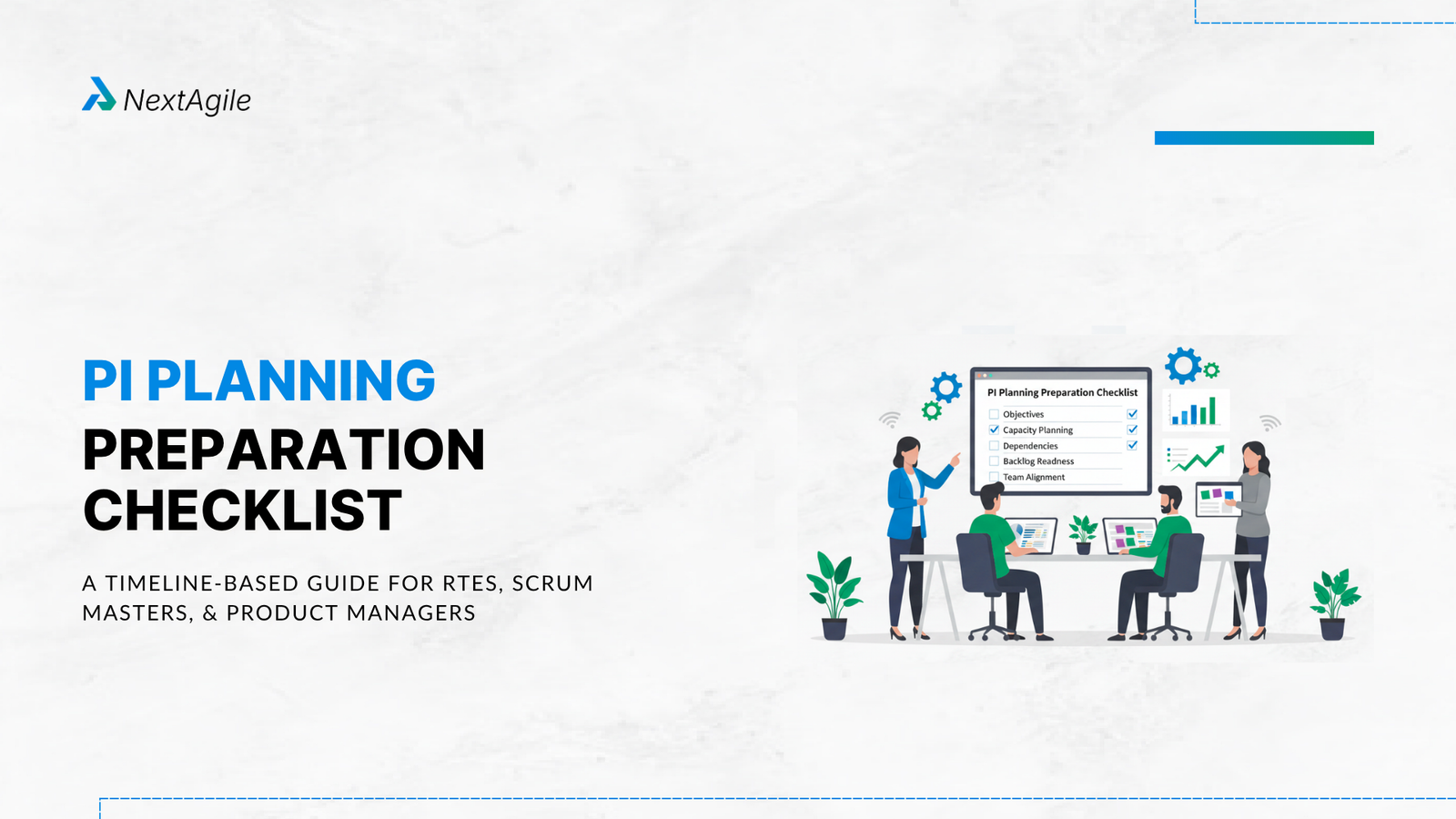
- 60+ checklist items organized across 4 phases: 8 weeks out, 4 weeks out, 1 week out, and day-of PI planning.
- Role-specific checklists for Release Train Engineers (RTEs), Product Managers, Scrum Masters, and executive stakeholders.
- Includes a post-PI planning retrospective checklist, missed by all top 5 competitors.
- Updated for 2026: AI-augmented PI planning tools and hybrid team facilitation guidance.
- According to Scaled Agile’s 2023 Business Agility Report, teams that conduct structured PI planning achieve 35% faster time-to-market than those without regular increment planning.
Introduction
PI Planning, Program Increment Planning, is the heartbeat event of the Scaled Agile Framework. Every 8 to 12 weeks, all teams within an Agile Release Train align on goals, surface dependencies, and commit to a shared Program Increment Backlog. If done right by following this PI planning preparation checklist, it helps in eliminating months of misalignment in two days.
The difference between a high-impact PI Planning event and a chaotic one is almost entirely in the preparation. According to Scaled Agile Inc., organizations that follow structured PI planning preparation practices are 35% more likely to achieve PI objectives than those that improvise. This checklist gives you a phase-by-phase, role-by-role preparation guide covering everything from eight weeks before the event to the day-of facilitation.
For organizations implementing SAFe for the first time or scaling across multiple ARTs, NextAgile’s SAFe Consulting Services provide practitioner-led preparation support from the ground up.
What Is PI Planning and Why Preparation Is Everything
PI Planning is a 2-day planning event, or 2-day equivalent for remote teams, where all Agile Release Train teams align on what they will build in the upcoming Program Increment, typically a 10 to 12 week sprint cycle.
The event brings together:
- 50 to 150+ team members
- Product managers and business owners
- Architects and systems teams
- Executive stakeholders and leadership
In a study of 350 SAFe implementations published by Scaled Agile in 2022, 89% of organizations cited PI Planning as the single highest-value SAFe event. The same study found that preparation quality, specifically the completeness of the Program Backlog and business context alignment, was the top factor separating successful PI events from failed ones.
For distributed Indian enterprise teams, PI Planning carries additional complexity:
- IST time zone coordination for global ARTs
- Asynchronous pre-work requirements
- Digital collaboration tools that maintain engagement across locations
Understanding the broader what is SAFe transformation context helps frame why preparation matters this much.
The PI Planning Preparation Checklist: Phase by Phase
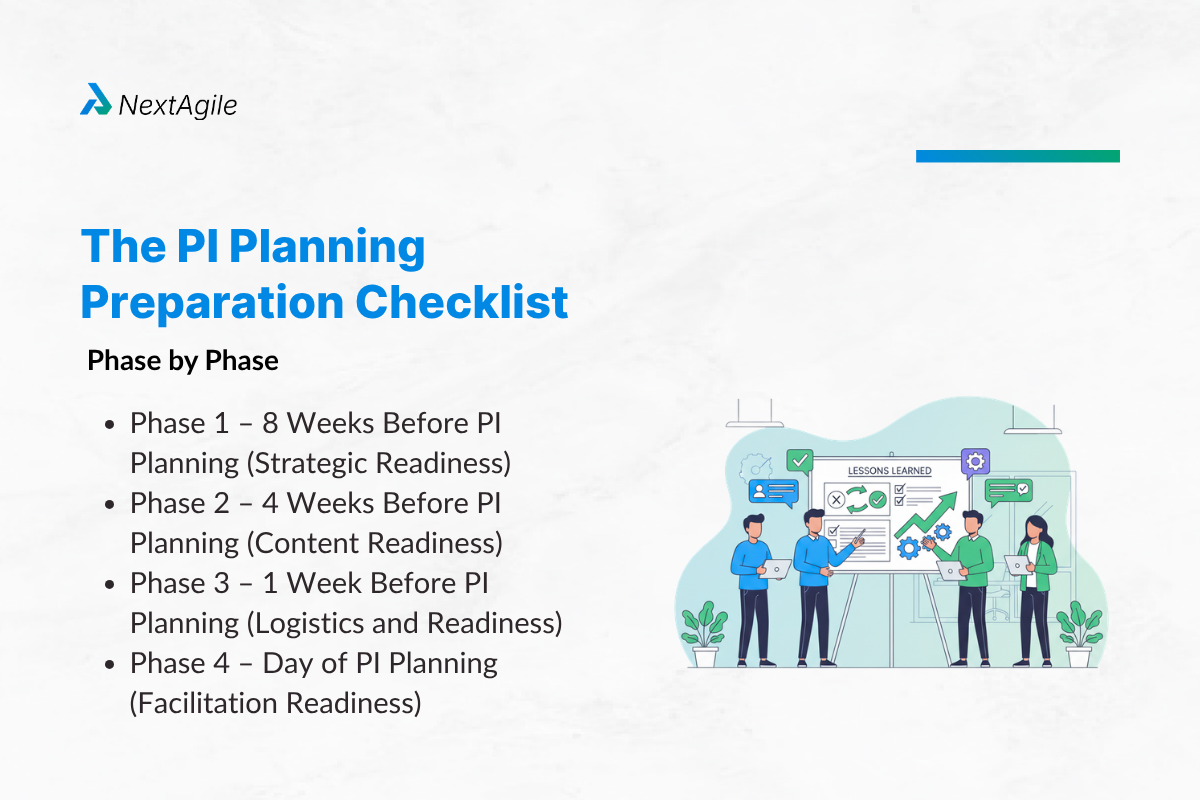
Phase 1 – 8 Weeks Before PI Planning (Strategic Readiness)
Release Train Engineer (RTE) Checklist:
- Confirm PI Planning dates and secure venue or virtual platform booking
- Define the PI Planning agenda (Day 1 and Day 2 structure)
- Identify and confirm attendance of Business Owners and executive stakeholders
- Confirm System Architect and Systems Team availability for architecture briefing
- Schedule pre-PI planning readiness reviews with Product Management
- Assess agile maturity of teams new to the ART and flag coaching needs
- Review previous PI’s objectives and metrics, identify patterns and improvement areas
- Confirm facilitator assignments for breakout sessions
For a deep dive into agile maturity assessment, see NextAgile’s guide on how to conduct agile maturity assessments.
Product Management Checklist:
- Draft the Vision update covering what has changed since the last PI
- Prioritize the Program Backlog with Business Owners and confirm the top 8 to 12 features
- Ensure all prioritized features have clear benefit hypotheses and business value scores
- Identify any architectural runway needs and flag for the Architecture team
- Begin drafting the Top 10 Features presentation for Day 1
Phase 2 – 4 Weeks Before PI Planning (Content Readiness)
Product Management Checklist:
- Program Backlog features finalized with acceptance criteria and dependencies noted
- NFRs (Non-Functional Requirements) reviewed and confirmed with Architecture
- Business context presentation finalized covering market situation and strategic themes
- Business value assignment rubric confirmed for team PI Objectives
Scrum Master Checklist:
- Team Backlog refined with top user stories broken down and estimated
- Team capacity for the PI calculated accounting for leaves, holidays, support commitments
- Previous PI retrospective actions reviewed to confirm which improvements are embedded
- Team members briefed on the PI Planning agenda and expectations
- Team-level dependencies flagged to RTE for pre-PI coordination
Architecture and Systems Team Checklist:
- Architecture vision presentation prepared covering what is changing and what is enabler work
- Architectural runway gaps identified and surfaced to Product Management
- Spike stories drafted for significant technical unknowns
Executive and Business Owner Checklist:
- Business context brief reviewed and approved
- Strategic themes confirmed and communicated to Product Management
- Availability confirmed for Day 1 Briefing, ART Sync, and Final Plan Review
- Decision-making authority confirmed: who can approve scope tradeoffs during the event?
Phase 3 – 1 Week Before PI Planning (Logistics and Readiness)
RTE Checklist:
- Dry-run the PI Planning facilitation sequence with co-facilitators
- Confirm all remote participants have access to collaboration tools (Miro, Jira, Azure DevOps, etc.)
- Test AV, conferencing, and digital board tools, run a 30-minute tech rehearsal for virtual or hybrid events
- Distribute pre-read materials to all participants including Vision, Roadmap, and Business Context
- Confirm team board templates are set up, physical or digital
- Send logistics communication to all participants covering agenda, location or link, and pre-work expectations
- Identify a Parking Lot facilitator for capturing issues outside PI Planning scope
Scrum Master Checklist:
- Confirm team attendance and escalate any gaps in Product Owner or key developer availability
- Pre-populate team iteration plans with known work (support rotations, DevOps tasks)
- Review dependency mapping with neighboring teams and surface cross-ART dependencies early
For teams using Jira as their PI Planning tool, NextAgile’s JIRA Training Masterclass covers advanced board setup, dependency mapping, and PI execution tracking.
Phase 4 – Day of PI Planning (Facilitation Readiness)
Morning of Day 1:
- RTE welcome and agenda walkthrough ready (10 to 15 minutes)
- Business context presenter briefed and confirmed present
- Architecture walkthrough presenter confirmed
- Team breakout rooms set up (physical or virtual)
- Risk and impediment log template open and accessible to all
- Parking lot visible to all participants
End of Day 1 Checklist:
- All teams have draft PI Objectives with business value scores
- Program Board updated with at least first-pass dependencies mapped
- Management Review and Problem-Solving session conducted and scope adjustments decided
- Day 2 agenda confirmed with any necessary adjustments
End of Day 2 Checklist:
- All teams have presented final PI Objectives
- Business Owners have assigned business value scores
- Program Risks classified using ROAM (Resolved, Owned, Accepted, Mitigated)
- PI Planning confidence vote conducted, target 3.5 or above out of 5
- ART PI Objectives finalized and recorded
- Retrospective on the PI Planning event completed
Post-PI Planning Follow-Up Checklist
PI Planning does not end when teams leave the room. The post-event follow-up determines whether the commitments made during PI Planning translate into actual delivery. This section is not covered by any of the top 5 competitor pages on this topic.
Within 48 Hours:
- PI Objectives documented and distributed to all stakeholders
- Program Board (physical or digital) published to a shared location accessible to all teams
- ROAM risks assigned to owners with review dates
- PI Planning retrospective actions assigned and added to team and ART backlogs
Within 1 Week:
- First ART Sync or Scrum of Scrums scheduled for the PI
- Business Owner alignment check to confirm value scores are reflected accurately
- Metrics baseline set for the PI (team velocity targets, PI predictability goal)
For a full picture of the agile transformation journey that PI Planning sits within, see NextAgile’s guide on agile transformation journey.
AI-Augmented PI Planning Tools for 2026
Enterprise teams running PI Planning in 2026 are increasingly using AI tools to accelerate preparation:
AI-assisted backlog refinement:
- Tools such as LinearB’s AI Assist and Azure DevOps Copilot help Product Managers identify dependency patterns and prioritization conflicts in the Program Backlog before PI Planning begins.
- Teams using AI-assisted backlog refinement report spending 30 to 40% less time in pre-PI backlog preparation (Agile Alliance, 2024).
AI facilitation support:
- Using LLMs to generate draft team iteration plans based on historical velocity and current backlog is emerging as a preparation accelerator.
- Natural language querying of ART metrics during the event reduces facilitator cognitive load.
- AI-generated PI risk summaries help RTEs surface pattern risks across teams faster.
For enterprise teams looking to build this capability, NextAgile’s AI for Agility Workshop specifically covers AI integration within Jira, Miro, Confluence, and SAFe tooling.
PI Planning for Remote and Hybrid Teams: Additional Checklist Items
Distributed teams require 8 to 12 additional preparation steps beyond what co-located teams need:
- Collaboration tool training (Miro, Mural, or EasyAgile) completed 2 weeks before event
- Time zone windows confirmed with no team expected to attend at unreasonable hours consistently
- Asynchronous pre-work completed: teams submit draft objectives before Day 1
- Designated on-site liaison confirmed for each remote location
- Recorded briefings for Business Context and Architecture Vision available for async review
- Digital Program Board template pre-populated and shared with all teams
Conclusion
A thorough PI Planning preparation checklist is the single highest-leverage intervention an RTE or Agile program lead can make. The 60+ checklist items in this guide, organized across eight weeks of preparation and post-PI follow-up, represent the preparation practices of enterprise-grade agile consulting engagements.
If your organization is:
- Implementing SAFe for the first time
- Scaling from one ART to three or more
- Running PI Planning across distributed India and international teams
NextAgile’s SAFe Consulting Services bring practitioner-led preparation support directly to your PI Planning events. Contact us at consult@nextagile.ai.