OKR goal setting is the process of deciding what matters most for a team during a defined period, turning those priorities into measurable outcomes, and creating a regular rhythm for reviewing progress and making course corrections.
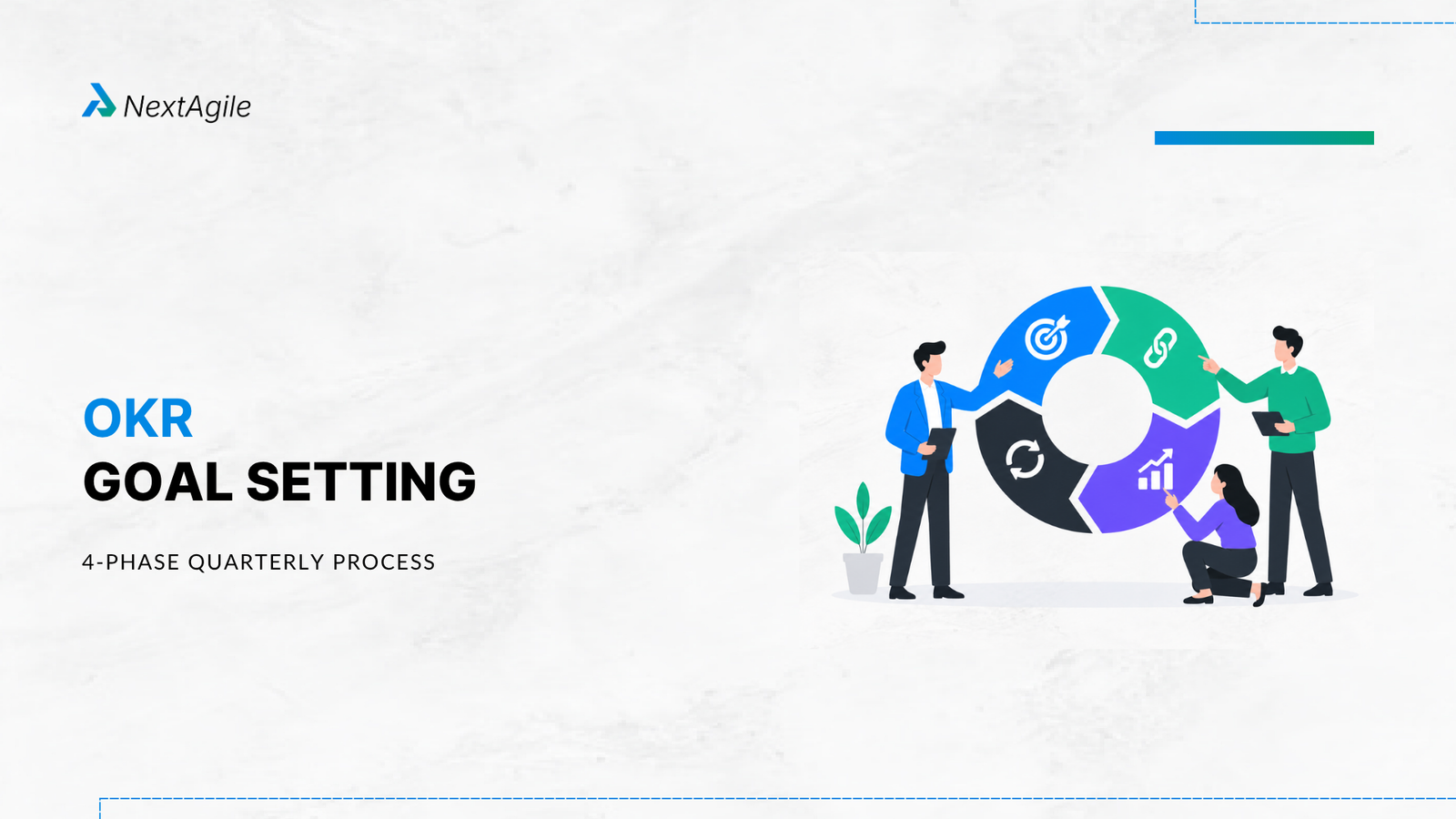
A practical quarterly OKR cycle has four phases: kickoff and objective setting, mid-quarter check-ins, end-of-quarter scoring, and retrospective and next-cycle planning.
The important part is that OKRs do not end when the goals are written. Teams need to use them throughout the quarter to make priorities visible, identify risks early, adjust their approach, and learn what should change in the next cycle.
Key Highlights of OKR Goal Setting OKR goal setting is a quarterly management process, not a one-time goal-writing exercise. A strong OKR cycle moves through four phases: set, check, score, and learn. Teams should keep Objectives focused and use Key Results to measure meaningful outcomes rather than activities. Every Key Result should have a clear baseline, target, owner, measurement method, and review cadence. Weekly or biweekly OKR check-ins help teams identify risks before the end of the quarter. Re-forecasting a Key Result is different from quietly lowering its target. A useful OKR score tells you what happened, while the retrospective helps explain why it happened. Not every unfinished OKR should automatically carry into the next quarter. A consistent OKR cadence helps teams coordinate priorities without turning OKRs into a reporting exercise. The best OKR process creates a learning loop from one quarterly cycle to the next. Introduction Most teams do not have a shortage of goals. They have a shortage of clarity about which goals deserve attention first.
At the beginning of a quarter, product launches, revenue targets, customer issues, operational improvements, hiring plans, and strategic initiatives can all compete for the same limited capacity. When everything becomes a priority, teams often lose the ability to make clear trade-offs.
This is where OKR goal setting becomes useful. It gives teams a structured way to decide what matters most, define evidence of progress, and create a management rhythm around those outcomes.
But writing Objectives and Key Results is only the starting point. The real value of an OKR process appears during the weeks that follow, when teams use their goals to make decisions.
A strong quarterly OKR cycle therefore answers four practical questions:
What are we trying to achieve? How will we know whether we are making progress? What should we change if progress falls behind? What should we learn before setting the next quarter’s goals? This guide explains the complete OKR goal-setting process through four phases, along with practical examples, scoring guidance, check-in rules, and a framework teams can use to run their next quarterly OKR cycle.
What Is OKR Goal Setting? OKR goal setting is the process of deciding what matters most during a planning period, defining measurable evidence of success, and establishing how progress will be reviewed throughout the cycle.
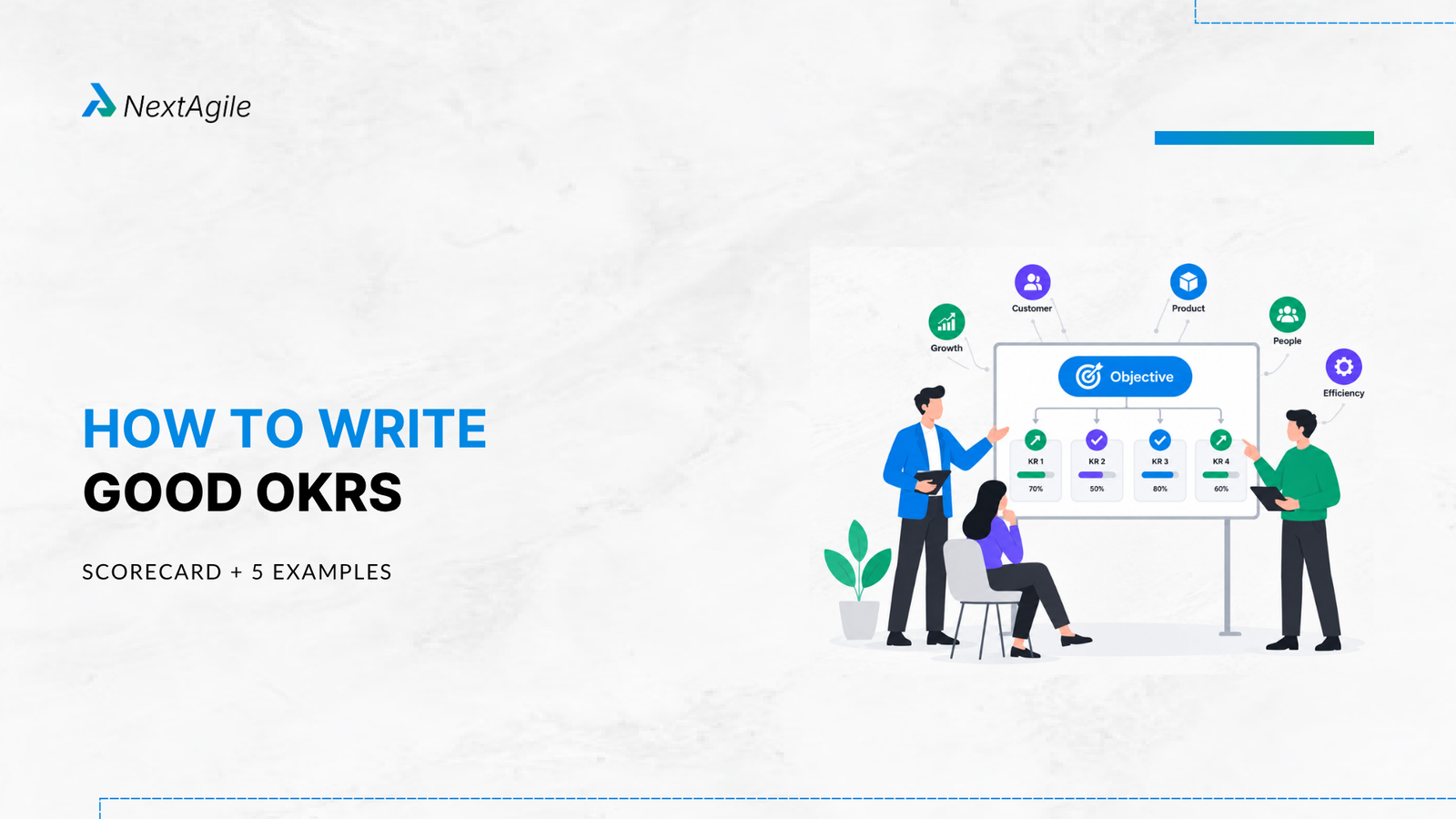
An Objective describes the meaningful outcome or direction a team wants to pursue. Key Results define the measurable evidence that indicates whether the team is making progress toward that Objective (see what is OKR for the fundamentals).
For example:
Objective: Make customer onboarding faster and more effective.
Key Result 1: Increase onboarding completion from 68% to 85%. Key Result 2: Reduce median time to first value from 5 days to 2 days. Key Result 3: Increase new customer activation from 61% to 78%. The Objective gives the team direction. The Key Results define what progress should look like.
But an effective OKR goal-setting process goes further. It establishes what happens before the goals are approved, how progress will be monitored, what happens when a Key Result goes off track, and how lessons are carried into the next quarter.
Why OKR goal setting is more than writing objectives OKR goal setting is not complete when a team fills in an OKR template .
The actual process is about making choices. Teams need to decide which outcomes matter most, which results can demonstrate progress, and where limited time and resources should be concentrated.
A useful OKR check-in is not simply a status meeting. It is the point where the team decides whether to continue the current approach, change an initiative, remove a blocker, or re-forecast the expected result.
This distinction matters because a team can have excellent-looking OKRs and still fail to use them as a management tool.
The goal is not to create a document that looks complete at the beginning of the quarter. The goal is to create a system that remains useful when conditions change.
How OKR goal setting differs from traditional goal setting Traditional annual goal setting often establishes broad goals for the year and reviews them at predetermined points.
OKRs can operate within that broader planning system by creating shorter cycles. Quarterly OKRs give teams more frequent opportunities to clarify priorities, inspect progress, and learn from results.
The difference is therefore not simply the length of the planning period.
The bigger difference is the feedback loop. Quarterly OKRs create a structured connection between planning, execution, measurement, course correction, scoring, and learning.
Annual strategy can provide direction. Quarterly OKRs translate that direction into outcomes that teams can actively manage.
The OKR Goal Setting Process: 4 Phases of a Quarterly Cycle A practical quarterly OKR cycle can be organised into four connected phases.
Phase 1 – Establishes direction and priorities.
Phase 2 – Focuses on progress, risks, and course correction.
Phase 3 – Assesses the results achieved.
Phase 4 – Converts those results into learning for the next cycle.
The four phases are:
Kickoff and set objectives Mid-quarter check-in End-of-quarter scoring Retrospective and next-cycle planning The phases should not be treated as four disconnected meetings. Each phase produces information that feeds the next.
A simple quarterly rhythm could look like this:
Stage Main activity Key question Week 0 OKR planning What matters most? Weeks 1 to 3 Execution and updates Are we moving? Week 4 to 6 Check-in What is at risk? Weeks 7 to 10 Course correction What needs to change? Weeks 11 to 12 Final review What did we achieve? Quarter end Retrospective What should we do differently?
This structure gives teams a repeatable OKR goal-setting cadence without making the process unnecessarily complicated.
Phase 1: Kickoff and Set Objectives The first phase establishes the priorities for the quarter.
Leadership should provide enough strategic context for teams to understand what matters. Teams then translate that context into outcomes they can meaningfully influence.
The kickoff should answer three questions:
What matters most this quarter? What outcomes would demonstrate meaningful progress? Which dependencies need to be addressed before execution begins? The aim is not to capture every activity the team expects to perform. It is to identify the outcomes that deserve explicit attention.
Phase 2: Mid-Quarter Check-In The second phase moves OKRs from planning into active management.
Teams review current results, compare progress against the expected trajectory, identify blockers, and decide whether their current approach is still appropriate.
The most useful check-ins focus on exceptions rather than forcing every Key Result into a lengthy presentation.
If a result is progressing as expected, little discussion may be needed. If a result is stalled, the team should spend time understanding why and deciding what action is required.
Phase 3: End-of-Quarter Scoring At the end of the quarter, teams assess actual results against the targets they established.
OKR scoring provides a consistent way to describe the level of achievement.
However, the score is not the end of the conversation. Teams also need to understand whether the target was well designed, whether assumptions changed, and what influenced the final result.
A score tells the team what happened. The retrospective helps explain why.
Phase 4: Retrospective and Next-Cycle Planning The final phase turns the completed quarter into input for the next one.
Teams review the quality of their Objectives, Key Results, measurements, assumptions, dependencies, and execution decisions.
The retrospective should produce concrete changes.
If a team repeatedly sets too many Objectives, the next cycle should address that. If Key Results consistently measure activities rather than outcomes, the next planning cycle should correct that pattern.
This creates a continuous loop:
Set goals → execute → inspect → adapt → score → learn → set better goals.
Phase 1: Kickoff and Set Objectives The quality of an OKR cycle depends heavily on the quality of the decisions made during kickoff.
Teams should begin by understanding organisational priorities rather than immediately writing individual goals.
This prevents a common problem where every function creates reasonable goals that do not connect into a coherent set of business outcomes.
How many objectives should a team set? Teams should keep the number of Objectives deliberately limited.
For many teams, one to three meaningful Objectives can provide sufficient focus for a quarter. The exact number depends on team size, scope, strategic complexity, and how much influence the team has over each outcome.
The test is simple:
If we could make meaningful progress on only a few outcomes this quarter, which ones would matter most?
If an Objective does not influence priorities, decisions, or resource allocation, it may not need to be an OKR.
Fewer Objectives also make trade-offs more visible. That is one of the practical benefits of an OKR framework.
How to write measurable key results Key Results should measure meaningful changes rather than simply listing activities.
Weak Key Result: Launch three email campaigns.
Stronger Key Result: Increase qualified marketing leads from 800 to 1,100 per quarter.
The campaign is an initiative. The increase in qualified leads is the measurable result.
This distinction is fundamental when learning how to set OKRs.
A useful test is:
If we complete the activity but the intended outcome does not improve, would we still consider the Key Result successful?
If the answer is no, the Key Result probably needs to measure the outcome more directly.
Each Key Result should ideally include a baseline, target, measurement period, and clear source of data.
Should OKRs be top-down, bottom-up, or collaborative? A practical OKR process combines strategic direction with team input.
Leadership should communicate the priorities and constraints that matter at the organisational level. Teams should contribute their understanding of the outcomes they can influence and the approaches they believe will work.
A purely top-down model can create goals that teams do not understand or own.
A purely bottom-up model can create locally sensible goals that do not connect to wider strategy.
Collaborative goal setting creates a useful middle ground. Strategy provides direction, teams contribute expertise, and cross-functional dependencies are discussed before the cycle begins.
OKR Goal Setting Checklist Before the Quarter Starts Before publishing quarterly OKRs, teams should validate more than the wording of the Objectives.
Use this checklist:
Check Question Strategic connection Does the Objective support an important priority? Focus Is the team trying to achieve too many things? Outcome Does each KR measure a meaningful result? Baseline Do we know where the result starts? Target Is the intended change clearly defined? Ownership Does someone own the result? Measurement Is the data source known? Dependencies Do other teams influence the result? Cadence When will progress be reviewed? Initiative Do we know which actions will influence the KR?
This checklist helps prevent teams from confusing a well-written OKR with a well-designed OKR.
A polished sentence does not guarantee a useful goal. The goal must also be measurable, influenceable, strategically relevant, and manageable during the quarter.
Phase 2: Mid-Quarter Check-In The OKR check-in is where the process becomes operational.
Without regular reviews, teams may discover too late that a Key Result has been off track for several weeks.
A useful OKR goal-setting cadence does not require long meetings. It requires consistent attention to the results that need intervention.
What to review during an OKR check-in Review each Key Result using five questions:
What is the current result? What was the expected progress by now? What is the latest forecast? What is blocking progress? What action is required? For example:
Key Result: Increase activation from 60% to 80%. Current result: 68%. Expected result at this point: 72%. Forecast: 74%. Status: At risk. Issue: New customers are not completing the onboarding sequence. Action: Product and Customer Success will test a revised onboarding flow. This is much more useful than saying the KR is 68 percent complete.
The discussion creates a direct link between measurement and action.
When to re-forecast a key result A re-forecast is appropriate when evidence suggests that the expected quarter-end result has changed.
Suppose a team originally targets a conversion increase from 4% to 6%. Halfway through the quarter, conversion is at 4.5% and the current trend suggests a quarter-end result of 5%.
The team should record the forecast rather than quietly changing the target from 6% to 5%.
The target represents the original ambition.
The forecast represents what the team currently expects based on evidence.
Keeping these separate protects the integrity of OKR scoring while allowing teams to manage reality.
How to respond when priorities change OKRs should provide focus without becoming rigid.
If a major strategic decision, customer issue, regulatory development, market change, or operational event changes the team’s priorities, the OKRs may need to be reviewed.
But difficulty alone is not a reason to change an OKR.
A useful distinction is:
Change an initiative when the approach is not working. Re-forecast a Key Result when evidence changes the expected outcome. Change an Objective when the underlying strategic priority has materially changed. This prevents teams from rewriting goals simply because they are difficult.
Phase 3: End-of-Quarter Scoring The third phase assesses what the team actually achieved.
OKR scoring works best when teams agree on their scoring approach before the quarter ends. This reduces the temptation to reinterpret the scale based on the final result.
How the 0.0–1.0 OKR scoring scale works A commonly used OKR scoring scale runs from 0.0 to 1.0, popularised by Google .
A simple interpretation might be:
0.0 = no meaningful progress 0.3 = limited progress 0.5 = moderate progress 0.7 = substantial progress 1.0 = target achieved The exact interpretation can vary by organisation.
For example:
Baseline: 40% Target: 70% Final result: 60% Expected improvement: 30 percentage points Actual improvement: 20 percentage points Progress against intended improvement: 20 ÷ 30 = 0.67 The calculation provides a useful reference, but teams should still consider context.
Some Key Results may use milestone scoring or binary measures rather than a linear calculation.
Why a perfect score on every OKR may signal weak goal setting A team achieving every target can indicate strong execution. But consistently perfect scores may also raise a goal quality question.
Were the targets challenging enough?
Were the outcomes genuinely important?
Did the team have to make meaningful trade-offs to achieve them?
OKRs are often designed to encourage teams to pursue significant outcomes rather than simply document work they were already certain to complete.
At the same time, a score below 1.0 should not automatically be treated as failure.
A team may make substantial progress against an ambitious target and generate valuable learning even without reaching the original number.
The score should therefore be discussed alongside the quality of the goal and the conditions under which the work was performed.
Phase 4: Retrospective and Carrying Lessons Forward The retrospective is where the OKR cycle becomes a learning system.
A team should not finish one quarter, copy its unfinished goals into the next quarter, and call the process complete.
The retrospective should examine what happened and what should change. Agile retrospective techniques can keep this conversation structured.
What to discuss in an OKR retrospective A practical retrospective can examine five areas:
Goal quality Measurement quality Execution Dependencies Decision-making Ask:
Were our Objectives genuinely important? Did the Key Results measure outcomes? Were the baselines reliable? Could the team influence the results? Did dependencies slow progress? Did our check-ins lead to useful decisions? Did priorities change during the quarter? Did our initiatives actually influence the intended results? The retrospective should produce decisions rather than observations alone.
If a team repeatedly creates too many Objectives, reduce the number next quarter.
If measurement data arrives too late, change the measurement system.
If a Key Result depends heavily on another function, address the dependency before the next cycle.
Which OKRs should carry into the next quarter? An unfinished OKR should never be carried forward automatically.
First determine why it remained unfinished. If the Objective remains strategically important and the team still has influence over the outcome, continuing it may make sense.
But the Key Result may need to change.
For example, the original KR may have exposed a measurement problem or revealed that the chosen metric was not actually a useful indicator of the Objective.
In other cases, the entire Objective may no longer matter.
The decision should therefore be based on strategic relevance and learning, not simply on whether the previous target was achieved.
How to Run a Simple Weekly OKR Check-In A practical OKR process does not require a large meeting every week. A 15-20-minute team check-in can be enough when the data is already available in your OKR software tools .
Start by reviewing the Key Results that changed since the previous check-in.
Next, identify any result that is below its expected trajectory.
Then ask what has changed, what is blocking progress, and what action is required.
Finally, record the decision and assign ownership for the next action.
A simple weekly rhythm might look like:
5 minutes: Review updated results 5 minutes: Discuss risks and blockers 5 minutes: Decide actions or course corrections 5 minutes: Confirm owners and next review The purpose is not to report activity. The purpose is to make better decisions while there is still time to influence the quarter. Atlassian’s OKR team playbook uses a similar lightweight format.
Worked Example: OKR Goal Setting Across One Quarter Consider a SaaS product team working on customer adoption.
The team sets this Objective:
Objective: Make the new product capability part of customers’ regular workflow.
Key Results:
Key Result Baseline Target Mid-Quarter Final Weekly active usage 35% 60% 48% 57% New customer adoption 45% 75% 61% 73% Usability issues per month 40 20 27 18
During the first check-in, the team notices that new customer adoption is improving more slowly than expected.
Instead of simply marking the result as at risk, the team investigates the cause. It discovers that the onboarding material does not clearly explain the new capability.
The team introduces a guided walkthrough and changes the onboarding sequence.
At the next check-in, adoption has improved.
By the end of the quarter, the team has not reached every original target, but it has achieved meaningful progress across all three Key Results.
The retrospective identifies onboarding quality as an important driver of adoption. That insight becomes useful input for the next OKR cycle.
This is what makes OKR examples useful. They should demonstrate how teams think and make decisions, not simply show attractive Objective and Key Result statements.
OKR Goal Setting vs. Traditional Annual Goal Setting Annual goals and quarterly OKRs can work together, a point also made in this comparison of annual vs. quarterly OKRs .
Annual planning can establish broader strategic direction, while quarterly OKRs translate that direction into a smaller number of measurable outcomes.
Frequency, flexibility, and transparency differences Dimension Traditional annual goals Quarterly OKRs Planning horizon Usually annual Usually quarterly Review cadence Periodic Regular Adaptability Often slower More frequent Focus Broad priorities Near-term outcomes Learning cycle Longer Shorter Course correction Periodic Built into the cycle
The shorter cycle does not mean strategy changes every quarter.
Instead, quarterly OKRs give teams a structured opportunity to determine what matters now and whether the current approach is producing the intended results.
For teams that want to connect quarterly OKRs with day-to-day execution, weekly planning for business goals can provide a useful complementary approach.
How to Make OKR Goal Setting Work Across Teams An OKR framework becomes more valuable when teams use a consistent process without forcing every team to have identical goals.
Consistency should exist around the cadence, definitions, check-ins, and scoring approach. The actual Objectives should still reflect each team’s contribution.
Keep objectives focused If a team has eight Objectives, the OKR framework has not necessarily created focus. The team still needs to decide what matters most.
Keep Objectives limited enough that they influence prioritisation and resource allocation.
A good Objective should make trade-offs easier, not simply document everything the team already intends to do.
Separate learning from performance evaluation Teams need to be able to discuss missed targets honestly.
If every missed Key Result becomes an individual performance judgment, people may become less willing to set ambitious goals or surface risks early.
OKR scoring should therefore be distinguished from individual performance management .
The purpose of scoring is to understand progress, ambition, execution, and learning.
This creates an environment where teams can report problems before they become quarter-end surprises.
Give teams a consistent OKR cadence A shared cadence helps teams know when to plan, review, adapt, score, and retrospect.
A practical quarterly OKR process might follow this rhythm:
Week 0: Planning and alignment Weeks 1 to 3: Execution and updates Week 4: Progress review Weeks 5 to 8: Course correction Weeks 9 to 11: Final execution and forecasting Week 12: Scoring and retrospective The exact timing can vary, but the rhythm should be predictable.
Teams can also use an OKR tracking sheet to make current results, ownership, and updates visible.
For teams building their broader goal-setting approach, OKR planning can help connect quarterly planning with the wider OKR process.
It is also useful to distinguish OKRs from other goal-setting approaches. A discussion of goals vs. SMART goals can help teams understand where OKRs fit within a broader goal-setting framework.
Conclusion OKR goal setting works when teams treat it as a management cycle rather than a quarterly documentation exercise.
The four phases provide a practical structure:
Set meaningful Objectives and measurable Key Results. Review progress before the quarter is over. Score results using consistent evidence. Retrospect and carry useful lessons into the next cycle. The strongest OKR process also creates room for controlled adaptation. Teams should remain committed to meaningful outcomes while being willing to change initiatives, re-forecast results, or revise an Objective when circumstances genuinely change.
The objective is not to produce a perfect set of goals.
It is to create enough focus for teams to make better choices, enough measurement to see whether those choices are working, and enough learning to improve the next cycle.
When this rhythm becomes part of how teams operate, the OKR framework becomes more than a planning tool. It becomes a practical system for focus, alignment, transparency, course correction, and continuous learning.
If your teams struggle with unclear priorities, disconnected goals, and inconsistent progress tracking, a structured OKR process can help create greater focus and alignment. NextAgile consulting can help you co-create and implement a practical OKR framework that connects strategic priorities with measurable outcomes and a consistent quarterly cadence. Do reach out to us at consult@nextagile.ai and we would be happy to explore more.
Frequently Asked Questions 1. How many OKRs should a team set per quarter? There is no universal number, but teams generally benefit from keeping Objectives limited. One to three meaningful Objectives can provide strong quarterly focus for many teams.
The right number depends on the team’s scope and complexity. If the team cannot explain which outcomes matter most, it probably has too many Objectives.
2. What’s a good OKR score, and is 1.0 always the goal? A 1.0 means the defined target was achieved, but it is not the only useful outcome.
OKRs can be designed around meaningful or ambitious outcomes, so a score below 1.0 can still represent substantial progress.
Teams should examine the score alongside target quality, execution, assumptions, external conditions, and lessons learned.
3. Should OKR goal setting be top-down or bottom-up? A collaborative approach usually combines the strengths of both. Leadership provides strategic direction and context. Teams contribute their understanding of what outcomes they can influence and how they can contribute.
This creates alignment without requiring every Key Result to be dictated from the top.
4. How do you handle a key result that becomes irrelevant mid-quarter? First determine why it became irrelevant. If the strategic priority has materially changed, the Key Result may need to be replaced or retired.
If the target has simply become difficult, that is not automatically a reason to remove it.
Document the reason for any material change so the quarter-end review can distinguish between a genuine strategic change and a response to execution difficulty.
5. Is OKR goal setting suitable for annual planning too, or only quarterly? OKRs can be used across different planning horizons, but quarterly cycles are common because they create shorter feedback loops.
Many organisations use annual planning to establish strategic direction and quarterly OKRs to translate that direction into measurable outcomes.
The two approaches can complement each other.
6. What’s the biggest reason OKR goal setting fails after the first cycle? A common problem is treating OKRs as a planning event rather than an ongoing management process.
Teams may spend significant effort writing Objectives and Key Results and then stop using them once the quarter begins.
A sustainable OKR process requires regular check-ins, meaningful course correction, consistent scoring, and a retrospective that changes something about the next cycle.
The real test is not whether a team can write OKRs once.
It is whether the team can run the cycle repeatedly and become better at setting and managing goals each quarter.
Sujith G. is an agile practitioner with expertise in setting up the agile environment by coaching and training teams, individuals and stakeholders in the area of lean agile software principles. He has overall 12+ years of exp out of which 9+ years have been in Agile and Scrum implementation and adoption. Sujith has coached 70+ teams on agile practices & implementation techniques and has extensive experience in setting up metrics, JIRA & Azure DevOps. Experienced in identifying gaps in the system, creating scrum awareness, piloting and scaling scrum.
 Skip to content