Ever wonder why some companies hit ambitious goals quarter after quarter while others quietly abandon OKRs after one failed cycle?
Here’s a pattern we’ve seen repeatedly across startups and large enterprises: teams don’t fail at setting OKRs; they fail at making them work in execution.
And that’s where most OKR implementation failures begin.
OKR implementation failures occur when organizations adopt OKRs but fail to achieve measurable outcomes, alignment, or execution discipline.
In simpler terms: your teams are setting goals, but those goals aren’t driving results.
If even one of these shows up in your organization, your OKRs are already underperforming, if not failing entirely. To understand how OKRs should be structured correctly, see our detailed guide on how to implement OKRs for practical step-by-step execution.
Before jumping into mistakes, let’s simplify the problem.
Teams don’t fully adopt outcome thinking In most cases, OKR implementation failures aren’t caused by the framework. They’re caused by execution gaps across alignment, measurement, and accountability.
This “failure stack” is useful because it tells you exactly where to fix the system.
Why Do OKR Implementations Fail? 7 Root Causes Explained Let’s go deeper into why OKRs fail and what’s actually happening beneath the surface.
1. Treating OKRs Like KPIs This is one of the most common OKR vs KPI mistakes.
KPIs = performance tracking OKRs = transformation and change When teams turn OKRs into dashboards, ambition disappears.
Fix: Define OKRs around change, not maintenance.
Many of these mistakes come from misunderstanding goal systems, which is explained in detail in OKRs vs KPIs comparison where we break down their differences in real business contexts.
2. Lack of Leadership Alignment Misaligned leadership leads to misaligned teams every time.
I’ve seen organizations where product, sales, and marketing chase conflicting priorities. The result? OKR alignment issues across the board.
Fix: Align leadership first. Always.
3. Poorly Defined Key Results Bad Key Results are the fastest path to OKR failures.
Instead of:
Use:
“Increase weekly active users from 20K → 35K” In our experience, shifting from output-based to outcome-driven Key Results is the highest-leverage change most organizations can make and often the fastest way to reverse failing OKRs.
4. No Regular Check-ins Here’s what usually happens:
OKRs are set Teams get busy Progress isn’t reviewed And by the end of the quarter? Surprises.
Fix: Weekly check-ins with clear progress tracking.
5. Overcomplicated Frameworks Especially in large organizations, OKRs become bloated. Too many objectives. Too many dependencies.
Fix: Keep it simple – 3 to 5 OKRs per team.
6. Lack of Training and Coaching OKRs require a mindset shift from tasks to outcomes. Without training, teams revert to old habits.
Fix: Invest in onboarding and continuous coaching.
7. Ignoring Culture and Mindset OKRs need:
Transparency Accountability Psychological safety Without these, adoption fails.
Quick Reality Check: Is Your OKR System Already Failing? Teams can’t explain how their OKRs connect to company goals Key Results measure activity, not outcomes No weekly review cadence exists Too many OKRs dilute focus If you nodded to even two of these, your system needs fixing.
Real Examples of OKR Implementation Failures in Enterprise Teams Let’s make this tangible.
Example 1: Misaligned Departments Product focused on stability Sales pushed aggressive growth Result: delivery conflicts and missed targets.
Objective: Improve engagement KR: Ship 10 features Result: Activity increased; impact didn’t.
Example 3: Overloaded OKRs A large enterprise team had:
Tracking collapsed within weeks.
Pattern: Most failures aren’t strategic; they’re operational.
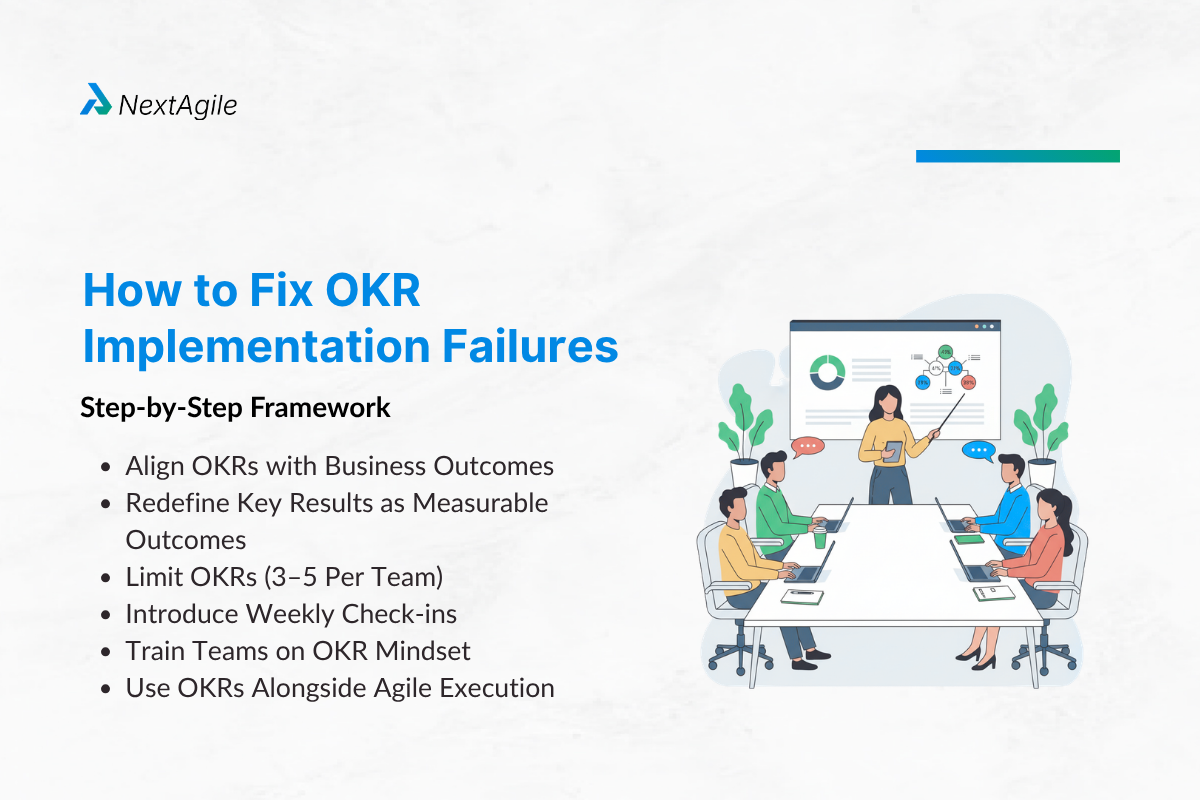
How to Fix OKR Implementation Failures: Step-by-Step Framework Let’s fix this systematically.
Step 1: Align OKRs with Business Outcomes Start with top priorities:
Growth Retention Efficiency Then cascade downward.
Step 2: Redefine Key Results as Measurable Outcomes Move from outputs → outcomes.
This single shift changes everything.
Step 3: Limit OKRs (3-5 Per Team) Focus increases execution quality. Always.
Step 4: Introduce Weekly Check-ins Use a simple structure:
Progress Blockers Confidence Consistency beats complexity.
Step 5: Train Teams on OKR Mindset Cover:
Outcome vs output Stretch goals Ownership If your organization is struggling with adoption, a structured OKR Fundamentals Workshop
Step 6: Use OKRs Alongside Agile Execution OKRs define direction Agile delivers execution Integrate both for impact.
OKR Best Practices to Prevent Failures in Agile and SAFe Teams This is where many teams struggle, especially in scaled environments.
Align OKRs with Product Backlog Every feature should map to an outcome.
Integrate with Sprint Reviews Use reviews to track KR progress and not just delivery.
Use OKRs at Team + Program Level Ensure alignment across layers.
Leadership-Driven Adoption If leaders don’t use OKRs, teams won’t either.
Organizations that combine OKRs with delivery systems often see better results, as explained in OKR Agile Scrum alignment where execution and goal-setting work together.
Tools and AI for Avoiding OKR Implementation Failures Let’s address a common challenge, OKR tracking issues. Manual tracking breaks quickly.
Modern platforms (like nextagile.ai) help teams:
Track real-time KR progress Visualize alignment across teams Identify at-risk OKRs early Use AI to suggest improvements Before vs After Using OKR Tools Without Tools With Tools Manual updates Automated tracking No visibility Real-time dashboards Delayed decisions Faster course correction
But here’s the truth: tools don’t fix bad OKRs; they amplify good systems.
For practical inspiration on how well-structured OKRs look in real scenarios, explore OKR examples across industries used by high-performing teams.
Conclusion: Fix the System, Not the Framework OKR implementation failures follow predictable patterns.
Misalignment. Poor metrics. Lack of consistency.
But once you identify these gaps, the solution becomes clear.
Fix alignment. Focus on outcomes. Build execution rhythm.
That’s how OKRs start working.
Bottom line?
Fix how you implement them and results will follow.
If your teams are struggling with misaligned goals, inconsistent execution, or OKRs that simply don’t deliver results, a structured and well-guided implementation approach becomes critical. As an OKR consulting
If you’re looking to fix recurring OKR implementation failures and build a scalable execution model, reach out to us at consult@nextagile.ai
Frequently Asked Questions Q1: How long does it take to see results from a successful OKR implementation? Most organizations see improvements within 1–2 quarters, with full maturity taking 2–3 cycles.
Q2: Can OKR implementation failures impact employee morale? Yes. Poorly implemented OKRs create confusion and frustration, while clear OKRs improve motivation and alignment.
Q3: Do OKR failures differ between startups and large enterprises? Yes. Startups struggle with focus, while enterprises struggle with alignment but the core issues remain similar.
Q4: Can OKR implementation fail due to poor tool selection? Yes, but tools are rarely the root cause. Strategy and execution matter more.
Alok Dimri is the co-founder and leads the overall business at NextAgile, where he is responsible for strategy, client and consultant partnerships, and a whole lot of other core business activities like solutioning, branding, and customer engagement.
Over the past 16 years, he has worked extensively in business strategy, new business development, and key account management initiatives across process consulting and training domains.
 Skip to content