Skip to content


Key Highlights of Prompt Engineering Techniques
- Prompt engineering can improve LLM output accuracy by 40 to 60% compared to unstructured queries (Stanford HAI, 2025).
- 10 core techniques covered: zero-shot, few-shot, chain-of-thought, RAG, meta prompting, tree of thoughts, role prompting, self-consistency, prompt chaining, and agentic prompting.
- Each technique includes a practical enterprise use case, not just a definition.
- A decision framework table helps you choose the right technique for the right task.
- Covers how enterprise teams can build internal prompt libraries and governance practices.
Introduction
Prompt engineering techniques are the structured methods you use to design inputs for large language models (LLMs) so they return accurate, useful, and contextually correct outputs. Without the right technique, even the most powerful LLM, whether GPT-4, Claude, or Gemini, produces vague, hallucinated, or off-target responses. With the right technique, the same model becomes a dependable business tool.
According to Stanford’s 2025 AI Index Report, prompt design quality accounts for a measurable portion of LLM performance variance in enterprise tasks. Enterprises running GenAI at scale, in software development, customer support, legal review, and HR, are now treating prompt engineering as a core organizational competency, not an individual skill.
This guide covers 10 proven prompt engineering techniques with real examples, a comparison table, and a practical framework for choosing the right technique for each business task. If your team is adopting GenAI tools or planning enterprise AI programs, this is the starting point. NextAgile’s Generative AI Consulting Services can help you build this capability at scale.
What Is Prompt Engineering and Why Does It Matter for Enterprises?
Prompt engineering is the practice of designing, structuring, and refining the text inputs, called prompts, that you send to an AI language model to get desired outputs. It sits between your business problem and the AI model’s raw capability.
Why it matters for enterprise teams:
- Off-the-shelf LLM responses rarely meet business-grade requirements for accuracy, structure, compliance, or tone.
- A legal team reviewing contracts cannot afford hallucinations.
- A customer support team using AI needs consistent, brand-aligned responses.
- A developer using code generation needs output that compiles without errors.
The difference between a weak prompt and a well-engineered prompt is not subtle. Research from Google DeepMind (2023) showed that structured prompting techniques improve reasoning task performance by up to 58% on complex multi-step problems. The return on investment from training enterprise teams in prompt engineering is measurable within the first sprint cycle.
If you are just starting your Generative AI Consulting journey, building this foundational skill set should be your first priority.
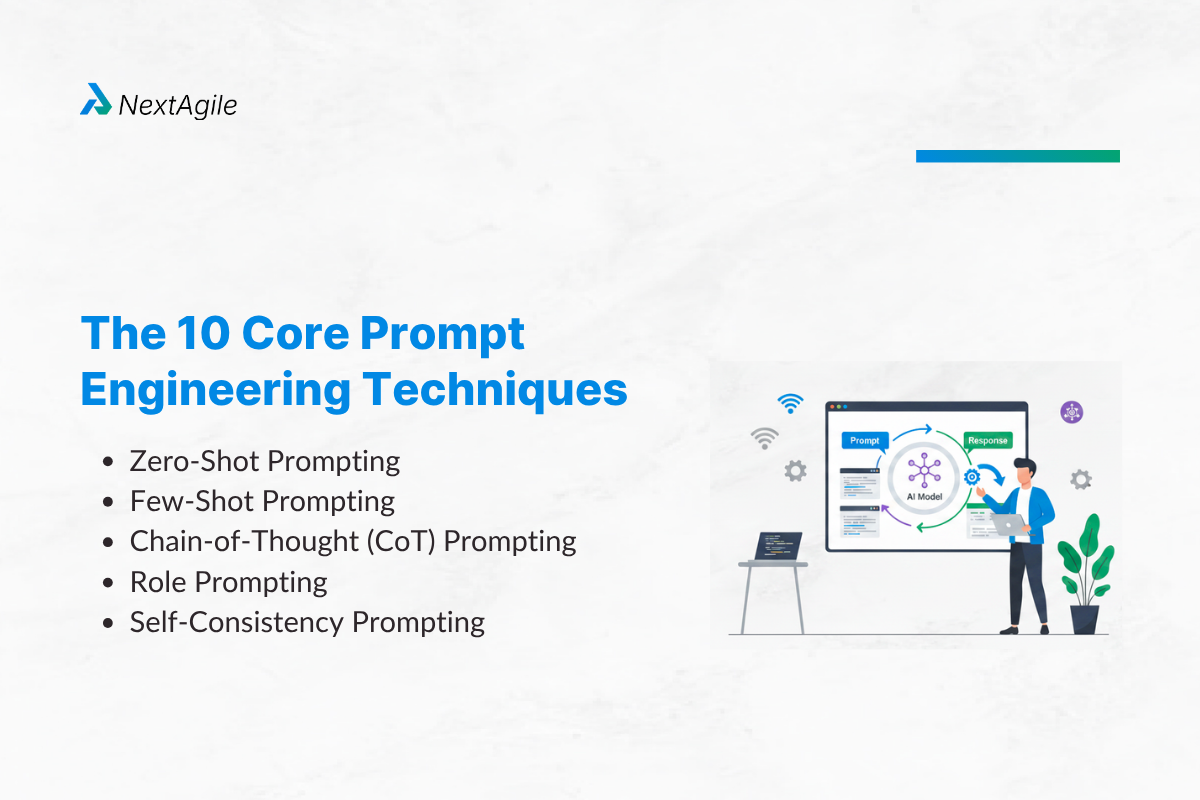
The 10 Core Prompt Engineering Techniques
1. Zero-Shot Prompting
Zero-shot prompting means asking an LLM to complete a task without providing any examples. You rely entirely on the model’s pretrained knowledge.
When to use it:
- Straightforward tasks with clear, well-defined outputs
- Summarization, translation, classification, and simple question answering
- Tasks where creative interpretation is undesirable
Enterprise use case: A procurement team asks, “Summarize this vendor contract and flag any non-standard indemnity clauses.” No examples needed. The model understands the task from its training data.
2. Few-Shot Prompting
Few-shot prompting gives the model 2 to 5 examples of the desired input-output pattern before asking it to complete your actual task. You train the model’s behavior in context without changing its weights. According to a landmark 2020 paper by Brown et al. (OpenAI), few-shot prompting with GPT-3 improved accuracy on a range of NLP tasks by 20 to 30% over zero-shot baselines.
When to use it:
- Tasks requiring consistent formatting or tone
- Domain-specific output style matching
- Repetitive document generation across large volumes
Enterprise use case: An HR team building a job description generator provides 3 sample job descriptions with the formatting and tone they need. The model replicates the structure consistently across 50+ new descriptions.
3. Chain-of-Thought (CoT) Prompting
Chain-of-thought prompting asks the model to reason through a problem step by step before giving a final answer. You either demonstrate the reasoning chain with examples (few-shot CoT) or simply add a phrase like “Think step by step” (zero-shot CoT). Research by Wei et al. (Google, 2022) showed CoT prompting improved accuracy on math and logical reasoning tasks by 40 to 80% across multiple LLM benchmarks.
When to use it:
- Complex multi-step problems and analytical tasks
- Financial modeling and strategic planning scenarios
- Backlog prioritization and product decision-making
Enterprise use case: A product manager asks an LLM to prioritize a backlog of 30 features using weighted scoring. The prompt says: “For each feature, think through business value, technical feasibility, and time to market, then score it 1 to 5 on each dimension.”
4. Role Prompting
Role prompting assigns a specific persona or professional role to the LLM before your request. You tell the model who it is before asking it to complete a task. This shifts the model’s vocabulary, framing, and expertise level.
When to use it:
- Domain-specific tasks requiring expert framing
- Stakeholder communication draft generation
- Role-specific document creation (legal, technical, HR)
Enterprise use case: An agile consulting team uses role prompting to generate PI Planning agenda templates by assigning the model as “an experienced SAFe consultant working with a 20-team Agile Release Train.”
5. Self-Consistency Prompting
Self-consistency is a technique that generates multiple reasoning paths for the same prompt and selects the most frequent or most consistent answer. Rather than trusting a single output, you run the prompt 5 to 10 times and aggregate results.
When to use it:
- High-stakes decisions where accuracy is non-negotiable
- Fact-checking and analytical validation tasks
- Legal or compliance document review
Enterprise use case: A data team uses self-consistency to verify AI-generated SQL query logic. The model generates the query 5 times. The team picks the version that appears most consistently.
6. Retrieval-Augmented Generation (RAG)
RAG connects the LLM to an external knowledge base, your documents, databases, or APIs, at inference time. Instead of relying only on training data, the model retrieves relevant information first, then generates a response grounded in that retrieved context. A 2023 paper by Lewis et al. (Meta AI) showed RAG reduces factual hallucination rates by up to 73% in open-domain question answering.
When to use it:
- Internal knowledge management and enterprise chatbots
- Compliance Q&A and regulatory document review
- Customer support automation grounded in product documentation
Enterprise use case: A consulting firm builds an internal knowledge assistant that retrieves relevant client case studies, methodology documents, and playbooks before generating a response to a consultant’s query.
7. Tree of Thoughts (ToT) Prompting
Tree of Thoughts prompting extends chain-of-thought by exploring multiple reasoning branches simultaneously. The model evaluates different solution paths, scores them, and selects the most promising direction. Introduced by Yao et al. (Princeton + Google, 2023), ToT improved performance on complex planning tasks by 74% over standard CoT in benchmark tests.
When to use it:
- Strategic planning and complex problem-solving
- Scenario analysis and architecture decisions
- Evaluating competing agile transformation approaches
Enterprise use case: A strategy consulting team uses ToT to evaluate three different agile transformation approaches for a 5,000-person IT organization, asking the model to explore pros, cons, and risk scenarios for each option before recommending one.
8. Meta Prompting
Meta prompting means asking the LLM to generate or refine its own prompt for a given task. Instead of writing the perfect prompt yourself, you tell the model: “Write the best prompt I should use to get [specific output] from you.”
When to use it:
- Building reusable prompt libraries for enterprise teams
- New domain exploration where you lack expertise
- Template creation for L&D and training programs
Enterprise use case: An L&D team asks the model to write the optimal prompt for generating customized agile training exercises for different roles including Scrum Masters, Product Owners, and Release Train Engineers.
9. Prompt Chaining
Prompt chaining breaks a complex task into a sequence of smaller prompts where the output of one becomes the input of the next. Each step in the chain handles a specific sub-task. This technique is the backbone of most agentic AI workflows. According to Anthropic’s published research, prompt chaining with task decomposition reduces error rates in complex, multi-step LLM tasks by 35 to 50% compared to single large prompts.
When to use it:
- Multi-step business processes and automated workflows
- Document generation pipelines (proposals, reports, briefs)
- End-to-end research and summarization workflows
Enterprise use case: An agile consulting team builds a proposal generation workflow where:
- Step 1 extracts client pain points from a discovery call transcript
- Step 2 maps those to relevant service offerings
- Step 3 drafts a customized proposal structure
- Step 4 generates an executive summary
10. Agentic Prompting
Agentic prompting enables AI models to take autonomous actions, calling tools, browsing the web, writing code, managing files, based on a high-level goal. Rather than responding to a single prompt, agentic systems plan, execute, observe results, and adapt. Frameworks like LangChain, AutoGPT, and Claude’s tool-use API support this approach. Gartner predicts that by 2026, 30% of enterprise GenAI deployments will use agentic architectures.
When to use it:
- Automation-heavy workflows and DevOps pipelines
- Enterprise AI product development
- Complex research tasks requiring multi-source synthesis
Enterprise use case: A software team builds an agentic code review assistant that retrieves the pull request, checks against coding standards, runs static analysis, identifies security vulnerabilities, and posts a structured review comment, all from a single high-level instruction.
For teams ready to move from individual prompt skills to enterprise agentic AI workflows, NextAgile’s Agentic AI Workshop provides the structured path forward.
Prompt Engineering Techniques Comparison Table
| Technique | Complexity | Best For | Accuracy Boost | Training Required |
| Zero-Shot | Low | Simple tasks, classification | Accuracy Boost | None |
| Few-Shot | Low-Medium | Tone/format consistency | Baseline | Low |
| Chain-of-Thought | Medium | Reasoning, analysis | 20+ to 30% | Medium |
| Role Prompting | Low | Expert framing | 40+ to 80% | Low |
| Self-Consistency | Medium-High | High-stakes outputs | Moderate | Medium |
| RAG | High | Knowledge retrieval | High | High |
| Tree of Thoughts | High | Complex planning | Up to 73% hallucination reduction | High |
| Meta Prompting | Medium | Prompt library building | 74% on planning tasks | Medium |
| Prompt Chaining | High | Multi-step workflows | Varies | High |
| Agentic Prompting | Very High | Autonomous enterprise workflows | 35+ to 50% error reduction | Very High |
How to Choose the Right Prompt Engineering Technique
Choosing the right technique depends on three factors:
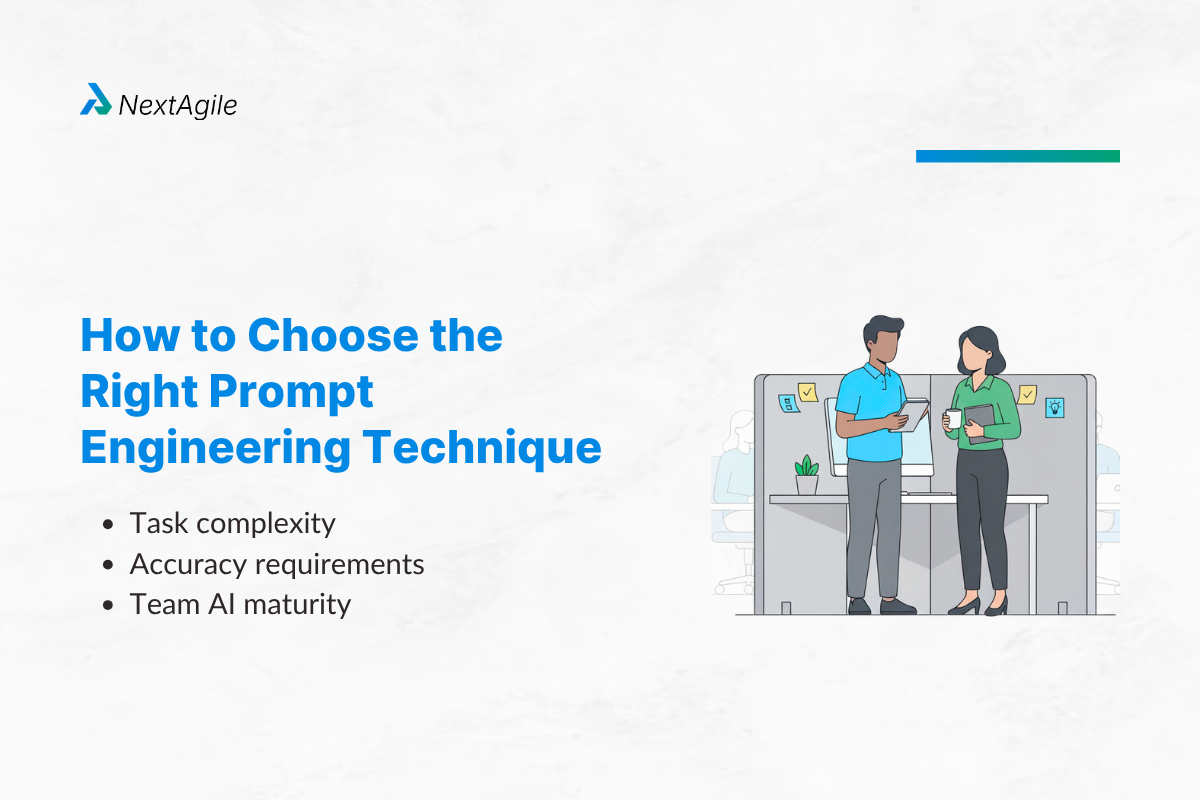
- Task complexity: Simple output vs. multi-step reasoning vs. autonomous action
- Accuracy requirements: Exploratory vs. high-stakes vs. production-grade
- Team AI maturity: Beginning adoption vs. moderate maturity vs. building AI products
A practical starting framework:
- For teams just starting: Zero-shot and few-shot prompting deliver immediate value without infrastructure investment.
- For moderate maturity teams: Chain-of-thought and role prompting unlock substantial performance gains on analytical and decision-support tasks.
- For advanced enterprise teams: RAG, prompt chaining, and agentic prompting drive competitive differentiation at scale.
According to McKinsey’s 2025 State of AI report, enterprises that combine structured prompting with retrieval architectures see 2.5x higher user adoption of GenAI tools compared to teams using unstructured prompting.
If your team needs a structured path through this progression, NextAgile’s Generative AI Foundations Workshop is designed for enterprise teams at every stage of AI maturity.
Building an Enterprise Prompt Library and Governance Practice
Individual prompt mastery is not enough for enterprise-scale AI adoption. You need:
- A shared prompt library: A curated repository of tested, reviewed, and approved prompt templates organized by use case and role
- A governance framework: Version control, quality review, and retirement processes for prompt templates
- A training program: Onboarding all relevant roles to the library and its proper use
What a strong enterprise prompt library includes:
- Role-specific prompts for each function (engineering, HR, legal, sales)
- Categorized by technique type with version history and performance notes
- Clear ownership for each prompt category
- Regular review cycles aligned with model updates
According to a 2024 survey by Forrester, organizations with centralized prompt governance frameworks report 45% fewer AI-output quality incidents compared to those without.
NextAgile’s enterprise Generative AI Consulting and AI for Agility Workshop programs help organizations build these libraries from the ground up, aligned with your existing delivery workflows.
Conclusion
Prompt engineering techniques are not theoretical constructs. They are operational tools that determine whether your enterprise’s GenAI investment delivers measurable results or produces inconsistent, unreliable outputs.
Key takeaways from this guide:
- The 10 techniques form a progression from basic task automation to fully autonomous AI-powered processes.
- Your entry point depends on your team’s current AI maturity and the business processes you want to improve first.
- Individual skill is not enough. Enterprise-grade AI adoption requires a shared prompt library, governance framework, and structured training program.
If your organization is planning a GenAI adoption program, starting with a structured Generative AI Foundations Workshop is the highest-ROI first step. NextAgile’s practitioner-led workshops equip your entire team, technical and non-technical, with the skills to apply these techniques in real business contexts. Reach out at consult@nextagile.ai.