What Is a TEAL Organization, and Why Should You Aim to Become One? (2026 Guide)
Alok Dimri
Talk to Expert for Free
Table of Contents
Quick Answer
A TEAL organization is a way of running a company built on three ideas: self-management instead of a management hierarchy, wholeness that lets people bring their full selves to work, and evolutionary purpose, where the organization’s direction emerges from its people rather than getting dictated from the top. Belgian author and former McKinsey consultant Frederic Laloux introduced the term in his 2014 book Reinventing Organizations, using a color-coded model (Red, Amber, Orange, Green, Teal) to describe how organizational structures have evolved. Real companies run this way today, including Dutch home-care provider Buurtzorg and US manufacturer Morning Star. The honest tradeoff: TEAL is not a plug-in you install over a struggling hierarchy. It requires a baseline of trust, clear decision rights, and leaders willing to give up control, which is why most organizations that attempt a full TEAL shift either fail or partially adopt select practices instead.
Key Highlights: What Is a TEAL Organization
Frederic Laloux introduced the TEAL model in his 2014 book Reinventing Organizations, based on research into more than 50 organizations that had operated for at least 5 years with 100+ employees.
The model names 3 breakthroughs unique to TEAL organizations: self-management, wholeness, and evolutionary purpose.
Buurtzorg, a Dutch home-care nonprofit, runs with self-managing teams of about 12 nurses each and no middle management layer, one of the most cited TEAL examples worldwide.
TEAL is a description of a paradigm, not a maturity ladder. Laloux is explicit that no color is automatically better than another; the right structure depends on what work actually needs.
Most organizations that attempt a full-scale TEAL transition either fail to sustain it or land on a hybrid, borrowing select practices like self-managing teams or transparent salaries without abandoning hierarchy entirely.
Introduction
A TEAL organization is a way of structuring a company around self-management, wholeness, and evolutionary purpose instead of a traditional management pyramid. The term comes from Frederic Laloux, a former McKinsey partner who left consulting, researched more than 50 companies, and published his findings in the 2014 bookReinventing Organizations. More than a decade later, TEAL is still one of the most discussed organizational models in leadership circles, and also one of the most misunderstood.
This guide explains what TEAL actually means, the 3 breakthroughs that define it, real companies running this way today, the honest limitations nobody puts in the pitch deck, and a realistic step-by-step path if your organization wants to move in this direction without breaking what already works.
What Is a TEAL Organization
Short Answer : A TEAL organization is a company structured around self-management, wholeness, and evolutionary purpose instead of a management hierarchy, a model introduced by Frederic Laloux in his 2014 book Reinventing Organizations.
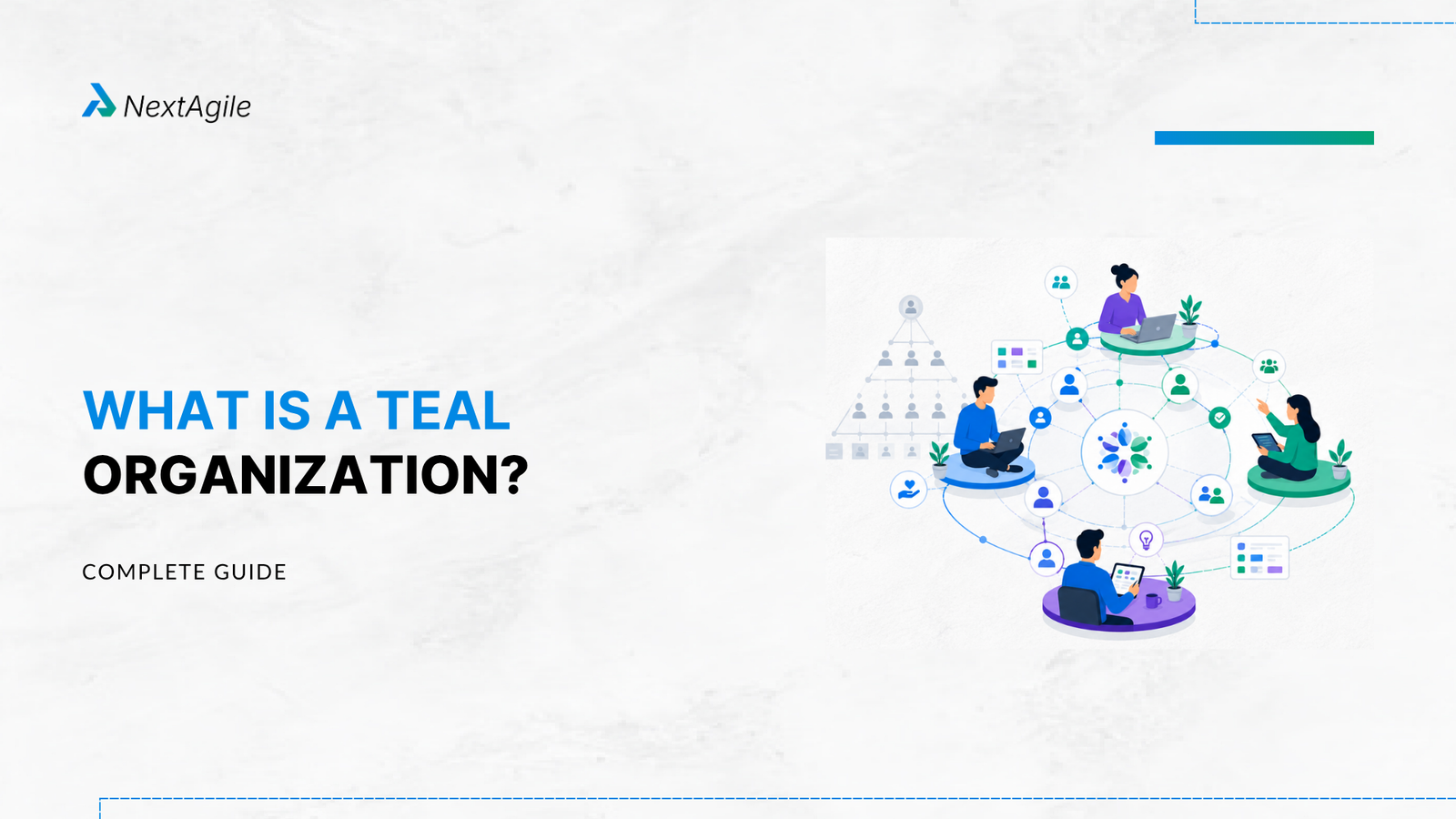
Laloux’s model describes 5 stages of organizational development, each given a color based on earlier work by philosopher Ken Wilber and psychologist Clare Graves. Red organizations run on raw power (a street gang or a mafia). Amber organizations are rigid, hierarchical, and process-driven (the military, most government agencies). Orange organizations chase competitive advantage through meritocracy and results (most modern corporations). Green organizations emphasize culture, values, and stakeholder inclusion (many mission-driven nonprofits and B-corps). Teal, the newest stage in the model, treats the organization less like a machine to control and more like a living system that self-organizes around a shared purpose.
Leaders exploring where their own organization currently sits on this spectrum before considering a TEAL shift can start with NextAgile’s guide toorganizational structure for growth, which maps common structural patterns at each growth stage.
The 3 Breakthroughs of a TEAL Organization
Self-Management
Self-management replaces the traditional chain of command with a system of distributed authority, where people and teams make decisions in their own domain and are accountable for coordinating with others rather than seeking approval up a hierarchy. This does not mean no structure or pure consensus, a misreading Laloux has pushed back on directly. Most TEAL organizations use a specific decision-making process, commonly an advice process, where anyone can make a decision as long as they first seek advice from people affected by it and people with relevant expertise.
Teams evaluating whether their culture has the trust foundation this requires can benchmark against NextAgile’s work onself-organizing teams andbuilding a culture of psychological safety, both prerequisites for self-management to function without descending into chaos.
Wholeness
Wholeness means the organization actively invites people to show up as full human beings rather than a narrow professional persona. In practice, this shows up in how organizations hire (interviews run by future colleagues, not just HR), onboard (new hires get real time and attention rather than a checklist), and design physical and emotional space for people to be honest about struggles, not just wins. Laloux’s research found this consistently correlated with higher engagement and lower turnover across the organizations he studied.
Evolutionary Purpose
Evolutionary purpose means the organization’s direction is treated as something that emerges and gets sensed by its people, rather than a fixed 5-year strategic plan handed down by leadership. Instead of asking employees to predict and control the future, TEAL organizations build practices for sensing what the organization is being called to become, and they let go of long-range plans that require top-down enforcement to stay on track.
This overlaps meaningfully with how NextAgile approachesagile culture and mindset, where responding to change is prioritized over following a rigid plan, though TEAL takes this further by removing the plan-approval hierarchy altogether.
 Skip to content