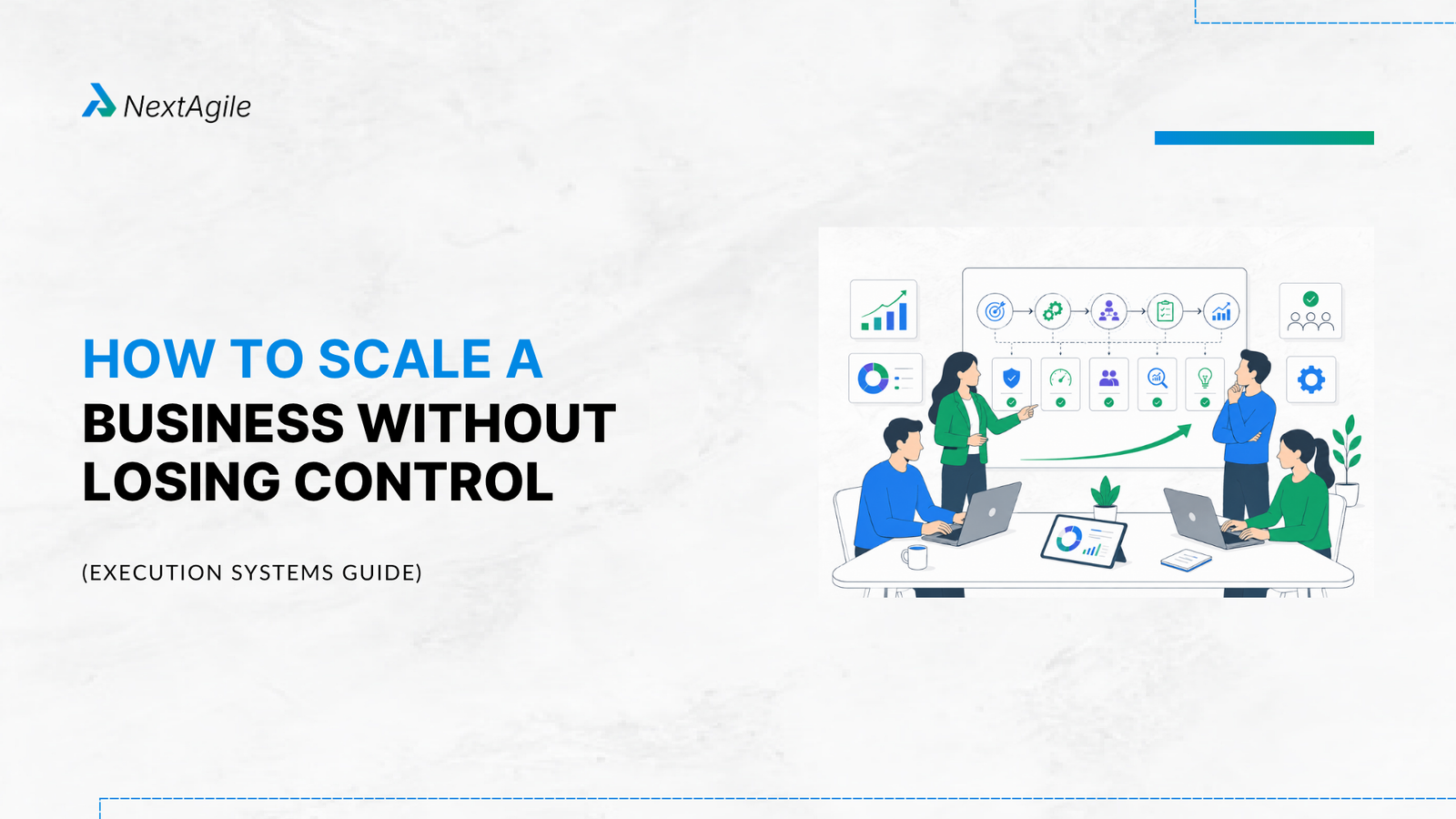
Key Highlights: How to Scale a Business Without Losing Control of Execution Learn why growing businesses lose execution control long before they run out of opportunities. Identify the early warning signs that your execution system is beginning to break. Understand why adding more people rarely solves scaling challenges. Discover practical business scaling strategies that improve ownership, visibility, and decision-making. Learn how operational scalability depends on systems, not heroic leaders. Build an execution system that helps your organisation scale without slowing delivery. Introduction For the first few years, scaling feels simple. You know every customer. Every major decision comes through you. If a project slips, someone walks into your office and tells you.
Then the business grows. More customers arrive. More managers join. New teams are created. The organisation becomes larger and more capable.
Yet something unexpected happens. Projects take longer. Meetings multiply and customers wait longer for decisions.
Leaders spend their day resolving issues instead of building the business.
Most organisations think they have a people problem. They don’t. They have an execution problem. The systems that helped the company reach fifty people rarely support five hundred. Processes become inconsistent. Decisions move more slowly. Ownership becomes unclear. Teams optimise their own work while losing sight of the bigger picture.
This is why many businesses struggle during growth.
Scaling is not simply about hiring more people or increasing revenue. It is about building an execution system that continues to work as complexity increases. Many organisations achieve this by combining Agile consulting services with structured execution frameworks that improve visibility, ownership, and decision-making as the business grows.
This guide explores why execution breaks as businesses grow and the practical changes that help organisations scale without losing speed, accountability, or control.
Why Businesses Lose Control of Execution as They Scale Businesses rarely lose control overnight. It happens gradually.
One additional approval. One new reporting layer. Another management meeting. A few more tools. Each change feels reasonable. Together, they create an organisation where work moves slower than the business itself.
The challenge isn’t growth. The challenge is that the way work is coordinated never evolves with it.
This is one of the biggest reasons organisations invest in Enterprise Agile Transformation , where execution systems evolve alongside organisational growth instead of relying on legacy ways of working.
What Losing Execution Control Actually Looks Like in Growing Companies Execution problems don’t usually appear on financial reports. They appear in everyday operations.
Managers spend most of their time chasing updates. Different departments work towards different priorities. Projects move from one team to another without clear ownership. Customers receive different experiences depending on who handles the work. Leaders find themselves solving operational issues they thought had already been delegated.
Everyone appears busy but only a few people feel productive. These are not isolated issues. They are symptoms of an execution system struggling to support growth.
Early Warning Signs of Execution Breakdown Most businesses ignore the warning signs because they develop slowly.
Watch for these patterns.
Projects regularly miss delivery dates despite teams working overtime. Leaders become involved in decisions they should no longer need to make. The same issues keep resurfacing across different departments. Meetings increase while decision speed decreases. Employees spend more time asking for updates than completing work. Customers notice inconsistent delivery. If several of these issues exist together, your organisation is probably outgrowing its current execution model. A structured Agile Maturity Assessment helps leadership teams identify these execution gaps before they begin affecting customers and business performance.
The earlier you recognise them, the easier they are to fix.
Where Execution Breaks Inside a Scaling Business Most leaders assume execution breaks because people make mistakes. More often, it breaks because work becomes harder to coordinate.
As organisations grow, communication paths multiply. Dependencies increase and decision making becomes slower. Without clear systems, complexity quietly replaces speed.
Work Gets Stuck Between Teams and Functions Individual teams often perform well. The delays happen between them.
Sales finishes its work and waits for Operations Operations waits for Finance Technology waits for Product Nobody feels responsible because every team completed its own part.
The customer, however, only experiences one journey.
One delayed handoff can slow the entire business. Techniques such as Value Stream Mapping Consulting Services help organisations visualise delays and remove unnecessary handoffs across departments.
This is why successful organisations optimise end-to-end execution instead of individual departments.
Decisions Slow Down as Layers Increase Growing companies often add management layers to improve governance. Unfortunately, they also increase waiting time.
Decisions that once took ten minutes now require multiple approvals. Simple customer requests wait days instead of hours. Managers become approval machines instead of business leaders.
The goal should never be more approvals. It should be better decisions made by the right people.
Invisible Dependencies Create Delays One team cannot begin until another finishes. A specialist supports six different departments. Critical information sits with one individual.
These dependencies are rarely visible until deadlines begin slipping. The larger the organisation becomes, the more expensive these hidden dependencies become.
Removing them often improves delivery far more than hiring additional staff.
No Single View of Work Across the Business Ask five department heads how delivery is progressing. You may receive five different answers.
Each team measures success differently Each uses different tools Each reports different priorities Without one shared view of work, leadership spends more time collecting information than making decisions. Execution becomes reactive. Instead of anticipating problems, leaders discover them after customers have already been affected.
Visibility is not about more reporting. It is about giving everyone the same picture of reality.
The Cost of Losing Execution Control While Scaling Execution problems rarely stay operational. Eventually, they become commercial problems.
Delayed projects affect customers Slow decisions reduce competitiveness Poor coordination increases costs Businesses often underestimate how expensive execution friction really is.
Delayed Delivery and Missed Commitments Customers rarely see your internal challenges. They simply notice missed deadlines.
Every delayed delivery reduces trust. Eventually, customers stop asking when the work will be completed. They start looking elsewhere. Consistent execution is one of the biggest competitive advantages a growing business can build.
Quality Issues and Rework Loops When teams work in isolation, quality suffers. Requirements become misunderstood. Information gets lost during handoffs. Problems are discovered late, creating expensive rework.
The cost is rarely just fixing the issue. It includes lost time, delayed delivery, frustrated customers, and distracted teams. Good execution systems prevent problems before they become rework.
Leadership Trapped in Daily Firefighting One of the clearest signs that execution is breaking is the founder or leadership team becoming the bottleneck. Instead of focusing on strategy, leaders spend every day solving operational problems.
Approving decisions Escalating issues Resolving conflicts between teams Answering questions that should already have clear owners The business continues to grow. The leadership team stops scaling. That is rarely sustainable. Leadership teams often struggle because ownership and accountability have not scaled with the organisation.
Reduced Speed of Decision-Making Growing businesses need faster decisions, not more meetings. Unfortunately, many organisations experience the opposite. Every new reporting layer increases delay. Every additional approval slows execution.
Opportunities disappear while organisations wait for consensus. Strong execution systems allow decisions to move closer to the people doing the work. That keeps the business responsive without sacrificing control.
Why Scaling Breaks Execution Systems (Not Just Structure) Many organisations respond to growth by changing the organisation chart.
They introduce new managers Create new departments Redesign reporting lines Sometimes those changes help. Most of the time, they simply move the problem somewhere else. Execution rarely breaks because of structure alone. It breaks because the systems supporting that structure never evolved.
Adding more people is easy. Building a business that continues to execute well as those people grow is much harder.
Many organisations believe execution problems can be solved by introducing another manager or creating another department.
Sometimes that helps. More often, it simply adds another layer between decisions and delivery. Execution doesn’t break because the organisation becomes bigger. It breaks because the systems that supported a 30-person company cannot support a 300-person company.
Headcount Grows Faster Than Processes Most companies scale by hiring. Few scale by improving how work gets done. Every new employee creates more communication, more dependencies, and more decisions.
If the underlying process stays the same, complexity grows much faster than capacity. That is why organisations often feel slower after a hiring spree.
The solution isn’t hiring fewer people. It is building processes that scale with them. Many organisations combine process improvements with Performance Management Consulting to ensure execution metrics, accountability, and operational performance improve together as teams grow.
Informal Knowledge Becomes a Bottleneck In smaller businesses, people know who to ask. The founder remembers every customer. Experienced managers know how every process works.
That approach doesn’t scale.
As new employees join, important knowledge remains inside a few people’s heads. Every question flows back to the same individuals. Soon, the most experienced people become the biggest bottlenecks. Documenting critical execution workflows isn’t bureaucracy. It is how organisations protect themselves from becoming dependent on individuals.
Lack of Ownership Across Execution Layers Growth often creates confusion around ownership. Everyone contributes but nobody feels accountable for the final outcome.
Sales blames Operations Operations blames Technology Technology waits for Product Meanwhile, the customer is still waiting. Scaling requires clear ownership at every stage of execution. Every workflow should have one accountable owner, even when multiple teams contribute.
Ownership speeds up decisions because everyone knows who is responsible for moving work forward.
Organisations also use OKR Consulting Services to align ownership with measurable business outcomes across teams, reducing ambiguity as the business scales.
A Practical Framework to Scale Without Losing Execution Control Most businesses don’t need another transformation programme. They need a better operating system.
The objective is simple. Make it easy for work to move, decisions to happen, and problems to become visible before customers are affected.
Here are five practices that consistently separate organisations that scale smoothly from those that struggle.
Standardize Core Business Processes Not every process needs documentation. Focus on the activities that directly affect customers or revenue.
Customer onboarding Sales handovers Product delivery Incident management Financial approvals These processes should work consistently regardless of who performs them. Standardisation reduces confusion while giving teams enough flexibility to adapt when needed.
Define Clear Ownership for Every Execution Flow One of the fastest ways to improve execution is to remove ambiguity. Every workflow should answer one simple question.
Who owns this outcome?
Ownership doesn’t mean doing all the work. It means making sure the work reaches the finish line.
Clear ownership also strengthens accountability because teams stop assuming someone else will solve the problem.
If ownership is unclear, revisit how accountability is defined across the organisation and strengthen the connection between responsibility and outcomes.
Introduce Visibility into Work and Dependencies You cannot improve work you cannot see. Leaders don’t need more status reports. They need better visibility.
A simple execution dashboard showing work in progress, delivery risks, blocked items, and major dependencies is often enough to improve decision-making dramatically.
The objective isn’t reporting. It is creating one shared version of reality. Many organisations achieve this through an Agile dashboard that makes delivery risks visible before they become business problems.
Create a Decision-Making Structure As organisations grow, decisions naturally become slower not because people lack capability. Because nobody knows who should decide.
Clarify decision rights early Which decisions belong to teams? Which require management approval? Which belong only to executives? When decision rights are clear, work moves faster without sacrificing governance.
Build a Simple Operating Cadence Execution should never depend on crisis meetings. Successful organisations create a predictable rhythm.
Weekly delivery reviews Cross-functional dependency discussions Leadership decisions made on a regular schedule Bottlenecks reviewed before they become escalations. This cadence keeps execution moving without creating unnecessary meetings.
Step-by-Step System to Maintain Execution Control While Scaling Improving execution doesn’t require changing everything at once. Start with the areas creating the biggest friction.
Step 1: Identify the 10 Processes That Break Most Often Every organisation has recurring problem areas.
Late approvals. Customer onboarding. Release planning. Budget sign-offs. Find the processes that create the most delays. Improving these first creates visible results quickly.
Step 2: Document Execution Workflows End-to-End Don’t document departments; document customer flow.
Follow work from the initial request through to delivery. Where does it wait? Where does it return for rework? Where do multiple teams become involved? Seeing the complete workflow often reveals problems no individual department can identify alone.
Step 3: Assign Owners for Each Execution Stream Every important workflow needs one accountable owner.
Not five.
Not a committee.
One person responsible for keeping work moving across teams. That single change removes countless delays during growth.
Step 4: Introduce KPI-Based Visibility Dashboards Leaders should spend less time asking for updates. A simple dashboard should answer the important questions immediately.
What is on track? What is blocked? Where are decisions waiting? Which teams need support? The best dashboards create conversations, not reports.
Step 5: Set Weekly Execution Review Rhythm Execution improves when problems are discussed early.
A weekly review should focus on three questions.
What slowed us down? What decisions are waiting? What needs leadership support? Avoid turning these meetings into lengthy status updates. Their purpose is to remove obstacles.
Step 6: Continuously Remove Bottlenecks Scaling is never complete. Every stage of growth introduces new constraints.
Solve one, and another appears, and that is normal.
Organisations that scale successfully treat execution improvement as an ongoing leadership responsibility rather than a one-time project.
How Strong Execution Systems Keep Scaling Under Control The strongest organisations rarely rely on exceptional individuals. They rely on strong systems. Those systems create consistency regardless of who joins the business.
Role of Delegation in Execution Stability Delegation is often misunderstood. Many managers believe delegation means handing work to someone else. Effective delegation transfers both responsibility and decision-making authority. Leaders who improve feedback and delegation create teams that solve problems independently rather than escalating every issue.
Without decision rights, managers continue becoming bottlenecks.
Building better feedback and delegation practices helps leaders create teams that solve problems independently instead of escalating every issue.
Why Decision Rights Matter More Than Hierarchy Hierarchy defines reporting relationships and decision rights define execution.
When everyone understands who can make which decisions, work accelerates naturally.The objective isn’t fewer leaders. It’s fewer unnecessary approvals.
How Visibility Prevents Operational Chaos Businesses lose control long before they lose performance. The warning signs simply remain hidden.
Good visibility exposes delays early. Dependencies become obvious and risks become visible.
Leadership spends less time reacting because problems are identified while they are still manageable. Visibility doesn’t create bureaucracy. It creates confidence.
Developing stronger leadership skills helps managers make faster, better decisions without increasing organisational complexity.
Common Mistakes When Scaling Without Losing Control Many organisations accidentally create complexity while trying to improve it.
Common mistakes include:
Hiring more managers before fixing broken processes. Delegating work without delegating authority. Measuring activity instead of outcomes. Creating additional approvals after every mistake. Allowing every department to develop its own way of working. Waiting until execution breaks before improving systems. The organisations that scale successfully simplify operations as they grow instead of adding unnecessary complexity.
Metrics to Measure Execution Control at Scale Execution should be measured using outcomes rather than activity.
Focus on a small set of practical indicators.
On-time delivery Decision turnaround time Cross-team dependency delays Work in progress Customer lead time Rework percentage Escalation frequency Together, these metrics provide a clear picture of organisational execution health without overwhelming leaders with unnecessary reporting.
Execution Control Readiness Checklist Before your next growth phase, ask yourself these questions.
Are our most important business processes documented? Does every execution workflow have a clear owner? Can leaders see delivery risks before customers do? Are decision rights clearly defined? Do we review execution every week? Are recurring bottlenecks actively removed? Can the business continue operating effectively without constant executive intervention? If several answers are “no”, your execution system may not be ready for the next stage of growth.
Conclusion Most businesses don’t lose control because they grow too quickly. They lose control because their execution system stops growing with them.
Adding more people, more managers, or more technology rarely fixes that problem. Better execution does.
The organisations that scale successfully build clarity before complexity.
They define ownership They simplify decisions They make work visible They improve the system before adding more people to it Growth should create momentum, not chaos.
The difference is almost always the quality of the execution system behind it.
If your organisation is preparing for its next stage of growth, NextAgile as a leadership consulting company helps leadership teams build practical execution systems that improve alignment, strengthen ownership, and support sustainable business agility. Whether you’re scaling an early-stage business, planning an enterprise Agile transformation, or looking for experienced leadership coaches, we work with organisations to improve execution without adding unnecessary complexity. Reach out to us at consult@nextagile.ai to explore how we can help.
Frequently Asked Questions 1. What is the first sign that execution is breaking in a scaling business? The earliest sign is usually slower decision-making. Projects begin waiting for approvals, leaders become involved in routine operational issues, and delivery becomes less predictable even though the organisation continues to grow.
2. How do you scale execution without increasing management overhead? Build better systems instead of adding more hierarchy. Clear ownership, defined decision rights, consistent operating rhythms, and shared visibility allow organisations to scale while keeping management layers lean.
3. What role does documentation play in maintaining execution control? Documentation creates consistency. It ensures important processes do not depend on individual knowledge and helps new employees become productive much faster.
4. How do high-growth companies prevent execution delays across teams? They standardise critical workflows, clarify ownership, review dependencies regularly, and use shared dashboards to identify risks before they affect delivery.
5. Can execution control be maintained without adding middle management? Yes. Organisations can maintain execution control by improving delegation, defining decision rights, strengthening ownership, and creating better visibility into work instead of relying solely on additional management layers.
6. What tools help maintain execution visibility in growing companies? The specific tool matters less than the visibility it provides. Most organisations benefit from delivery dashboards, workflow management platforms, dependency tracking, and business performance metrics that enable leaders to identify bottlenecks early.
Alok Dimri is the co-founder and leads the overall business at NextAgile, where he is responsible for strategy, client and consultant partnerships, and a whole lot of other core business activities like solutioning, branding, and customer engagement.
Over the past 16 years, he has worked extensively in business strategy, new business development, and key account management initiatives across process consulting and training domains.
 Skip to content