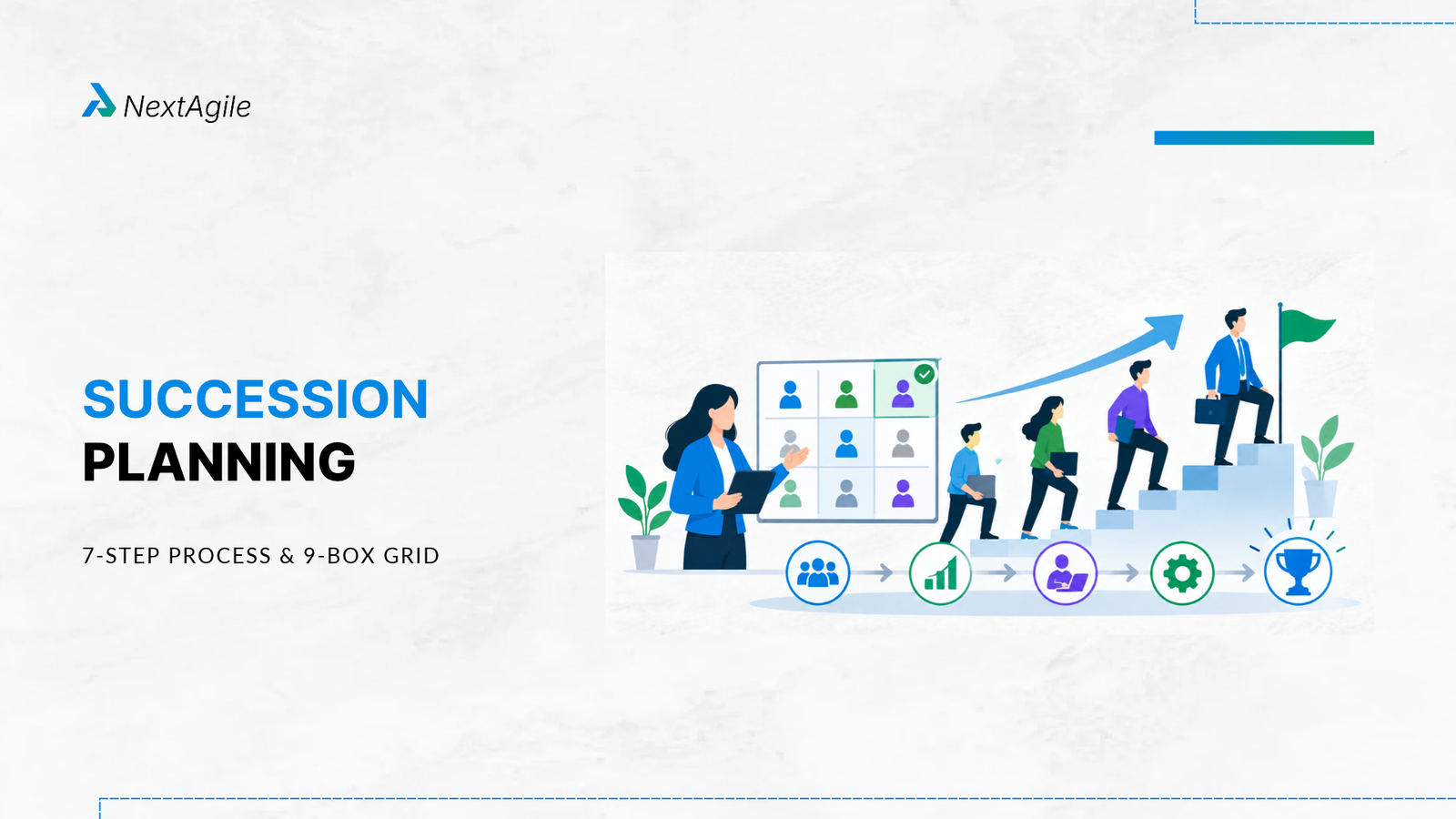
Succession planning is the process of identifying critical business roles, assessing potential successors, and preparing employees to take on greater responsibilities when leadership changes occur. An effective succession planning process combines role criticality, talent assessment, targeted development, and regular readiness reviews.
The 9-box grid helps organizations assess employees based on current performance and future potential. However, a high potential rating does not establish readiness for promotion. Coaching, stretch assignments, acting roles, and measurable business outcomes provide stronger evidence of a person’s ability to handle a larger role.
The objective is to build a leadership pipeline that protects business continuity, reduces dependence on individual decision makers, and prepares the organization for planned and unexpected transitions.
Key Highlights of Succession Planning Succession planning protects business continuity by preparing people for critical roles before vacancies arise. A seven-step succession planning process connects business risk, role requirements, talent assessment, development, and readiness reviews. The 9-box grid helps structure talent discussions but should never become a permanent label or automatic promotion decision. A practical succession planning template records critical roles, successor readiness, capability gaps, development actions, and review dates. Bench strength depends on the availability of credible successors, not the number of employees listed as high potential. Founders-led and family businesses need clear decision rights, governance arrangements, and planned knowledge transfer. CEOs, business leaders, HR, and boards must share responsibility for leadership continuity. Introduction A business can have a strong growth strategy, experienced managers, and a capable leadership team, yet remain vulnerable because too many important decisions depend on a few individuals.
The founder approves every major investment. The sales head owns relationships with the largest customers. The technology leader understands systems that nobody else can maintain. When any one of them leaves, the organization discovers how much of its operating capability was concentrated in a single person.
The cost extends beyond recruitment. Decisions stall, customer relationships become vulnerable, teams escalate routine problems, and strategic commitments slip. Succession planning reduces this exposure by preparing people to maintain execution when critical leadership responsibilities change hands.
The problem is that many companies confuse having a successor’s name on a spreadsheet with having someone who can perform the role. A high-performing manager may have the ambition and ability to grow but still lack the commercial judgement, financial ownership, or cross-functional experience required for the next position. Every leader’s strengths and weaknesses shift as the role grows.
Succession planning closes that gap between potential and demonstrated readiness. It connects talent decisions with business continuity, leadership development , and the organization’s ability to execute its strategy without depending on a handful of people.
What Is Succession Planning? And What It Is Not Succession planning is a structured process for identifying critical roles, assessing potential successors, developing the capabilities those roles require, and maintaining a credible pipeline of people who can assume greater responsibilities.
The process begins with the business, not the employee list. Organizations first determine which positions create the greatest continuity risk, then define what successful performance in those roles will require. Only then should they assess who might be suitable and what development is necessary.
This approach makes succession planning a business responsibility rather than an annual HR exercise. It also creates a practical connection between talent management, leadership development, and organizational resilience.
Succession planning vs replacement planning Replacement planning identifies who can step in when a position becomes vacant. Succession planning goes further by preparing people to assume the role through deliberate development and demonstrated capability.
Replacement planning Succession planning Addresses immediate vacancies Prepares for planned and unexpected transitions Identifies interim coverage Develops credible future successors Focuses on availability Evaluates capability and readiness Activates around a vacancy Operates throughout the year Protects immediate continuity Builds long-term leadership capacity
Both are necessary. If a plant head becomes unavailable tomorrow, the company needs someone authorized to maintain operations immediately. It also needs a longer term plan to determine who can eventually lead the plant independently.
A candidate ready in two years cannot solve tomorrow’s vacancy. Similarly, an interim replacement may keep the business running without being the right person for permanent appointment.
Which roles count as critical? Critical roles are positions whose sudden vacancy could materially affect revenue, customer confidence, delivery, compliance, safety, strategic execution, or specialized knowledge.
Assess each role against four factors: business impact, scarcity of required capabilities, time needed to recruit and onboard a replacement, and concentration of decision authority or institutional knowledge.
Do not limit the list to executive positions. A regional sales head, cybersecurity specialist, finance controller, or manufacturing expert may create substantial business exposure despite having no place on the executive committee.
Prioritize the roles where a vacancy would create the greatest disruption. This gives succession planning a manageable starting point and ensures development resources go where they can reduce the most risk.
Why Leadership Benches Stay Empty in Growing Companies The problem is rarely a complete absence of capable employees. More often, organizations fail to create the conditions in which people can demonstrate their readiness for larger responsibilities.
Managers are rewarded for current delivery, so they retain their strongest employees instead of preparing them for promotion. Senior leaders nominate familiar colleagues, while employees outside visible functions receive fewer opportunities to demonstrate their capabilities.
Training can create another false sense of progress. A manager completes a leadership programme, receives positive feedback, and enters the talent pipeline. Yet nobody has tested whether that person can manage a larger budget, resolve a difficult customer escalation, or make decisions across competing business priorities.
These gaps persist because development is often treated as an individual activity rather than a business commitment. Leaders discuss potential during annual reviews but do not consistently provide the assignments, authority, or feedback required to build readiness.
A stronger succession planning system makes development accountable. It identifies the evidence needed for a future role, creates opportunities to obtain that evidence, and reviews progress against specific business requirements.
The Business Risk of Leaving Critical Roles Uncovered A leadership vacancy creates different kinds of exposure depending on the role. A commercial leader’s departure may threaten key accounts, while the loss of a technical specialist may delay releases or increase operational risk.
Organizations should examine what would happen if a critical leader became unavailable for 30, 60, or 90 days. Which decisions would stop? Which relationships would need immediate transfer? What knowledge exists only in that person’s experience? Who has the authority to manage exceptions?
These questions turn an abstract talent discussion into a concrete risk assessment. They also reveal weaknesses that ordinary organization charts and performance reviews rarely capture.
For example, a company may have strong leadership coverage on paper but discover that the nominated successor cannot approve expenditure, access key customer information, or resolve disputes between functions. The apparent coverage does not translate into operational continuity.
The first objective should be to close immediate coverage gaps. The second is to develop successors who can assume full responsibility over time. Keeping these objectives separate prevents long-term development plans from hiding short-term business risks.
Not every leadership continuity problem can be solved by developing another leader.
Consider an organization where the business unit head personally approves commercial exceptions, resolves resource conflicts, authorizes expenditure, and manages escalations from important customers. Preparing a successor may reduce the risk of that leader leaving, but the organization will remain dependent on whoever occupies the position.
The deeper problem is that too many operational decisions have been concentrated in one role.
A more sustainable intervention may involve delegating routine authority , establishing clearer decision boundaries, improving cross-functional coordination , and building managerial capability below the leadership position.
Succession planning should therefore ask two different questions: Who can perform this role if the incumbent leaves? And which responsibilities should no longer depend on this role in the first place?
The first question builds leadership continuity. The second improves the organization’s operating resilience.
A 7-Step Succession Planning Process An effective succession planning process must answer three questions: which roles cannot remain vacant, who can credibly assume those responsibilities, and what evidence is still missing before they are ready?
The following seven steps create a repeatable approach that connects role requirements, talent decisions, development assignments, and business continuity.
Step 1: Identify critical roles and business risks Start by identifying positions whose absence could disrupt important business outcomes. Consider growth plans, customer concentration, operational dependencies, specialist knowledge, regulatory responsibilities, and the time required to replace the incumbent.
For each role, document the likely consequences of a vacancy and the responsibilities that must continue without interruption. Prioritize roles based on their business impact rather than seniority alone.
The output is a list of critical roles supported by clear business reasons. This keeps the process focused and prevents succession planning from becoming an attempt to nominate a successor for every position.
Step 2: Define future role requirements Determine what each critical role will require over the next two to five years, depending on the business strategy and pace of change. A future business unit head may need financial ownership, commercial judgement, stakeholder influence, and experience managing cross-functional priorities.
Translate these expectations into observable leadership skills and capabilities. Instead of asking whether someone has executive presence , assess whether the person can communicate trade-offs, make decisions with incomplete information, and resolve disagreements between functions.
This creates a consistent standard for assessing candidates. It also prevents organizations from promoting employees simply because they resemble the incumbent or have performed well in their current position.
One of the most common succession planning mistakes is preparing someone to replicate the current leader rather than preparing them for the business’s future needs.
A founder who built a ₹50 crore business through personal relationships, rapid decisions, and hands-on involvement may have been exactly the leader the organization needed at that stage. However, the next phase of growth may require a CEO who can build institutional capabilities, manage professional leadership teams, strengthen governance, and make capital allocation decisions across multiple business units.
The successor therefore needs to be assessed against the responsibilities the role will carry in the future, not simply against the qualities that made the incumbent successful.
Before nominating candidates, leadership teams should ask: If we were designing this role for the next three years rather than replacing its current occupant, what would we expect the person to do differently?
Step 3: Assess internal talent using evidence Identify candidates across functions and locations rather than limiting the search to the incumbent’s immediate team. Assess sustained performance, relevant experience, learning agility, motivation, and demonstrated leadership behavior.
Use multiple sources of evidence, including business outcomes, structured interviews, stakeholder feedback, and performance in unfamiliar assignments. The 9-box grid can help organize the discussion, but it should not replace professional judgement.
Document strengths, development needs, and uncertainties for each candidate. Where leaders disagree, investigate the evidence instead of forcing a consensus around an unsupported rating.
Step 4: Nominate successors and establish readiness Identify plausible successors for each critical role and assign realistic readiness horizons. Common categories include ready now, ready within one to two years, and ready in three or more years.
These horizons are planning estimates, not promotion promises. A candidate may have strong leadership potential but lack experience managing a large budget or making decisions with enterprise-wide consequences.
Record the specific conditions required for readiness. If no internal candidate is credible, acknowledge the gap, establish interim coverage, and consider external recruitment or a longer development horizon.
A succession plan can appear stronger than it really is when the same high-performing individual is nominated as a successor for several critical positions.
Consider a company with five business-critical roles and a successor identified for each. On paper, coverage appears complete. However, if three of those positions depend on the same individual, the organization cannot realistically fill all three vacancies should they arise together.
This is particularly important during rapid expansion, restructuring, or leadership turnover, when several vacancies may emerge within a short period.
Leaders should therefore review succession coverage at two levels: whether each critical role has a credible successor and whether the organization has sufficient distinct, available candidates to absorb multiple leadership transitions.
Bench strength is not simply the number of positions with names against them. It is the organization’s actual capacity to replace critical leadership capability without creating another vulnerability elsewhere.
Readiness should be reassessed when business conditions, role expectations, or candidate circumstances change; it is a time-bound judgement, not a permanent designation.
Step 5: Build individual development plans Translate each readiness gap into a development commitment. Specify the capability to improve, the assignment or intervention required, the accountable sponsor, the review date, and the evidence that will demonstrate progress.
A functional manager preparing for a business unit role might lead a cross-functional initiative, manage a defined budget, and present quarterly results to senior leadership. These experiences test capabilities that ordinary training attendance cannot establish.
Leadership coaching can support improvements in decision-making, stakeholder management, delegation, and behavior under pressure. It should complement practical responsibility rather than replace the experience required for the target role.
Step 6: Test readiness through real assignments Give potential successors opportunities to demonstrate their capabilities through acting roles, major projects, customer negotiations, operational decisions, or transformation initiatives.
Assess outcomes as well as leadership behavior. A candidate who achieves a target by exhausting the team may not be ready for broader responsibility. Someone who sustains delivery, manages trade-offs, and develops others may provide stronger evidence.
Use the findings to update readiness assessments. If an assignment reveals a significant gap, revise the development plan and provide another opportunity to practise the required capability.
A potential successor may perform exceptionally well while the incumbent remains available to resolve difficult decisions. That does not necessarily establish readiness to assume the role independently.
During acting assignments, organizations should examine what happens when the candidate encounters ambiguity, competing priorities, difficult stakeholders, or an unfamiliar business problem without immediate intervention from the current leader.
The purpose is not to expose candidates to unmanaged risk. Decision boundaries, escalation mechanisms, and appropriate safeguards should remain in place. However, the candidate must have enough genuine authority to demonstrate judgement rather than merely execute decisions already made by someone else.
A useful readiness review should distinguish between responsibilities the candidate handled independently, decisions requiring support, and situations where the incumbent had to intervene.
This provides more credible evidence than positive feedback from a stretch assignment alone.
Step 7: Review, update, and activate the plan Review critical roles, successor availability, readiness evidence, and development progress at least annually. High-risk roles and rapidly changing businesses may need quarterly reviews.
Define who can authorize an interim appointment, transfer critical responsibilities, communicate the transition, and manage stakeholder relationships. These arrangements should be clear before a vacancy occurs.
Update the plan when a successor leaves, declines the opportunity, or moves into another role. A credible leadership pipeline must remain functional even when individual candidates become unavailable.
Using the 9 Box Grid Without Turning It Into a Label The 9-box grid is a talent assessment tool that compares current performance with future potential. It helps leadership teams organize talent discussions, identify development needs, and determine where additional assessment is required.
The vertical axis represents performance, usually rated low, moderate, or high. The horizontal axis represents potential, also rated low, moderate, or high. The resulting nine combinations provide a starting point for decisions about development and future responsibilities.
How to interpret the 9-box grid Performance Low potential Moderate potential High potential High Strong specialist or consistent expert Strong contributor with selective development opportunities High performer to assess for broader responsibilities Moderate Clarify expectations and development needs Reliable contributor with targeted development needs Emerging talent requiring stronger performance consistency Low Address performance concerns Diagnose barriers and establish improvement goals Validate potential while addressing performance gaps
These descriptions are illustrative, not universal classifications. Each organization should define potential against the capabilities required for its future leadership roles.
A high-performing employee with limited interest in management may be better suited to a specialist career path. An employee with high potential but inconsistent performance may need clearer expectations and support before being considered for a larger role.
The grid does not establish whether someone can take over a particular position tomorrow. Readiness also depends on experience, motivation, role requirements, and demonstrated capability in relevant situations.
How to prevent bias in 9-box assessments The grid can make subjective judgments appear more objective than they really are. Managers may reward visibility, favour familiar colleagues, or use different standards when assessing potential across departments.
Set clear criteria before the assessment. Use multiple evidence sources, calibrate ratings across functions using a consistent performance management approach, document the reasoning behind placements, and revisit judgments when new evidence emerges.
Most importantly, connect every placement to a decision. What experience does the employee need? Which role might suit their capabilities? What evidence would justify a change in readiness? If the grid cannot inform a meaningful action, the discussion has not achieved enough.
A Practical Succession Planning Example and Template Consider a growing manufacturing company preparing for the departure of its business unit head. The current operations manager consistently meets production targets and is considered a strong potential successor.
However, the role also requires financial ownership, commercial judgement, and the ability to resolve disagreements between sales, operations, and supply chain teams. The manager has not yet demonstrated these capabilities at the required scale.
The company assigns the manager a cross-functional improvement initiative with a defined budget and measurable delivery outcomes. The candidate receives coaching on stakeholder influence and presents progress to the executive team. Readiness is reviewed using financial results, quality performance, decision-making independence, and stakeholder feedback.
The assignment provides evidence that the talent review alone could not. The manager may become ready for the role, need further development, or prove better suited to another leadership position.
Succession planning template Critical role Successor Readiness Development priority Next action Business unit head Operations manager Ready in 1 to 2 years Financial and commercial ownership Lead a budgeted cross-functional initiative Technology head Engineering lead Ready in 3 or more years Enterprise architecture and risk Own a strategic technology review Regional sales head Senior sales manager Ready now, subject to validation Strategic account transition Lead key customer reviews with oversight
This is an illustrative template, not a recommendation to assign readiness without assessment. Add the accountable sponsor, review date, interim coverage arrangement, and evidence required to confirm readiness.
For a smaller company, a spreadsheet with these fields may be sufficient. The value comes from the quality of the decisions and the follow through, not the complexity of the tool.
Development Plans That Prepare Successors A successor becomes credible through demonstrated capability, not repeated inclusion in talent reviews. Development must give the person opportunities to practise the work, receive feedback, and improve under conditions that resemble the target role.
Each plan should identify the target role, the most important readiness gaps, the experiences that will close those gaps, and the measures used to evaluate progress. Completing a leadership course is an activity. Making a sound commercial decision under pressure is evidence, the same distinction the Kirkpatrick model of training evaluation draws between learning and behaviour change.
Coaching and mentoring Coaching helps potential successors examine how they think, decide, communicate, and respond to pressure. Mentoring adds organizational context, stakeholder knowledge, and lessons from experienced leaders.
Both are more effective when connected to live business challenges. A candidate might work on delegation during a major initiative, receive feedback on stakeholder management, and review the outcome with a coach or sponsor.
Organizations can reinforce this development through corporate leadership training programmes that address decision-making, accountability, and leading through change.
Stretch assignments and acting roles Stretch assignments expose successors to responsibilities beyond their current positions. These can include leading cross-functional initiatives, managing a defined budget, negotiating with strategic customers, or presenting business results to senior leaders.
Acting roles provide a more direct test of readiness, provided the individual receives genuine authority and clear decision boundaries. Giving someone an expanded title while retaining every important decision with the incumbent does not test whether they can perform the role.
Evaluate results alongside leadership behaviour. Did delivery improve? Were quality and safety maintained? Could the person make decisions independently? Did the team become more capable?
Metrics to Track Bench Strength Over Time Bench strength measures whether the organization has credible people available to assume critical responsibilities. A long list of high-potential employees does not necessarily indicate strong succession coverage.
Start with a baseline of critical roles, identified successors, readiness horizons, and unresolved development gaps. Track the following measures over time.
Metric Calculation or assessment What it reveals Critical role coverage Roles with at least one identified successor divided by total critical roles Gaps in successor identification Ready now coverage Roles with at least one ready now successor divided by total critical roles Immediate leadership continuity Successor depth Number of credible successors per critical role Dependence on one candidate Internal fill rate Relevant leadership vacancies filled internally divided by total relevant vacancies Internal talent progression Development milestone completion Completed milestones divided by planned milestones Follow through on development Successor retention Identified successors retained over a defined period Stability of the talent pipeline Transition effectiveness Performance against agreed outcomes after appointment Whether readiness assessments predicted performance
For example, a company with 20 critical roles and at least one identified successor for 15 roles has 75 percent critical role coverage. If only eight roles have a ready now successor, ready now coverage is 40 percent.
These results reveal two different conditions. The company has identified potential successors for most critical roles, but immediate coverage remains limited. Management should prioritize interim arrangements, validate the most credible candidates, and close urgent readiness gaps.
Targets should reflect business risk rather than arbitrary benchmarks. Many HR teams track succession coverage and readiness as HR OKRs . Review metrics alongside actual performance evidence, because a high internal promotion rate does not automatically mean that appointments are successful.
Succession planning should not be considered successful simply because an internal candidate was appointed.
A leadership transition may look successful initially while important problems emerge several months later. Decision-making may slow, experienced employees may leave, customer relationships may weaken, or the new leader may struggle to establish authority across functions.
Organizations should therefore review transition effectiveness after appointment, using business outcomes appropriate to the role. These may include continuity of customer commitments, operational performance, team stability, decision turnaround, and progress against strategic priorities.
The assessment should also consider the conditions provided to the new leader. Poor transition results do not always mean the successor was wrongly selected; unclear authority, insufficient knowledge transfer, or contradictory expectations may have undermined an otherwise capable appointment.
This closes the loop between succession assessment and actual leadership performance, helping the organization improve future readiness decisions.
Leadership Continuity in Indian Founder-Led and Family Businesses In founder-led and family-owned businesses, succession planning often involves more than transferring a job title. Authority, customer trust, institutional knowledge, ownership, and decision making may all be concentrated in a small group of people.
A founder may have built the company through personal relationships and rapid decisions. Even after appointing a successor, employees may continue seeking the founder’s approval for budgets, hiring, and customer commitments. The new leader carries responsibility without having the authority to exercise it.
Separate ownership, governance, and executive responsibility The next family owner is not automatically the best person to become CEO. Family members may hold ownership rights while professional managers have the capabilities required to run the business.
Succession planning should clarify the distinction between ownership, board oversight, and executive responsibility. It should also define how successors are evaluated, who approves appointments, and how disagreements will be resolved.
The appropriate arrangements depend on the company’s ownership structure and governance requirements. However, leaving these responsibilities unclear can weaken the transition and create avoidable conflict.
Reduce founder dependency Founder dependency becomes a succession risk when critical decisions, relationships, and problem-solving remain concentrated in one person. Appointing a deputy does not resolve the problem if all meaningful authority remains with the founder.
The business must gradually transfer decision rights, document essential knowledge, develop leaders who can handle exceptions, and establish systems that work without constant intervention. This connects succession planning with reducing founder dependency in day-to-day operations.
Strengthening middle management is equally important. If every decision still requires executive approval, even a capable new CEO will inherit an organization that struggles to execute independently. Clear decision rights and accountable managers create the operating capacity required for a sustainable transition. Organizations can build this capability by strengthening middle management .
Conclusion A leadership bench is only as strong as the decisions the organization can make without its most important people. If a critical departure would stop approvals, disrupt customer relationships, or leave teams waiting for direction, the succession risk already exists.
The seven-step succession planning process helps organizations identify those dependencies, assess potential successors, and close capability gaps before a vacancy becomes urgent. The 9 box grid supports the assessment, while development assignments and readiness reviews establish whether people can perform the required responsibilities.
The real measure of success is not how many names appear on a succession chart. It is whether the business can maintain execution, transfer authority, and develop capable leaders as its needs change.
If your business depends heavily on a few key leaders and lacks ready successors for critical roles, a structured succession planning process becomes essential. NextAgile consulting can help you build leadership capability, strengthen your talent pipeline, and implement a practical leadership development roadmap aligned with your business goals. Reach out to us at c onsult@nextagile.ai to explore how we can help your organization prepare for leadership transitions with confidence.
Prepare your next leaders before you need them. NextAgile’s Leadership Coaching Programs help potential successors build the judgement, decision-making and stakeholder skills critical roles demand. Talk to our team about your leadership bench.
Frequently Asked Questions 1. How many years ahead should a company start planning for a CEO change? Begin planned CEO succession several years before an anticipated transition, often three to five years when internal candidates need substantial development. Maintain an emergency succession arrangement at all times because unexpected departures can occur regardless of the planned timeline.
2. Who owns the plan: the CEO, the board or HR? The board typically oversees CEO succession, a role explored in Harvard’s corporate governance forum on CEO succession planning , while the CEO and executive team develop successors across the business. HR coordinates assessments and development processes. Business leaders remain accountable for creating opportunities that prepare candidates for larger responsibilities.
3. Should employees be told they are on a successor list? Communicate development opportunities and readiness expectations transparently, but do not present inclusion on a successor list as a guaranteed promotion. Succession assessments can change as business needs evolve and employees demonstrate new capabilities.
4. How many successors should each critical role have? Aim for at least one credible ready now option for the most critical roles where feasible, supported by additional candidates at different readiness stages. The required depth depends on business impact, recruitment difficulty, and the consequences of an unexpected vacancy.
5. How can a 200 person company do this without a large HR team? Start with the most business critical roles, document role requirements, assess potential successors, and assign development actions with clear owners and review dates. A simple succession planning template and quarterly reviews can make the process manageable without a large HR function.
6. What happens if the named successor leaves the company? Reassess the affected role immediately, activate interim coverage, and evaluate remaining candidates against the role requirements. Update development plans and consider external recruitment if internal readiness is insufficient. A succession plan must maintain a pipeline rather than depend on one individual.
Anuj Ojha is Co-Founder & Consulting Head at NextAgile. Anuj has designed & led multiple turnkey transformation journeys across industries, domains & geographies and has 16+ years of experience as an agile practitioner. He has worked with CXOs, CTOs & Key Leaders to translate their business objectives on the ground, contextualizing org transformations and creating buy-in across level, leading a team of coaches/consultants to implement agility across 150+ teams & trained more than 12k team members. Anuj’s core area of interest is business agility & working with leaders & teams to achieve long term sustainable, Agile culture & mindset.
 Skip to content