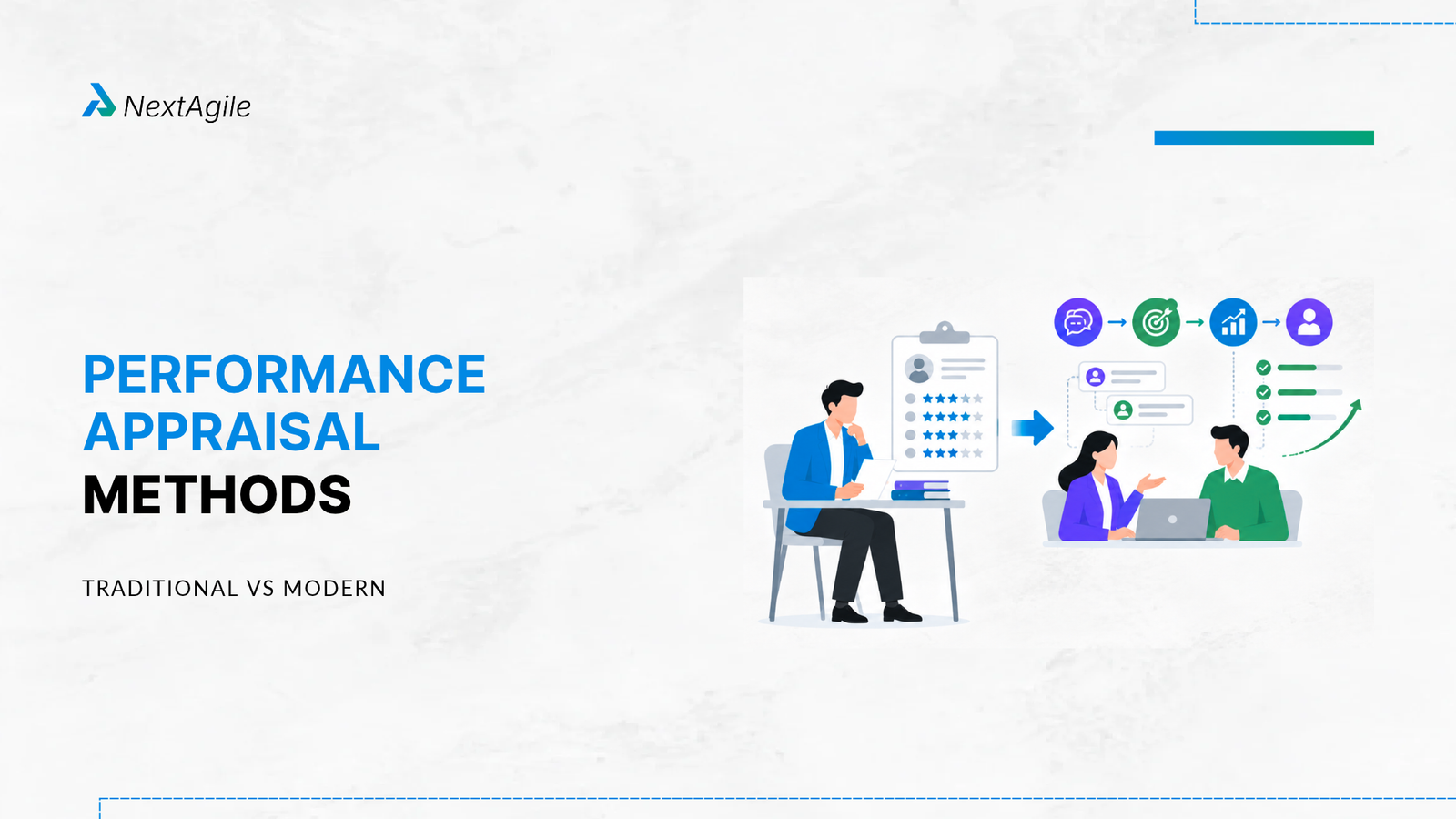
Quick Answer Performance appraisal methods help organisations evaluate employee contributions against defined expectations. Traditional methods such as rating scales, ranking, checklists and forced distribution offer structure, while modern methods such as 360 degree feedback, behaviourally anchored rating scales and OKR-linked reviews provide richer evidence about outcomes, behaviours and development needs.
There is no single best method for every role. The right choice depends on what the organisation needs to assess, the evidence available, the nature of the work and how appraisal results will be used. Many organisations get better results by combining methods instead of relying on one rating or score.
Key Highlights Choose an appraisal method based on the decision you need to make, not its popularity or perceived sophistication. Use measurable outcomes to assess results and role-specific behavioural evidence to understand how those results were achieved. Combine methods when one source of evidence cannot provide a complete view of performance. Reduce rating bias through clear criteria, documented examples, manager calibration and employee discussion. Treat appraisals as part of an ongoing performance management process, not as a once-a-year administrative exercise. Introduction An employee delivers projects on time, supports colleagues and handles difficult customer conversations. Another employee closes more tasks but leaves behind recurring defects and unresolved complaints. If both are assessed using the same narrow productivity measure, the appraisal may reward the wrong contribution.
This is where performance appraisal methods matter. They influence what managers notice, which evidence counts and how employees understand good performance. A method that works well for a sales role may be inadequate for a software engineer, a team leader or a specialist whose contribution depends on collaboration.
The objective is not to find the most sophisticated appraisal model. It is to build a process that makes performance expectations clear, supports fairer decisions and gives employees useful direction for improvement. That requires choosing suitable methods, applying them consistently and connecting ratings to a meaningful follow-up process.
What Performance Appraisal Really Measures (And What It Does Not) A performance appraisal is a structured assessment of an employee’s contribution over a defined period. Depending on the role, it may consider results, work quality, behaviours, role responsibilities and progress against agreed goals. The assessment should use expectations that employees understand before the review takes place.
An appraisal does not automatically reveal an employee’s full potential, explain every business outcome or measure the quality of their manager. Results may be affected by workload, market conditions, team dependencies, changing priorities and access to resources. A sound process considers these factors rather than treating every outcome as an individual achievement or failure.
Appraisal vs performance management Dimension Performance appraisal Performance management Primary purpose Evaluate contribution over a defined period Guide performance and improvement continuously Typical frequency Often quarterly, half-yearly or annually Ongoing, with regular check-ins Main activities Review evidence, assess performance and discuss ratings Set expectations, monitor progress, coach and remove obstacles Time orientation Reviews past performance and identifies future needs Connects past results with current execution and future goals Output Assessment, feedback and development priorities Agreed goals, support actions and course corrections Relationship One part of the wider system The broader process that includes appraisals
A rating can summarise performance, but it cannot replace the conversations that shape it. If managers wait until the end of the year to raise concerns, employees lose the opportunity to correct course while the work is happening.
Organisations should therefore design appraisal as one checkpoint in a broader performance management system. Clear goals, regular feedback, coaching and documented evidence make the formal review more useful and reduce dependence on a manager’s memory.
An organization can have employees who consistently meet their performance targets while the business continues to struggle with customer satisfaction, delivery delays, or operational inefficiency.
Consider a software company where developers are rewarded for completing assigned work, testers for identifying defects, and project managers for meeting committed delivery dates. Each function may achieve its individual targets while customers experience delayed releases, recurring rework, and slow resolution of important problems.
The issue may not be employee capability. It may be that the performance system rewards local achievements without adequately considering the outcomes those functions are expected to create together.
This is why leaders should examine whether appraisal criteria encourage collaboration across dependencies, responsible decision-making, and contribution to shared business outcomes.
A performance management system should not merely explain who performed well. It should help the organization understand whether the behaviours it rewards are producing the results the business needs.
Output, behaviour and potential: Related but Different Assessments Performance appraisal primarily examines contribution against current role expectations. Potential assessment asks a different question: whether an employee may be capable of succeeding in a future role with different responsibilities. Organizations can discuss both during talent reviews, but should avoid combining them into one unexplained performance score.
Output measures what an employee delivered. Examples include revenue generated, defects resolved, projects completed against agreed criteria or customer issues closed within a service target. Output measures need context because quantity alone may hide quality problems or work that has been shifted to another team.
Behaviour measures how work was carried out. Depending on the role, this may include collaboration, customer communication, safety practices, decision-making or knowledge sharing. Behavioural expectations should be observable and relevant to the job, rather than based on vague labels such as attitude or cultural fit.
Potential concerns an employee’s capacity to take on broader responsibilities in the future. It should not be confused with current performance or treated as a guarantee of promotion. Organisations should assess potential through relevant evidence, structured development opportunities and role-related capabilities, not simply through visibility or a manager’s personal preference.
Traditional Appraisal Methods and Where They Still Work Traditional methods remain useful when the organisation needs a consistent structure, a manageable review process or comparable assessments across employees doing similar work. Their limitations usually appear when managers apply them without clear criteria or treat a simple score as a complete explanation of performance.
1. Ranking method Ranking places employees in order from strongest to weakest performance within a defined group. It can help distinguish relative contribution when employees perform similar work and the organisation has credible evidence to compare them.
The main risk is that ranking forces a relative judgement even when several employees meet expectations equally well. It can also create competition, discourage knowledge sharing and confuse team results with individual contribution. Use ranking cautiously, and avoid comparing employees whose responsibilities, goals or working conditions differ significantly.
2. Graphic rating scale A graphic rating scale scores employees against defined factors such as quality, reliability, role knowledge or communication. Each factor uses a rating range, often with descriptions of what different performance levels mean. The format is easy to administer and can support organisation-wide consistency.
Its value depends on the quality of the criteria. A scale that asks managers to rate employees on broad traits without behavioural definitions invites subjective judgement. Before introducing a rating scale, define what each level looks like in practice and require examples to support ratings that materially affect pay, promotion or development.
3. Checklist method A checklist asks whether an employee has demonstrated specified actions, responsibilities or behaviours. It is practical for roles with established procedures, recurring responsibilities or compliance requirements.
A checklist is less useful when it treats every item as equally important. Completing routine tasks does not necessarily demonstrate strong judgement, quality or impact. Use it as evidence of required responsibilities, then pair it with outcome measures or a manager discussion where the role demands more than procedural completion.
4. Critical incident method Managers document specific examples of effective or ineffective work throughout the review period. These incidents may include how an employee handled a service failure, resolved a complex issue, supported a colleague or responded to a serious risk.
The method creates more useful evidence than relying on memory at year end. However, managers may record dramatic events while overlooking consistent everyday contributions. Set a simple documentation rhythm and capture both effective and ineffective examples against agreed role expectations.
5. Forced distribution method Forced distribution places employees into predetermined performance categories, sometimes following a bell-shaped curve. It is intended to differentiate performance and can appear attractive when leaders believe managers rate everyone too highly.
The difficulty is that a predetermined distribution assumes a particular spread of performance regardless of the evidence. A strong team may contain many employees who meet or exceed expectations, while a struggling team may have few who do. Forced distribution can distort ratings when category quotas override actual contribution.
Use evidence-based calibration to compare the quality and consistency of assessments instead of requiring a fixed percentage of employees to receive each rating. If an organisation retains forced distribution, leaders should understand its effect on trust, collaboration, reward decisions and the accuracy of performance records.
Modern Appraisal Methods Built for Today’s Teams Modern methods are not automatically fairer than traditional ones. They can produce better insight when the organisation defines the purpose of the assessment, trains reviewers and gathers evidence from appropriate sources. Without those safeguards, additional feedback and more complex frameworks can create more noise rather than better decisions.
360 degree feedback 360 degree feedback gathers input from several perspectives, commonly including a manager, peers, direct reports and the employee. It is particularly useful when collaboration, leadership, communication or influence across teams forms a meaningful part of the role.
Its strength is the range of perspectives. A manager may see delivery and planning, while peers experience the employee’s responsiveness and direct reports observe how feedback and delegation happen in practice. Differences between these perspectives can reveal development needs that a single reviewer may miss.
The process can become a popularity vote if respondents rate personal relationships instead of observable behaviour. Keep questions specific, protect confidentiality where appropriate, seek feedback from people who have worked closely with the employee and interpret patterns rather than reacting to one unusually high or low score. For high-stakes decisions, use 360 feedback alongside other evidence instead of treating it as a standalone verdict.
Behaviourally anchored rating scale A behaviourally anchored rating scale, commonly called BARS, defines performance levels through examples of observable behaviour. Instead of asking whether an employee communicates well, a scale might distinguish between sharing updates only when prompted, providing timely updates on risks and dependencies, and anticipating communication needs across teams.
This approach helps managers discuss performance in more concrete terms. It is especially useful where behaviour affects quality, safety, leadership or service delivery but is difficult to capture through a simple numerical target.
BARS takes work to build and maintain. The behaviours must reflect the role, and employees and managers need to understand the anchors before the review cycle starts. If the descriptions are vague, outdated or disconnected from real work, the scale simply gives subjective judgement a more formal appearance.
Management by objectives and OKR-linked reviews Management by objectives assesses performance against goals agreed between an employee and manager. OKR-linked reviews use Objectives and Key Results to connect individual or team contributions with measurable outcomes. Both approaches can improve clarity when goals are relevant, understood and within the employee’s sphere of influence.
For example, a customer success team may set an objective to improve customer retention, supported by key results on renewal rates and early risk identification. An appraisal can consider the employee’s contribution to those results alongside account complexity, customer circumstances, collaboration and the quality of their decisions.
A target score should not become the entire appraisal. Employees may miss a result because of factors outside their control or hit a target through actions that damage quality or customer trust. Review both outcomes and the evidence behind them. For more context, explore how OKRs strengthen performance management and the distinction between OKR vs KRA .
Assessment centre method Assessment centres use structured exercises such as simulations, presentations, case studies or role plays to evaluate capabilities relevant to a position. They are most useful for leadership development , succession planning and roles where future responsibilities require skills that may not be visible in current output alone.
They can provide richer evidence than an informal discussion, but they require time, trained assessors and consistent scoring criteria. An assessment centre should complement performance history and development evidence, not replace them or guarantee that an employee will succeed in a future role.
Self-assessment method Self-assessment asks employees to review their own achievements, challenges, learning and priorities before the formal discussion. It encourages preparation and gives employees a chance to explain the context behind their results.
The difference between an employee’s self-rating and a manager’s assessment can be useful diagnostic information. An employee who rates their performance highly while the manager rates it lower may be working to different expectations or may lack visibility into quality concerns. The reverse can indicate that the employee is overlooking meaningful contributions or applying stricter standards to themselves.
The purpose is not to accept either rating automatically. Compare both assessments against the same criteria and evidence, then discuss where expectations or interpretations differ.
Performance Appraisal Methods: Side-by-Side Comparison Table The following table compares ten common methods by purpose, evidence, effort and the decisions they can support. Implementation effort varies with organisation size, role complexity and the quality of existing performance data.
Method Best suited for Evidence required Implementation effort Main caution Ranking Comparing similar roles Comparable outcomes and role expectations Low to medium Forces relative differences Graphic rating scale Consistent reviews across teams Defined criteria and rating descriptions Low to medium Vague criteria encourage bias Checklist Routine responsibilities and compliance Records of completed duties or behaviours Low Can overvalue task completion Critical incident Understanding specific work behaviours Dated examples linked to expectations Medium Managers may record selectively Forced distribution Differentiating employees within a group Comparable performance evidence and clear categories Medium Quotas may override actual performance 360 degree feedback Collaboration and leadership Relevant feedback from multiple observers Medium to high Vulnerable to popularity bias BARS Role-specific behavioural assessment Observable behaviour anchors for each rating level High initially Requires careful design and maintenance MBO or OKR-linked review Goal achievement and strategic contribution Agreed goals, results and contextual evidence Medium to high Target achievement can overshadow quality Assessment centre Promotion readiness and development Structured exercises and assessor observations High Costly and dependent on design quality Self-assessment Reflection and review preparation Employee examples, results and learning Low Perception may differ from other evidence
The table is a starting point, not a ranking of which method is best. A method is suitable when its evidence answers the question being asked. A rating scale can provide consistency but may not reveal how a leader influences peers; 360 feedback may reveal that influence but cannot by itself establish whether business targets were achieved.
Most organisations need a small, deliberate combination. Choose one method to assess core results, add a behavioural method where how work gets done matters, and use development-focused evidence when considering future responsibilities. Avoid adding methods unless they improve a real decision.
How to Choose a Method by Role, Team Size and Culture Start with the decision the appraisal must support. Is the organisation assessing achievement against goals, consistency of service, leadership behaviour, readiness for promotion or development needs? These are different questions, and no single method answers all of them equally well.
Appraisal need Practical combination Why it fits Sales or revenue roles Goal-based review plus quality and customer measures Balances commercial results with sustainable customer outcomes Software and IT teams Delivery and quality evidence plus role-specific behaviours Avoids rewarding task volume while ignoring defects, maintainability or collaboration People managers Goal-based review plus 360 feedback or BARS Examines both team outcomes and observable leadership behaviour Operations and compliance Checklist plus quality, safety or service measures Covers required procedures and the reliability of results Promotion readiness Performance history plus structured assessment exercises Separates current contribution from capabilities needed in a larger role Small organisations Simple rating scale plus documented examples and regular conversations Keeps administration manageable while preserving evidence Large, multi-team organisations Common criteria, calibrated ratings and selected role-specific methods Improves consistency without pretending every role is identical
Team size matters because a process that depends on many reviewers, complex surveys and long calibration meetings may be difficult to sustain in a small organisation. Larger organisations need consistent definitions and governance, but excessive standardisation can make the framework irrelevant to specialist roles.
Culture matters too. Where managers have little experience giving feedback, begin with clear expectations, examples and manager training before introducing a complex model. Where teams already use regular goal reviews, connect those conversations to formal appraisal rather than building a separate process that duplicates the same information.
Worked example: choosing a method for a software engineer Imagine an engineer who delivers most planned work on schedule but whose releases generate recurring defects. Peers appreciate their technical knowledge, while the manager believes the engineer needs to communicate risks earlier. A task-count rating alone would give an incomplete picture.
A more balanced appraisal would review agreed delivery outcomes, escaped defects or rework, documented examples of technical decisions and peer feedback on collaboration. A BARS-style scale could clarify what proactive risk communication looks like at different levels. The manager and employee would then agree on a specific improvement goal and review progress during regular check-ins.
This combination makes the decision more persuasive because each source of evidence answers a different question. Delivery measures show what was completed, quality measures show how well it worked, and behavioural evidence helps explain how the employee contributes to the wider team.
Running the Appraisal Process Without Rater Bias Bias cannot be removed simply by introducing a standard form or a rating scale. It must be managed through the design of the process, the quality of evidence and the way managers discuss differences. The goal is to make assessments more consistent and explainable, not to claim that every judgement becomes perfectly objective.
A practical appraisal process has six steps:
Define role expectations and performance criteria before the review period begins. Collect evidence throughout the period, including results, quality, behaviours and significant changes in responsibilities. Ask employees to prepare a self-assessment using the same criteria. Have managers evaluate evidence before discussing final ratings with peers or leadership. Calibrate comparable cases and investigate unusual rating differences. Hold the appraisal conversation, record agreed actions and schedule follow-up. Calibration should test the reasoning behind a rating rather than force managers toward a predetermined distribution. When two employees receive different ratings for similar work, reviewers should compare their goals, the evidence available, the difficulty of assignments and the standards applied. A difference may be justified, but the reason should be clear.
Use practical safeguards against common biases. Ask managers to record examples from across the review period, not just recent events. Separate evidence from impressions, and avoid treating confidence, visibility, long working hours or personal similarity as proof of performance. Give employees an opportunity to correct factual errors and explain relevant context before a rating is finalised.
Where ratings affect pay or promotion, document the criteria and decision rationale carefully. Monitor patterns across teams and groups to identify unexplained differences, while respecting privacy and applicable employment requirements. If the organisation cannot explain how a rating was reached, it should revisit the evidence before relying on that rating for a high-stakes decision.
Calibration meetings are intended to improve consistency, but they can become counterproductive when leaders focus more on achieving an acceptable distribution of ratings than on examining the evidence behind them.
A manager may arrive with a well-supported assessment, only to be asked to lower it because too many employees in the department received high ratings. Another manager may successfully defend an assessment through seniority or influence rather than stronger evidence.
Neither outcome improves fairness.
A useful calibration discussion should examine whether employees were assessed against comparable expectations, whether the evidence supports the rating, and whether contextual differences justify different conclusions.
Where evidence is insufficient, the appropriate response may be to defer a high-stakes judgement or gather additional information rather than force agreement.
The objective is not unanimous ratings. It is a decision-making process that can explain why different employees received different assessments.
From Annual Reviews to Continuous Performance Conversations Annual appraisals often fail when they are expected to capture an entire year from memory. Employees may receive feedback too late to act on it, while managers may place disproportionate weight on recent achievements or mistakes. Regular conversations reduce this gap by making feedback part of the work rather than a separate event.
A workable rhythm does not require lengthy weekly meetings for every employee. Teams can use short check-ins to discuss progress against goals, risks, support needed and changes in priorities. Monthly or quarterly conversations can examine trends, development and whether the agreed goals remain relevant. The formal appraisal then summarises evidence already discussed instead of introducing unexpected criticism.
Continuous performance management also helps managers distinguish between a performance issue and a system issue. If several employees miss the same target because approvals are delayed or priorities keep changing, the organisation should address the operating conditions rather than treat each miss as an individual failure.
Connect goals, check-ins, feedback and formal review records so that employees do not have to reconstruct their work at the end of the cycle. If your organisation is reviewing its broader approach, use the performance readiness checklist to assess whether expectations, feedback practices and review processes are in place before changing the appraisal model.
Appraisal Trends in Indian Companies: Moving Beyond the Bell Curve The bell curve remains part of the discussion about performance appraisal in Indian companies, especially when leaders consider how to differentiate employees and distribute rewards. However, it is important not to assume that all large employers use forced distribution or that every organisation is moving away from it at the same pace. Practices differ by sector, company size, leadership philosophy and reward policy.
The central issue is not whether a bell curve is traditional or modern. It is whether the rating distribution reflects credible performance evidence. If a team has several employees who consistently exceed well-defined expectations, a fixed quota may understate their contribution. If standards are unclear, abandoning the curve will not automatically make ratings fair.
A more defensible approach is evidence-based calibration. Managers compare employees doing comparable work, review the standards applied, check whether goals and resources were similar, and document why ratings differ. Leaders should also distinguish performance ratings from pay decisions. Salary budgets, market adjustments, internal equity and promotion policies may affect compensation, but they should not be disguised as evidence about an employee’s performance.
For Indian organisations with distributed teams or multiple business units, consistent criteria and manager capability are particularly important. Standardise the principles and review process, then allow role-specific measures where the work genuinely differs. The aim is comparable judgement, not identical scoring regardless of context.
Conclusion The best performance appraisal methods are those that help an organisation make better decisions about contribution, development and future responsibilities. Traditional methods can provide structure, while modern methods can add behavioural insight, multiple perspectives and clearer links to business outcomes. Neither category guarantees fairness without sound criteria and disciplined implementation.
Start by defining what the organisation needs to assess. Select methods that fit the role, use evidence that can support the judgement, and give managers a consistent process for discussing differences. Then connect formal ratings to regular feedback and practical development actions.
If unclear expectations, inconsistent ratings or disconnected reviews are weakening performance conversations, it may be time to redesign your performance management system . NextAgile can help your organisation connect goals, review practices, manager capability and follow-through into a more practical performance management approach. Contact consult@nextagile.ai to explore how to build a system that supports both accountability and employee development.
Frequently Asked Questions 1. Which appraisal method works best for IT and software teams? A combination of delivery and quality measures, role-specific behavioural criteria and regular manager conversations is usually more useful than task counts alone. Teams can assess delivery against agreed goals, defect patterns, reliability, collaboration and communication of risks. Peer feedback or BARS can add context where technical work depends on teamwork, review quality or mentoring.
The method should reflect the engineer’s actual responsibilities. A senior engineer, a support specialist and a delivery manager contribute in different ways, so applying identical criteria to all three may create misleading comparisons.
2. Is bell curve rating still used by large Indian employers? Some organisations may continue to use bell curve or forced distribution approaches, while others use rating frameworks based on defined performance standards and calibration. It is not accurate to assume that every large Indian employer follows the same model.
The more useful question is whether the organisation’s ratings reflect actual performance. A fixed distribution can force artificial differences, while a poorly designed alternative can still produce inconsistent judgements. Review the evidence, rating rules and reward policy before deciding whether the model should change.
3. Can you combine two appraisal methods in one review cycle? Yes. Combining methods is often appropriate when each one answers a different question. A manager might use goal-based assessment for outcomes, BARS for critical behaviours and 360 degree feedback for leadership or collaboration.
The combination should remain manageable and purposeful. Define which evidence informs each decision, explain the process to employees and avoid counting the same behaviour several times under different criteria. More methods do not automatically mean a better appraisal.
4. How often should formal appraisals happen if you run monthly check-ins? Monthly check-ins can support a formal quarterly, half-yearly or annual appraisal, depending on the organisation’s work cycle and decision needs. Check-ins focus on progress, obstacles, feedback and changing priorities, while a formal appraisal consolidates evidence and evaluates contribution against agreed expectations.
The important factor is continuity. Formal reviews should not introduce major concerns that employees have never heard before, except where a serious incident requires immediate action. Regular conversations make the final assessment more accurate and useful.
5. How do you stop 360 feedback from turning into a popularity vote? Use behaviour-specific questions, select respondents who have directly observed the employee’s work and explain what the feedback will be used for. Protect confidentiality where appropriate and avoid treating a single comment as conclusive evidence. Look for patterns across respondents and compare them with other relevant information.
Managers should also distinguish constructive disagreement from personal dislike. If feedback conflicts sharply across groups, investigate the context before drawing a conclusion. For high-stakes decisions, use 360 feedback as one input rather than the sole basis for a rating or promotion.
6. Should appraisal ratings be directly linked to salary increments? There is no universal rule. Some organisations link ratings to compensation decisions, while others separate performance discussions from pay reviews to encourage more open conversations about development. The right policy depends on the organisation’s reward philosophy, governance and ability to explain decisions consistently.
If ratings influence increments, employees should understand the criteria and how the process works. Managers should distinguish performance evidence from factors such as market corrections, salary bands, budget limits and internal equity. A rating should not be changed merely to fit a predetermined pay outcome.
7.Can an employee receive a poor appraisal because of problems outside their control?
An employee’s results can be affected by factors such as changing priorities, resource shortages, delayed approvals, team dependencies, or market conditions. A fair appraisal should examine these factors alongside the employee’s decisions, behaviour, and contribution.
This does not mean employees are exempt from accountability whenever circumstances are difficult. It means managers should distinguish between what the employee could reasonably influence and what required organizational intervention. The purpose is to reach a defensible assessment and identify the right improvement action.
Anuj Ojha is Co-Founder & Consulting Head at NextAgile. Anuj has designed & led multiple turnkey transformation journeys across industries, domains & geographies and has 16+ years of experience as an agile practitioner. He has worked with CXOs, CTOs & Key Leaders to translate their business objectives on the ground, contextualizing org transformations and creating buy-in across level, leading a team of coaches/consultants to implement agility across 150+ teams & trained more than 12k team members. Anuj’s core area of interest is business agility & working with leaders & teams to achieve long term sustainable, Agile culture & mindset.
 Skip to content