Introduction
At senior levels, personal effectiveness at work stops being about productivity, and most leaders don’t realize when that shift happens.
What worked before:
- Speed
- Ownership
- Execution intensity
Stops working at scale. Yet many leaders double down on the same behaviors.
The result is predictable:
- Full calendars, low clarity
- Faster activity, slower outcomes
- Strong effort, weak leverage
This is the personal effectiveness trap.
Because at senior levels, effectiveness is no longer about: How much you get done?
It is about: What actually moves because of you?
And that requires a fundamentally different operating model.
Personal effectiveness at senior levels is not constrained by time. It is constrained by where attention is placed and how decisions are shaped.
What Personal Effectiveness at Work Really Means at Senior Levels?
Personal effectiveness at work at senior levels is the ability to create disproportionate impact through focus, decisions, and influence, not effort.
Impact is created through leverage, not effort.
It scales through:
- Decisions that unlock movement
- Teams that operate with clarity
- Systems that sustain execution
Why does the definition change after promotion?
Early in your career:
- You are rewarded for output
- Effort directly correlates with results
At senior levels:
- Your value is mediated through others
- Outcomes are delayed and indirect
- Decisions carry system-wide consequences
The feedback loop becomes delayed and distorted. Which means:
- Poor decisions take longer to surface
- Ineffectiveness is harder to detect
- Course correction happens later than required
This transition quietly derails high performers because the behaviors that made them successful start limiting their scale, often without immediate failure signals.
Success patterns become scale constraints. What once accelerated performance:
- Direct involvement
- Rapid execution
- Personal ownership
Now reduces:
- Team autonomy
- Decision velocity
- Organizational scalability
The shift from output to outcomes and why it destabilizes high performers
The hardest adjustment is not capability. It is identity.
You move from:
- Doing → enabling
- Solving → directing
- Owning → aligning
This creates internal friction:
- “I’m less in control”
- “Progress feels slower”
- “My value feels less visible”
Leaders must influence:
- What gets prioritized
- How decisions are framed
- Where teams focus effort
Many leaders respond by re-entering execution.
Which creates a hidden cost:
- They become the bottleneck
- Teams become dependent
- Scale collapses silently
Over time:
- Teams escalate more
- Leaders get overloaded
- System throughput declines
What senior leaders get consistently wrong?
At scale:
- More activity increases noise
- More involvement reduces clarity
- More collaboration slows decisions
Three recurring misjudgments:
- Involvement equals control
→ In reality, it reduces team ownership and decision speed - More collaboration equals alignment
→ Often produces noise, not clarity - Effort equals impact
→ At scale, misdirected effort amplifies inefficiency
At senior levels, effectiveness is not about effort. It is about precision of attention and leverage of action.
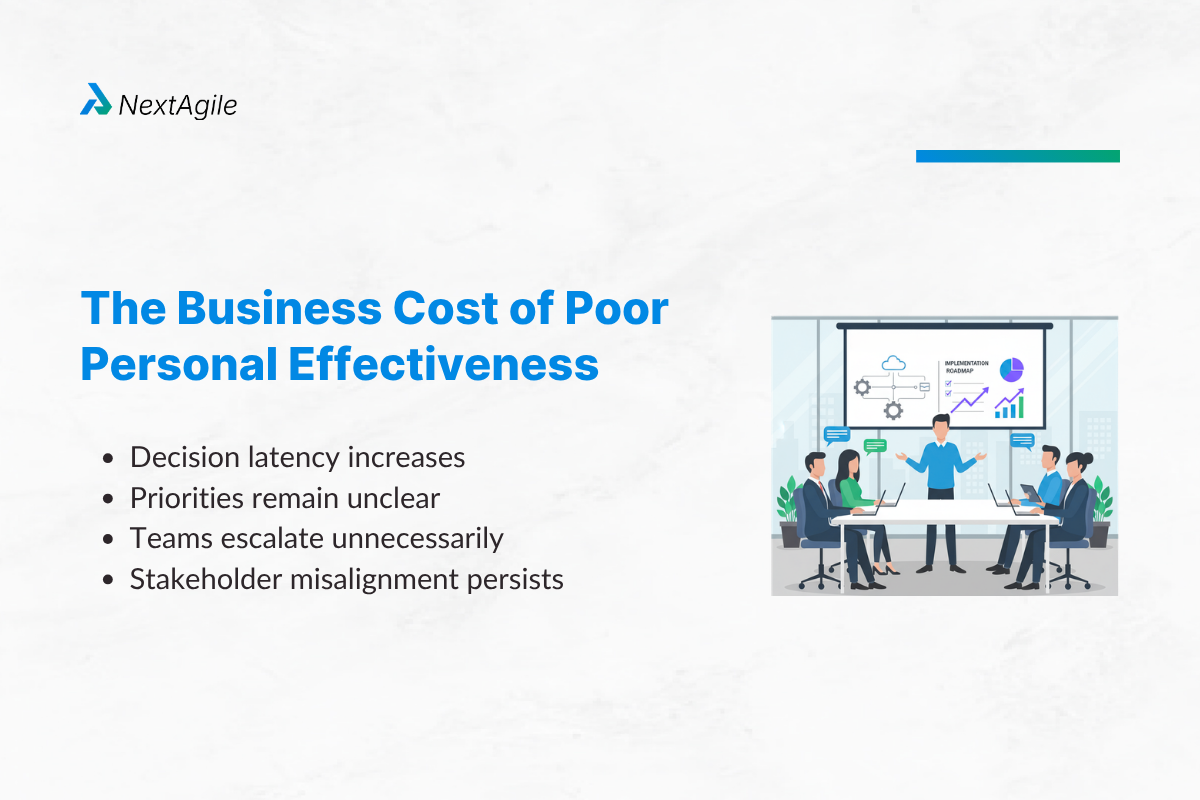
The Business Cost of Poor Personal Effectiveness
This is where most content stays shallow. Let’s make it explicit. Ineffectiveness is rarely attributed correctly.
It is often mistaken for:
- Market complexity
- Team capability gaps
- Execution challenges
When senior leader effectiveness breaks, organizations pay for it.
- Decision latency increases → missed market windows
- Priorities remain unclear → fragmented execution
- Teams escalate unnecessarily → leadership bandwidth collapses
- Stakeholder misalignment persists → slow delivery cycles
At Director and VP levels, ineffective leadership doesn’t look like failure.
It looks like:
- Gradual slowdown
- Increasing complexity
- Invisible friction
By the time it is noticed:
- Recovery becomes expensive
- Alignment requires rework
- Momentum is already lost
Until performance drops. Personal effectiveness is not a personal trait.
It is a business performance variable.
The Effectiveness Operating System (NextAgile Framework)
Senior leaders don’t need more tactics. They need a system.
The Effectiveness Operating System:
Attention → Energy → Decisions → Influence → Outcomes
Each layer influences the next:
- Attention shapes energy usage
- Energy impacts decision quality
- Decisions determine execution speed
This is a causal chain not a checklist.
- Misplaced attention → wrong problems solved
- Low energy → poor decision quality
- Weak decisions → unclear direction
- Poor influence → slow or resisted execution
- Weak outcomes → perceived ineffectiveness
Most leaders try to fix outcomes. Effective leaders manage the upstream system. Without correcting:
- Attention allocation
- Decision clarity
- Influence alignment
Outcomes remain inconsistent.
Where Is Your Effectiveness Breaking? (Diagnostic)
Before fixing effectiveness, you need to locate the constraint.
Use this diagnostic:
- Constant busyness, low progress → Attention problem
- Decision fatigue, second-guessing → Energy problem
- Frequent escalations from teams → Decision clarity problem
- Slow alignment across stakeholders → Influence problem
- High effort, inconsistent results → System breakdown
Improvement requires:
- Identifying the primary bottleneck
- Avoiding generalized fixes
- Applying targeted changes
If you misdiagnose the problem, you optimize the wrong lever.
That’s why most effectiveness advice fails.
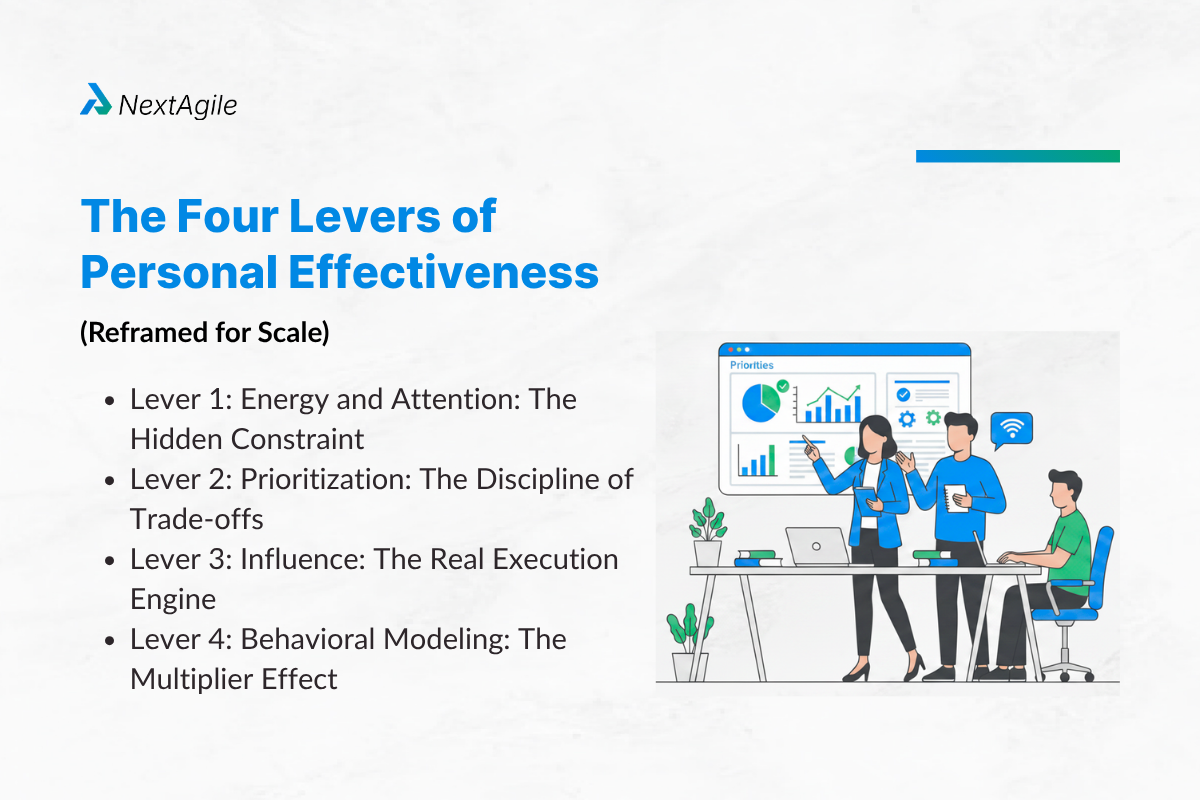
The Four Levers of Personal Effectiveness (Reframed for Scale)
This is where most frameworks become predictable. So let’s go deeper through failure modes and real leadership patterns.
Lever 1: Energy and Attention: The Hidden Constraint
Most senior leaders think time is the constraint.
It isn’t. Cognitive bandwidth is.
A Director managing multiple priorities often:
- Switches context every 15-20 minutes
- Makes dozens of micro-decisions daily
- Operates in a constant reactive loop
Failure pattern: Important decisions are made in low-energy states.
Business consequence:
- Poor judgment
- Increased rework
- Slower execution cycles
Upgrade:
- Design your day around decision quality windows, not availability
- Protect cognitive bandwidth for high-impact thinking
Leaders must:
- Protect peak cognitive windows
- Reduce reactive switching
- Align energy with decision importance
Lever 2: Prioritization: The Discipline of Trade-offs
At VP and CXO levels, priorities are rarely unclear.
Trade-offs are avoided.
Failure pattern: Everything remains important → nothing moves decisively.
Example:
- 5 strategic initiatives → all partially resourced → none fully delivered
Business consequence:
- Execution dilution
- Resource fragmentation
- Strategic drift
Upgrade:
- Force visible trade-offs
- Reduce active priorities
- Align teams to fewer, clearer outcomes
Clarity is not communication. It is elimination. Without elimination:
- Priorities expand
- Focus diffuses
- Execution weakens
Lever 3: Influence: The Real Execution Engine
Execution at scale is a function of alignment.
Not authority.
Failure pattern: Leaders communicate decisions after they are made.
Result:
- Passive resistance
- Slow adoption
- Rework cycles
At senior levels:
- Stakeholders don’t block openly
- They delay, redirect, or deprioritize
Business consequence:
- Hidden execution drag
- Political friction
- Reduced speed-to-market
Upgrade:
- Align before decisions not after
- Map stakeholder incentives early
- Build trust pre-emptively
Influence is not persuasion. It is alignment before commitment. When done early:
- Decisions move faster
- Stakeholder friction reduces
- Outcomes stabilize
Lever 4: Behavioral Modeling: The Multiplier Effect
Your behavior scales faster than your strategy.
Failure pattern: Leaders optimize personally but create systemic dysfunction.
Examples:
- You respond instantly → teams expect urgency everywhere
- You attend all meetings → teams over-collaborate
- You avoid conflict → teams delay decisions
Business consequence:
- Cultural inefficiency
- Decision avoidance
- Burnout patterns
Upgrade:
- Audit what your behavior is teaching the system
- Model clarity, not busyness
- Model decisiveness, not over-analysis
Leadership effectiveness is contagious, for better or worse. Over time:
- Teams replicate patterns
- Norms become embedded
- Culture reinforces effectiveness or inefficiency
The Role of Self-Awareness in Personal Effectiveness
Self-awareness is not reflective, it is operational. Without it:
- Patterns repeat automatically
- Signals are misread
- Ineffectiveness persists
How blind spots reduce effectiveness at scale?
Senior leaders develop invisible defaults:
- Over-control
- Conflict avoidance
- Need for certainty
Under pressure, these patterns intensify. Not consciously but predictably.
Without awareness:
- You repeat ineffective behaviors
- You misinterpret outcomes
- You limit team autonomy
Under stress:
- Control increases
- Openness reduces
- Decision quality declines
Feedback as a calibration system
At senior levels, feedback does not come naturally. You must design for it.
Effective leaders:
- Ask for contradiction, not validation
- Seek input before, not after, decisions.
- Use coaching to expose blind spots
Feedback is not judgment. It is performance calibration. Leaders must:
- Actively design feedback loops
- Encourage dissent
- Validate assumptions early
The Operating Rhythms That Sustain Effectiveness
Senior leader effectiveness compounds through structured operating rhythms, weekly prioritization, protected thinking time, and monthly recalibration, not bursts of effort.
Sustainable performance comes from:
- Structured reflection
- Intentional planning
- Regular recalibration
Weekly: Direction Reset
- What actually moved outcomes last week?
- What created noise?
- What must matter this week?
Outcome: → Intentional execution
Otherwise:
- Effort compounds in the wrong direction
- Teams optimize misaligned goals
Daily: Decision Protection
- Block high-quality thinking time
- Reduce unnecessary inputs
- Avoid decision fatigue
Outcome: → Better judgment under pressure
Leaders must:
- Minimize cognitive overload
- Sequence high-impact decisions
- Avoid reactive commitments
Monthly: System Audit
- Where is effectiveness breaking?
- What patterns are repeating?
- What must change structurally?
Outcome: → Continuous recalibration
Without audits:
- Inefficiencies persist
- Patterns remain hidden
- Effectiveness plateaus
Personal Effectiveness in 2026: A Strategic Capability
The environment has shifted. As velocity increases:
- Misalignment scales faster
- Poor decisions propagate quickly
- Recovery becomes harder
AI increases speed, but reduces clarity
AI enables:
- Faster analysis
- Faster execution
- Faster iteration
But also:
- Information overload
- Conflicting signals
- Shorter decision cycles
Leaders who respond by doing more fail faster. More effort:
- Does not fix poor prioritization
- Does not improve decision quality
- Does not resolve misalignment
The new differentiator: Human effectiveness
In an AI-augmented system:
- Execution is commoditized
- Information is abundant
What matters:
- Judgment
- Prioritization
- Influence
- Clarity under uncertainty
In complex environments:
- Data informs
- AI accelerates
- Leaders decide
Personal effectiveness at work is no longer optional. It is a competitive advantage.
Conclusion: Effectiveness Is the Difference Between Scale and Stall
The uncomfortable truth is that most leaders don’t fail because they lack capability. They fail because:
- They apply effort in the wrong places
- They hold on to control too long
- They optimize activity instead of outcomes
So the question is not: “Am I working hard enough?” The real question is: “Where is my effectiveness breaking and what is it costing the business?”
Because every week you delay that answer:
- Decisions slow down
- Teams lose clarity
- Opportunities slip
If you want to operate at the next level, start here:
- Identify your constraint (attention, energy, decisions, or influence)
- Remove one low value commitment this week
- Force one clear trade-off in your priorities
- Align one key stakeholder before your next major decision
In our leadership coaching or leadership training programs, we at NextAgile understand that at senior levels, personal effectiveness is not a soft skill. It is the difference between scaling impact and becoming the bottleneck. The leaders should focus not on more effort but better leverage.
Check our comprehensive guide on how to develop leadership skills. You can also reach out to us consult@nextagile.ai to explore how we can help your leadership transformation journey.
Frequently Asked Questions
Q1: How do senior leaders stay personally effective?
By focusing on high-leverage activities, managing energy and attention, and enabling outcomes through teams rather than direct execution.
Q2: What are the biggest personal effectiveness challenges at senior levels?
Shifting from execution to direction, managing cognitive load, and prioritizing impact over activity.
Q3: How does self-awareness improve personal effectiveness?
It helps leaders identify behavioral patterns and biases that reduce effectiveness, enabling better decisions and alignment.
Q4: What is the difference between productivity and personal effectiveness?
Productivity focuses on output. Personal effectiveness focuses on outcomes, leverage, and organizational impact.
Q5: Can personal effectiveness be developed?
Yes. With structured reflection, feedback, and coaching, leaders can significantly improve their effectiveness over time.
Q6: What are early signs of declining personal effectiveness at senior levels?
Increased busyness with limited progress, repeated escalations, unclear priorities, and slower decision cycles.
Q7: Why do high-performing leaders struggle after promotion?
Because behaviors that drive individual success often limit scalability when leading through others.
Q8: How can leaders identify their effectiveness constraint quickly?
By analyzing patterns such as decision delays, stakeholder misalignment, or persistent execution gaps.
Q9: Does working longer hours improve personal effectiveness?
No. Without clarity and prioritization, additional effort often amplifies inefficiency.
Q10: How does personal effectiveness impact business performance?
It directly affects decision speed, alignment, execution quality, and overall organizational throughput.