Ever wonder why some leaders consistently come up with innovative solutions while others get stuck in routine thinking? That’s the power of creative thinking skills. In today’s fast-paced business landscape, the ability to think creatively isn’t just a “nice-to-have”; it’s essential for solving complex problems, driving innovation, and maintaining a competitive edge.
Creative thinking enables you to attack problems in new ways, see how unrelated things fit together, and come up with solutions that others may not consider. It is not the domain of artists or designers alone; executives, managers, and team leaders all stand to gain from developing this skill. From my work with C-suite leaders, those who intentionally develop their creative thinking tend to outperform others at problem-solving, strategic planning, and team influence.
This blog will discuss the definition of creative thinking, its forms, examples in the real world, and exercises you can adopt to hone your skills. By the end of this, you’ll have practical tips to use right away in your leadership journey.
What is Creative Thinking? Creative thinking is the capacity to come at problems and opportunities with new eyes, creating original solutions that are effective as well as practical. It is a step beyond usual problem-solving in that it promotes experimentation, curiosity, and calculated risk-taking. Consider it a muscle, the more you use it, the stronger you get.
Essentially, creative thinking combines imagination with reason. You do not simply come up with ideas; you subject them to critical analysis to make sure they are able to address actual problems. Great leaders in creative thinking are able to discern patterns, question assumptions, and forecast the future. Developing a leadership mindset shift can help leaders challenge conventional thinking and discover new opportunities.
In organizational environments, creative thinking equates to new product development, enhanced processes, and enhanced team participation. It enhances problem-solving, allowing executives to manage complexity while creating a culture of innovation. Many organizations use design thinking approaches to systematically encourage creative problem-solving and customer-centric innovation. Cultivating this competency is essential for leaders who want to have a positive impact.
Why Most Organizations Confuse Creativity with Random Ideation Many organizations say they value creativity, but operationally reward predictability, speed, and risk avoidance.
As a result, employees often associate creative thinking with:
brainstorming sessions spontaneous ideas abstract innovation workshops unstructured experimentation In reality, high-value creative thinking is disciplined.
It combines:
curiosity pattern recognition business context systems thinking execution awareness The strongest leaders are not necessarily the people generating the highest number of ideas.
They are the ones consistently producing useful, strategic, and implementable ideas under constraints.
This distinction is important because organizational creativity is not measured by how imaginative discussions become.
It is measured by whether new thinking improves:
customer outcomes execution quality adaptability differentiation decision-making effectiveness Many organizations strengthen these capabilities through structured Design Thinking Consulting Services that transform creative ideas into measurable business outcomes.
Why Creative Thinking Is Important?
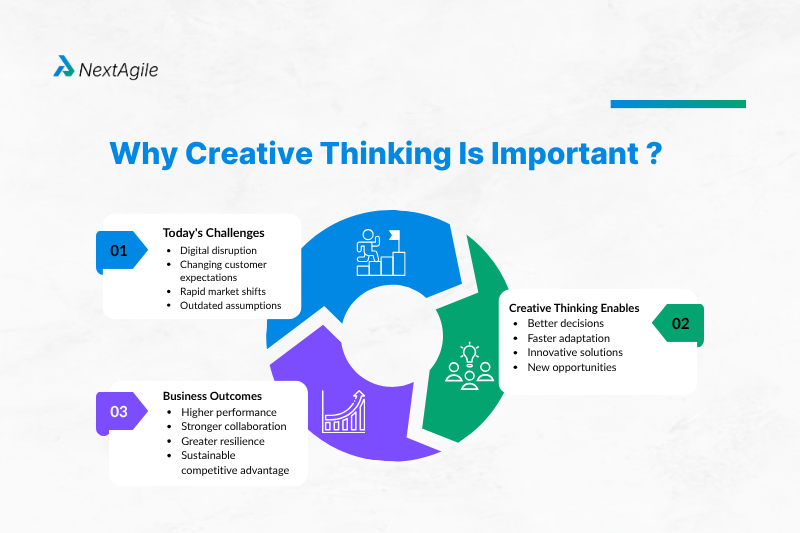
Today, companies are confronted with challenges never seen before; digital disruption and changing customer expectations. Executives who bet on traditional methods are in danger of falling behind. That’s where creative thinking and problem solving enter.
Creative thinking drives innovation, strengthens decision-making, and increases resilience within an organization. Executives who can create a range of solutions are better placed to manage uncertainty and drive change. It also inspires collaboration: when people see their ideas matter, motivation and morale increase.
Moreover, creative thinking helps executives identify opportunities that others might miss. It’s not just about “big ideas”; it’s about applying innovative strategies to everyday decisions. In my coaching experience, leaders who actively practice creative thinking report greater confidence in navigating ambiguity. This capability often develops alongside efforts to develop leadership skills that support adaptability and strategic decision-making.
Developing this skill isn’t optional. It’s a competitive advantage. And luckily, it’s learnable with the right guidance and exercises.
Creative thinking matters most when leaders face ambiguity without predefined answers.
During stable periods, organizations can rely heavily on established processes and historical patterns.
But during uncertainty:
past playbooks weaken assumptions become outdated market behavior shifts rapidly traditional operating models lose effectiveness This is where creative leadership becomes a strategic advantage.
Leaders who think creatively can:
reframe challenges faster identify non-obvious opportunities simplify complexity adapt operating models create clarity amid uncertainty In enterprise environments, creative thinking is often less about “inventing something new” and more about seeing existing problems differently before competitors do.
That capability directly influences organizational resilience and long-term relevance.
Types Of Creative Thinking There is more than one way to be creative. Knowledge about the types of creative thinking enables leaders to recognize and cultivate the styles that are best for them.
Artistic Creativity Artistic creativity is the application of imagination to develop visually or emotionally appealing concepts. Executives may benefit from it less than designers or marketers but still want to use it when making presentations of strategies, creating stories, or motivating teams. These capabilities are closely related to several core leadership qualities that help leaders inspire action and engagement. For instance, an executive creating a compelling internal communications campaign applies artistic creativity to command attention and instill alignment.
One of the most limiting beliefs in organizations is assuming creativity belongs only to marketing, branding, or product design functions.
In practice, creative thinking creates impact across every business domain.
For example:
HR leaders redesign employee experiences Operations leaders optimize workflows creatively Finance leaders rethink budgeting structures Technology leaders simplify complex systems Strategy leaders identify unconventional growth opportunities Creative thinking is ultimately about producing better approaches and not simply more visually appealing ideas.
Organizations that democratize creativity across functions typically innovate faster because problem-solving becomes distributed rather than centralized within a few “creative” teams.
Analytical Creativity Analytical creativity merges critical thinking with creativity. Executives use it to analyze data in new forms, uncover patterns, and make evidence-based decisions. A finance director, for example, can use analytical creativity to reorganize budgets in a creative way, making it efficient without compromising quality. It is particularly relevant in addressing intricate business problems requiring insight as well as imagination.
Modern organizations have more data than ever before, yet many still struggle with innovation.
This happens because data reveals patterns, but creativity interprets meaning.
Without creative thinking:
dashboards become passive reporting tools insights remain disconnected teams optimize existing systems instead of reimagining them Creative leaders ask questions that data alone cannot answer:
What assumptions are we making? What customer behavior are we ignoring? What if the current constraint no longer existed? What alternative models could work better? Innovation often emerges not from more information, but from new interpretations of existing information.
This is where analytical creativity becomes a competitive differentiator.
Lateral Thinking The term “lateral thinking” was coined by Edward de Bono. Lateral thinking inspires individuals to view challenges differently. Rather than approaching problems directly, leaders explore other routes. Practically, lateral thinking could be brainstorming with cross-functional teams or making assumptions about a product launch. Leaders who practice lateral thinking tend to find solutions that competitors miss. Thus turning failures into success stories. Lateral thinking encourages looking at problems from entirely new angles, if your organization wants to systematically apply this approach, partnering with human centered design consulting firms can help turn creative ideas into actionable solutions.
Many organizational inefficiencies survive simply because nobody questions them long enough.
Over time, teams normalize:
outdated workflows unnecessary approvals meeting overload reporting duplication slow decision chains Creative thinkers challenge these inherited assumptions.
Instead of asking: “How do we improve this process?”
they often ask: “Why does this process exist at all?”
That shift changes the quality of strategic conversations.
The best leaders do not automatically accept organizational norms as fixed realities.
They examine whether those norms still create value.
This mindset often becomes the starting point for operational transformation and innovation.
Divergent And Convergent Thinking Divergent thinking creates multiple solutions without instant critical judgment, leading to creativity through discovery. Convergent thinking then consolidates those options to determine the most practical solution. Effective leaders master both: they promote ideation (divergent) but enforce alignment to business objectives (convergent). For instance, in a strategic planning session, groups come up with lots of ideas for market growth (divergent) and then evaluate feasibility and ROI to choose the best way forward (convergent). Command of these complementary thinking modes empowers executives to innovate without sacrificing operational discipline.
Many teams struggle with creativity not because employees lack ideas, but because organizations mix ideation and evaluation too early.
When teams immediately criticize new concepts:
creativity contracts participation decreases risk-taking disappears discussions become politically safe instead of strategically valuable Strong facilitators intentionally separate:
idea generation idea evaluation During divergent thinking, the goal is exploration.
During convergent thinking, the goal becomes prioritization and execution alignment.
Organizations that master this balance generate more innovative solutions without losing operational discipline.
Examples Of Creative Thinking Creative thinking appears in various forms across leadership, problem-solving, and team collaboration. Below are real-life examples to inform application.
Analysis
Creative thinkers look at problems from several different directions. A marketing executive, for example, would study customer behavior data to discover unmet needs and design campaigns others overlook. Through marrying curiosity with rigorous evaluation, leaders create solutions that are innovative as well as actionable.
Open-Mindedness
Leaders who are open-minded embrace different ideas and question assumptions. Such a skill enables breakthrough solutions, such as blending cross-departmental ideas into one overall strategy. Open-minded leaders foster psychological safety, which challenges teams to voice unorthodox ideas without fear, enabling ongoing innovation.
Creative thinking struggles in environments where employees fear embarrassment, criticism, or failure.
Innovation requires intellectual safety.
Teams are far more likely to contribute original ideas when leaders normalize:
experimentation constructive disagreement questioning assumptions iterative learning Without psychological safety, organizations unintentionally train employees to remain operationally compliant instead of intellectually engaged.
As a result:
meetings become predictable innovation slows teams avoid challenging existing thinking strategic blind spots increase Creative cultures are rarely built through innovation slogans alone.
They are built through leadership behaviors that make curiosity safe.
Problem-Solving
Innovative problem-solving combines imagination with pragmatism. Take a supply chain interruption: an innovative leader may employ substitute suppliers, map out logistics, or re-engineer processes instead of taking temporary measures. This policy reduces risk while creating solutions for the long term.
One common misconception is that creativity thrives without constraints.
In reality, constraints often improve creative thinking.
Business leaders operate within:
budgets timelines regulations resource limitations operational dependencies Creative thinking becomes valuable when leaders can innovate despite those constraints rather than ignoring them.
Some of the most effective solutions emerge precisely because limitations force teams to:
simplify prioritize differently rethink assumptions eliminate unnecessary complexity This is why practical creativity often outperforms theoretical innovation inside enterprise environments.
Organisation
Organizational creativity is about creating effective structure and workflow that maximizes productivity. Innovative thinkers who are leaders reorganize the team, establish flexible processes, or bring in new technologies to maximize performance. Creative organization assists businesses in expanding effectively without squashing innovation.
Communication
Effective communication is a creative leadership skill. Presenting a vision, engaging stakeholders, or motivating employees, leaders apply storytelling, imagery, and compelling words to relate meaningfully. Creative communication guarantees ideas resonate and inspire action.
Creative communication is not merely about presenting information clearly.
It is about helping people emotionally connect with ideas.
Data informs people.
Stories move people.
Leaders who use storytelling effectively can:
simplify complexity align teams faster improve stakeholder buy-in create strategic clarity increase organizational influence In large organizations, even strong ideas fail when leaders cannot communicate them in ways that people remember, trust, and emotionally engage with.
Creative communication bridges the gap between insight and action. Leaders seeking to strengthen these capabilities often benefit from leadership coaching services focused on influence, communication, and executive presence .
Benefits Of Creative Thinking
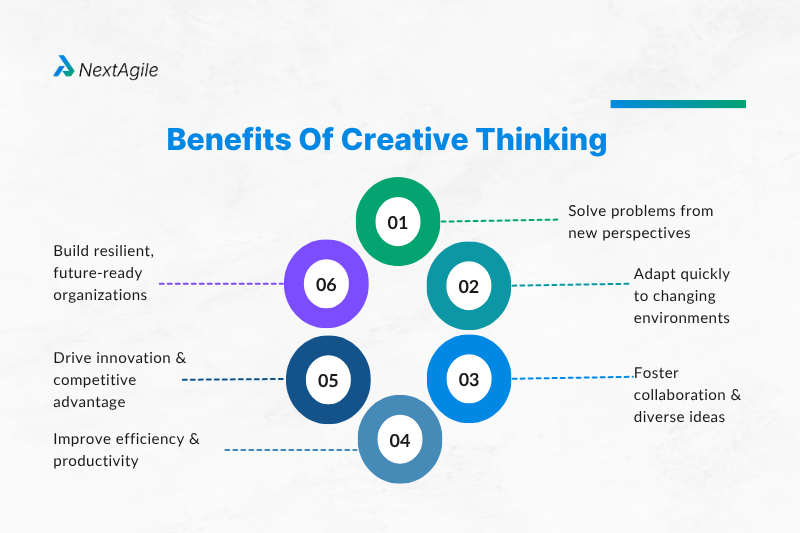
The benefits of developing creative thinking skills reach personal, team, and organizational levels:
Augmented Problem-Solving: Original thinkers are able to tackle challenges from diverse perspectives, recognize out-of-the-box solutions, and envision possible hiccups ahead of time. This enhances decision-making as efficient and nimble. Increased Adaptability: With the fast pace of the world today, the power to think creatively enables teams and leaders to shift gears swiftly, adapt to change, and convert unexpected situations into opportunities for development. More Effective Collaboration: Creative thinking promotes openness and sharing. Teams that are creative instill a culture of respect, varied viewpoints, and innovative solutions that would never be found in cliquish environments. More Productivity: When people can create new solutions and optimize processes, jobs become more efficient. Creative thinking will often result in wiser, quicker solutions that save resources and time. Personal Development: Creative thinking builds curiosity, resilience, and confidence. Regularly exercising creativity, leaders become more inspired, motivated, and enabled to lead others towards beneficial outcomes. Competitive Edge: Organizations that nurture creative thinkers are more effective at innovating, predicting market trends, and staying relevant. Programs such as the Agile Leadership Masterclass help leaders cultivate innovation, adaptability, and strategic thinking across teams. Creativity is a strategic advantage that fuels sustained success. Essentially, creative thinking revolutionizes leadership. It prepares executives to manage complexity, engage teams, and drive measurable business outcomes. Organizations that collaborate with NextAgile’s human centered design consulting firms often see stronger innovation pipelines, more effective problem-solving across teams, and a culture that encourages continuous creativity and collaboration.
Organizations that fail to develop creative thinking capabilities often become highly efficient at maintaining outdated systems.
This creates long-term strategic risk.
Low creative capacity usually results in:
repetitive problem-solving slow adaptation overdependence on legacy thinking excessive process rigidity weak innovation pipelines Over time, competitors with stronger creative cultures begin responding faster to:
customer shifts technology disruption market uncertainty operational inefficiencies Creative thinking is no longer a soft skill operating at the margins of business.
It increasingly influences:
adaptability strategic positioning execution agility organizational longevity Creative Thinking Vs Analytical Thinking While creative thinking prioritizes originality, analytical thinking is more about logic, structure, and assessment. Both are indispensable for leadership success. Creative thinking creates possibilities; analytical thinking validates feasibility.
For instance, a CEO may think of some new ways of entering a new market (creative) and then apply financial modeling, risk assessment, and scenario planning to select the ideal approach (analytical). Leaders who are both creative and analytical are great at putting forward change ideas without unwarranted risk.
We invite leaders at NextAgile to infuse human-centered design consulting approaches to combine creative brainstorming with analytical data, making solutions practical as well as innovative. Creating this two-way solution enables leaders to make better, quicker, and more effective decisions.
Organizations sometimes create a false divide between creative thinkers and operational leaders.
High-performing executives integrate both capabilities simultaneously.
They know:
when to explore possibilities when to apply structure when to challenge assumptions when to prioritize execution discipline Pure creativity without operational thinking creates chaos.
Pure analytical thinking without creativity creates stagnation.
Leadership effectiveness increasingly depends on balancing:
imagination with feasibility experimentation with accountability innovation with execution This integration allows organizations to remain adaptive without losing operational reliability.
Creative thinking scales fastest when organizations embed it into everyday operating behavior rather than isolating it within innovation initiatives.
This includes:
encouraging thoughtful questioning rewarding experimentation reducing fear of failure promoting cross-functional collaboration enabling reflective thinking time Organizations that consistently nurture creative thinking often experience:
faster learning cycles stronger employee engagement higher adaptability improved innovation quality better long-term strategic resilience Creativity is not simply about generating breakthrough ideas.
It is about building organizations capable of evolving continuously in changing environments.
Conclusion Creative thinking isn’t a nice-to-have skill; it’s a building block of great leadership and organizational success. Leaders who develop creative thinking not only access novel solutions but also challenge their teams to attack problems with curiosity and confidence. By understanding various forms of creativity, including artistic and analytical, and applying tools like lateral or divergent thinking, executives can solve tough problems more effectively and create an environment that breeds innovation.
Furthermore, creative thinking supports decision-making, flexibility, and collaboration, imperatives of today’s fast-paced business environment. It enables leaders to foresee challenges, consider a variety of approaches, and apply solutions that lead to real outcomes. Building this capability is an ongoing process, facilitated by reflection, play, and deliberate practice. In the end, creative thinking enables leaders to revolutionize their own performance and their organization’s direction, making it an imperative for long-term prosperity.
Frequently Asked Questions What are some of the typical obstacles to creative thinking? Aphobia, rigid routines, and insufficient psychological safety are significant obstacles. If individuals feel judged or bound, they do not experiment. It is possible to overcome these challenges and foster innovation by facilitating open communication, flexible thinking, and taking risk.
How is creative thinking connected with emotional intelligence? Emotional intelligence strengthens creative thinking by promoting empathy, self-awareness, and social competence. Leaders who have an awareness of themselves as well as others’ emotions can come at problems with wider angles of view, think of other solutions, and create collaborative environments that foster innovation.
Are creative thinking skills trainable? Yes, creative thinking can be developed through deliberate practice. Techniques such as brainstorming, lateral thinking exercises, role-playing, and journaling help individuals challenge assumptions, explore alternatives, and consistently generate innovative solutions over time.
How can journaling enhance creative thinking? Journaling stimulates reflection, exploration of ideas, and the detection of patterns. Through putting thoughts into writing, leaders sort out their thinking, monitor progress, and discover new solutions. Journaling is a psychological playground where ideas are tried out safely prior to application in the real world.
Why is play so important in cultivating creative thinking? Play broadens imagination, diminishes fear of failure, and stimulates experimentation. Playful activities enable leaders to experiment with novel ideas, develop resilience, and stimulate curiosity, which are building blocks of long-term creative thinking and problem-solving.
Alok Dimri is the co-founder and leads the overall business at NextAgile, where he is responsible for strategy, client and consultant partnerships, and a whole lot of other core business activities like solutioning, branding, and customer engagement.
Over the past 16 years, he has worked extensively in business strategy, new business development, and key account management initiatives across process consulting and training domains.
 Skip to content