Test Automation in Agile: Scrum Teams Implementation Guide

Picture of Anuj Ojha
Anuj Ojha
Test Automation in Agile
Table of Contents

Key Highlights of Test Automation in Agile

  • Agile testing activities consume 20 to 30% of total sprint effort when distributed correctly across developers, QA, and product owners (monday.com Agile Testing Guide, 2026).
  • Teams that automate consistently catch bugs 60% earlier in the development lifecycle than teams that rely on end-of-sprint manual testing.
  • Behavior-Driven Development (BDD) with frameworks like Cucumber improves collaboration between Product Owners, developers, and QA by writing test scenarios in plain language before code begins.
  • The Definition of Done for every user story should include “automated tests written and passing in CI” to prevent automation debt from accumulating sprint by sprint.
  • Over all enterprises will adopt AI for test authoring and maintenance by end of 2026.

Introduction

Test automation in agile is the practice of integrating automated quality checks into every phase of an agile sprint, from story writing to retrospective, so that teams can validate features continuously and deploy with confidence. Without test automation, agile delivery speed creates quality debt: teams ship features faster than manual testing can validate, defects accumulate, and release confidence declines.

According to monday.com’s 2026 Agile Testing Guide, testing activities should consume 20 to 30% of total sprint effort. In teams without automation, most of that effort goes to manual regression, leaving little capacity for exploratory testing, risk-based quality work, or test strategy improvement. Automation shifts that balance: repetitive regression runs on autopilot, and QA engineers apply human judgment where it creates the most value.

This guide covers the specific steps for implementing test automation in agile Scrum teams: from writing the first automated test to integrating automation into sprint ceremonies and establishing the practices that make it sustainable. For teams also managing Jira-based sprint workflows, NextAgile’s JIRA Training Masterclass covers automated test status visibility within Jira sprints.

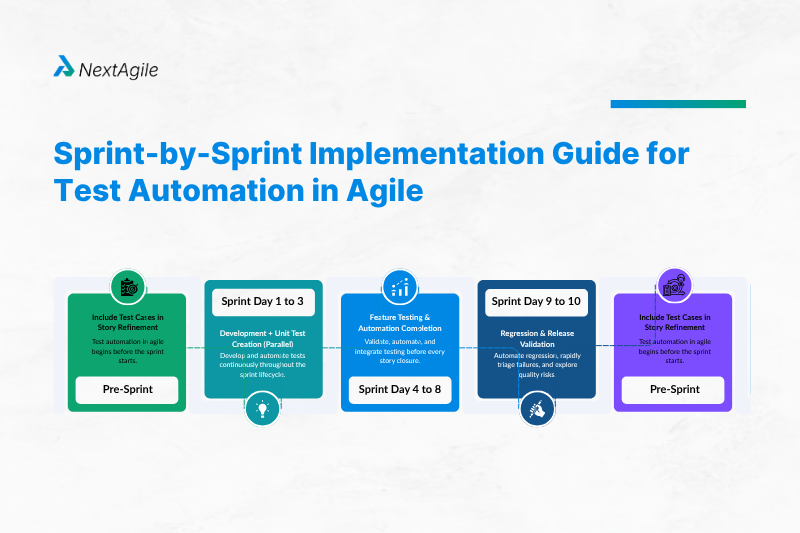
Sprint-by-Sprint Implementation Guide for Test Automation in Agile

Pre-Sprint: Include Test Cases in Story Refinement

Test automation in agile begins before the sprint starts. During backlog refinement:

Actions for QA engineers in refinement:

  • Review each user story and draft test scenarios in plain language (using Given/When/Then format if practicing BDD)
  • Identify automation candidates: any scenario that will need to be re-tested every sprint after this feature ships
  • Flag stories that lack testable acceptance criteria and block them from sprint inclusion
  • Estimate automation effort separately from development effort in story points or hours

This pre-sprint practice prevents the most common anti-pattern: writing user stories that developers consider done when the feature is coded, but that have no automation and no acceptance criteria that QA can verify.

Test Automation in Agile

Sprint Day 1 to 3: Development + Unit Test Creation (Parallel)

For developers:

  • Write unit tests alongside production code, not after it
  • Apply Test-Driven Development (TDD) for complex business logic: write the failing test first, write the code to pass it
  • Maintain unit test coverage above the team’s agreed threshold (target: 70% line coverage for all new code)

For QA engineers:

  • Begin writing automation scripts for the sprint’s stories while developers build features
  • Use the acceptance criteria as the specification for test script logic
  • Set up or verify test data in the shared test environment

Sprint Day 4 to 8: Feature Testing and Automation Completion

Acceptance testing:

  • QA engineers test completed stories against acceptance criteria
  • Automated tests run as features are completed, not at end of sprint
  • Failed tests are assigned immediately to the developer responsible

Automation completion requirements before story closure:

  • All automated tests for the story are passing in CI
  • Test scripts are in version control and reviewed
  • New tests are added to the regression suite and running in nightly builds

Sprint Day 9 to 10: Regression and Release Validation

Automated regression run:

  • Full regression suite executes automatically via CI/CD pipeline
  • Results are visible to the whole team on a shared dashboard
  • Any new failures are triaged immediately: is this a product defect or a test issue?

Manual exploratory testing:

  • QA engineers use the time saved by automation on exploratory testing of edge cases and user experience quality
  • Session-based exploratory testing generates defect and insight reports for product discussion

Sprint Retrospective: Automation Health Review

Add 10 minutes to retrospective for automation health:

  • What was the automation coverage delivered this sprint?
  • Did any tests become flaky? Who is assigned to fix them?
  • Did the regression suite run time increase? If yes, investigate root cause
  • What is the trend line on defect escape rate? Is automation actually catching more bugs?

For teams using a structured retrospective process, NextAgile’s Team Development Workshop covers retrospective facilitation practices that include data-driven quality reviews.

Behavior-Driven Development as the Bridge Between QA and Product

Behavior-Driven Development (BDD) is an approach to test automation that writes test scenarios in plain language (usually Given/When/Then format) before development begins. BDD scenarios become both the acceptance criteria for the story and the specification for the automated tests.

Why BDD improves test automation in agile:

  • Product Owners can read and validate scenarios without technical knowledge
  • Developers implement to a specific behavioral specification
  • QA engineers automate the exact scenarios the Product Owner agreed to
  • The resulting automated tests are self-documenting

BDD scenario example for a login feature:

Scenario: Successful login with valid credentials

  Given the user is on the login page

  When the user enters a valid email and password

  And the user clicks the Login button

  Then the user should be redirected to their dashboard

  And the dashboard should display the user’s first name

This scenario is written before development begins. It serves as the acceptance criterion and is directly converted into an automated Cypress, Playwright, or Selenium test script.

BDD frameworks commonly used in agile teams:

  • Cucumber (Java, Ruby, JavaScript): the most widely adopted BDD framework globally
  • SpecFlow (C#/.NET): Cucumber equivalent for .NET teams
  • Behave (Python): BDD framework for Python development teams
  • Playwright with TypeScript + Gherkin: emerging combination for modern web teams

Continuous Integration Setup for Agile Test Automation

Continuous integration (CI) is the infrastructure backbone of test automation in agile. Without CI, automated tests run when someone remembers to run them, which means they do not prevent defects from reaching the next sprint.

Minimum CI configuration for an agile Scrum team:

Unit tests: Run on every commit to any feature branch. Failure blocks the pull request from merging. Result time: 2 to 5 minutes.

Integration/API tests: Run on every commit to the main/development branch. Result time: 5 to 15 minutes.

Full regression suite: Run nightly or on every release candidate build. Result time: 15 to 45 minutes.

Smoke tests post-deployment: Run after every deployment to any environment (staging, production). Result time: under 5 minutes.

For teams using Azure DevOps pipelines, GitHub Actions, or GitLab CI, the configuration patterns for each pipeline stage are standard and well-documented. NextAgile’s AI for Agility Workshop covers how AI-assisted tools like GitHub Copilot can help generate CI pipeline configuration files and review them for completeness.

Handling Common Test Automation Challenges in Agile Scrum Teams

Challenge 1: “We don’t have time for automation this sprint”

This is the most common and most destructive pattern in agile QA. Teams skip automation under sprint pressure, accumulating manual testing debt that compounds sprint over sprint.

Solution: Make test automation a non-negotiable part of the Definition of Done. If a story ships without automated tests, it is not done. This is a team agreement enforced by the Scrum Master. Initially, add automation effort to story estimates so it is planned for, not squeezed in.

Challenge 2: Flaky tests eroding team trust

When automated tests fail intermittently, teams start ignoring failures. Once ignored, the automation suite stops being a quality gate.

Solution: Implement a flaky test policy from Day 1. Any test that fails 3 times without a code change is quarantined (removed from the CI gate, tracked separately). It must be fixed or deleted within 5 business days by a named owner.

Challenge 3: QA engineers becoming a bottleneck

If only QA engineers write and maintain automated tests, they become a bottleneck that limits test coverage to QA capacity.

Solution: Make test automation a shared team skill. Developers write unit tests for their own code. QA engineers focus on integration and scenario-level tests. Use BDD to make scenario authoring accessible to non-developers (Product Owners can write the Given/When/Then scenarios that QA engineers automate).

Conclusion

Test automation in agile Scrum teams works when it is treated as a sprint commitment, not an afterthought. The practices in this guide, pre-sprint automation planning, sprint-day parallel test development, BDD for shared scenario authorship, and CI integration for continuous validation, collectively produce the environment where teams can ship every sprint with confidence.

For enterprise Scrum teams scaling this practice across multiple ARTs or SAFe programs, the governance elements covered in the pillar blog on Agile Test Automation and the strategy blog become critical. NextAgile’s agile consulting services support teams in building this practice from the ground up. Contact us at consult@nextagile.ai.

Frequently Asked Questions

Q1. How do you integrate test automation into a Scrum sprint without slowing down delivery? Start by including automation effort in story point estimates during refinement. If a story is estimated at 5 points and the automated test would take 1 point of effort, estimate 6 points total. This prevents automation from being treated as extra work and ensures sprint capacity accounts for it. Add “automated tests passing in CI” to your Definition of Done so it is a planned deliverable, not a post-sprint afterthought.

Q2. What is BDD and should Scrum teams use it? BDD (Behavior-Driven Development) is a practice where test scenarios are written in plain language (Given/When/Then format) before development begins. These scenarios become both the acceptance criteria and the specification for automated tests. Scrum teams benefit from BDD when they struggle with ambiguous acceptance criteria, when Product Owners cannot read technical test scripts, or when QA is siloed from development. BDD creates a shared language for Product Owners, developers, and QA engineers.

Q3. Who should write automated tests in an agile team? Test automation is a shared responsibility in agile. Developers write unit tests for their own code using TDD or test-alongside-code practices. QA engineers write integration, API, and scenario-level automated tests. Product Owners can write BDD scenarios (Given/When/Then) that QA engineers automate. The key is to define these responsibilities explicitly in your team working agreement and your Definition of Done.

Q4. How do you prevent test automation debt in agile teams? Prevent automation debt with three practices: first, include automation effort in every story estimate during refinement; second, make “automated tests written and passing in CI” a Definition of Done requirement; third, address flaky tests within 5 business days with a named owner. Without these three practices, automation debt accumulates silently and compounds until the test suite is too expensive to maintain and too unreliable to trust.

Q5. What is the minimum CI setup a Scrum team needs for test automation? The minimum viable CI setup for an agile Scrum team includes: unit tests that run on every pull request (2 to 5 minutes), integration tests that run on every merge to the main branch (5 to 15 minutes), and a full regression suite that runs nightly or on release candidates (15 to 45 minutes). Add deployment smoke tests for each environment push. This setup catches the most expensive defects at the cheapest point in the development cycle.

Q6. How long does it take to implement test automation for a Scrum team starting from scratch? Phase 1 (CI setup + first unit tests): 2 to 4 sprints. Phase 2 (50%+ unit coverage + API tests for core endpoints): 6 to 10 sprints. Phase 3 (Full pyramid including UI automation for key journeys + nightly regression suite): 12 to 18 sprints from zero. The fastest path is to start with a focused automation strategy, prioritize high-value tests first, and build consistently rather than trying to automate everything at once.

Talk to Our Experts

Get expert guidance within 1 business day.

expert-advice

Expert Advice

lightning

Fast Response

100% Confidential

100% Confidential


No spam. Your information stays private

call

Prefer a call?

Schedule a call with our expert after submission

Recent Posts