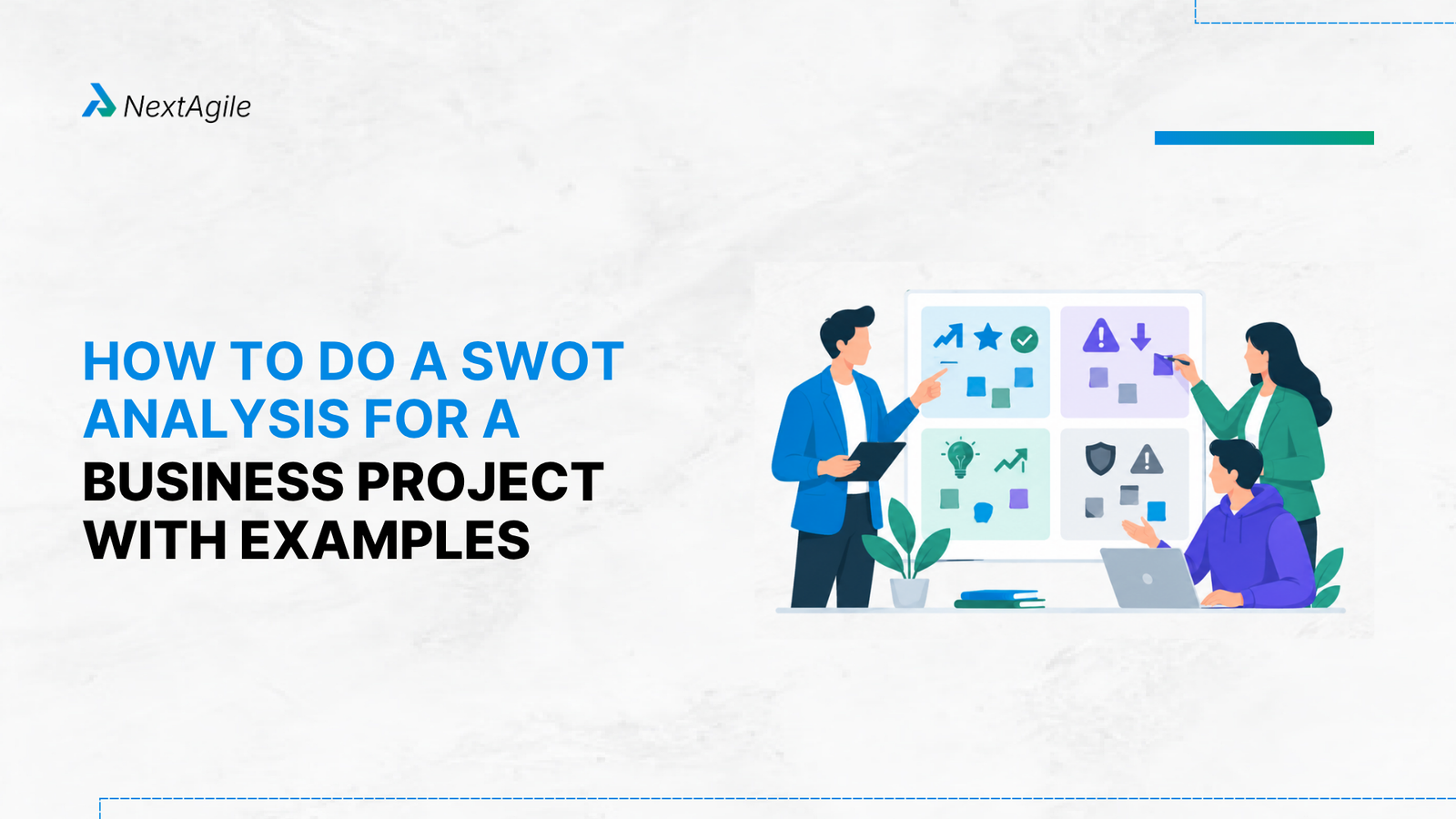
A SWOT analysis becomes useful when a business has an important decision to make but does not yet have a clear view of what could accelerate, constrain, enable, or derail the plan.
Should you enter a new market? Launch a product? Expand an existing business? Invest in automation? Move into a new customer segment?
These decisions rarely fail because leaders cannot list strengths and weaknesses. They fail when the team cannot connect those observations to the decision in front of them.
A strong SWOT analysis creates that connection. It brings internal capabilities, internal constraints, market conditions, and external risks into one view, then turns those findings into strategic options.
Key Takeaways: How to Do a SWOT Analysis for Your Business Project Define the business decision before building the SWOT matrix. Separate internal factors from external factors using the control test. Support important SWOT findings with measurable evidence. Avoid generic statements such as strong brand or high competition. Prioritize three to five factors that can materially affect the project. Use TOWS to turn SWOT findings into strategic options. Connect every major recommendation to a specific SWOT finding. Use competitor, customer, market, operational, and financial data to strengthen the analysis. Treat SWOT as a diagnostic tool, not a complete decision-making system. Review the SWOT as conditions change instead of treating it as a one-time exercise. To do a SWOT analysis for a business project, first define the exact business question and scope. Then identify strengths and weaknesses inside the organization, followed by opportunities and threats in the external environment.
Support important findings with evidence rather than assumptions. Prioritize the factors that could materially affect the project, then use TOWS analysis to combine those factors into practical strategic actions.
The final objective is not to create an attractive four-box matrix. It is to improve the quality of the business decision that follows.
What Is a SWOT Analysis for a Business Project? A SWOT analysis for a business project is a structured way to examine the internal capabilities and limitations that affect a project, along with the external conditions that could create opportunities or risks.
SWOT stands for Strengths, Weaknesses, Opportunities, and Threats. The first two relate to factors within the organization, while the last two relate to the environment in which the business operates.
The framework is simple. The analysis should not be.
A weak SWOT analysis produces four lists that could apply to almost any company. A useful SWOT analysis explains why a particular factor matters to the business decision and what the organization could do about it.
For example, saying strong customer loyalty tells the reader very little. Saying that 48 percent of monthly orders come from repeat customers gives the strength evidence and makes its strategic relevance easier to assess.
Strengths and Weaknesses: Internal Factors Strengths and weaknesses are internal factors because they originate within the organization and can generally be influenced through decisions, investments, processes, people, technology, or capability building.
Strengths can include a strong brand, proprietary technology, customer retention, distribution capability, experienced employees, operational efficiency, intellectual property, or established partnerships.
Weaknesses can include high acquisition costs, manual processes, limited production capacity, skill shortages, technology debt, weak forecasting, fragmented systems, or excessive dependence on a founder or small number of customers.
The useful question is not simply whether something is good or bad. Ask whether the organization can influence the factor and whether it affects the project being evaluated.
A capability that is valuable in the current business may not automatically be a strength for a new project. Context matters.
Opportunities and Threats: External Factors Opportunities and threats come from outside the organization. They may arise from customer behaviour, technology, competitors, regulation, economic conditions, industry changes, new channels, or shifts in supply and demand.
An opportunity could be growing demand in a new customer segment, an emerging distribution channel, a technology shift, or a change in regulation that creates room for a new business model.
A threat could be an aggressive competitor, rising input costs, changing customer expectations, new compliance requirements, supply disruption, or technology that makes an existing offering less relevant.
The important distinction is control. The business may respond to an external factor, but it cannot directly control the market condition itself.
SWOT Analysis vs Personal SWOT Analysis A business SWOT analysis evaluates an organization, product, market, project, or strategic initiative. A personal SWOT analysis evaluates an individual and is usually used for career planning or personal development.
The four categories remain the same, but the evidence changes.
For a business, a strength might be customer retention or production capacity. For an individual, it might be technical expertise or communication skills. Leaders face the same challenge when assessing their own strengths and weaknesses .
For a business project, keep the analysis focused on the organization and the strategic question unless the project specifically concerns an entrepreneur, founder, or individual professional.
How to Do a SWOT Analysis for a Business Project The quality of a SWOT analysis depends heavily on what happens before the four boxes are filled.
Start with the decision you are trying to support. Gather relevant evidence. Separate internal conditions from external ones. Then prioritize what actually matters.
The following six steps provide a practical way to do that.
Step 1: Define the Company, Product or Market Scope Do not begin with a blank SWOT template.
First define exactly what you are analysing and the decision the analysis needs to support. A company-wide SWOT may be too broad if the real question concerns one product or market.
Instead of asking whether the business is strong, ask a decision-specific question.
For example, should the company enter the Indian premium skincare market within the next 12 months? Should a SaaS company expand from small businesses into enterprise accounts?
The more precise the question, the more useful the SWOT becomes. It also gives the team a filter for deciding what belongs in the analysis and what should be left out. Public bodies such as the U.S. Economic Development Administration use the same scoped approach in their SWOT guidance.
Step 2: Identify Strengths With Evidence Look for capabilities that give the business an advantage in relation to the project.
Consider customer retention, product performance, cost position, technology, intellectual property, brand reputation, operational capability, distribution, talent, partnerships, and financial resources.
Then ask what evidence supports the claim. Customer data, revenue figures, retention rates, product metrics, customer research, operational performance, and internal capability assessments can all strengthen the analysis.
Compare these two statements:
Weak statement Evidence-based statement Strong customer base 62 percent of customers have renewed for at least two consecutive years Strong brand Brand searches increased 35 percent year over year Efficient operations Average order processing time is 18 percent below the internal target
The second column gives decision-makers something they can investigate and act upon.
Step 3: Identify Internal Weaknesses Weaknesses are internal constraints that could reduce the project’s ability to deliver its intended outcome.
Look at capability gaps, process inefficiencies, financial constraints, technology limitations, resource shortages, customer complaints, operational bottlenecks, and dependencies. Value stream mapping can help expose where delays actually occur.
Do not hide weaknesses because the SWOT is being presented to senior stakeholders. An analysis that only highlights positive factors is not strategic analysis.
A useful weakness should also have consequences.
For example, limited production capacity matters when the project depends on rapid volume growth. Founder dependency matters when decisions need to scale across multiple teams.
The question is not whether the weakness sounds serious. The question is whether it could materially affect the decision.
Step 4: Analyse External Opportunities Now move outside the organization.
Look for changes in customer demand, technology, regulation, distribution, demographics, industry structure, partnerships, and competitive behaviour that could create room for growth.
But avoid treating every positive market trend as an opportunity.
An attractive market is not automatically an opportunity for every company. The organization must have, or be able to develop, the capabilities needed to capture it.
For example, growing demand for enterprise software may look attractive to a SaaS startup. If that startup lacks enterprise security capabilities, implementation support, and an enterprise sales process, the opportunity also exposes a capability gap.
That distinction makes the analysis more realistic.
Step 5: Identify External Threats Threats are external conditions that could make the project more difficult, expensive, or risky.
Look at competitors, pricing pressure, regulation, customer expectations, technology disruption, supply chains, economic conditions, substitute products, and changes in industry structure.
Avoid vague entries such as high competition. Instead, identify what is actually happening.
For example, three competitors may have introduced lower-priced products targeting the same customer segment. That is more useful because the team can investigate pricing, positioning, differentiation, customer value, and cost structure.
Specific threats produce better strategic conversations.
Step 6: Prioritize the Most Important Factors A SWOT matrix can quickly become crowded.
If every observation is included, the team ends up with a long list but little clarity about what matters. Prioritization is therefore essential.
A simple approach is to assess each factor according to impact, relevance, and evidence.
Factor Type Impact Relevance Evidence High repeat purchase rate Strength 5 5 5 Limited production capacity Weakness 5 5 5 Growing category demand Opportunity 4 5 4 Aggressive competitor pricing Threat 5 5 5
The scores do not need to create mathematical certainty. Their purpose is to force the team to distinguish critical factors from observations that are interesting but unlikely to change the decision.
A practical SWOT often becomes more valuable when five important factors replace fifteen weak ones.
A Simple Control Test for Getting SWOT Categories Right One of the most common problems with SWOT analysis is placing factors in the wrong quadrant.
A simple control test can help.
First ask: Can the organization directly influence this factor?
If yes, it is likely an internal factor. Consider Strengths or Weaknesses. If no, it is likely an external factor. Consider Opportunities or Threats. Then ask whether the factor supports or constrains the project.
This produces a simple decision path:
Question Direction Can the business directly influence it? Internal Can the business not directly control it? External Does it create an internal advantage? Strength Does it create an internal constraint? Weakness Does the external condition create potential value? Opportunity Does the external condition create risk or pressure? Threat
This prevents common errors such as treating competition as a weakness or calling an internal capability an opportunity.
Bad SWOT vs Good SWOT: What Strong Analysis Looks Like The difference between a weak and strong SWOT is often the quality of the statements.
Generic statements may be easy to write, but they rarely help a business make a decision.
Weak SWOT statement Stronger SWOT statement Strong brand 35 percent of new customers in the target segment come through organic brand-led searches High competition Two established competitors launched lower-priced alternatives in the same segment Growing market The target category is expanding while the company has limited current penetration Poor operations Manual planning contributes to average production scheduling delays of two days Good customer loyalty Repeat customers generate 48 percent of monthly orders
The stronger statements have three characteristics.
They are specific. They are connected to the project. They provide evidence that can be investigated.
This is what turns SWOT from a brainstorming exercise into a business analysis tool.
Evidence to Use in a SWOT Analysis A strong SWOT should not depend entirely on management opinion.
Different quadrants require different types of evidence.
SWOT area Useful evidence Strengths Revenue, retention, margins, customer data, capabilities Weaknesses Process metrics, costs, complaints, delays, skill gaps Opportunities Market research, customer trends, industry data Threats Competitor activity, pricing, regulation, technology shifts
For a student project, credible secondary sources may be sufficient. These can include annual reports, government statistics, industry research, company disclosures, market studies, and reputable business publications.
For an enterprise project, the evidence base can be much broader.
Customer interviews, employee data, operational dashboards, financial metrics, sales pipeline data, competitor research, product analytics, and product discovery research can all contribute.
The important point is consistency. A major strategic conclusion should not rest entirely on an unsupported assumption.
SWOT Analysis Examples for Business Projects The following examples show how SWOT can be used to analyse different business decisions.
Example 1: Indian D2C Brand Consider an Indian D2C skincare brand that has built a strong online customer base and is considering expansion into offline retail.
A basic SWOT might look like this:
Strengths Weaknesses High repeat purchase rate Dependence on paid digital acquisition Strong customer reviews Limited offline distribution Direct customer data Small operations team Strong social media engagement Limited geographic reach
Opportunities Threats Offline retail expansion Established beauty brands Growing skincare demand Rising acquisition costs Marketplace expansion Price competition Influencer partnerships Platform algorithm changes
The strategic issue is more nuanced than market expansion.
The company already has evidence that customers return. That strength could support a loyalty and referral strategy, while offline distribution could diversify the acquisition model.
At the same time, the limited operations team could become a weakness if offline expansion increases inventory and fulfillment complexity.
The SWOT therefore points toward both growth and capability requirements.
Example 2: SaaS Startup Consider a B2B SaaS company that has achieved strong product-market fit with small businesses and wants to move into the mid-market segment.
Strengths Weaknesses Fast product development Limited enterprise sales experience Flexible architecture Small customer success team Strong SMB engagement Limited security certifications High product usage Founder involvement in major deals
Opportunities Threats Mid-market demand Established enterprise platforms Channel partnerships Longer sales cycles Higher-value plans Procurement pressure Industry-specific solutions Higher security expectations
The company has an attractive opportunity, but the opportunity exposes several weaknesses.
Fast product development could help the company build industry-specific functionality. However, limited enterprise sales experience and security capabilities could slow adoption.
This means the strategic question is not simply whether the company should enter the mid-market.
It is whether the company can build the capabilities required to compete there without weakening the existing business.
Example 3: Traditional Manufacturing Business Consider a manufacturing company planning to introduce automation across its production operations.
Strengths Weaknesses Experienced workforce Legacy equipment Established supplier relationships Manual reporting Long-term customer contracts Limited digital skills Strong quality reputation Slow production planning
Opportunities Threats Industrial automation Low-cost competitors Predictive maintenance Rising energy costs Digital production monitoring Supply chain disruption Export expansion Faster technology adoption
The business has strong operational knowledge, but much of that capability may remain dependent on manual processes.
Automation could improve productivity and create better production visibility. However, the company will need technical skills, investment, process redesign, and employee adoption.
The SWOT therefore reveals a transformation challenge rather than simply an equipment purchase decision.
How to Turn SWOT Findings Into Strategy With TOWS A SWOT matrix can describe the situation without telling the business what to do next. That is where TOWS becomes useful. The TOWS matrix was introduced by Heinz Weihrich in 1982 .
TOWS forces the team to combine internal and external factors and ask what strategic choices emerge from those relationships.
The four combinations are Strengths-Opportunities, Strengths-Threats, Weaknesses-Opportunities, and Weaknesses-Threats.
Strengths-Opportunities Strategies The SO question is:
How can existing strengths be used to capture external opportunities?
For the D2C brand, high repeat purchases are an existing strength. Offline retail expansion is an opportunity.
The company could use customer purchase data to identify high-potential locations and products before expanding its physical presence.
The strategy is stronger because it connects an existing capability with a specific market opportunity.
Strengths-Threats Strategies The ST question is:
How can existing strengths reduce exposure to external threats?
For the SaaS company, flexible product development is a strength. Established enterprise platforms are a threat.
The company could focus on industry-specific workflows and faster customization where larger competitors may have slower product cycles.
The goal is not to eliminate competition. It is to use a distinctive capability to respond to the competitive environment.
Weaknesses-Opportunities Strategies The WO question is:
Which internal weaknesses must be addressed to capture an external opportunity?
The manufacturing company’s limited digital skills could prevent it from capturing the opportunity presented by industrial automation.
A response could combine targeted hiring, technical training, vendor partnerships, and controlled pilot projects.
The opportunity therefore becomes a reason to close a capability gap.
Weaknesses-Threats Strategies The WT question is:
How can internal weaknesses be reduced when external conditions increase risk?
The D2C brand’s dependence on paid acquisition becomes more serious when digital advertising costs rise.
The company could develop owned acquisition channels through email, referral programs, loyalty initiatives, content, and customer communities.
The strategy addresses the weakness while reducing exposure to the threat.
From SWOT to Action: A Practical TOWS Matrix The real value of TOWS appears when the combinations become specific initiatives.
Opportunities Threats Strengths Use customer loyalty to expand referral-led acquisition Use strong retention to reduce price sensitivity Weaknesses Build digital capability to capture new channels Reduce dependence on paid acquisition
The next step is to turn each strategic option into an action. When several options compete for resources, a RICE prioritization framework can help rank them.
For example:
Finding: High repeat purchase rate.
Opportunity: Growing customer interest in adjacent products.
TOWS strategy: Introduce complementary products to existing customers.
Action: Test two products with the highest-retention customer segment.
Measure: Repeat purchase rate, average order value, and contribution margin.
This creates a useful chain:
Evidence → SWOT finding → Strategic implication → Action → Measure
That is where a SWOT analysis begins to influence execution. Teams that implement OKRs can use these measures as key results.
What SWOT Analysis Cannot Tell You SWOT is useful, but it has limits.
It can organize strategic information, identify patterns, and expose relationships between internal capability and external conditions. It cannot by itself determine financial viability, expected ROI, implementation effort, or competitor response.
It also does not automatically tell leadership which initiative should receive investment.
A business case may still be required. Scenario planning may be needed where market conditions are uncertain. Financial modelling may be necessary before committing capital.
Think of SWOT as a diagnostic tool, not a complete decision engine.
Its job is to improve the quality of the conversation and make important assumptions visible.
How to Present a SWOT Analysis in a Business Project A good analysis can lose impact if the presentation becomes a wall of text.
The matrix should provide a quick view of the situation. The supporting discussion should explain the evidence and strategic implications.
For a business project, keep each factor concise and specific. Avoid filling the matrix with paragraphs.
The reader should be able to understand the major strengths, weaknesses, opportunities, and threats within a few minutes.
Structuring the SWOT Matrix Use a four-quadrant matrix with internal factors on one side and external factors on the other.
Keep the number of factors manageable. Three to five important factors per quadrant are usually more useful than a long list of minor observations.
Each factor should ideally answer three questions:
What is happening? What evidence supports it? Why does it matter to the project? The matrix itself should remain concise. Put the detailed evidence below it or in an appendix.
Explaining the Most Important Insights Do not simply display the matrix and move directly to recommendations.
Explain the pattern.
For example, a business may have strong customer retention but rising customer acquisition costs. Those two findings together are more strategically important than either finding individually.
The insight could be that the company has a valuable existing customer base but needs a less expensive growth engine. This is where analysis becomes more valuable than description.
Connecting SWOT Findings to Recommendations Every major recommendation should have a visible connection to the SWOT findings.
Consider this chain:
Finding: Strong customer retention.
Threat: Rising acquisition costs.
Implication: Existing customers represent an underused growth asset.
Recommendation: Build a referral and loyalty program.
Measure: Referral-generated revenue and customer acquisition cost.
This approach makes the recommendation easier to defend because the logic can be traced back to evidence.
SWOT Analysis Template for a Business Project Use the following structure when creating a SWOT analysis for a business project.
Project: Strategic question: Scope: Date:
Strengths Weaknesses 1. 1. 2. 2. 3. 3. 4. 4. 5. 5.
Opportunities Threats 1. 1. 2. 2. 3. 3. 4. 4. 5. 5.
For each important factor, add:
Evidence: What data supports this finding?
Priority: How significantly could it affect the project?
Strategic implication: What does this finding mean?
Recommended action: What should the business investigate or do next?
This makes the template more useful than a traditional four-box worksheet because it connects the analysis to decision-making.
How to Make a SWOT Analysis More Useful for Leadership Teams A SWOT analysis becomes more valuable when different functions contribute to it.
Sales may identify customer and competitor insights that operations does not see. Finance may challenge assumptions about margins or investment. Product teams may identify technology opportunities. HR may highlight capability constraints.
This cross-functional coordination reduces the risk of creating a SWOT based on one team’s assumptions.
The discussion should also focus on disagreements.
If sales believes a market is attractive but operations believes the business lacks the capacity to serve it, that tension is strategically valuable.
The objective is not to make every stakeholder agree on the first draft. It is to surface the assumptions that need to be tested, something a design thinking workshop does well.
Conclusion A SWOT analysis for a business project should do more than produce four lists.
The strongest analysis begins with a clear decision, uses evidence to identify the factors that matter, separates internal capabilities from external conditions, and prioritizes the issues that could materially change the outcome.
The next step is where many SWOT exercises fall short.
Use TOWS to connect strengths and weaknesses with opportunities and threats. Turn those combinations into strategic options, then connect the options to actions and measurable outcomes.
That creates a much stronger chain from analysis to execution.
A good SWOT does not tell leadership what decision to make. It gives leadership a clearer view of the conditions, trade-offs, risks, and capabilities that should shape the decision.
If your business struggles to turn strategic challenges into clear priorities and actionable decisions, a structured SWOT analysis can provide the clarity needed to move forward. NextAgile consulting can help you identify critical business factors, translate insights into strategic actions, and co-create a practical Business Agility roadmap. Do reach out to us at consult@nextagile.ai and we would be happy to explore more.
Frequently Asked Questions 1. What is the difference between SWOT and TOWS analysis? SWOT identifies strengths, weaknesses, opportunities, and threats. TOWS uses those findings to develop strategic options by combining internal factors with external conditions. SWOT helps clarify the current strategic situation, while TOWS helps explore what the business could do in response.
2. How many factors should a SWOT analysis include? There is no fixed number, but a focused analysis is generally more useful than an exhaustive list. Three to five high-impact factors per quadrant can provide enough information without making the matrix difficult to interpret. Prioritize factors based on relevance, impact, and supporting evidence.
3. Can I complete a SWOT analysis without primary research? Yes. A SWOT analysis can use secondary research such as annual reports, government statistics, industry studies, competitor information, market research, and company disclosures. Primary research through customer interviews, surveys, or employee discussions can add useful context when reliable internal or external data is limited.
4. How do I find reliable evidence for a SWOT analysis? Match the evidence to the factor being assessed. Financial statements can support financial strengths or weaknesses. Customer data can support retention or satisfaction claims. Industry research can support market opportunities. Competitor information, regulatory sources, and technology research can help validate threats.
5. Should SWOT analysis be done before or after competitor analysis? Competitor analysis can be conducted before or alongside SWOT. In practice, competitor research often improves the external side of the SWOT because it helps identify competitive threats, market gaps, pricing pressure, and areas of differentiation. The final SWOT should reflect the relevant competitive evidence.
6. How do I present a SWOT analysis in an MBA report? Begin with the business context and strategic question. Present a concise four-quadrant matrix, explain the evidence supporting the most important factors, and discuss the strategic implications. Use TOWS to connect the findings to recommendations and clearly explain how those recommendations address the project objective.
Sujith G. is an agile practitioner with expertise in setting up the agile environment by coaching and training teams, individuals and stakeholders in the area of lean agile software principles. He has overall 12+ years of exp out of which 9+ years have been in Agile and Scrum implementation and adoption. Sujith has coached 70+ teams on agile practices & implementation techniques and has extensive experience in setting up metrics, JIRA & Azure DevOps. Experienced in identifying gaps in the system, creating scrum awareness, piloting and scaling scrum.
 Skip to content