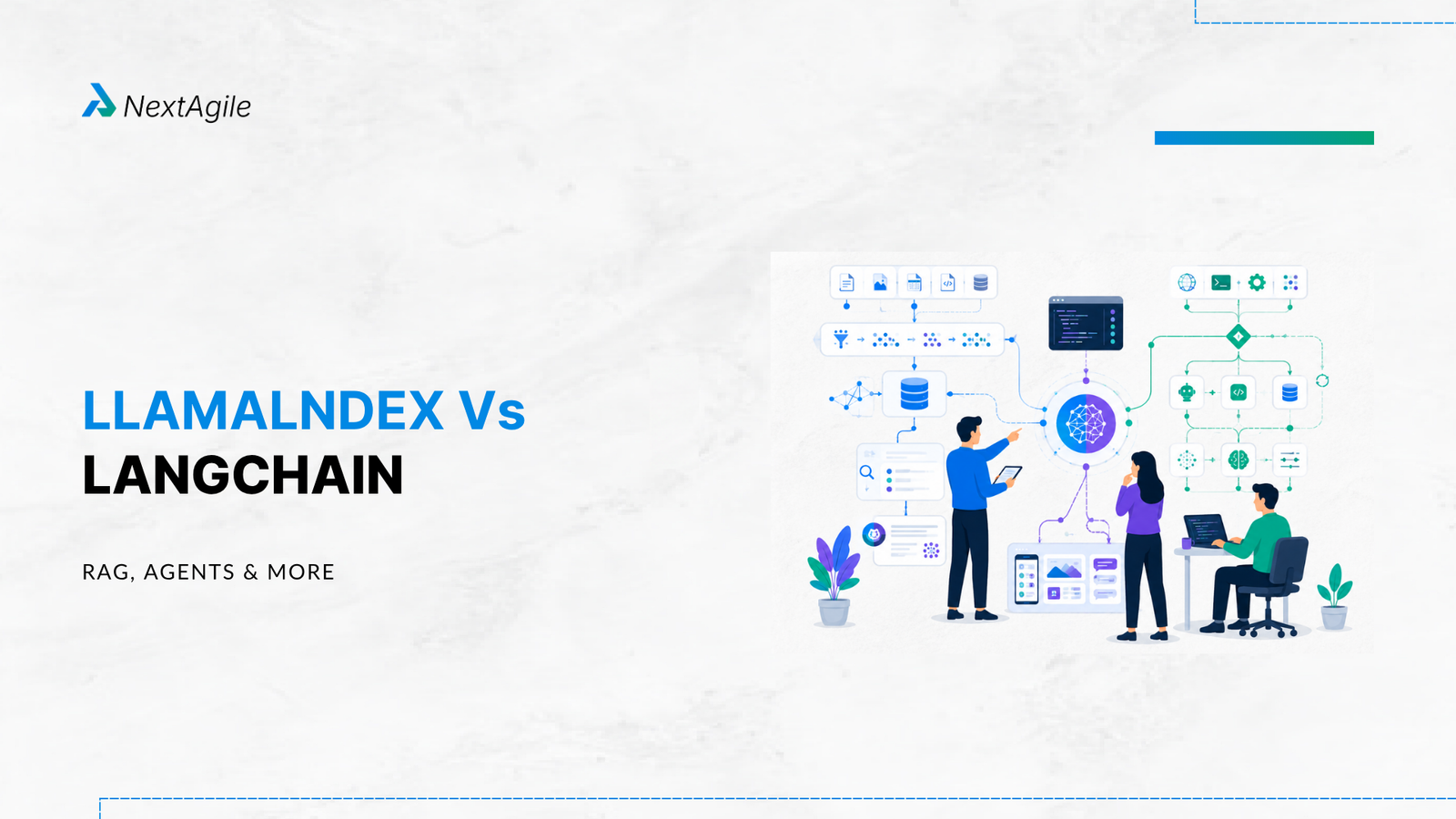
LlamaIndex vs LangChain: RAG, AI Agents & Which to Choose in 2026
Rahul Singh
Talk to Expert for Free
Table of Contents
Quick Answer
LlamaIndex wins for retrieval-augmented generation (RAG) and data-indexing pipelines, with more thought-through abstractions for ingesting, chunking, and querying documents. LangChain wins for multi-step agent orchestration and conversational AI, backed by LangGraph, its stateful graph-based runtime for complex, cyclical agent loops. Both are genuinely production-ready in 2026, and by mid-2026 the two frameworks overlap enough that a clean either-or choice is less common than it used to be. Most serious production systems in 2026 run both side by side: LlamaIndex as the data and retrieval layer, LangChain or LangGraph as the orchestration layer. The honest tradeoff to know upfront: if your workflow is a single prompt against a small, stable dataset, adding either framework’s abstraction layer costs you latency and maintenance overhead without a matching benefit.
Key Highlights of LlamaIndex vs LangChain
LangChain’sofficial documentation describes LangGraph as a stateful, graph-based runtime purpose-built for complex, cyclical agent loops, distinct from LangChain’s original linear chain abstraction.
LlamaIndex, formerly GPT Index, is described in itsofficial documentation as a data framework for ingesting, indexing, and querying private or domain-specific data with LLMs.
LangChain’s 1.0 release in late 2025 resolved most of the earlier API-churn instability that burned teams on pre-1.0 versions; most new 2026 projects start directly on the 1.x line.
LlamaIndex’s Workflows primitive, introduced in v0.10, added agent-orchestration capability, but agent tooling remains a secondary strength compared to its core retrieval and indexing depth.
LlamaIndex Core is fully open-source under the MIT license; LlamaCloud and LlamaParse are separate paid managed services for enterprise-grade document parsing and retrieval at scale.
Introduction
LlamaIndex vs LangChain is one of the first architecture decisions almost every AI engineering team makes in 2026, and picking the wrong one early can cost weeks of refactoring later. Both are open-source Python and TypeScript frameworks, both support every major LLM provider, and both have large, active communities, which is exactly why the decision is confusing rather than obvious. They solve genuinely different core problems: LangChain is built around composable chains and agents for wiring together prompts, tools, memory, and LLMs into computation graphs, while LlamaIndex is built around data pipelines, with ingestion, indexing, retrieval, and synthesis as its core primitives.
This guide breaks down the real architectural differences, where each framework wins by use case, what changed with LangChain 1.0 and LlamaIndex’s Workflows, and when running both together in one production stack makes more sense than picking just one.
LlamaIndex vs LangChain: RAG and AI Agent Frameworks Compared
Dimension
LangChain
LlamaIndex
Core philosophy
Composable chains and agents wired into computation graphs
Data pipelines: ingestion, indexing, retrieval, synthesis
Agent tooling
LangGraph: first-class, stateful graph runtime for complex loops
Workflows primitive (v0.10+); agent orchestration is secondary
More concepts to learn: chains, agents, LangGraph nodes/edges
Gentler for RAG-focused tasks; a working system in under 10 lines
Licensing / cost
Open-source core; LangSmith and LangGraph Platform for paid observability
MIT-licensed core; LlamaCloud and LlamaParse are paid managed add-ons
2026 stability
1.0 release (late 2025) resolved most prior API churn
Stable since well before 1.0-era churn affected LangChain
What Are LangChain and LlamaIndex Used For?
Short answer: LangChain is a general-purpose framework for building LLM-powered applications through composable chains and agents, with LangGraph as its stateful runtime for complex agent loops. LlamaIndex is a data framework focused on ingesting, indexing, and retrieving private or domain-specific data for use with LLMs.
LangChain for AI Application Development and Agent Orchestration
LangChain breaks complex AI behavior into composable building blocks instead of cramming everything into one massive prompt. Its ecosystem includes LangChain Core (base abstractions for prompts, models, and output parsers) and LangGraph (a stateful, graph-based runtime for building complex, cyclical agents). A chain moves a task through a fixed sequence of LLM and tool calls, while an agent decides at runtime which tool to call next based on the goal and the previous step’s result, which is what makes LangChain a strong fit for research assistants, ops copilots, and support bots that need real branching logic.
LlamaIndex for RAG, Data Ingestion, and Knowledge Retrieval
LlamaIndex, formerly called GPT Index, is a data framework purpose-built to make retrieval-augmented generation simpler to ship and operate. It offers different index types for different data shapes: vector indices for semantic search, tree indices for hierarchical documents, and keyword indices for exact-match scenarios. Its abstractions around loading, chunking, and indexing varied document types, PDFs, Word docs, Notion pages, web pages, and database rows, are consistently rated more thought-through than LangChain’s equivalent tooling by engineering teams comparing both in production.
Engineers new to either framework can pair this comparison with NextAgile’s broader breakdown ofAI agents vs agentic AI, since understanding that distinction first makes the LangChain-vs-LlamaIndex architecture choice much clearer.
LlamaIndex vs LangChain Use Cases: RAG, Agents, and Enterprise AI
Short answer: Choose LlamaIndex for document-heavy retrieval use cases like internal Q&A, legal or policy assistants, and knowledge bases. Choose LangChain for agentic use cases involving multi-step reasoning, tool orchestration, and complex conversational branching logic.
Internal documentation Q&A, legal and policy assistants, and support knowledge bases: LlamaIndex, because retrieval accuracy from large document sets matters more than complex multi-step reasoning.
Research assistants, ops copilots, and customer support bots that must decide between multiple tools at runtime: LangChain with LangGraph, because the branching, stateful logic is exactly what LangGraph is built for.
Financial document analysis, contract knowledge-graph generation, and hybrid RAG plus Text2SQL routing: LlamaIndex, whose adoption in aviation, legal, and finance is driven specifically by retrieval accuracy requirements.
Multi-tool agents that need broad third-party integrations across LLM providers, vector stores, and APIs: LangChain, which maintains one of the broadest integration ecosystems of any framework in this space.
Teams scoping their first production RAG or agent project can benchmark their use case against NextAgile’s guide toagentic AI use cases before committing to either framework.
 Skip to content