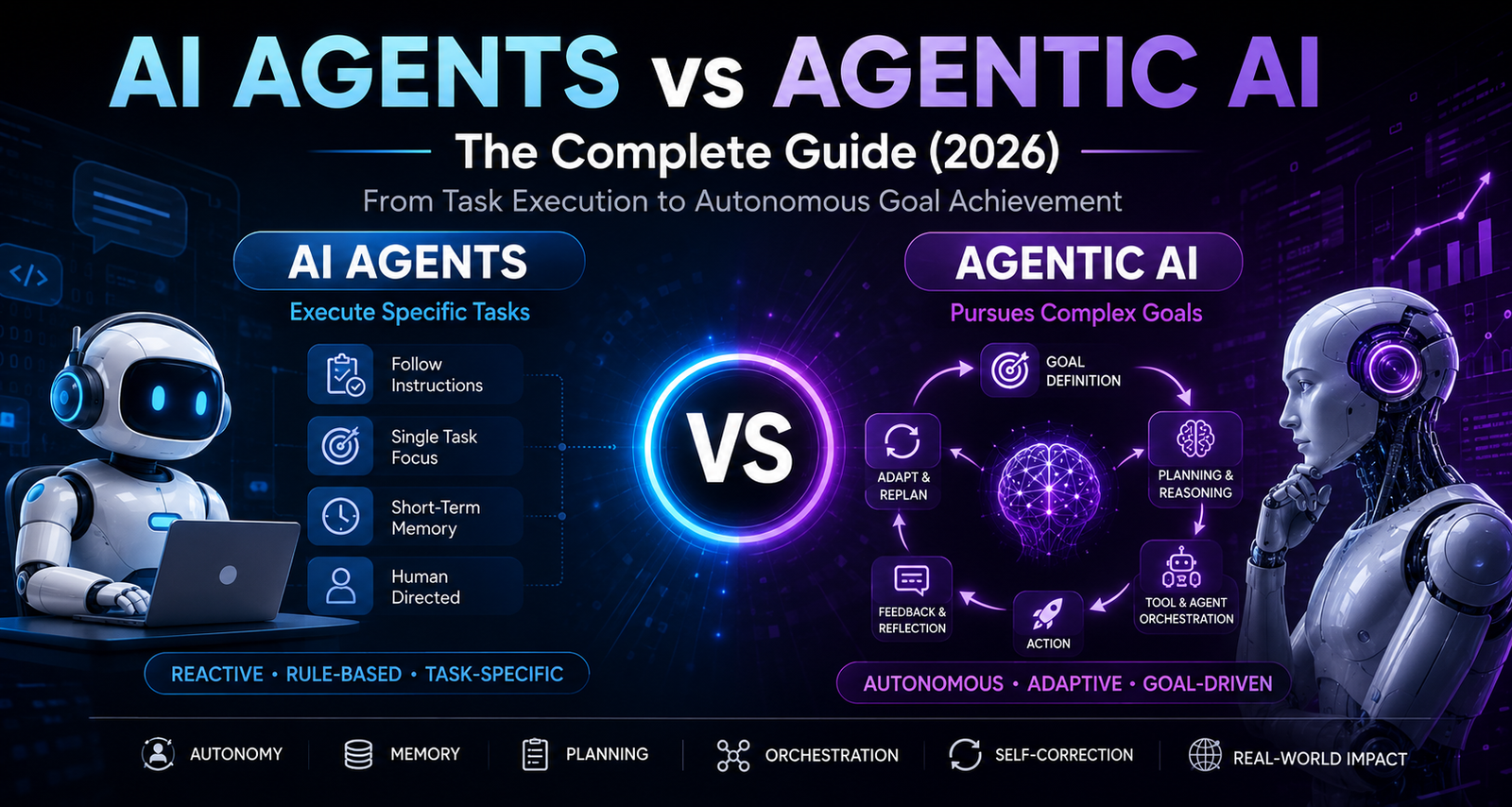
AI agents and agentic AI are not the same thing. An AI agent is a software component built to execute a specific, bounded task, such as answering a support ticket, flagging fraud, or scheduling a meeting. Agentic AI is a broader architectural paradigm where autonomous systems plan multi-step goals, coordinate multiple agents, reason over context, and self-correct to achieve complex business outcomes without constant human input.
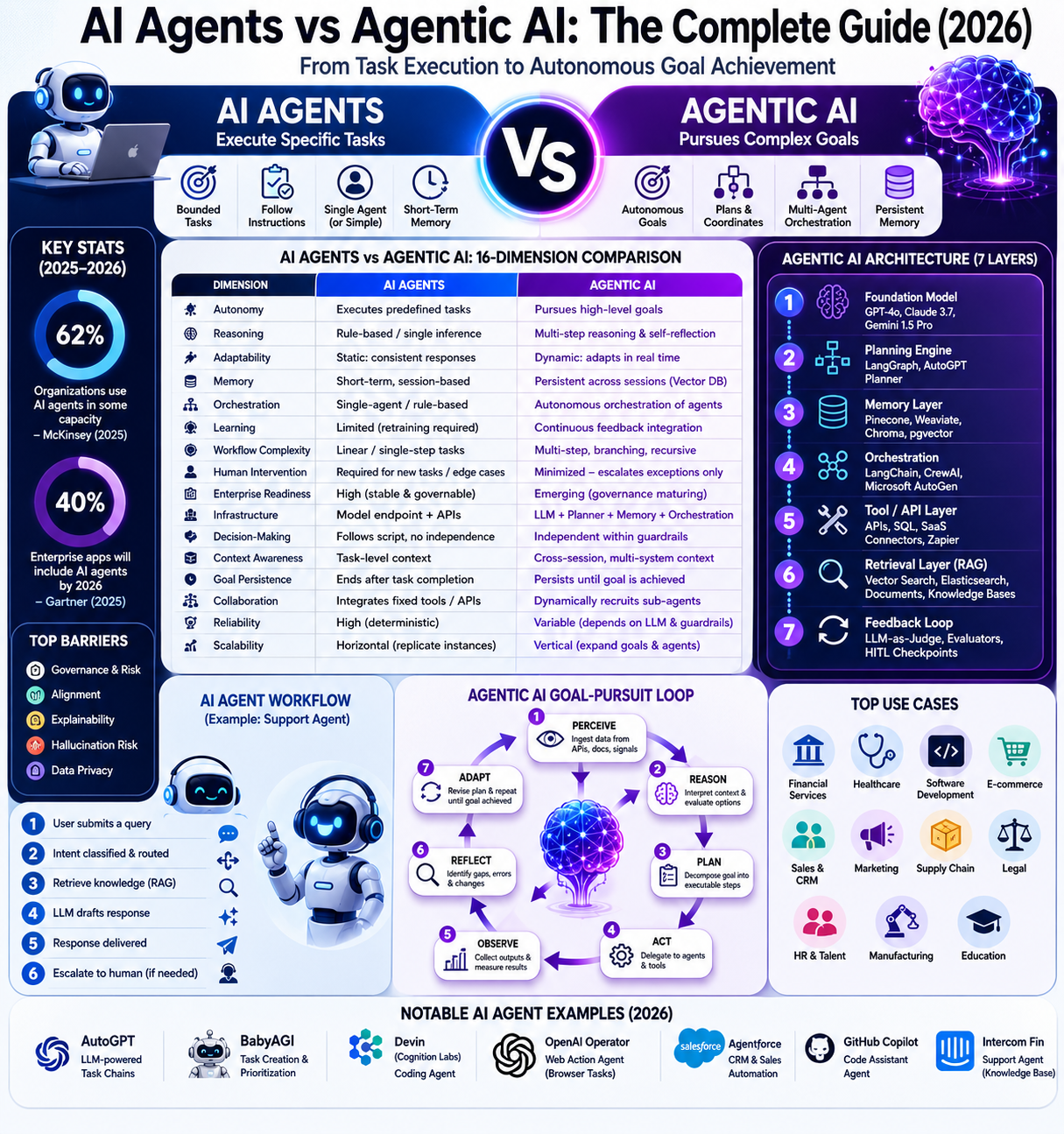
According to Gartner (2025), 40% of enterprise applications will include task-specific AI agents by 2026, up from under 5% in 2025. McKinsey (2025) reports 62% of organizations already use AI agents in some capacity. Agentic AI extends this by combining reasoning, memory, orchestration, and feedback loops into systems that pursue goals instead of just executing instructions.
The key limitation: agentic AI is still early-stage for enterprise deployment. Governance, alignment, and explainability remain the top challenges. This article is essential for CTOs, AI product managers, SaaS founders, and transformation leaders evaluating where to invest in autonomous AI.
Key Highlights of AI Agents vs Agentic AI McKinsey (2025): 62% of organizations already use AI agents in production environments. Gartner (2025): AI agents will appear in 40% of enterprise apps by 2026, up from under 5% in 2025. AI agents execute specific tasks; agentic AI orchestrates multi-agent systems toward broader business goals. The core differentiator is autonomy: agents react, agentic AI plans, coordinates, and adapts. Agentic AI architecture requires 7 layers: LLM reasoning, memory (vector DB), planning engine, orchestration framework (LangChain , AutoGen ), tool access, retrieval (RAG), and feedback loops. Top industries deploying agentic AI: financial services, healthcare, software development, and ecommerce. Governance, hallucination risk, and AI alignment remain the #1 enterprise adoption barriers in 2026. AI Agents vs Agentic AI
What Are AI Agents? Definition, History, and Core Components An AI agent is a software program that perceives its environment, processes information using programmed logic or trained models, and executes specific actions to achieve a defined objective. AI agents operate within bounded parameters — they do not set their own goals. Examples include customer support chatbots, fraud detection algorithms, recommendation engines, scheduling bots, and RPA automations.
The concept of an AI agent dates to 1998, when Wooldridge and Jennings defined it as ‘any hardware or software-based computer system that enjoys properties such as autonomy, social ability, reactivity, and proactivity.’ The term pre-dates large language models by over two decades.
Modern AI agents, especially LLM-powered ones, evolved significantly after GPT-3 (2020) and GPT-4 (2023) arrived. Tools like AutoGPT (2023), BabyAGI (2023), and OpenAI Operator (2025) demonstrated how language model reasoning could enable agents to use tools, chain actions, and interpret complex queries.
Core Components of an AI Agent Perception layer: inputs such as text, voice, images, sensor data, or API signals Processing engine: LLM or rule-based model that interprets input and determines action Action engine: API calls, tool use, database queries, form submissions, or notifications Memory: short-term context window or long-term vector database retrieval Goal definition: set explicitly by a human operator or encoded in a system prompt Output: a response, a workflow action, a data transformation, or a trigger to another system Five Types of AI Agents (Russell and Norvig Classification) Reactive agents: respond to current inputs with no memory or learning (e.g., spam filters) Model-based agents: maintain an internal world model to make decisions (e.g., inventory bots) Goal-based agents: select actions based on a desired end state (e.g., route planners) Utility-based agents: evaluate tradeoffs to maximize a value function (e.g., recommendation engines) Learning agents: improve over time using feedback loops and reinforcement signals (e.g., fraud models) Single-Agent vs Multi-Agent Systems A single AI agent handles one bounded function. A multi-agent system coordinates multiple specialized agents toward a shared outcome. In a multi-agent customer service stack, one agent classifies intent, a second retrieves account data, and a third drafts the response. Each operates within its own task scope.
The distinction matters because multi-agent systems are often confused with agentic AI. They are not the same. Multi-agent systems coordinate tasks. Agentic AI reasons about which tasks to pursue, how to sequence them, and how to recover when plans fail.
Named Production AI Agent Examples Agent Name Type Function Autonomy Level AutoGPT LLM-powered Self-directed task chains using GPT-4 Medium BabyAGI LLM-powered Task creation and prioritization loops Medium Devin (Cognition Labs) Coding agent Full software development cycle High OpenAI Operator Web action agent Browser-based task execution Medium Salesforce Agentforce CRM agent Sales pipeline automation Low,Medium GitHub Copilot Code assistant agent Code suggestion and generation Low Intercom Fin Support agent Customer query resolution via knowledge base Medium
What Is Agentic AI? Formal Definition and Architecture Agentic AI is an architectural paradigm where autonomous AI systems can independently set goals, plan multi-step action sequences, coordinate multiple specialized agents and tools, maintain contextual memory across sessions, and self-correct based on real-time feedback to achieve complex business outcomes. Agentic AI is not a single product or model — it is a system design approach that builds genuine agency into AI infrastructure.
Sapkota, Roumeliotis, and Karkee (arXiv 2505.10468) , revised September 2025, define agentic AI systems as representing ‘a paradigm shift marked by multi-agent collaboration, dynamic task decomposition, persistent memory, and coordinated autonomy.’
ISACA (August 2025) defines agentic AI as possessing ‘genuine agency, the capability for independent action,’ with systems designed to operate ‘with a high degree of autonomy, allowing them to independently perform tasks such as hypothesis generation, literature review, experimental design, and adaptive decision-making.’
Five Core Properties of Agentic AI
Goal-oriented reasoning: the system pursues an outcome it was not explicitly scripted to achieve step by step Autonomous planning: it decomposes high-level goals into subtasks without human step-by-step instruction Dynamic orchestration: it decides which agents, tools, and data sources to activate at each step in real time Persistent memory: it retains context across sessions using vector databases and retrieval-augmented generation (RAG) Adaptive self-correction: it detects when a plan fails and replans without human intervention The Agentic AI Perception,Reasoning,Action Loop Agentic AI systems operate inside a continuous loop that mirrors human executive cognition
PERCEIVE: ingest structured and unstructured inputs from APIs, documents, databases, and sensors REASON: use LLM chain-of-thought reasoning to interpret context and evaluate options PLAN: decompose the goal into executable subtasks using a planning engine such as LangGraph or AutoGPT ACT: delegate subtasks to specialized agents or tool integrations OBSERVE: collect outputs and compare against the goal state using an evaluator REFLECT: identify gaps, errors, or changed conditions that affect the plan ADAPT: revise the plan and repeat the loop until the goal is achieved or escalation is triggered This loop is what fundamentally separates agentic AI from traditional AI agents. An AI agent executes step 4 only. An agentic system executes all seven, continuously, until the goal is reached.
AI Agents vs Agentic AI: The 16-Dimension Comparison This is the most comprehensive side-by-side breakdown available. Use it to decide which system fits your organization’s current AI maturity and risk tolerance.
Dimension AI Agents Agentic AI Autonomy Executes predefined tasks within fixed boundaries Pursues high-level goals with minimal human instruction per step Reasoning Rule-based or single-model inference Multi-step chain-of-thought reasoning with self-reflection Adaptability Static: responds to defined inputs consistently Dynamic: revises approach based on real-time feedback Memory Short-term within one session or context window Persistent across sessions via vector DBs and RAG pipelines Orchestration Single-agent or rule-based multi-agent Autonomous orchestration of heterogeneous agent networks Learning Capability Limited — requires formal retraining cycles Continuous feedback integration without full model retraining Workflow Complexity Single-step or linear task execution Multi-step, branching, conditional, and recursive workflows Human Intervention Required for new tasks or edge cases Designed to minimize touchpoints — escalates exceptions only Scalability Scales horizontally via instance replication Scales vertically via expanded goal scope and agent count Enterprise Readiness High: stable, auditable, governable today Emerging: governance frameworks still maturing in 2026 Infrastructure Standard API + model endpoint LLM + planning engine + vector DB + orchestration framework Decision-Making No independent decision-making; follows script Independent decision-making within defined organizational guardrails Contextual Awareness Task-level context only within one session Cross-session, multi-system, organizational-level context Goal Persistence Dissolves after task completion Persists and adapts until high-level goal is achieved Collaboration Integrates with fixed APIs and workflow tools Dynamically recruits and coordinates specialized sub-agents Reliability High: deterministic and auditable Variable: depends on LLM reasoning quality and guardrail design
Architecture Deep Dive: How AI Agent and Agentic AI Systems Are Built AI Agent Architecture (3 Layers) Input layer: API endpoint, webhook, or UI widget that receives a trigger Logic layer: a fine-tuned LLM, rules engine, or ML classifier that processes the input Output layer: API call, database write, notification, or response generation Modern AI agents also include a tool use layer where the model calls external functions. OpenAI’s function calling API, Anthropic’s tool use API, and Google Vertex AI tool integration all enable agents to query databases, run code, and interact with external services within a bounded scope.
Agentic AI Architecture: The 7-Layer Stack Layer Component Enterprise Examples 1. Foundation Model LLM providing reasoning and language understanding GPT-4o, Claude 3.7, Gemini 1.5 Pro 2. Planning Engine Decomposes goals into executable subtasks LangGraph, AutoGPT Planner, OpenAI Assistants API 3. Memory Layer Stores context across sessions and agents Pinecone, Weaviate, Chroma, pgvector 4. Orchestration Routes tasks to the right agent or tool LangChain , CrewAI, Microsoft AutoGen , Semantic Kernel 5. Tool/API Layer Connects agents to external systems and data Zapier, REST APIs, SQL engines, SaaS connectors 6. Retrieval Layer Pulls relevant knowledge for grounded reasoning RAG pipelines, Elasticsearch, vector search indices 7. Feedback Loop Evaluates outputs and triggers replanning LLM-as-judge evaluators, HITL checkpoints
The Model Context Protocol (MCP) , introduced by Anthropic in 2024, has become the emerging standard for connecting LLMs to external tools and data sources in agentic systems. MCP provides a standardized interface enabling agents to interact with databases, file systems, APIs, and services without custom integrations for each connection.
How AI Agents Work: Step-by-Step Workflow Example: An AI Customer Support Agent User submits a support query via the chat interface or email channel Intent classification model routes the query to the correct specialist agent The agent retrieves relevant knowledge base articles using semantic search The LLM drafts a response using retrieved context and the conversation history The response is delivered to the user within 2 to 8 seconds If unresolved, the ticket is escalated to a human support queue with full context The agent executes a fixed workflow. It does not decide whether this query should exist, what additional systemic data to collect, or how to improve the product that caused the issue. Those decisions require agentic AI.
How Agentic AI Works: The Autonomous Goal-Pursuit Loop Example: An Agentic Sales Operations System Business objective ingested: ‘Increase pipeline value by 20% in Q3 without adding headcount’ Planning engine decomposes this into subtasks: lead scoring, outreach sequencing, objection handling, forecast modeling The orchestrator activates a lead scoring agent, a CRM data agent, and an email personalization agent in parallel The lead scoring agent pulls real-time signals from LinkedIn, CRM, and intent data platforms The personalization agent drafts individualized outreach messages based on persona, company stage, and recent buying triggers The forecast agent models pipeline scenarios and flags at-risk deals for human review A reflection module evaluates outputs against pipeline growth KPIs weekly If pipeline growth stalls, the planner revises channel mix and retargets accounts based on performance data This is not task execution. This is goal pursuit. The system does not need a human to tell it to ‘now do lead scoring.’ It determines that lead scoring is required as part of achieving the stated business goal, activates the relevant agent, and evaluates whether the action moved the KPI.
Real-World Use Cases: AI Agents vs Agentic AI Across 11 Industries 1. Financial Services AI Agent use case: A fraud detection agent at a fintech firm flags transactions above a risk threshold in real time. It routes flagged transactions to a compliance queue without determining what the threshold should be.
Agentic AI use case: An agentic risk management system at a Tier 1 bank ingests live market feeds, customer portfolio data, regulatory updates, and macroeconomic signals simultaneously. It autonomously rebalances risk exposure, triggers compliance checks, and drafts board-level risk reports within defined regulatory boundaries. JP Morgan’s COIN system and Goldman Sachs’ AI-assisted trading models represent early versions of this architecture.
2. Healthcare AI Agent use case: A clinical decision support agent flags drug interactions in EHR data and alerts the prescribing physician via an integrated notification.
Agentic AI use case: An agentic diagnostic system at a hospital network synthesizes imaging reports, lab results, patient history, and medical literature to autonomously generate differential diagnoses, suggest evidence-based treatment pathways, and schedule follow-up care. According to Nature Medicine (2023) , AI-assisted clinical reasoning reduced diagnostic errors by 27% in radiology studies. Agentic architecture extends this capability across the full care pathway.
3. Software Development AI Agent use case: GitHub Copilot suggests the next line of code based on the developer’s current context and project patterns.
Agentic AI use case: Devin by Cognition Labs operates as a full software engineer, reading a Jira ticket, cloning a repository, writing code, running tests, debugging failures, and submitting a pull request. It completed 13.86% of SWE-bench tasks autonomously compared to 1.96% for prior state-of-the-art agents (Cognition Labs, 2024). This is agentic AI applied to software engineering.
4. Ecommerce AI Agent use case: A product recommendation agent surfaces relevant items based on browsing history, cart state, and purchase history.
Agentic AI use case: An agentic merchandising system at a large retailer autonomously manages pricing, inventory reordering, supplier negotiation, and promotional planning across 50,000+ SKUs. It monitors competitor pricing, detects demand signals, and adjusts markdown strategies in real time without human approval at each step.
5. Insurance AI Agent use case: A claims intake agent extracts key data fields from submitted documents and pre-fills the claims management form for a human adjuster to review.
Agentic AI use case: An agentic claims processing system receives a claim, retrieves the policy, assesses liability using historical precedent data, requests missing documents, coordinates with a repair vendor network, issues a settlement offer, and closes the claim end to end. Industry benchmarks show agentic claims processing reduces cycle time by 60 to 80%.
6. Manufacturing AI Agent use case: A predictive maintenance agent triggers a maintenance alert when sensor readings exceed a predefined degradation threshold.
Agentic AI use case: An agentic production optimization system monitors OEE (Overall Equipment Effectiveness) across a factory floor, autonomously adjusts shift schedules, reroutes production lines around equipment constraints, coordinates with suppliers for expedited parts, and continuously optimizes throughput against cost and delivery targets.
7. Cybersecurity AI Agent use case: A SIEM agent detects and logs anomalous network traffic patterns for human security analyst review.
Agentic AI use case: An agentic threat response system detects a ransomware intrusion, autonomously isolates affected network nodes, rolls back to clean snapshots, patches identified vulnerabilities, updates firewall rules, and produces a full incident report within minutes. Palo Alto Networks’ Cortex XSIAM represents this class of agentic security architecture.
8. Marketing Automation AI Agent use case: An email personalization agent generates individualized subject lines and body copy for a campaign blast based on audience segment data.
Agentic AI use case: An agentic marketing intelligence system sets quarterly campaign goals, autonomously allocates budget across channels, generates creative variants, tests them against audience segments, reallocates spend to top-performing combinations, and reports ROI without a campaign manager approving each decision step.
9. Customer Support AI Agent use case: A chatbot resolves Tier 1 support queries using a curated knowledge base and escalates unresolved cases to human agents.
Agentic AI use case: An agentic support system handles the full customer lifecycle: onboarding, proactive issue detection before the customer notices, root cause analysis, resolution, follow-up, and churn risk identification. According to Intercom (2024), their Fin AI agent resolves 51% of queries without human intervention. Agentic systems aim to resolve the remaining 49% through multi-step reasoning across novel edge cases.
10. Education Agentic AI use case: An AI tutoring system powered by agentic architecture assesses a student’s knowledge gaps, dynamically builds a personalized curriculum, generates practice problems calibrated to the student’s level, evaluates answers, adjusts difficulty in real time, and notifies instructors when direct intervention is needed. Khanmigo by Khan Academy represents this direction in AI-powered personalized learning.
11. SaaS Product Development Agentic AI use case: An agentic product intelligence system monitors user behavior data, identifies drop-off patterns, generates and prioritizes product hypotheses, runs A/B tests, evaluates results, and proposes roadmap changes, compressing what normally takes a product team 6 weeks into 48 hours of autonomous analysis.
Benefits of AI Agents Automation of repetitive, high-volume tasks with deterministic, auditable outcomes Low implementation cost: most SaaS platforms in 2026 include agent capabilities out of the box High reliability: rule-based and fine-tuned agents behave predictably within defined scope Easy governance: all actions are auditable, scoped, and explainable to compliance teams Fast time to value: most agent integrations go live in days, not months Horizontal scalability: handles volume spikes without architectural redesign Benefits of Agentic AI Goal-oriented intelligence: pursues outcomes instead of just completing individual instructions Long-horizon planning: coordinates work across weeks or quarters, not just single sessions Autonomous decision optimization: reduces human bottlenecks in judgment-heavy processes Continuous improvement: integrates feedback signals without requiring full model retraining Enterprise transformation: compresses multi-team workflows into single agentic pipelines Orchestration efficiency: one agentic system coordinates the work of dozens of specialized agents Compounding competitive advantage: organizations deploying agentic systems in 2026 build durable leads through 2030 Limitations and Risks: What You Must Know Before Deploying Risk AI Agents Agentic AI Hallucination Low risk: bounded task scope limits the error surface High risk: errors compound across multi-step reasoning chains Governance Well understood: standard API auditing applies Emerging: no universal enterprise governance framework as of 2026 AI Alignment Low: follows explicit rules and boundaries Significant: goal misinterpretation can cascade across agent networks Security Standard API security applies Expanded attack surface: prompt injection, task hijacking, credential exposure Privacy Manageable with data minimization practices Complex: agents may access sensitive cross-system data without clear boundaries Infrastructure Cost Low: single model endpoint and standard APIs High: vector DBs, orchestration layers, evaluation pipelines, monitoring Explainability High: outputs traceable to rules or specific prompts Low: multi-step reasoning chains are difficult to audit step by step Human Oversight Easy: humans review outputs before action Requires intentional design: HITL checkpoints must be architected in
The most important risk management principle for agentic AI: scope before you scale. Define the exact boundaries of autonomous action before deployment. Build human-in-the-loop checkpoints at every decision node that carries financial, legal, or reputational consequence. Always start with internal workflows before extending autonomy to customer-facing systems.
When to Use AI Agents vs Agentic AI: Enterprise Decision Framework Scenario Recommended System Why Automate a single, well-defined task at high volume AI Agent Predictable, auditable, and fast to deploy without governance risk Replace a human-in-the-loop approval workflow AI Agent with HITL Keeps oversight in place while reducing processing time significantly Pursue a multi-week business goal autonomously Agentic AI Requires planning, memory, and multi-step reasoning across sessions Coordinate 5+ specialized agents toward one business outcome Agentic AI Orchestration is the core value of agentic architecture Early-stage AI adoption with low risk tolerance AI Agent Lower failure modes and significantly easier to govern and explain Mature AI organization with established governance frameworks Agentic AI Has the infrastructure to manage complexity and compliance requirements Customer-facing processes in regulated industries AI Agent first Risk of agentic errors is too high without proven internal guardrails Internal knowledge work and decision support functions Agentic AI High value output with contained risk when systems remain internal
For organizations unsure of their current AI maturity level, NextAgile’s Gen AI consulting services include an AI readiness assessment to map your organization’s position and define the right deployment path.
The Future of Agentic AI: Predictions for 2026, 2030, and Beyond 2026: Enterprise Pilots Become Production Systems Gartner predicts that 40% of enterprise applications will include AI agents by the end of 2026. The more significant shift: leading organizations will move from isolated agents to coordinated agentic systems managing full business functions. Expect agentic AI to manage HR onboarding cycles, financial close processes, customer renewal pipelines, and security operations centers without human orchestration at each step.
2028 to 2030: AI-Native Organizations Emerge The ‘AI coworker’ becomes a business reality. Organizations will assign specific business outcomes to agentic systems, not tasks, but outcomes. A Fortune 500 firm may deploy an agentic system as its Head of Supply Chain Optimization with authority to act within defined cost and compliance boundaries. The human role shifts from doing to deciding what boundaries to set and reviewing what the system achieved.
Multimodal agentic AI, systems that reason across text, images, video, audio, and sensor data simultaneously, will transform healthcare diagnostics, manufacturing quality control, and retail customer experience. Physical AI integrating robotics with agentic reasoning will move from research labs into warehouse operations, logistics, and surgical assistance by 2030.
Beyond 2030: Toward Autonomous Enterprise Architecture Agentic AI is not Artificial General Intelligence. AGI requires human-equivalent reasoning across all domains. Agentic AI is task-scoped, even when the task scope is large. However, the architectural patterns being built today, including persistent memory, multi-agent coordination, recursive self-improvement, and multimodal reasoning, are the precursor infrastructure for any AGI system that emerges in the future.
The organizations building fluency with agentic AI architectures in 2025 and 2026 will be positioned to deploy and govern whatever comes next. The NextWoW approach at NextAgile is specifically designed to help enterprises blend Agile maturity with AI adoption to build this organizational readiness now.
Expert Insights and Industry Perspectives Industry Perspectives (2025) Satya Nadella, Microsoft CEO (2025): ‘We are moving from copilots to agents. Every business function will have an AI operating system managing it by 2028.’Jensen Huang, NVIDIA CEO (2025): ‘Agentic AI is the next wave. Physical AI and digital agentic systems will generate $1 trillion in economic value by 2030.’Anthropic (2024): ‘Agentic settings introduce unique challenges around how to perform well and behave safely. The key risk is that mistakes may be difficult to reverse and could have downstream consequences within the same pipeline.’
Deloitte’s AI in the Enterprise Report (2025) finds that 67% of financial services firms plan to increase agentic AI investment by 40% or more in 2026. The primary constraint is not the technology itself. It is governance infrastructure, AI talent, and organizational change readiness.
For enterprise leaders who want to build agentic AI fluency without requiring technical depth, the NextAgile Agentic AI Workshop for Non-Tech Professionals provides a practitioner-led, business-focused path to understanding, designing, and deploying AI agents responsibly.
Frequently Asked Questions Q1: Is agentic AI the same as AI agents? No. AI agents are components that execute specific, bounded tasks. Agentic AI is a system design approach where autonomous systems plan multi-step goals, coordinate multiple agents, and self-correct based on feedback. Every agentic AI system uses AI agents as its building blocks. Not every AI agent system qualifies as agentic AI.
Q2: Is agentic AI better than AI agents? ‘Better’ depends entirely on the use case. AI agents are better for high-volume, well-defined, auditable tasks where predictability and governance matter. Agentic AI is better for complex, multi-step, goal-oriented work requiring adaptive planning across extended timeframes. Most mature enterprise AI strategies require both working in concert.
Q3: What companies are building agentic AI platforms? The primary platforms as of 2026 include Anthropic (Claude agentic systems and MCP ), OpenAI (Operator, Assistants API), Microsoft (Copilot Studio, AutoGen ), Salesforce (Agentforce), ServiceNow (Now Assist), and Google DeepMind (Gemini agents). On the infrastructure layer, LangChain , CrewAI, and Vertex AI Agent Builder power most enterprise agentic deployments.
Q4: Is ChatGPT an AI agent? ChatGPT in its conversational form is a generative AI model, not an AI agent. With the Operator feature (2025), it gains agentic capabilities: it can browse the web, execute browser-based tasks, and perform multi-step workflows autonomously. That version qualifies as an AI agent with limited agentic properties built on top of a generative AI foundation.
Q5: What is the difference between autonomous AI and agentic AI? ‘Autonomous AI’ is a broad descriptor for any AI operating without constant human input. ‘Agentic AI’ is a specific architectural term describing systems that combine autonomy with goal-pursuit, multi-step planning, multi-agent coordination, and persistent memory. All agentic AI is autonomous by definition. Not all autonomous AI is agentic in the architectural sense.
Q6: Can AI agents learn over time? Traditional AI agents learn only through formal retraining cycles. Modern LLM-powered agents can integrate feedback within a session via in-context learning, but this learning does not persist after the session ends. Agentic AI systems with vector database memory can retain key learnings across sessions. True continual learning without catastrophic forgetting remains an active research area as of 2026.
Q7: Are AI agents safe for enterprises to deploy? Well-scoped AI agents with deterministic logic are among the most governance-friendly AI deployments available. Risk level rises with agent autonomy, data access scope, and decision authority. Agentic AI requires deliberate safety design: human-in-the-loop checkpoints, data access controls, clear escalation paths, and alignment verification. ISACA’s 2025 AI Governance Framework recommends tiered risk assessment for all agentic AI deployments in enterprise settings.
Q8: What is multi-agent AI? Multi-agent AI refers to systems where two or more AI agents collaborate, compete, or coordinate to accomplish a task or set of tasks. A customer service multi-agent system might include a classifier agent, a retrieval agent, and a response generation agent. This differs from agentic AI: multi-agent systems coordinate tasks. Agentic AI reasons about which tasks to create, how to sequence them, and how to evaluate whether collective action achieved the high-level goal.
Q9: What is the future of AI agents in enterprise? By 2026, AI agents will be embedded in virtually every enterprise SaaS product as standard features. By 2028 to 2030, the frontier will shift to agentic systems managing entire business functions autonomously. The transition mirrors how the internet moved from static websites to dynamic applications: agents are the static website phase. Agentic AI is the dynamic application era.
Q10: How does agentic AI architecture work technically? Agentic AI architecture combines seven layers: a foundation LLM for reasoning, a planning engine for goal decomposition, a memory layer (vector database) for persistence, an orchestration framework (LangChain , CrewAI, AutoGen ) for multi-agent coordination, a tool/API layer for external system access, a retrieval layer (RAG) for grounded reasoning, and a feedback loop for self-correction. The Model Context Protocol (MCP) is the emerging standard for tool integration in 2026.
Q11: What is the difference between agentic AI and generative AI? Generative AI creates content, including text, images, code, and audio, from prompts. Agentic AI takes actions in the world to achieve goals. A generative AI model answers a question. An agentic AI system decides what questions to ask, what data to retrieve, what actions to take, and how to evaluate whether it succeeded. Agentic AI uses generative AI as its reasoning engine but extends far beyond content generation into autonomous execution.
Q12: What are the biggest mistakes organizations make when adopting AI agents? The five most costly mistakes: (1) treating AI agents as agentic AI before building governance infrastructure; (2) giving agents access to production systems without human oversight gates at critical decision points; (3) deploying agents in customer-facing contexts before internal pilots have proven reliability; (4) ignoring hallucination risk in high-stakes decisions that carry legal or financial consequences; and (5) failing to define and measure agent performance against specific success criteria from day one.
Q13: What is the ROI of agentic AI for enterprise organizations? Deloitte (2025) cites average cost reduction of 20 to 40% for automated knowledge work processes. McKinsey (2025) estimates that full deployment of AI automation including agentic systems could deliver $4.4 trillion in annual economic value globally. Early enterprise deployments in insurance claims processing report 60 to 80% cycle time reductions. Infrastructure costs for agentic systems are 3 to 5 times higher than simple agent deployments, so total cost of ownership analysis is essential before committing.
Q14: Who should use agentic AI vs standard AI agents? Use AI agents when you need reliable automation of a well-defined task, when you have low risk tolerance, or when you are in the early stages of organizational AI adoption. Use agentic AI when you are pursuing complex multi-step business goals that span multiple systems, when you have existing AI governance infrastructure in place, and when you have the technical capacity to build and maintain orchestration systems. The NextAgile Gen AI Consulting team can help your organization run a maturity assessment to map the right deployment path.
Q15: What types of agents exist inside an agentic AI system? Agentic AI systems typically include: orchestrator agents (direct other agents and manage the overall plan), worker agents (execute specific bounded tasks), planner agents (decompose high-level goals into subtasks), memory agents (manage context retrieval from vector databases), evaluator agents (assess output quality and flag errors), and tool-use agents (interface with external APIs and data systems). The orchestrator agent is what gives agentic AI its coherence, deciding which agents to activate, in what sequence, and when to adapt the plan.
Alok Dimri is the co-founder and leads the overall business at NextAgile, where he is responsible for strategy, client and consultant partnerships, and a whole lot of other core business activities like solutioning, branding, and customer engagement.
Over the past 16 years, he has worked extensively in business strategy, new business development, and key account management initiatives across process consulting and training domains.
 Skip to content