Key Highlights of Agentic AI Use Cases with Real-World Examples Gartner projects agentic AI will resolve 80% of common customer service issues without human intervention by 2029, cutting costs by 30% Walmart reduced product workflows from 30+ weeks to approximately 8 weeks using multi-agent orchestration (Product School, 2026) IDC projects total AI spending will reach $1.3 trillion by 2029, with agentic AI as the primary growth driver India saw a 340% year-over-year increase in agentic AI job postings in Q2 2026 vs Q2 2025 (Naukri.com) Use cases in BFSI and healthcare are reporting the strongest early ROI; IT/DevOps and supply chain are close behind Enterprises in 2026 are not asking whether to deploy agentic AI. They are asking where to start and how to measure results. This guide gives you both: 20 specific use cases mapped to real organizations, with ROI data where available, and a clear framework for choosing your first deployment.
What Makes Agentic AI Different from Traditional Automation Traditional automation (RPA, workflow tools) follows fixed rules: if X happens, do Y. It fails the moment it encounters variation.
Agentic AI operates differently. It receives a high-level goal, breaks it into subtasks, selects tools based on context, evaluates its own outputs, and adjusts its approach in real time. The same system that handles a standard billing query can also handle an edge-case escalation it has never seen before.
This distinction matters for use case selection. Fixed-rule, zero-variation tasks belong to RPA. Tasks involving judgement, unstructured data, or multi-step decision trees are where agentic AI creates genuine competitive advantage.
NextAgile’s Agentic AI Architecture Framework guide explains how enterprise agentic systems are structured across six technical layers, including where human-in-the-loop approval gates fit relative to each use case category.
Agentic AI Use Cases in Customer Operations Customer operations is the highest-volume deployment area for agentic AI in 2026. ROI data is the most mature here.
Autonomous Customer Support Resolution Problem: High ticket volume, repetitive queries, expensive human agent labor, slow resolution.
How it works: An intake agent classifies the ticket by intent. A resolution agent queries the CRM, knowledge base, and order management system. If confidence exceeds 85%, the action executes automatically. Between 60% and 85%, the ticket routes to human review with a draft pre-populated. Irreversible actions always require approval.
Real example: Gartner projects this model will resolve 80% of common service issues without human intervention by 2029 while cutting costs by 30%. Dialpad’s AI Agent platform is already achieving full-conversation autonomous resolution for billing and account queries across enterprise deployments.
ROI benchmark: 30 to 40% reduction in cost per ticket; 60 to 70% faster average resolution time.
Proactive Customer Outreach Agent How it works: Agents monitor signals such as site visits, job changes, and product activity. They personalize outreach based on intent data and orchestrate multi-touch follow-up across email and live chat. Unlike fixed marketing automation sequences, the agent adjusts messaging based on each contact’s response pattern.
Real example: Warmly.ai and similar revenue intelligence platforms use this architecture to automate outbound workflows that previously required dedicated SDR teams.
Agentic AI Use Cases in BFSI Fraud Detection and Real-Time Risk Assessment How it works: Security agents correlate transaction data, authentication events, and behavioral patterns simultaneously. When a suspicious pattern is detected, the agent investigates, assesses risk level, and triggers a containment or alert response within seconds. Human review is triggered for patterns above a defined risk threshold.
Real example: EICTA’s 2026 enterprise report cites financial services firms achieving sub-second fraud detection with false positive rates 40% lower than rule-based systems.
ROI benchmark: 40% fewer false positives; detection latency reduced from minutes to under 3 seconds.
Loan Underwriting and Compliance Monitoring How it works: An orchestrated agent team retrieves applicant financial data, cross-references credit history, runs regulatory compliance checks, and produces a structured underwriting recommendation with a full audit trail. Compliance agents also monitor regulatory changes and flag portfolios that need policy updates.
ROI benchmark: 70% reduction in manual underwriting time, reported by early adopters in US and UK banking (Omdena, 2026).
Reconciliation and Financial Reporting Automation How it works: Agents pull transaction records from multiple systems, match entries across sources, flag discrepancies above defined thresholds for human review, and generate structured reconciliation reports on schedule. Month-end close processes that previously took 5 to 7 days have been reduced to under 24 hours in early enterprise deployments.
Agentic AI Use Cases in Healthcare Clinical Documentation Automation Problem: Physicians spend approximately 2 hours per day on documentation. That is time not spent on patients.
How it works: Agentic AI transcribes clinician-patient interactions in real time, structures them into SOAP notes (Subjective, Objective, Assessment, Plan), populates EHR systems, and flags coding errors before submission. The agent handles documentation workflow; it does not make clinical decisions.
Real example: Nuance DAX ( Microsoft ) is deployed across 500+ US healthcare organizations and reduces documentation time by an average of 7 minutes per patient encounter, according to the company’s 2025 outcomes report.
Patient Flow and Scheduling Optimization How it works: Agents monitor bed availability, appointment cancellations, and incoming referrals in real time. They automatically reschedule appointments, notify patients via SMS or email, and alert staff to bed management decisions. Human approval is required for complex transfers or high-risk patient movements.
ROI benchmark: 15 to 22% improvement in appointment utilization rates in 2025 case studies from health systems piloting agent-based scheduling.
Prior Authorization and Claims Processing How it works: Agents extract clinical documentation required for insurance prior authorization, check it against payer rules, draft the authorization request, and submit it. They track response timelines and escalate delays. This task currently takes clinical staff 45 to 90 minutes per authorization.
Agentic AI Use Cases in Supply Chain and Manufacturing Demand Forecasting and Inventory Redistribution How it works: Agents analyze historical sales data, live POS feeds, weather forecasts, and supplier lead times simultaneously. They generate demand forecasts, propose redistribution orders between warehouses, and flag stockout risks 14 to 21 days in advance. Approved orders execute automatically; exceptions route to procurement managers.
Real example: Omdena’s 2026 agricultural use cases show agents adjusting irrigation schedules based on soil moisture, weather data, and crop needs – conserving water and improving drought resilience in farm operations across South Asia.
Quality Control and Defect Detection How it works: Vision agents analyze manufacturing line images in real time, flag defect patterns, and trigger process parameter adjustments. When defect rates exceed thresholds, agents notify engineers and pause specific line segments pending human review. Many manufacturers extend this same camera infrastructure beyond quality control, pairing it with manufacturing camera systems
ROI benchmark: Manufacturers piloting vision agents report 25 to 35% reduction in defect escape rates in early 2026 case studies.
How it works: Agents continuously monitor supplier news, financial filings, logistics data, and geopolitical signals. They score supplier risk levels daily and alert procurement teams to developing risks before they affect delivery timelines.
Agentic AI Use Cases in IT and DevOps Autonomous IT Support and Ticket Triage How it works: Agents triage incoming ITSM tickets (ServiceNow, Jira), classify by severity and category, retrieve knowledge base articles, and execute known fixes for Tier 1 issues including password resets, access provisioning, and software installations. Complex tickets auto-escalate with full context pre-populated.
Real example: Atlassian Intelligence embeds agentic capabilities directly into Jira. It auto-triages issues, suggests sprint compositions based on velocity history, generates release notes from sprint data, and surfaces dependency risks. NextAgile’s guide to the 11 best agentic AI tools for 2026 covers Jira-native agent capabilities and third-party alternatives in detail.
ROI benchmark: 50 to 65% of Tier 1 IT tickets resolved without human intervention in enterprise deployments.
Cloud Resource Optimization How it works: Cloud management agents continuously analyze resource utilization across an organization’s infrastructure. They identify idle capacity, adjust compute allocations based on actual demand, and propose reserved instance commitments based on usage forecasts. For cloud-heavy enterprises, this can recover 20 to 35% of cloud spend wasted on idle infrastructure (EICTA, 2026).
Code Review and Security Scanning How it works: Developer agents run automated code reviews, identify security vulnerabilities, suggest fixes with code samples, and check proposed changes against defined architecture patterns. They integrate into CI/CD pipelines and block merges for critical security issues while queuing non-critical feedback for developer review.
Agentic AI Use Cases in Human Resources Candidate Screening and Interview Scheduling How it works: Agents screen CVs against structured job criteria, rank candidates, send preliminary assessments, schedule interviews by integrating with calendar APIs, and update the ATS with each candidate’s status. Hiring managers receive a pre-ranked shortlist with AI-generated candidate summaries.
ROI benchmark: 50 to 65% reduction in time-to-first-interview across organizations using agentic hiring workflows (HR technology vendor outcome data, 2025).
Employee Onboarding Orchestration How it works: Onboarding agents create system accounts, assign mandatory training modules, schedule orientation sessions, send pre-boarding communications, and track completion status. They flag blockers like IT access delays or missing documents and escalate to HR or IT leads automatically.
Real example: Enterprises using agentic onboarding workflows report new hire productivity reaching baseline 2 to 3 weeks earlier than with manual onboarding processes.
Learning and Development Personalization How it works: L&D agents analyze employee performance data, role requirements, and skill gaps. They recommend personalized learning paths, track completion, and surface skill gaps before performance review cycles. Managers receive structured summaries of their team’s development progress.
Agentic AI Use Cases in Marketing and Sales Autonomous Campaign Optimization How it works: Marketing agents monitor campaign performance in real time, adjust bid strategies, pause underperforming ad sets, and run A/B tests on creative variants autonomously within pre-approved budget guardrails. Marketing leads review weekly summaries and approve significant budget reallocations.
Competitive Intelligence Monitoring How it works: Research agents monitor competitor websites, press releases, job postings, and social signals on a scheduled basis. They compile structured competitive intelligence reports and push alerts when a competitor makes a significant move – product launch, pricing change, or leadership hire. This task previously required a dedicated analyst 10 to 15 hours per week.
Pipeline and Deal Acceleration How it works: Sales agents monitor deal signals (email engagement, product usage, website visits), generate personalized follow-up drafts, flag deals at risk of going cold, and update CRM records automatically. Sales reps focus on high-value relationship work; agents handle follow-up consistency and CRM hygiene.
Agentic AI in Agile and SAFe Delivery Pipelines
This is the use case category most specific to NextAgile’s enterprise clients. It is also the one no competitor blog covers.
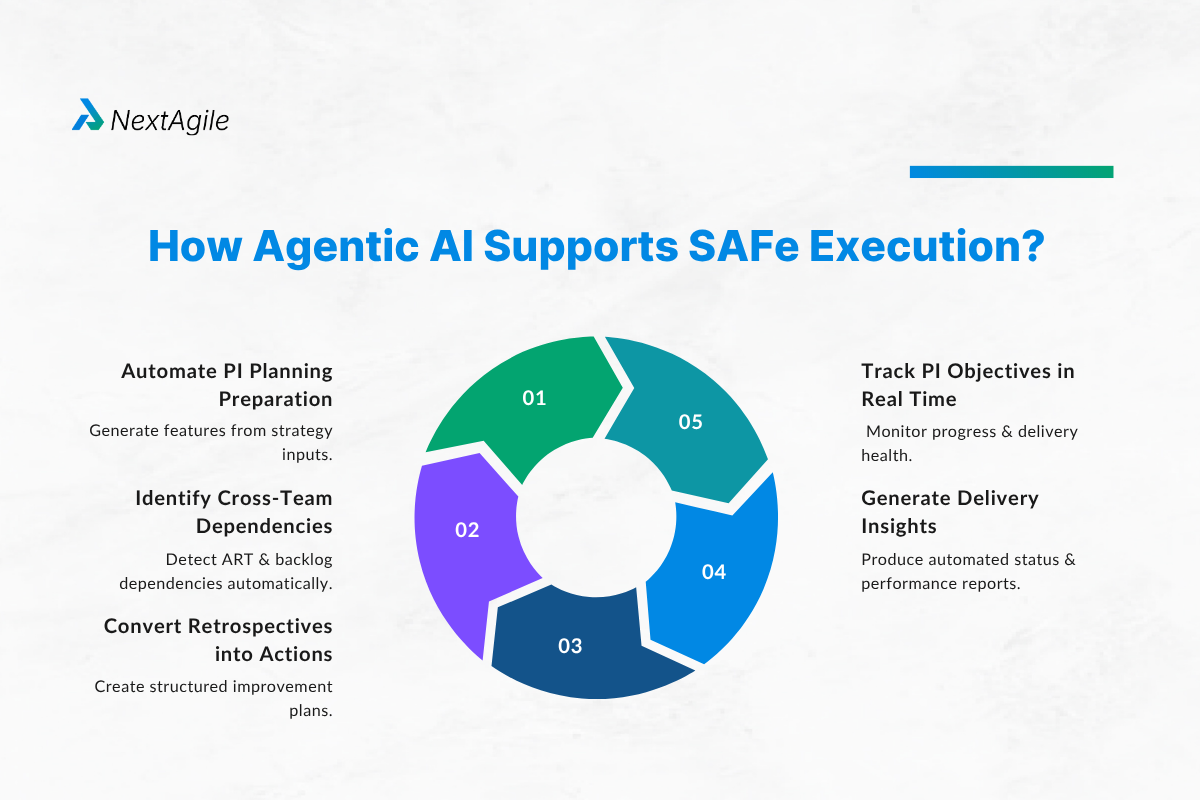
Agile teams running SAFe face specific challenges that agentic AI addresses directly. PI Planning preparation is one of the most time-intensive activities per quarter. Agents can auto-populate features from product strategy documents, flag cross-ART dependencies by analyzing existing backlog items, summarize sprint retrospectives into structured action items, monitor PI objective completion in real time, and generate weekly delivery health reports for RTEs and Product Managers.
At the team level, agents integrated with Jira can triage incoming backlog items, detect duplicate stories, check acceptance criteria completeness, and suggest story point estimates based on historical velocity data.
NextAgile’s corporate training programs include specific modules on integrating agentic AI tools into Jira-based SAFe workflows, covering both automation opportunities and human-in-the-loop governance for decision-critical planning activities.
For teams evaluating where agentic AI fits within a SAFe transformation, NextAgile’s Generative AI consulting services provide architecture assessment as the first engagement step.
How to Identify Your First Agentic AI Use Case: A 3-Step Framework Step 1: Find high-volume, repetitive tasks with structured outputs. The agents that succeed first in production are not doing complex reasoning. They are handling repetitive, structured tasks at scale. Ticket triage, document extraction, report generation, and data entry are all strong candidates. Step 2: Map your tool dependencies. Every agentic use case requires at least one external tool call – CRM, ERP, knowledge base, or calendar. Identify which APIs and data sources are already available and permissioned in your organization. Start where the plumbing already exists. Step 3: Define human-in-the-loop boundaries before building anything. Before writing a line of code, document exactly which actions require human approval and which can execute autonomously. This is the difference between a production system and a liability. Irreversible actions always start behind a HITL gate, even if you remove it later. Conclusion The use cases in this guide span eight industries and cover both quick wins (IT support triage, customer service automation) and strategic deployments (SAFe delivery integration, clinical documentation, and compliance monitoring). The organizations achieving results share three things: they started narrow, defined HITL boundaries explicitly, and built feedback loops that improve agent performance over time.
As an Agentic AI consulting firm , NextAgile works with enterprise teams in India and the US to identify the right starting use case, build the right architecture, and train the right people to govern it. If you want to move from evaluation to deployment, explore NextAgile’s Agentic AI Workshop or book a discovery call through our consulting services page.
For teams building internal agentic AI projects, NextAgile’s guide to 15 Agentic AI Projects to Build in 2026 provides implementation ideas with source code references.
Frequently Asked Questions 1. What industries are getting the most measurable ROI from agentic AI in 2026? BFSI and customer operations report the strongest early ROI because use cases have clear baseline metrics and structured data inputs. Healthcare is close behind due to documentation automation savings. Supply chain and HR are emerging high-ROI sectors with 2025 and 2026 pilots showing 50 to 70% time savings in specific workflows.
2. What is the difference between agentic AI and robotic process automation? RPA follows fixed, deterministic rules and fails when it encounters any variation. Agentic AI reasons dynamically. It handles unstructured inputs, selects tools based on context, retries on failure, and adapts its approach. Think of RPA as a macro recorder and agentic AI as an autonomous employee with a set of tools and a goal.
3. Is agentic AI being deployed by Indian enterprises in 2026? Yes, significantly. Major Indian banks, IT services firms, and manufacturing conglomerates are running production agents across IT support automation, recruitment, compliance monitoring, and supply chain. Naukri.com’s 2026 workforce data shows a 340% year-over-year increase in agentic AI job postings. DPDP Act 2023 compliance requirements are also driving investment in compliance monitoring agents specifically.
4. How is agentic AI different from a chatbot? A chatbot responds to one query and waits for the next input. An agentic AI system receives a high-level objective, breaks it into subtasks, calls multiple tools, evaluates its own outputs, and iterates until the goal is achieved, all without waiting for human input at each step.
5. What governance is required before deploying an agentic AI system? At minimum: an inventory of tools the agent can access, explicit HITL approval gates for irreversible actions, logging of every tool call and model response, a fallback plan for tool failures, and a regular review cadence to assess performance against baseline metrics. Regulated sectors need additional alignment with sector-specific compliance frameworks.
6. Can small and mid-sized businesses benefit from agentic AI? Yes. No-code platforms like Microsoft Copilot Studio, Zapier Agents , and Make make use cases like automated customer follow-up, invoice processing, and lead qualification accessible without dedicated AI engineers. Start with a single high-volume workflow rather than attempting broad automation.
Rahul seasoned technology leader with 20+ years of experience, now dedicated to mentoring and training individuals and groups in Generative AI, advanced AI/ML system design, and production best practices. He is a hands-on tech entrepreneur and has deep industry experience in building cutting-edge AI products.
 Skip to content