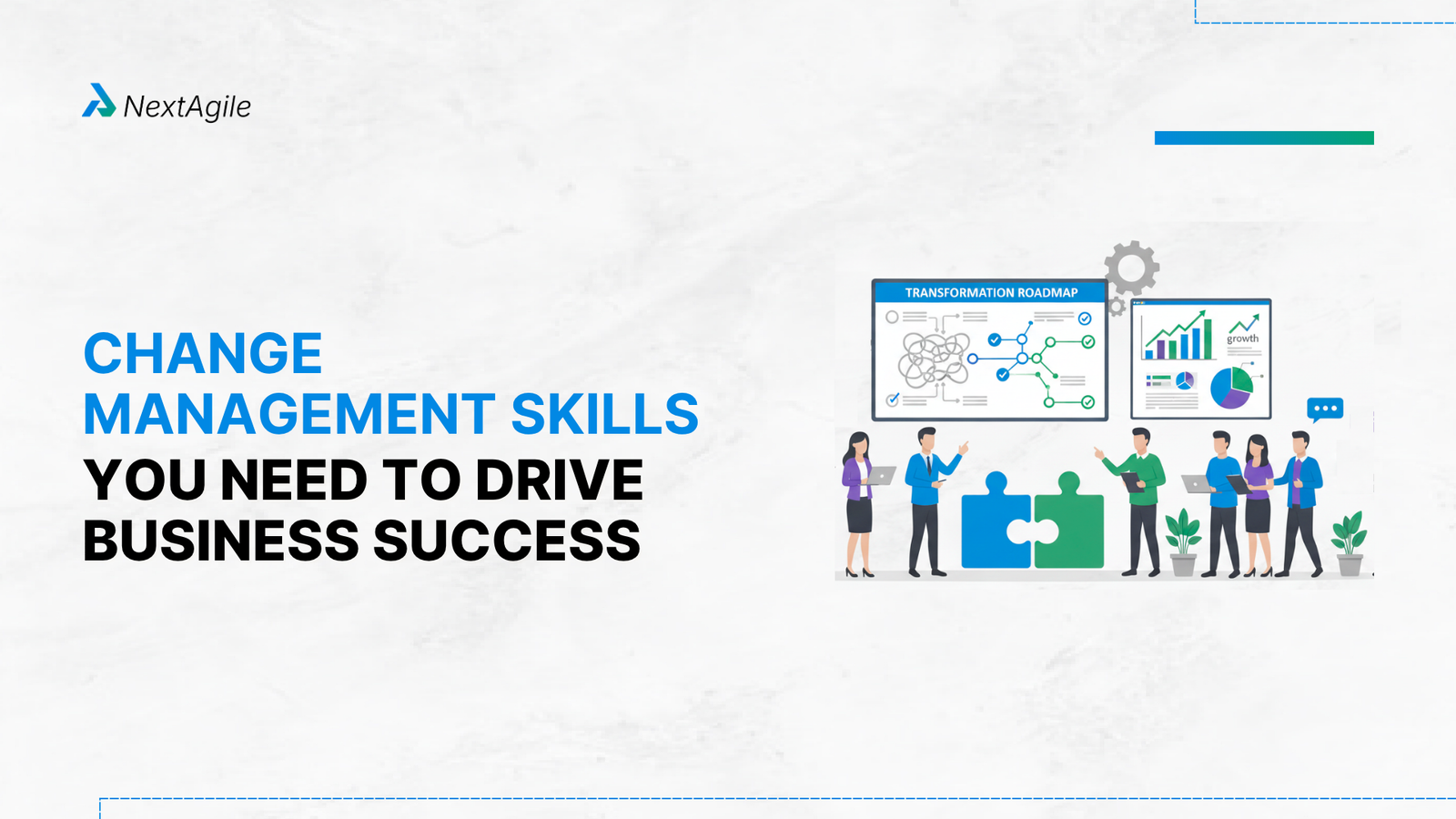
Key Takeaways From Change Management Skills Change management is the structured process of helping people and organizations move successfully from a current state to a desired future state. Strong change management skills reduce resistance, improve adoption, and increase the success of business transformation initiatives. Communication, emotional intelligence, stakeholder management, and strategic planning are among the most valuable skills needed for change management. Leadership and change management are closely connected because people follow trusted leaders during uncertainty. Organizations that invest in change capability improve resilience, innovation, and long term business performance. Change management skills can be developed through experience, certifications, mentorship, and continuous learning. Introduction Business transformation rarely fails because of poor strategy. It fails because people are expected to change faster than the organization knows how to lead them.
A company invests in new technology, yet employees continue working the old way. A merger promises growth but creates confusion across departments. A large transformation program launches with enthusiasm and loses momentum within months. The problem is often not the change itself. The problem is the ability to manage change in a way that aligns people, leadership, and business goals.
In an environment shaped by digital disruption, artificial intelligence, changing customer expectations, and global competition, change management has become a strategic business capability. Organizations that build strong change leadership adapt faster, recover from setbacks more effectively, and create sustainable competitive advantage.
This guide explores what change management is, why change management skills matter, the capabilities leaders need to succeed, and how organizations can strengthen their ability to navigate constant change.
What Is Change Management? Change management is the structured approach used to prepare, support, and guide individuals, teams, and organizations through change.
Many people think change management is about introducing a new system or process.
In reality, it is about helping people adopt new behaviors that allow the business to achieve better outcomes.
Every successful transformation depends on three connected elements:
People who understand the purpose of change. Processes that support new ways of working. Leadership that provides direction and confidence. Without those three elements working together, even well designed strategies struggle to deliver value.
Change management is no longer limited to large transformation programs. It has become part of everyday business leadership.
Why Are Change Management Skills Important? The pace of change is increasing across every industry.
Organizations are introducing artificial intelligence, modernizing operations, adopting digital platforms, and responding to changing market conditions. Each initiative requires people to think differently and work differently.
Strong change management skills help organizations:
Improve employee engagement Reduce resistance Increase project success rates Accelerate technology adoption Strengthen collaboration Build organizational resilience Align execution with business strategy The importance of leadership skills and change management becomes most visible during periods of uncertainty.
When employees lack clarity, they look to leadership. When stakeholders have competing priorities, they expect direction. When unexpected problems emerge, they need confidence that the organization can adapt.
Change management gives leaders the tools to create that confidence.
The Hidden Cost of Poor Change Management Many organizations focus on the cost of implementing change. Few calculate the cost of managing change poorly. The financial impact can be significant.
Delayed projects increase operational expenses. Confused teams duplicate work. Low adoption reduces the return on technology investments. Employee frustration increases turnover. Customers experience inconsistent service.
Weak change leadership often creates:
Budget overruns Strategy execution gaps Missed market opportunities Talent attrition Innovation bottlenecks Low employee morale Reduced organizational trust The damage is rarely immediate. It accumulates over time until transformation efforts lose momentum.
Organizations that consistently outperform competitors understand that leadership capability is one of the strongest predictors of successful change.
Why Great Leaders Become Great Change Leaders Change management and leadership cannot be separated. People do not simply follow plans; they follow leaders they trust.
Great change leaders create stability during uncertainty. They communicate openly, listen carefully, and make difficult decisions. They acknowledge challenges without creating fear.
Most importantly, they model the behaviors they expect from others. A leader who asks teams to embrace change while refusing to change personally creates resistance. A leader who demonstrates commitment, adaptability, and accountability creates momentum.
This is why change management leadership skills have become essential for executives, managers, and transformation leaders.
The NextAgile Change Leadership Framework
Many articles describe change management as a collection of independent skills.
Successful transformation is more integrated.
The NextAgile Change Leadership Framework organizes change capability into four connected pillars.
Pillar One: Create Clarity People rarely resist progress. They resist confusion. Leaders must create a clear understanding of why change is necessary and what success looks like.
This pillar includes:
Communication Strategic planning Stakeholder management Strong communication goes beyond announcements. It creates dialogue. Strategic planning ensures that change supports business objectives.
Stakeholder management helps leaders build alignment across departments and leadership levels.
Without clarity, organizations lose focus.
Pillar Two: Build Trust Trust determines whether people engage with change or avoid it. Building trust requires leaders to understand the human side of transformation.
This pillar focuses on:
Leaders who recognize employee concerns and provide meaningful support create stronger commitment. Culture also matters. Every organization has established behaviors and beliefs.
Successful change leaders work with culture instead of trying to ignore it. Coaching and mentoring reinforce confidence and help teams navigate uncertainty.
Pillar Three: Drive Execution Vision without execution produces frustration. Execution requires discipline and adaptability.
This pillar includes:
Transformation programs rarely follow a perfect path. Unexpected obstacles emerge and resources change along with shifting priorities. Strong execution leaders evaluate information, solve problems quickly, and keep initiatives moving.
Project management provides structure while analytical thinking improves decision making.
Pillar Four: Sustain Adoption Many organizations complete projects but fail to sustain change. Employees gradually return to old habits, and the benefits disappear.
This final pillar focuses on:
Change management expertise Continuous improvement Leadership reinforcement Long term success depends on measuring outcomes, learning from experience, and reinforcing desired behaviors. Transformation is not complete when a project ends. It is complete when the new way of working becomes normal.
Essential Change Management Skills in Practice Real business challenges rarely require a single skill.
Imagine an organization implementing a company wide digital transformation. Leadership must explain the vision. Stakeholders need alignment and employees require support.
Unexpected technical issues demand problem solving while project timelines need active management. Cultural barriers must be addressed. Data must be analyzed to measure adoption.
The ability to combine these capabilities separates successful transformation leaders from project coordinators.
This is why developing skills for change management should focus on integrated leadership rather than isolated competencies.
Business Transformation Examples Example One A financial services organization invested heavily in automation technology. The implementation plan focused on software deployment and technical training. Employee adoption remained low because leaders failed to explain how the change would improve daily work. Departments continued using legacy processes.
After introducing leadership communication sessions, stakeholder engagement workshops, and structured coaching, adoption improved and operational efficiency increased.
The technology had not changed, but the leadership approach had.
Example Two A growing technology company expanded rapidly through acquisitions. Each business unit had its own processes and culture. Collaboration became difficult and decision making slowed.
Leadership created a structured change program focused on shared goals, cross functional communication, and executive sponsorship.
The result was improved alignment and faster delivery across teams. The transformation succeeded because people were guided through change instead of being expected to adapt automatically.
How to Develop Change Management Skills?
Change management capability develops through practical experience and continuous learning.
Gain Hands On Experience The best way to build business change manager skills is by participating in transformation initiatives. Lead improvement projects, support organizational change, manage cross functional programs; experience develops confidence and judgment.
Earn Professional Certifications Structured certifications help leaders understand proven frameworks and methodologies.
Popular options include:
Prosci Change Management Certification Certified Change Management Professional Project Management Professional Agile and business transformation certifications These programs provide practical tools that can be applied across industries.
Learn From Real World Case Studies Successful and unsuccessful transformations both offer valuable lessons. Studying business examples helps leaders understand common challenges and avoid repeating costly mistakes. Learning from experience shortens the path to improvement.
Seek Mentorship and Leadership Development Mentors provide perspective that books and courses cannot replace. Leadership development programs also strengthen communication, influence, strategic thinking, and organizational awareness. Organizations that invest in long term capability building often create stronger and more sustainable transformation outcomes.
How to Improve Change Management Skills Leaders who want to improve change management skills should focus on consistent practice.
Seek honest feedback. Strengthen listening skills. Build relationships across teams. Improve emotional intelligence. Develop strategic thinking. Study successful transformations. Reflect on previous experiences. The best change leaders remain students of leadership. They understand that every transformation creates new opportunities to learn.
Common Change Management Mistakes Organizations Make Many organizations invest in change but overlook the factors that determine success.
Common mistakes include:
Treating change management as a communication exercise instead of a leadership capability. Waiting until resistance appears before engaging stakeholders. Assuming technology adoption will happen naturally. Ignoring organizational culture. Separating change initiatives from business strategy. Failing to reinforce new behaviors after implementation. Avoiding these mistakes increases the likelihood that transformation efforts will deliver lasting value.
Leadership and Change Are Becoming Competitive Advantages Technology can be purchased. Processes can be copied. Products can be imitated.
The ability to help people adapt, collaborate, and perform during uncertainty is far more difficult to replicate. Organizations that develop strong change leadership capabilities build cultures that learn faster and recover more effectively. They become more resilient because change is no longer viewed as disruption. It becomes part of how the business grows.
Conclusion Change is no longer an occasional event; it is a permanent business reality.
Organizations that succeed are not necessarily the ones with the largest budgets or the newest technologies. They are the ones with leaders who can align people, strategy, and execution.
Strong change management skills help businesses reduce resistance, improve adoption, strengthen collaboration, and create sustainable transformation.
The future belongs to organizations that can adapt with confidence. That confidence begins with leadership.
If your organization is facing leadership gaps, inconsistent execution, or challenges in scaling transformation, a structured change management approach can help create clarity and momentum. As a leadership coaching company , NextAgile works with organizations to co-create practical leadership and business agility frameworks that strengthen strategy execution, improve collaboration, and enable sustainable transformation. Reach out to us at consult@nextagile.ai and we would be happy to explore how we can support your transformation journey .
Frequently Asked Questions 1. What are the most important skills for effective change management? The most important change management skills include communication, stakeholder management, emotional intelligence, strategic planning, analytical thinking, problem solving, coaching, and project management.
2. How can a leader improve change management skills? Leaders can improve change management skills by gaining practical experience, earning professional certifications, seeking mentorship, studying business transformations, and strengthening emotional intelligence and communication.
3. Why is emotional intelligence important in change management? Emotional intelligence helps leaders understand employee concerns, build trust, manage resistance, and support teams through uncertainty, making transformation initiatives more successful.
4. Which certifications help in developing change management skills? Well recognized certifications include Prosci Change Management Certification, Certified Change Management Professional, Project Management Professional, and agile and transformation related credentials.
Alok Dimri is the co-founder and leads the overall business at NextAgile, where he is responsible for strategy, client and consultant partnerships, and a whole lot of other core business activities like solutioning, branding, and customer engagement.
Over the past 16 years, he has worked extensively in business strategy, new business development, and key account management initiatives across process consulting and training domains.
 Skip to content