Skip to content


Key Highlights of Agentic AI Projects
- The agentic AI market is projected to grow from $7.6 billion in 2025 to $10.8 billion in 2026, reaching up to $196 billion by 2034 (IDC, 2026).
- Gartner predicts over 40% of agentic AI projects will be canceled by end of 2027, primarily due to escalating costs, unclear ROI, and inadequate governance (Gartner, June 2025).
- Only 11% of enterprises that adopted AI agents actually run them in production (Deloitte Emerging Technology Trends, 2025).
- Top frameworks for building agentic AI projects include LangChain, CrewAI, Microsoft AutoGen, LangGraph, and AutoGPT.
- GitHub now hosts over 4.3 million AI-related repositories, a 178% year-over-year jump in LLM-focused projects (GitHub Octoverse 2025).
What Are Agentic AI Projects?
Agentic AI projects are software development initiatives that build autonomous AI systems called agents. These agents perceive their environment, reason through goals, plan multi-step tasks, and take independent actions with minimal human intervention. Unlike standard chatbots that respond to single prompts, agentic AI systems can browse the web, write and execute code, call APIs, manage memory across sessions, and coordinate with other agents to complete complex, open-ended goals.
Key characteristics of any agentic AI project:
- Autonomy: The agent acts on its own, without waiting for step-by-step human instructions.
- Goal-Orientation: The agent breaks large objectives into subtasks and pursues them sequentially.
- Tool Use: Agents call external tools such as search engines, databases, and APIs to gather information and take action.
- Memory: Agents retain context across interactions, making them more effective over time.
- Multi-Agent Collaboration: Advanced projects coordinate multiple specialized agents working in parallel.
Popular frameworks used to build agentic AI projects include LangChain, CrewAI, Microsoft AutoGen, LangGraph, and AutoGPT. These frameworks handle orchestration, memory, and tool integration. At NextAgile, we work with all of these frameworks as part of our Generative AI consulting practice, helping enterprises move from pilot to production at scale.
Why Agentic AI Projects Matter in 2026
The numbers tell a clear story. According to an IDC analysis published in April 2026, the agentic AI market expanded from $7.6 billion in 2025 to a projected $10.8 billion in 2026, outpacing early cloud adoption rates. IDC projects total AI spending will reach $1.3 trillion by 2029, growing at 31.9% year over year, with agentic AI applications as the primary driver.
Gartner named agentic AI one of the top 10 strategic technology trends for 2025 and predicts that 40% of enterprise applications will embed task-specific AI agents by the end of 2026, up from less than 5% in early 2025. A January 2025 Gartner poll of 3,412 business professionals found that 61% had already made investments in agentic AI.
The IEEE Global Survey released in November 2025 found that 96% of technology leaders expect agentic AI adoption to continue at lightning speed, and 92% are increasing AI spending, with 43% allocating more than half their AI budget to agentic systems.
The 40% Cancellation Warning: What Gartner Really Said
On June 25, 2025, Gartner issued a stark prediction: over 40% of agentic AI projects will be canceled by the end of 2027. The reasons cited were escalating costs, unclear business value, and inadequate risk controls. The technology itself was not the failure point.
“Most agentic AI projects right now are early stage experiments or proof of concepts that are mostly driven by hype and are often misapplied.” – Anushree Verma, Senior Director Analyst, Gartner (June 2025)
Gartner also identified agent washing, where vendors rebrand existing chatbots and RPA tools as agentic AI without actual autonomy. Gartner estimates only about 130 of the thousands of agentic AI vendors are genuinely delivering agentic capabilities.
However, Gartner’s own projections confirm that the 60% of projects that succeed will see transformational returns: 15% of day-to-day work decisions made autonomously by 2028, and 33% of enterprise software with agentic AI capabilities by that same year.
The Production Gap: Why This Matters for You
Deloitte’s 2025 Emerging Technology Trends study revealed the scale of the gap: 30% of surveyed organizations are exploring agentic AI, 38% are piloting it, but only 14% have production-ready solutions and just 11% actively run agents in production. McKinsey research shows that while nearly two-thirds of enterprises have experimented with agents, fewer than 10% have scaled them to deliver measurable value.
This gap is your opportunity. If you understand how to build agentic AI projects that are well-scoped, properly governed, and genuinely autonomous rather than just hype-driven prototypes, you can be in the successful 60%. NextAgile’s AI for Agility Workshop is specifically designed to help enterprise teams bridge this gap with hands-on, outcome-focused implementation.
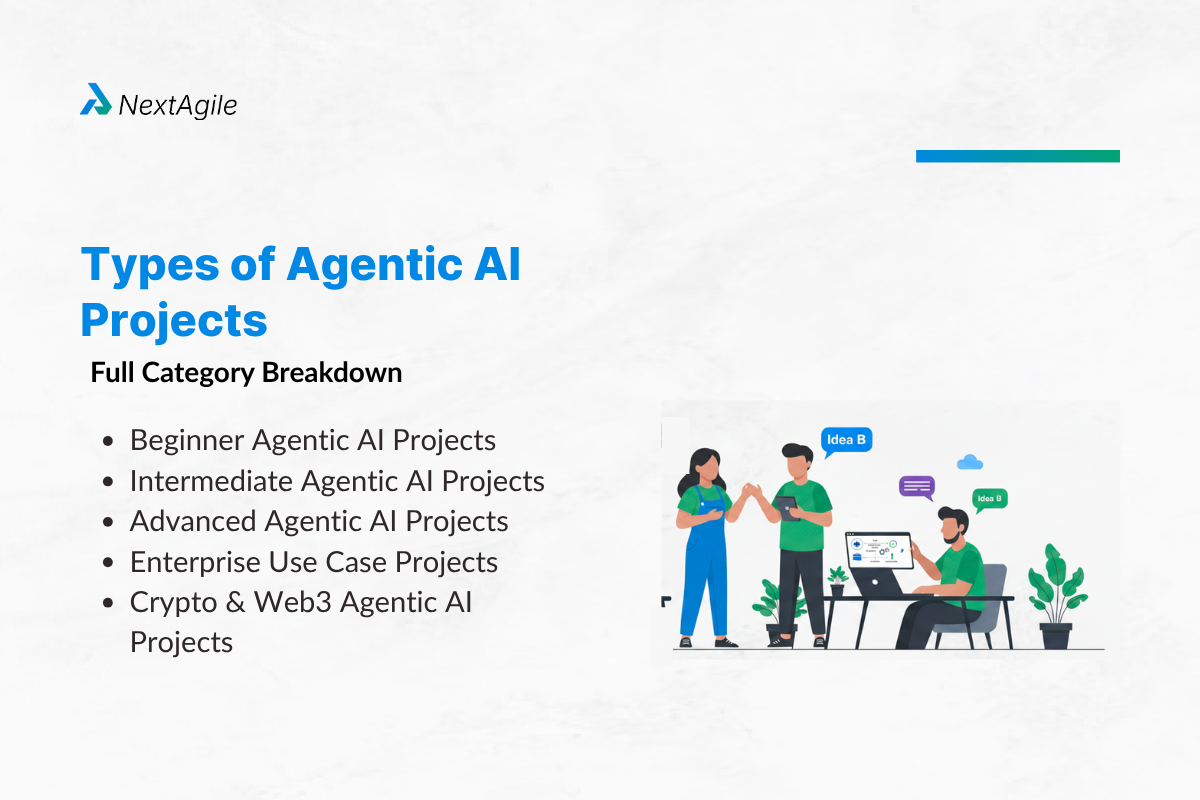
Types of Agentic AI Projects: Full Category Breakdown
Agentic AI projects span a wide spectrum of complexity. Here is how to categorize them by skill level and use case.
1. Beginner Agentic AI Projects
These use visual builders or minimal code. They help you understand how agents plan, route tasks, and use tools without needing to master orchestration from scratch.
- AI Email Responder: Reads your inbox, categorizes messages, drafts replies, and flags urgent items.
- Daily News Briefing Agent: Collects news from multiple APIs, filters by topic, and produces a morning digest.
- Personal Task Manager Agent: Breaks a high-level goal such as preparing for a job interview into daily actionable steps.
- YouTube Summarizer Agent: Pulls video transcripts and generates structured summaries using an LLM.
- Web Research Agent: Searches a topic, reads top sources, and organizes findings into a report.
2. Intermediate Agentic AI Projects
These require framework knowledge such as LangChain, LangGraph, CrewAI, or AutoGen, and involve multi-step reasoning, tool calling, and basic memory.
- SQL Query Agent: Accepts natural language queries, generates SQL, executes against a database, and returns formatted results.
- Crypto Market Analyst Agent: Uses Llama 3 for inference, Exa for real-time news, and outputs a structured market report.
- AI Study Planner: Takes a subject and deadline, breaks the curriculum into a daily plan, and adapts based on quiz performance.
- Lead Qualification Bot: Scrapes CRM data, scores leads based on ICP criteria, and drafts outreach emails.
- Code Review Agent: Analyzes a GitHub pull request, identifies bugs, suggests improvements, and flags security issues.
3. Advanced Agentic AI Projects
These involve multi-agent orchestration, persistent memory, and integration with production systems.
- Multi-Agent Research System: A Researcher agent, Writer agent, Fact-Checker agent, and Editor agent collaborate to produce a publication-ready article.
- Autonomous DevOps Agent: Monitors CI/CD pipelines, detects failures, diagnoses root causes, and triggers rollbacks or reruns.
- AI-Powered Customer Support System: Multi-agent system coordinating between support, billing, and fulfillment agents to resolve issues end-to-end.
- Autonomous Data Pipeline Agent: Monitors pipeline health, diagnoses schema drift or missing data, and autonomously repairs issues.
- AI Software Engineer: Takes a feature request, plans architecture, writes code, runs tests, and opens a pull request, all without human input.
4. Enterprise Use Case Projects
Enterprise deployments demand governance, auditability, and integration with legacy systems. A five-agent underwriting system deployed by a financial services firm cut processing time by 67% and reduced errors by 41% (EvoluteIQ, November 2025).
5. Crypto and Web3 Agentic AI Projects
LangChain and CrewAI have launched agents equipped with cryptocurrency wallets for automated blockchain operations. Web3 agentic projects include autonomous trading bots, DeFi portfolio managers, and smart contract audit agents.
| Project Type | Difficulty | Typical Stack | Time to Build |
|---|---|---|---|
| Email Responder Agent | Beginner | Langflow, OpenAI API | 1-2 days |
| News Briefing Bot | Beginner | Python, NewsAPI, LLM | 1-3 days |
| SQL Query Agent | Intermediate | LangChain, SQLite, GPT-4o | 3-5 days |
| Lead Qualification Bot | Intermediate | CrewAI, LangChain, Serper | 5-7 days |
| Multi-Agent Research System | Advanced | CrewAI, LangGraph, AutoGen | 2-3 weeks |
| Autonomous DevOps Agent | Advanced | AutoGen, GitHub API, Cloud | 3-4 weeks |
| AI Software Engineer | Enterprise | Claude Code, MCP, LangGraph | 1-2 months |
15+ Best Agentic AI Projects with Source Code References
Each project below includes the problem it solves, the recommended stack, difficulty level, and where to find source code or similar open-source repositories.
Project 1: Autonomous Research Agent
- Problem: Manual research takes hours. This agent searches, reads, synthesizes, and produces a full report.
- Stack: LangChain, Serper API, GPT-4o, Markdown output
- Difficulty: Intermediate
- Use Case: Content creation, academic research, competitive intelligence
- Source Code: The ashishpatel26/500-AI-Agents-Projects repository on GitHub contains a working implementation. Search ‘AI Researcher SERPAPI LangChain’ on GitHub.
- Ideal For: Resume, freelance, hackathon
Project 2: Multi-Agent Content Creation Crew
- Problem: Creating high-quality content requires research, writing, and editing, which needs multiple specialized skills.
- Stack: CrewAI, OpenAI, Serper with Researcher, Writer, and Editor agent roles
- Difficulty: Intermediate
- Use Case: Marketing agencies, content production pipelines
- Source Code: CrewAI’s official GitHub at github.com/crewAIInc/crewAI contains starter templates for multi-role agent crews.
- Ideal For: Freelance, portfolio, agency automation
Project 3: AI-Powered Customer Support System
- Problem: Customer service requires coordinating billing, support, and fulfillment, which is too slow manually.
- Stack: Microsoft AutoGen, Azure OpenAI, CRM API integration
- Difficulty: Advanced
- Use Case: E-commerce, SaaS companies, fintech
- Source Code: Microsoft’s AutoGen repository at github.com/microsoft/autogen includes multi-agent customer service examples.
- Ideal For: Enterprise projects, startup product development
Project 4: Crypto Market Analysis Agent
- Problem: Crypto markets move 24/7. Manual analysis cannot keep pace.
- Stack: LangChain, Groq-Llama 3, Exa API, report generation
- Difficulty: Intermediate
- Use Case: Crypto traders, fintech startups, investment research
- Source Code: Search ‘LangChain crypto agent Groq Llama 3 Exa’ on GitHub or ProjectPro.
- Ideal For: Resume, hackathon, agentic AI crypto projects 2026
Project 5: Autonomous DevOps Pipeline Agent
- Problem: CI/CD failures require human diagnosis, often taking hours to resolve.
- Stack: AutoGen, GitHub Actions API, Slack notification, Cloud logs
- Difficulty: Advanced
- Use Case: DevOps teams, SRE automation, platform engineering
- Source Code: The awesome-ai-agents-2026 repository on GitHub references Claude Code and OpenHands for automated pre-merge review pipelines.
- Ideal For: Enterprise, startup CTO portfolio projects
Project 6: AI Study Planner Agent
- Problem: Students struggle to structure learning for complex topics.
- Stack: Phidata, Groq, FastAPI, Python
- Difficulty: Beginner to Intermediate
- Use Case: EdTech platforms, personal productivity
- Source Code: Search ‘study planner agent Phidata Groq FastAPI’ on Analytics Vidhya or GitHub.
- Ideal For: Beginner portfolio, resume projects for AI roles
Project 7: YouTube Content Summarizer Agent
- Problem: Watching hours of video content is slow. This agent extracts and summarizes key points.
- Stack: Python, OpenAI API, LangChain, YouTube Transcript API
- Difficulty: Beginner
- Use Case: Research, competitive analysis, content marketing
- Source Code: Analytics Vidhya’s solved AI projects guide (March 2026) includes a YouTube Summarizer Agent with full source code.
- Ideal For: Beginners building their first agentic AI project
Project 8: Data Analyst AI Agent
- Problem: Non-technical users cannot query databases. This agent turns plain English into SQL.
- Stack: Flowise, SingleStore, OpenAI LLM Chain
- Difficulty: Intermediate
- Use Case: Business intelligence, data analytics teams
- Source Code: DataCamp’s Top 10 AI Agent Projects guide (September 2025) includes a Flowise-based implementation.
- Ideal For: Data science portfolio, Kaggle submissions, analyst roles
Project 9: Lead Qualification and Outreach Agent
- Problem: Sales teams waste time on unqualified leads.
- Stack: CrewAI, LangChain, LinkedIn scraper, email API
- Difficulty: Intermediate
- Use Case: Sales automation, B2B marketing
- Source Code: CrewAI’s official examples repository includes a sales prospecting crew template.
- Ideal For: Freelance SaaS projects, startup automation
Project 10: AI Software Engineer (Devin-Style Agent)
- Problem: Feature development requires planning, coding, testing, and deployment, which is a complex multi-step workflow.
- Stack: OpenHands (formerly OpenDevin), Claude API, GitHub integration
- Difficulty: Advanced
- Use Case: Software agencies, open-source project automation
- Source Code: OpenHands is open-source at github.com/All-Hands-AI/OpenHands. It is one of the most starred AI agent repositories as of 2026.
- Ideal For: Advanced developers, startup AI tools portfolio
Project 11: Travel Planning Agent
- Problem: Trip planning across flights, hotels, and activities is fragmented and time-consuming.
- Stack: LangChain, travel APIs such as Skyscanner and Booking.com, NLP
- Difficulty: Intermediate
- Use Case: Travel startups, personal productivity tools
- Source Code: Search ‘LangChain travel planning agent’ on GitHub.
- Ideal For: Hackathon, freelance development, consumer apps
Project 12: Healthcare Monitoring Agent
- Problem: Patients struggle to track health metrics and interpret trends.
- Stack: Python, OpenAI API, health APIs such as Fitbit and Apple Health, alert system
- Difficulty: Intermediate
- Use Case: Health tech, telemedicine, wearable integration
- Source Code: The ashishpatel26/500-AI-Agents-Projects repository includes healthcare agent implementations.
- Ideal For: HealthTech portfolio, hackathons, research
Project 13: Autonomous Web Research and Fact-Checking Agent
- Problem: Verifying claims takes time and requires checking multiple sources manually.
- Stack: AutoGPT, Exa, multiple search APIs, LLM reasoning chain
- Difficulty: Intermediate to Advanced
- Use Case: Journalism tools, academic research, content verification
- Source Code: AutoGPT’s platform at github.com/Significant-Gravitas/AutoGPT supports web-browsing agent configurations.
- Ideal For: Research portfolio, journalism tools, Kaggle NLP projects
Project 14: AI Voice Assistant Agent
- Problem: Text-based agents miss the speed and naturalness of voice interaction.
- Stack: Vapi AI, Deepgram for speech-to-text, Play.ht for text-to-speech, Python
- Difficulty: Intermediate
- Use Case: Call centers, accessibility tools, smart home integration
- Source Code: Analytics Vidhya’s solved project guide includes a Smart AI Voice Assistant with full implementation details.
- Ideal For: Resume projects, freelance voice AI development
Project 15: Supply Chain Optimization Agent
- Problem: Supply chain disruptions require real-time analysis and autonomous corrective actions.
- Stack: AutoGen, nested agent chats, supply chain APIs, safeguard agent
- Difficulty: Advanced to Enterprise
- Use Case: Manufacturing, logistics, retail operations
- Source Code: Microsoft AutoGen’s example repository includes the OptiGuide supply chain optimization implementation.
- Ideal For: Enterprise projects, MBA and operations research portfolios
Agentic AI Projects with Source Code: Where to Find Them
Finding quality agentic AI source code is straightforward once you know where to look. GitHub now hosts over 4.3 million AI-related repositories, a 178% year-over-year jump. Here are the best platforms and specific repositories to explore.
GitHub: The Primary Repository
Search using terms like ‘agentic AI agent LangChain CrewAI’ or browse curated lists. Key repositories:
- ashishpatel26/500-AI-Agents-Projects: 500+ curated agentic AI use cases across industries including healthcare, finance, education, and retail.
- caramaschiHG/awesome-ai-agents-2026: 340+ resources covering frameworks, coding agents, and browser agents. Updated monthly.
- slavakurilyak/awesome-ai-agents: 300+ agentic AI resources with star counts and implementation links.
Framework-Specific Repositories
- LangChain: github.com/langchain-ai/langchain with 112,000+ stars. Contains agent templates, RAG implementations, and tool integration examples.
- CrewAI: github.com/crewAIInc/crewAI with role-based multi-agent crew templates for content, sales, and research workflows.
- Microsoft AutoGen: github.com/microsoft/autogen with multi-agent conversation examples for supply chain, code generation, and customer service.
- AutoGPT: github.com/Significant-Gravitas/AutoGPT with 177,000+ stars. The original autonomous agent framework including Forge for custom agent creation.
- OpenHands: github.com/All-Hands-AI/OpenHands is the leading open-source AI software engineer agent.
Learning Platforms with Source Code
DataCamp’s Top 10 AI Agent Projects guide provides step-by-step walkthroughs with Langflow, Flowise, LangGraph, Haystack, ADK, and CrewAI. Analytics Vidhya’s Solved AI Projects collection (updated March 2026) includes downloadable code and explanatory videos. ProjectPro includes over 35 AI agent project solutions targeted at resume-building and interview preparation.
For a curated learning path that combines these frameworks with enterprise delivery principles, explore NextAgile’s Generative AI Workshop for Enterprise, which covers agentic AI implementation from use case identification through to production deployment.
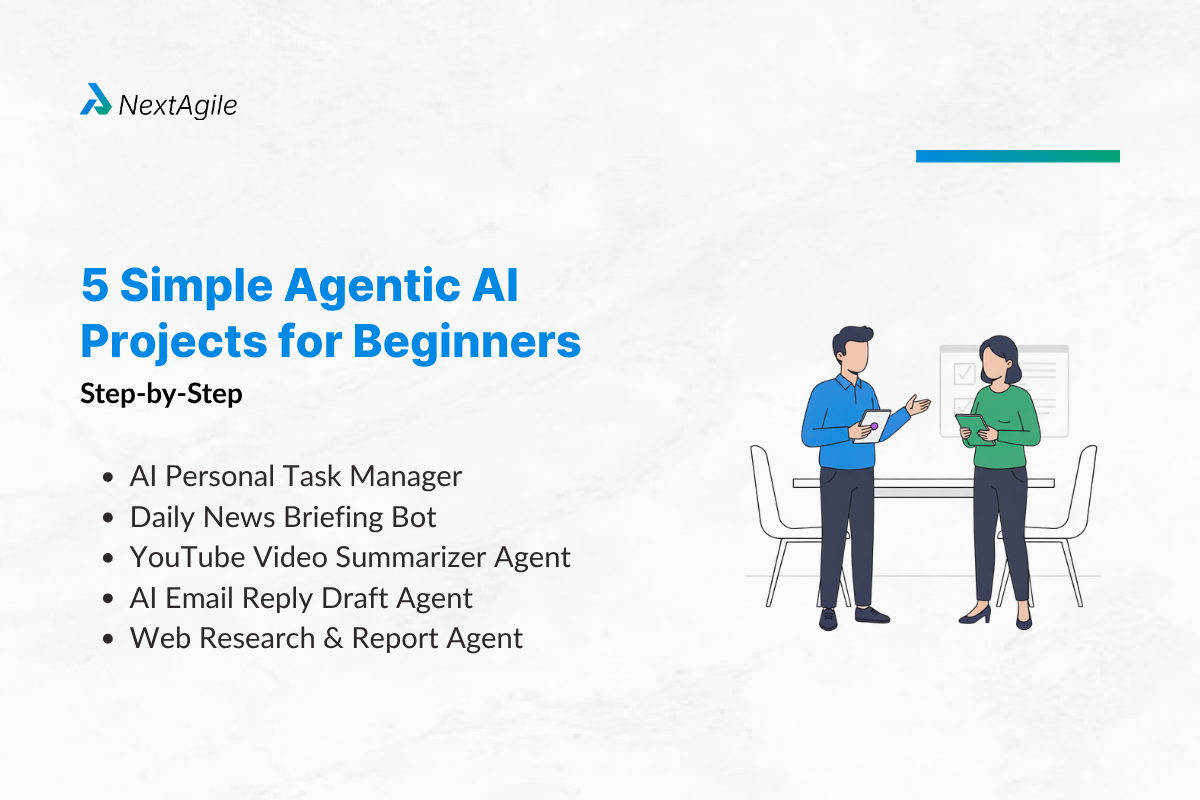
5 Simple Agentic AI Projects for Beginners: Step-by-Step
You do not need a PhD or a decade of coding experience to start building agentic AI projects. These five projects are designed for Python beginners with basic API knowledge.
Beginner Project 1: AI Personal Task Manager
What it does: Takes a big goal such as getting AWS certified in 60 days and breaks it into a structured daily plan.
- Step 1: Install Python, create a virtual environment, and run pip install langchain openai.
- Step 2: Set up an OpenAI API key as an environment variable.
- Step 3: Write a LangChain agent with a simple goal-decomposition prompt: ‘You are a planning agent. Break this goal into 60 daily tasks with specific actions.’
- Step 4: Add a tool call to a calendar API such as Google Calendar to schedule each daily task automatically.
- Step 5: Run the agent, review the plan, and iterate on the prompt until outputs are precise and useful.
Skills learned: Prompt design, task decomposition, API integration.
Beginner Project 2: Daily News Briefing Bot
What it does: Runs every morning, fetches top news from NewsAPI for your chosen topics, and sends you a 200-word email summary.
- Step 1: Install Python libraries: pip install requests openai schedule.
- Step 2: Get a free NewsAPI key from newsapi.org.
- Step 3: Write a function that calls NewsAPI, collects the top 5 articles, and passes the text to an LLM with the prompt: ‘Summarize these articles in 200 words, focusing on the key facts.’
- Step 4: Use Python’s schedule library to trigger this function at 7:00 AM daily.
- Step 5: Connect to the Gmail API to send the summary to your inbox.
Skills learned: API usage, scheduling, summarization.
Beginner Project 3: YouTube Video Summarizer Agent
What it does: Takes a YouTube URL, extracts the transcript, and produces a structured summary with key points.
- Step 1: Install libraries: pip install youtube-transcript-api openai langchain.
- Step 2: Use YouTubeTranscriptApi.get_transcript(video_id) to extract the full transcript text.
- Step 3: Chunk the transcript into 1,000-word segments and pass each through an LLM for partial summaries.
- Step 4: Use a final LLM call to synthesize the chunk summaries into a single structured output with key points.
- Step 5: Print or save the result as a Markdown file for easy sharing or publishing.
Skills learned: Text chunking, sequential LLM calls, structured output generation.
Beginner Project 4: AI Email Reply Draft Agent
What it does: Reads your Gmail inbox, categorizes emails by urgency, and drafts reply suggestions for each.
- Step 1: Set up Gmail API access via Google Cloud Console and download credentials.json.
- Step 2: Install libraries: pip install google-auth google-auth-oauthlib openai.
- Step 3: Write a function to fetch the last 10 unread emails and extract the subject and body text.
- Step 4: Pass each email to an LLM with a prompt: ‘Classify urgency as High, Medium, or Low and draft a professional 3-sentence reply.’
- Step 5: Display the drafts in a terminal UI or save them directly as drafts in Gmail.
Skills learned: OAuth integration, NLP classification, workflow automation.
Beginner Project 5: Web Research and Report Agent
What it does: Takes a topic, searches the web for the top 5 sources, reads each page, and produces a 500-word structured report.
- Step 1: Install libraries: pip install langchain openai requests beautifulsoup4.
- Step 2: Use Serper API on the free tier or DuckDuckGo search to find top URLs for your topic.
- Step 3: Use BeautifulSoup to extract the main text content from each URL.
- Step 4: Pass all extracted text to an LLM with a prompt: ‘Synthesize this into a 500-word report with an introduction, 3 key findings, and a conclusion.’
- Step 5: Save the output as a .txt or .md file ready for use.
Skills learned: Web scraping, multi-source synthesis, report generation.
Agentic AI Projects for Resume and Freelancers
What Recruiters Look for in 2026
Hiring managers at AI-first companies no longer want candidates who only know prompt engineering. Based on LinkedIn job postings reviewed in Q1 2026, the most in-demand skills for AI engineer roles are LangChain or LangGraph proficiency, multi-agent system design, RAG implementation, and experience with production-grade agent evaluation. Your resume projects should demonstrate that you can build systems that do things autonomously, not just chatbots that answer questions.
Top 5 Projects Guaranteed to Impress Recruiters
- Multi-Agent Research System with CrewAI: Shows system thinking, role-based agent design, and tool integration.
- Autonomous Code Review Agent with OpenHands: Demonstrates understanding of real production workflows and CI/CD integration.
- RAG-Based Enterprise Q&A Agent with LangGraph: Shows knowledge of retrieval, state management, and persistent memory.
- Data Analyst Agent with Text-to-SQL: Directly applicable in BI, analytics, and data engineering roles.
- Customer Support Multi-Agent System: Shows end-to-end product thinking and user-focused system design.
How to Present Agentic AI Projects on Your Portfolio
- Write a clear README: Include the problem, the agentic components such as which tools it uses and how it plans, the tech stack, and setup instructions.
- Record a 3-minute walkthrough video: Show the agent taking a goal and autonomously producing output. This is far more convincing than screenshots alone.
- Measure and report outcomes: ‘Agent reduced research time from 45 minutes to 4 minutes’ is more compelling than ‘built an AI research agent.’
- Host on GitHub with clean commit history: Recruiters check commit frequency and code organization before they read any documentation.
- Add an evaluation section: Show how you tested the agent’s accuracy, latency, and failure modes under different conditions.
Agentic AI Freelance Projects: High-Value Niches
Freelancers building agentic AI projects can charge significantly more than standard web development rates. Based on market data from Appinventiv (2026) and freelance platforms, the highest-value agentic AI freelance niches in 2026 are:
- AI-powered sales outreach agents covering email and LinkedIn: $2,000 to $8,000 per project.
- Document processing and contract review agents: $3,000 to $12,000 per project.
- Multi-agent customer support system integration: $5,000 to $20,000 per project.
- Automated content production pipelines built on CrewAI: $1,500 to $6,000 per project.
Why Agentic AI Projects Fail: The 6 Root Causes
Gartner’s June 2025 prediction that over 40% of agentic AI projects will be canceled by 2027 is backed by clear failure patterns. Understanding these is the single most valuable thing you can do before starting your own project.
Failure Reason 1: Unclear Business Value
Most failed projects cannot answer one simple question: what specific business outcome does this agent improve, and by how much? Gartner’s survey found that most projects are early-stage experiments driven by hype. If you cannot define the success metric before you build, such as reduced processing time, fewer errors, or lower cost per transaction, the project will drift and eventually get canceled.
Failure Reason 2: Agent Washing and Wrong Use Cases
Many organizations deploy agentic AI for tasks that do not require it. Gartner’s Senior Director Analyst Anushree Verma stated that many use cases positioned as agentic today do not require agentic implementations. A simple rule: if a standard automation script or a basic chatbot would solve the problem, do not use a complex agent framework. Reserve agentic AI for multi-step, context-dependent, decision-heavy workflows.
Failure Reason 3: Escalating and Underestimated Costs
Agent frameworks can trigger hundreds of LLM calls to complete a single workflow. Without proper cost controls such as caching, model routing, and response length limits, production costs can spiral. A McKinsey study found that data limitations alone block 80% of enterprises from scaling AI systems beyond the pilot stage.
Failure Reason 4: No Human-in-the-Loop
The PwC AI Agent Survey found that only 20% of leaders trust AI agents for financial transactions. Deploying agents without a review step for high-stakes decisions is a governance failure waiting to happen. The most successful implementations use supervised mode for the first two to four weeks, where humans review outputs before they are finalized. Unsupervised operation comes later, after the system has demonstrated consistent accuracy.
Failure Reason 5: Legacy System Integration Challenges
Deloitte’s 2025 report identified legacy system integration as one of the three fundamental infrastructure obstacles. Traditional enterprise systems were not designed for agentic interactions. APIs and conventional data pipelines create bottlenecks that limit autonomous capabilities. In many cases, rethinking workflows from the ground up with an agent-first approach is the only viable path to production.
Failure Reason 6: Overengineering from Day One
Teams that try to build a 10-agent orchestration system before validating a single-agent prototype consistently fail. The successful pattern identified by Gartner: start with one narrow process, run it supervised, measure outcomes, then expand incrementally. Every layer of complexity added before validation is a layer of risk.
Best Practices for Building Agentic AI Projects That Succeed
Practice 1: Define Agent Boundaries Before Writing Code
Before touching a framework, write a one-page document that answers: What is the agent’s goal? What tools can it use? What decisions can it make autonomously? What requires human approval? What happens if it fails? This boundary document prevents scope creep and sets the foundation for governance.
Practice 2: Start with the Simplest Agent That Works
Build a single-agent system that solves 80% of the problem before introducing multi-agent complexity. A two-agent system that works reliably is worth far more than a ten-agent system that fails unpredictably. Validate the core use case cheaply before scaling the architecture.
Practice 3: Use Modular Architecture
Design your agent system so each component, including memory, tool calls, LLM inference, and output formatting, can be swapped independently. This allows you to upgrade models or replace tools without rebuilding the entire pipeline. A modular design also makes testing and debugging significantly faster.
Practice 4: Add Memory Thoughtfully
The Mem0 library at github.com/mem0ai/mem0 with 52,000 stars is a popular persistent memory layer for production agents. Without persistent memory, every agent interaction starts from scratch. But unconstrained memory growth degrades performance over time. Design memory with explicit retrieval and pruning policies from the beginning.
Practice 5: Define Evaluation Metrics Before Launch
You cannot improve what you do not measure. At minimum, track task completion rate (did the agent finish the goal?), tool call accuracy (did it use the right tools?), latency (how many seconds per workflow?), and cost per run (how many LLM tokens consumed?). Add domain-specific metrics such as research quality score, SQL execution accuracy, or email reply acceptance rate.
Practice 6: Build Governance Structures from Day One
Gartner identifies governance as the defining factor separating the 60% of successful projects from the 40% that get canceled. Governance means audit trails logging every agent action, escalation paths triggering human review when confidence is low, and rollback procedures restoring the system if something goes wrong. NextAgile’s Generative AI consulting framework includes bias mitigation, transparency, risk controls, and governance policies built in from the start of every engagement.
| Practice | Why It Matters | Common Mistake to Avoid |
|---|---|---|
| Define agent boundaries first | Prevents scope creep and governance failures | Building the agent before defining its limits |
| Start with single-agent prototype | Validates the core use case cheaply | Jumping to 10-agent orchestration immediately |
| Modular architecture | Allows model and tool swaps without rebuild | Hard-coding LLM and tool dependencies |
| Persistent memory layer | Makes agents smarter over time | Forgetting memory design until production |
| Evaluation metrics from day one | Enables optimization and business justification | Shipping without measuring outcomes |
| Governance and audit trails | Survives Gartner’s 40% cancellation filter | Treating agents as black boxes in production |
Future Trends in Agentic AI Projects: 2026 and Beyond
Understanding where agentic AI is heading helps you build projects that remain relevant and valuable over the next two to three years.
Trend 1: Multi-Agent Ecosystems Replace Single Agents
Gartner reported a 1,445% surge in multi-agent system inquiries from Q1 2024 to Q2 2025. The shift from single-agent to orchestrated teams of specialized agents mirrors what happened with microservices in software architecture. The puppeteer pattern, where one orchestrator coordinates multiple specialist agents, is emerging as the standard for production deployments.
Trend 2: Protocol Standardization with MCP and A2A
Anthropic’s Model Context Protocol (MCP) saw broad adoption throughout 2025, standardizing how agents connect to external tools, databases, and APIs. Google’s Agent-to-Agent Protocol (A2A) extends this to agent-to-agent communication across different vendors’ systems. These protocols are the HTTP-equivalent standards for agentic AI, enabling interoperability that was impossible before.
Trend 3: Agent Marketplaces Become Mainstream
In July 2025, AWS launched an AI agent marketplace featuring over 900 pre-built agents. Google, Microsoft, and Salesforce followed. By 2026, organizations can deploy pre-vetted, A2A-compatible agents without building from scratch. This creates a new category of agentic AI project: building agents designed to be sold and reused in these marketplaces.
Trend 4: AI Workforce Automation at Scale
Estimates project approximately 1.3 billion active AI agents by 2028 (Splunk, February 2026). New pricing models based on task completion rates are emerging, where agents are billed like workers at hourly or per-task rates. This shifts agentic AI from a tool category to a workforce category, with major implications for how enterprises plan and budget for AI.
Trend 5: Agentic Coding Becomes Standard Practice
Anthropic’s 2026 Agentic Coding Trends Report describes 2025 as the year that agentic AI changed how a large portion of developers write code. Tools like Claude Code, Cursor, GitHub Copilot’s Agent Mode, and OpenHands now handle tasks that previously required weeks of cross-team coordination. In 2026, these tools are becoming standard rather than experimental.
Trend 6: Domain-Specific Agents Replace General-Purpose Ones
The shift from general-purpose foundation models to narrow, specialized agents is accelerating. Cisco’s 2026 analysis found that customers are requesting domain-specific models that can handle particular tasks. Projects built around deep domain expertise such as legal contract review, medical coding, or supply chain optimization will outperform generalist agents. NextAgile’s AI for Agility Workshop specifically covers how to identify high-value, domain-specific use cases within your enterprise context.
Conclusion
Agentic AI projects represent the most significant shift in software development since the cloud era. The market is growing from $7.6 billion in 2025 to a projected $10.8 billion in 2026, with Gartner predicting that 40% of enterprise applications will embed AI agents by year’s end. At the same time, Gartner’s warning that over 40% of agentic AI projects will be canceled by 2027 is a clear signal: success requires discipline, not just enthusiasm.
Whether you are building your first beginner project such as a YouTube Summarizer Agent or a Daily News Briefing Bot, or designing an enterprise-grade multi-agent orchestration system, the principles are the same. Define boundaries before building, start small, measure everything, and treat governance as a design requirement rather than an afterthought.
The 60% of projects that succeed will be the ones built by teams who understand what agentic AI actually means: a system that perceives, reasons, plans, and acts. If you are ready to move from experimentation to production-grade implementation, NextAgile’s Generative AI consulting services and GenAI Enterprise Workshop are designed to help your team build, govern, and scale agentic AI projects with measurable outcomes.
Frequently Asked Questions About Agentic AI Projects
Q1: What are agentic AI projects?
Agentic AI projects are software systems built using autonomous AI agents that can perceive context, plan multi-step tasks, use tools like web search or APIs, and take action with minimal human input. They go beyond simple chatbots by being goal-oriented and capable of executing complex workflows independently. Common frameworks used to build them include LangChain, CrewAI, AutoGen, and AutoGPT.
Q2: Where can I find agentic AI projects on GitHub?
Search GitHub using terms like ‘AI agent LangChain,’ ‘CrewAI examples,’ or ‘agentic AI framework.’ The most comprehensive curated lists are ashishpatel26/500-AI-Agents-Projects (500+ use cases), caramaschiHG/awesome-ai-agents-2026 (340+ resources), and slavakurilyak/awesome-ai-agents (300+ resources). The official repositories for LangChain, CrewAI, Microsoft AutoGen, and AutoGPT also contain dozens of working example projects.
Q3: Are agentic AI projects good for beginners?
Yes, but start with a simple single-agent project using a visual builder like Langflow or Flowise before writing code. The YouTube Summarizer Agent, Daily News Briefing Bot, and Web Research Agent are all achievable in one to three days with basic Python skills. The key is understanding how agents plan and use tools, not mastering the entire framework from day one.
Q4: What tools are used in agentic AI projects?
The most widely used tools in 2025-2026 are LangChain and LangGraph for orchestration and state management, CrewAI for role-based multi-agent teams, Microsoft AutoGen for conversational multi-agent systems, AutoGPT for autonomous goal-pursuing agents, Mem0 for persistent memory, and Langflow or Flowise for visual no-code agent builders. For model inference, most projects use OpenAI GPT-4o, Anthropic Claude, Groq-Llama 3, or local models via Ollama.
Q5: Why are some agentic AI projects failing?
Gartner identified three primary failure modes in its June 2025 prediction: escalating costs, unclear business value, and inadequate risk controls. Additional causes include agent washing (deploying chatbots marketed as agents), legacy system integration challenges, and the absence of human-in-the-loop governance for high-stakes decisions. The organizations that succeed start small, define success metrics upfront, and build governance structures before scaling.
Q6: What are the best agentic AI projects for a data science resume?
The highest-impact agentic AI projects for data science roles are a Data Analyst Agent using Text-to-SQL with Flowise and SingleStore, a Crypto Market Analysis Agent with LangChain, Groq, and Exa, and a Multi-Agent Research System using CrewAI. Each demonstrates the ability to build systems that go beyond model training into end-to-end autonomous workflow design, which is the skill set most valued by AI engineering teams in 2026.